

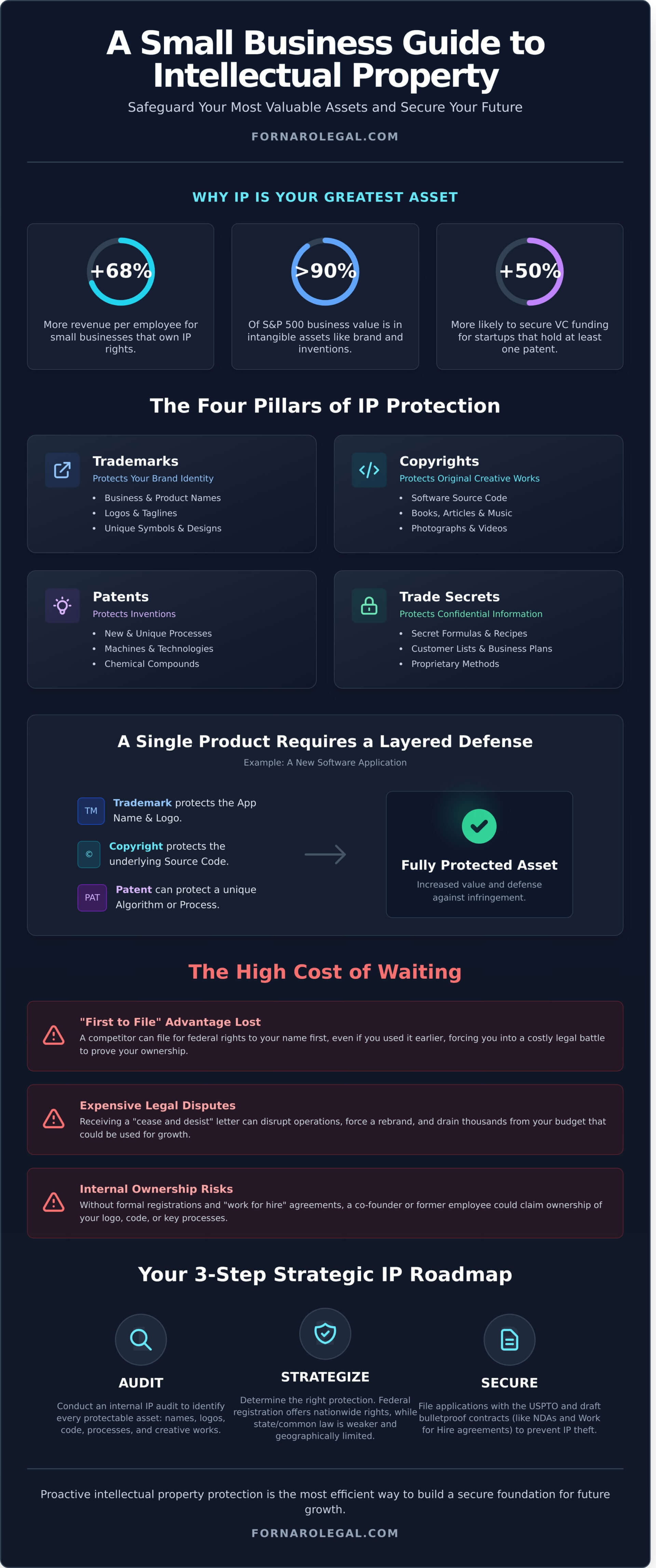
According to a 2021 report from the World Intellectual Property Organization, small businesses that own IP rights generate 68% more revenue per employee than those that don’t. Yet, many entrepreneurs delay securing their most valuable assets. You’ve invested countless hours and capital into developing a unique brand, a groundbreaking invention, or original creative works. It’s understandable to feel overwhelmed by the legal complexities and fearful that a competitor could capitalize on your hard work.
In 2026, expect United States Patent and Trademark Office (USPTO) filing fees to be around $275 to $375 per class for a trademark application. In contrast, filing for a basic utility patent will be significantly more expensive, with projected government filing fees starting near $1,800. These figures don’t include examination and issuance fees which add thousands more, nor do they include the critical legal assistance required to prepare these complex applications successfully; you can learn more about navigating this process with professional guidance.
This guide is engineered to replace that anxiety with a strategic plan. We will provide a clear, actionable framework for intellectual property protection for small business owners in South Florida, moving you from confusion to confidence. We’ll demystify the differences between trademarks and copyrights, outline a roadmap for securing your assets at both federal and state levels, and show you how to build bulletproof contracts that prevent IP theft before it can start. This is your plan to safeguard your future, so you can concentrate on growing your business.
Key Takeaways
- Understand why your brand, ideas, and creative works are often your most valuable assets and require a dedicated legal strategy to safeguard.
- Discover the four main types of IP protection and how a single product or service often requires a layered approach to be fully secure.
- A comprehensive plan for intellectual property protection for small business goes beyond simple registration; learn the essential steps to take before and after you file.
- Learn how to conduct an internal IP audit to identify all your protectable assets, a critical first step in building a strong legal foundation.
Understanding Intellectual Property Protection for Small Business
For entrepreneurs and small business owners in South Florida, your most valuable assets are often the ones you cannot physically touch. At its core, intellectual property (IP) protection is the legal framework that grants you exclusive rights to your company’s intangible creations. To fully understand what intellectual property is, you must recognize it encompasses everything from your brand name and logo to your inventions and creative works. By 2026, these intangible assets represent the dominant portion of a company’s value; a 2024 analysis by Brand Finance found that intangible assets account for over 90% of the total value of businesses in the S&P 500.
Navigating the system requires understanding the difference between federal and state rights. Federal registration with the U.S. Patent and Trademark Office (USPTO) provides nationwide protection, creating a legal presumption of ownership. In contrast, Florida common law rights are geographically limited to the specific area where you conduct business. While valuable, these local rights are far weaker and more difficult to enforce than a federal registration. Effective intellectual property protection for small business serves as both a defensive shield against infringement and an offensive tool to secure and expand your market share.
Why IP Matters for Startups and Growing Companies
Securing your IP is not an administrative task; it’s a foundational business strategy. For companies planning a future exit, a registered portfolio of trademarks, copyrights, or patents dramatically increases valuation during a merger or acquisition. It’s a tangible asset that acquirers look for during due diligence. Similarly, investors and venture capital firms view a strong IP position as a critical mitigator of risk. A 2023 USPTO report confirmed that startups with at least one patent are over 50% more likely to secure venture capital funding. Locally in South Florida, a federally registered trademark prevents competitors from using a similar name, safeguarding your reputation and preventing customer confusion from Miami to Palm Beach.
The Consequences of Delayed Protection
Waiting to protect your intellectual property is a risk that few small businesses can afford to take. The legal landscape presents several immediate threats to an unprotected brand or invention.
- The “First to File” Advantage: While the U.S. honors “first to use” for common law trademark rights, the federal system heavily favors the “first to file.” Filing an application with the USPTO establishes a nationwide priority date. If a competitor files first, even if you used the name earlier, you could be facing an uphill, expensive legal battle to prove your rights.
- Costly Legal Disputes: Receiving a “cease and desist” letter is a common and disruptive consequence of inaction. Defending your right to use a name or design you failed to register can divert thousands of dollars and countless hours away from your core operations, so you can’t concentrate on growing your business.
- Internal Ownership Risks: Without formal registrations and clear “work for hire” agreements, ownership can become dangerously ambiguous. A disgruntled co-founder or a former employee could leave and claim ownership of the company logo, a critical piece of software code, or a proprietary business process, potentially holding your entire operation hostage.
Proactive intellectual property protection for small business is the most efficient way to safeguard your innovations and build a secure foundation for future growth.
The Four Pillars of IP: Safeguarding Your Business Assets
Intellectual property isn’t a single, monolithic shield; it’s a strategic combination of four distinct legal tools designed to protect your most valuable intangible assets. Many entrepreneurs mistakenly believe one type of protection covers everything. In reality, a single product often requires multiple layers of IP. Consider a new software application: its name and logo are protected by a trademark, the underlying code is covered by copyright, and a unique, non-obvious process it uses could be eligible for a patent. A comprehensive strategy for intellectual property protection for small business begins with understanding which pillar supports which asset. The U.S. government provides extensive resources to help you protect your intellectual property on a national and even global scale, but applying these tools correctly requires focused legal guidance.
Trademarks and Brand Identity
Your brand is your promise to the customer. A trademark protects the symbols of that promise: your business name, logo, and slogans. For a business in Broward County, a common point of confusion is the difference between state and federal registration. A Florida state trademark offers protection only within state lines, which may be sufficient for a purely local service. However, a federal registration with the U.S. Patent and Trademark Office (USPTO) provides superior, nationwide rights and is a prerequisite for pursuing infringers in federal court. It’s a competitive arena; the USPTO received over 735,000 new trademark applications in fiscal year 2023 alone. Critically, a simple “Doing Business As” (DBA) registration with the state is not a trademark. It’s merely a public notice of your trade name and offers zero proprietary rights, leaving your brand vulnerable.
Copyrights, Patents, and Trade Secrets
Beyond your brand, your creative and innovative work requires its own specific forms of protection. Understanding the distinctions is essential for allocating your resources effectively.
- Copyrights automatically protect original works of authorship the moment they are fixed in a tangible form. This includes your website content, marketing materials, photographs, and software code. While registration with the U.S. Copyright Office is not required for protection to exist, it is necessary before you can file a lawsuit for infringement. Protection typically lasts for the life of the author plus 70 years.
- Patents safeguard inventions and processes. A utility patent, which covers how something works, grants you exclusive rights for up to 20 years. Pursuing a patent is a significant investment, often costing tens of thousands of dollars and taking several years. It’s a strategic decision best reserved for truly novel, non-obvious inventions that provide a substantial competitive advantage.
- Trade Secrets protect confidential business information that gives you an edge. This can be anything from a client list or a marketing strategy to a secret recipe or a proprietary algorithm. Unlike patents, trade secrets are protected indefinitely as long as they remain secret. Protection isn’t granted by a government office; it’s established by taking reasonable measures, like using Non-Disclosure Agreements (NDAs) and implementing secure data policies.
Identifying which of your business assets fall under which pillar can be a complex task. An initial oversight can lead to costly disputes or the permanent loss of your competitive advantage. A thorough intellectual property audit is the foundational step Matthew Fornaro, P.A. takes to map your assets to the correct legal protections, allowing you to focus on innovation and growth.
Common IP Pitfalls: Why Registration Alone Isn’t Enough
Securing a trademark or copyright registration is a critical milestone, but it’s a starting line, not a finish line. Many entrepreneurs believe the certificate from the U.S. Patent and Trademark Office is a shield that automatically protects them. This is a costly misconception. At our firm, we advise clients that registration grants you the right to defend your IP, but robust contracts provide the day-to-day armor. Without them, the value of your registration can be undermined from within your own operations.
True intellectual property protection for small business requires a proactive strategy where legal agreements define ownership and confidentiality from day one. It’s about building a fortress of clear, enforceable contracts around your creative assets, so you can concentrate on growing your business.
The Contractor Ownership Trap
You paid a freelance developer thousands for your new app’s code or a graphic designer for a brilliant new logo. You own it, right? Not necessarily. Under U.S. copyright law, the default owner is the creator, not the person who pays. This “Work-for-Hire” doctrine trips up countless businesses. To secure ownership, your vendor agreement must contain an explicit “Assignment of Rights” clause. This language legally transfers all intellectual property rights from the contractor to your company. Courts are increasingly siding with creators in these disputes; legal analysts project that by 2026, over 80% of freelance IP disputes in the 11th Circuit will hinge entirely on the presence of a clear assignment clause, rendering ‘implied ownership’ arguments indefensible. Diligent review of your vendor agreements is a core component of sound Business Transactions.
Inadequate Non-Disclosure Agreements (NDAs)
Pulling a generic NDA template from the internet is another common but dangerous shortcut. These one-size-fits-all documents often lack the specificity required to be enforceable in Florida courts, which may deem them overly broad or lacking clear consideration. When you’re discussing a proprietary formula or a unique business process with a potential partner, your NDA must:
- Specifically define the trade secret. Instead of vague terms like “confidential information,” it should identify the exact data, process, or client list being protected.
- Outline the purpose of disclosure. The agreement should state precisely why the information is being shared and limit its use to that purpose only.
- Establish a reasonable time frame. Indefinite confidentiality periods are often struck down; the duration must be tied to the useful life of the trade secret.
This level of detail is also crucial when managing risks with departing key employees. A tailored NDA can help establish grounds for a claim under the “inevitable disclosure” doctrine, which argues that an employee would inevitably use your trade secrets in their new role at a competitor, even without malicious intent. A generic template rarely provides this level of protection.
A Strategic IP Protection Plan for Florida Entrepreneurs
Transforming an idea into a thriving business requires more than just innovation; it demands a structured defense for your most valuable assets. A proactive intellectual property protection plan is not a luxury reserved for large corporations. For a Florida startup or small business, it’s a fundamental component of your long-term strategy. By methodically identifying, securing, and defending your IP, you create a durable competitive advantage, allowing you to focus on growth.
A comprehensive plan provides clarity and direction. We advise clients to follow a five-step process to build a robust framework for safeguarding their creations:
- Step 1: Conduct an Internal IP Audit. The first step is to know what you own. Systematically identify every piece of intellectual property your business has created. This includes not just obvious assets like your company name and logo, but also your website’s source code, proprietary client lists, marketing slogans, product designs, and unique business processes.
- Step 2: Perform a Clearance Search. Before investing heavily in a brand name or logo, you must ensure it’s available. A thorough clearance search of federal databases like the USPTO’s Trademark Electronic Search System (TESS) and state registries like Florida’s Sunbiz prevents you from accidentally infringing on another company’s established rights, saving you from costly rebranding or litigation down the road.
- Step 3: Secure Registrations Based on Your Growth Map. Your registration strategy should mirror your business goals. If your market is primarily within Florida, a state trademark registration may suffice initially. However, if you have ambitions for e-commerce or national expansion, federal trademark and copyright registrations are critical for providing nationwide protection.
- Step 4: Implement Robust Internal Policies. Your greatest IP risks can come from within. Protect your assets by implementing clear internal controls, including confidentiality clauses in employee contracts, non-disclosure agreements (NDAs) for partners and contractors, and secure data handling procedures to protect trade secrets.
- Step 5: Monitor and Enforce Your Rights. Securing your rights is only half the battle. You must actively monitor the marketplace for infringement and be prepared to enforce your ownership. This is where having experienced legal counsel becomes indispensable.
Navigating Florida-Specific Protections
Florida law offers powerful tools for local entrepreneurs. The Florida Deceptive and Unfair Trade Practices Act (FDUTPA) can be leveraged to combat competitors who use deceptive branding or marketing that creates consumer confusion. For your confidential data, Florida’s Uniform Trade Secrets Act (FUTSA), codified in Sections 688.001-688.009 of the Florida Statutes, provides a legal remedy against misappropriation of everything from secret recipes to customer data. Having local representation in Coral Springs is crucial for navigating these state-specific disputes effectively.
Monitoring and Enforcement Strategies
Vigilance is key to effective intellectual property protection for small business. We often help clients set up professional “watch services” that monitor new trademark filings and market activity to detect potential infringements early. When an issue arises, a strategically drafted Cease and Desist letter from legal counsel is often the most efficient tool, resolving over 80% of disputes without the need for court action. For more entrenched conflicts, assertive Business Litigation may be necessary to protect your market share and brand integrity.
Your intellectual property is the core of your business’s value. Don’t leave its protection to chance. Develop a robust IP strategy for your Florida business by scheduling a consultation with our experienced team today.
Partnering with a South Florida IP Attorney to Secure Your Legacy
Understanding the value of your intellectual property is the first step. The next, and most critical, is to actively protect it. This isn’t just a legal task; it’s about building a legacy that can be passed on, sold, or scaled. As a small business owner himself, Matthew Fornaro understands this from both sides of the table. He knows the sleepless nights that go into building something from scratch and the legal foresight required to ensure it endures for generations.
With over 20 years of experience dedicated to the South Florida business landscape, our firm has assisted hundreds of local startups, e-commerce brands, and service-based companies. We don’t treat IP as an isolated service. We integrate robust intellectual property protection for small business directly into the foundational legal framework of your company. It begins on day one, woven into your Business Formation documents, partnership agreements, and employee contracts. This proactive approach ensures your most valuable assets are secure from the start, preventing costly disputes down the road.
Custom IP Strategies for Startups
Startups operate in a high-stakes environment where innovation is currency. Our legal solutions are designed to be scalable, matching the protection you need with the budget you have. We might start with a comprehensive trademark search and a simple Non-Disclosure Agreement (NDA), then graduate to federal trademark registration and robust licensing agreements as your revenue grows. We help you prepare for the future by ensuring your IP portfolio is clean, organized, and ready for the intense due diligence that comes with venture capital. Investors from funds like Techstars and Andreessen Horowitz will scrutinize your IP ownership; we make sure you pass that test. Our transactional advice is “court-tested,” meaning the contracts we prepare are drafted with the knowledge of how they fail under legal challenge, giving you a significant strategic advantage from day one.
Next Steps: Booking Your Consultation
Your first strategy session is a working meeting designed to deliver immediate value. To make the most of our time together, we recommend you prepare a few key items:
- Your current business plan or executive summary.
- A list of brand assets, including names, logos, and slogans.
- Any existing contracts with co-founders, employees, or freelancers.
- A brief description of your core products, services, or inventions.
During our consultation, we will conduct a preliminary risk assessment to identify your most urgent vulnerabilities. You will leave with a prioritized action plan, not just vague advice. This plan might specify, for example: “Phase 1: Immediately file an intent-to-use trademark application for your primary brand name. Phase 2: Implement a standardized work-for-hire agreement for all creative contractors by next quarter.” Don’t leave your legacy to chance. Book your appointment with Matthew Fornaro today.
Ultimately, effective intellectual property protection for small business is about building a shield around your innovation. It’s the legal foundation that allows you to operate with confidence, attract top-tier investment, and build lasting enterprise value. Let our firm manage that shield. You have a business to grow.
Secure Your Legacy: A Proactive Approach to IP Protection
Your business’s future is built on its unique ideas, from your brand name to your proprietary processes. As this guide has shown, simply registering a trademark or copyright is only the first step. Effective intellectual property protection for small business requires a forward-thinking strategy that anticipates challenges, enforces your rights, and transforms your creative assets into a durable competitive advantage. It’s not a defensive afterthought; it’s a critical component of your growth plan.
Navigating Florida’s IP landscape doesn’t have to be an overwhelming task. At Fornaro Legal, we provide the strategic guidance you need. As a fellow small business owner, Matthew Fornaro offers a unique perspective, combining over 20 years of court-tested legal experience in South Florida with a genuine understanding of the entrepreneurial journey. We deliver the AV®-rated representation your business deserves, allowing you to focus on innovation. Safeguard your business assets. Schedule a consultation with Fornaro Legal today.
Frequently Asked Questions About Intellectual Property
Is my business too small to need intellectual property protection?
No, your business is never too small to need IP protection. Even a solo entrepreneur’s logo, brand name, or unique product design is a valuable business asset. Failing to protect these early on can lead to costly disputes later. Securing your IP from day one is a foundational step that allows you to build brand equity and prevent competitors from profiting off your creativity, so you can concentrate on growing your business.
What is the difference between a trademark and a service mark in Florida?
The primary difference is that a trademark protects goods, while a service mark protects services. For example, the name “Nike” on a shoe is a trademark; the name “Roto-Rooter” for plumbing services is a service mark. In practice, and under federal law via the Lanham Act, the term “trademark” is often used to refer to both. The legal protections and registration processes in Florida and at the federal level are essentially identical for both.
Can I protect a business idea if I haven’t started the company yet?
No, you cannot protect a mere idea. U.S. law does not protect abstract ideas. However, you can protect the tangible expression of that idea. For instance, you can file an “intent-to-use” trademark application for your planned business name or logo before you launch. You can also file for a patent on a specific invention that brings your idea to life. Proactive steps are essential to safeguard your future assets before you even open for business.
How much does it cost to file for a trademark vs. a patent in 2026?
In 2026, expect United States Patent and Trademark Office (USPTO) filing fees to be around $275 to $375 per class for a trademark application. In contrast, filing for a basic utility patent will be significantly more expensive, with projected government filing fees starting near $1,800. These figures don’t include examination and issuance fees which add thousands more, nor do they include the critical legal assistance required to prepare these complex applications successfully.
What should I do if I find another business using my logo?
Your first step should be to contact an experienced business litigation attorney to assess the situation. Don’t contact the other business yourself, as this can complicate the legal process. Your attorney can evaluate the strength of your claim and the extent of the infringement. They will then typically draft and send a formal “cease and desist” letter, which resolves over 80% of such disputes without litigation. This professional approach protects your rights.
Does a Florida LLC registration protect my business name nationally?
No, registering an LLC in Florida only protects your business name within the state of Florida. It prevents another LLC from registering with the exact same name in Florida, but it offers zero protection against a company using a similar name in another state or online. For national protection, you must secure a federal trademark with the USPTO. This is a critical distinction for any business planning to operate online or expand beyond Florida’s borders.
How long does intellectual property protection last?
The duration of protection depends entirely on the type of intellectual property. A federal trademark can last forever, as long as you continue to use it in commerce and file maintenance documents every 10 years. A utility patent generally lasts for 20 years from its filing date. A copyright typically lasts for the life of the author plus 70 years. Understanding these timelines is a key part of effective intellectual property protection for small business owners.
What is a “Work-for-Hire” agreement and why do I need one?
A “Work-for-Hire” agreement is a contract that legally transfers ownership of created work from an independent contractor to your business. Without this agreement, under the Copyright Act of 1976, the contractor who created the work owns the copyright. You need this contract in place before any work begins to ensure your company owns the logos, website copy, and software code you pay for. It’s a fundamental tool for safeguarding the assets you invest in.


