

Key Takeaways
- Florida business law protects companies from unfair competition, contract breaches, and partner disputes.
- Acting early saves time, money, and business relationships.
- An experienced business attorney helps you assess risk and choose the right legal strategy.
Deciding how to choose business entity type Florida requires you to weigh legal exposure, tax obligations, and long-term growth plans all at once. Get it wrong, and you could end up personally liable for business debts, paying far more in taxes than necessary, or locked into a structure that fights your growth instead of supporting it. This guide cuts through the noise and gives you a practical, Florida-specific framework for making the right call the first time, covering every major structure, the formation steps, the tax realities, and the mistakes that trip up even experienced entrepreneurs.
Table of Contents
- Key Takeaways
- Choosing the right business entity type in Florida
- Key factors that drive your entity decision
- How to form your Florida business entity
- Common mistakes to avoid
- Verifying your entity is working for you
- My take on entity selection after 20 years of practice
- Ready to choose the right structure for your Florida business?
- FAQ
Key Takeaways
| Point | Details |
|---|---|
| Florida has no personal income tax | Pass-through entities like LLCs and S-Corps benefit from this, but federal tax obligations still apply. |
| LLC formation costs $125 | Filing Articles of Organization through Sunbiz.org takes 2-5 business days with a straightforward process. |
| Annual report deadline is May 1 | Missing this date triggers a $400 late fee and risks administrative dissolution of your entity. |
| S-Corp election requires strict timing | Form 2553 must be filed within 75 days of tax year start with unanimous shareholder consent. |
| Entity choice affects liability and taxes | Choosing the wrong structure based on simplicity alone often leads to costly regrets down the road. |
Choosing the right business entity type in Florida
Florida gives you several business structure options, each with a distinct legal and tax profile. Before you file anything, you need to understand what each one actually does for you.
Sole Proprietorship is the simplest path. No state registration is required, and you are the business. The downside is total exposure. Your personal assets are on the line for every business debt, lawsuit, or contract dispute. Many Florida freelancers and side-business owners start here, but most outgrow it quickly.
Limited Liability Company (LLC) is the most popular choice for Florida small business owners, and for good reason. It separates your personal assets from business liabilities, offers flexible management, and allows pass-through taxation by default. The LLC is the workhorse of the Florida business entity comparison because it balances protection with simplicity.

S-Corporation is not a separate entity type under state law. It is a federal tax election you layer on top of an LLC or corporation. When your net profit hits a level where self-employment taxes become painful, electing S-Corp status can save you real money by splitting income between salary and distributions.
C-Corporation is the right structure if you plan to raise venture capital, issue multiple classes of stock, or go public someday. The tradeoff is double taxation. Florida imposes a flat 5.5% corporate income tax on C-Corps, and profits are taxed again when distributed as dividends.
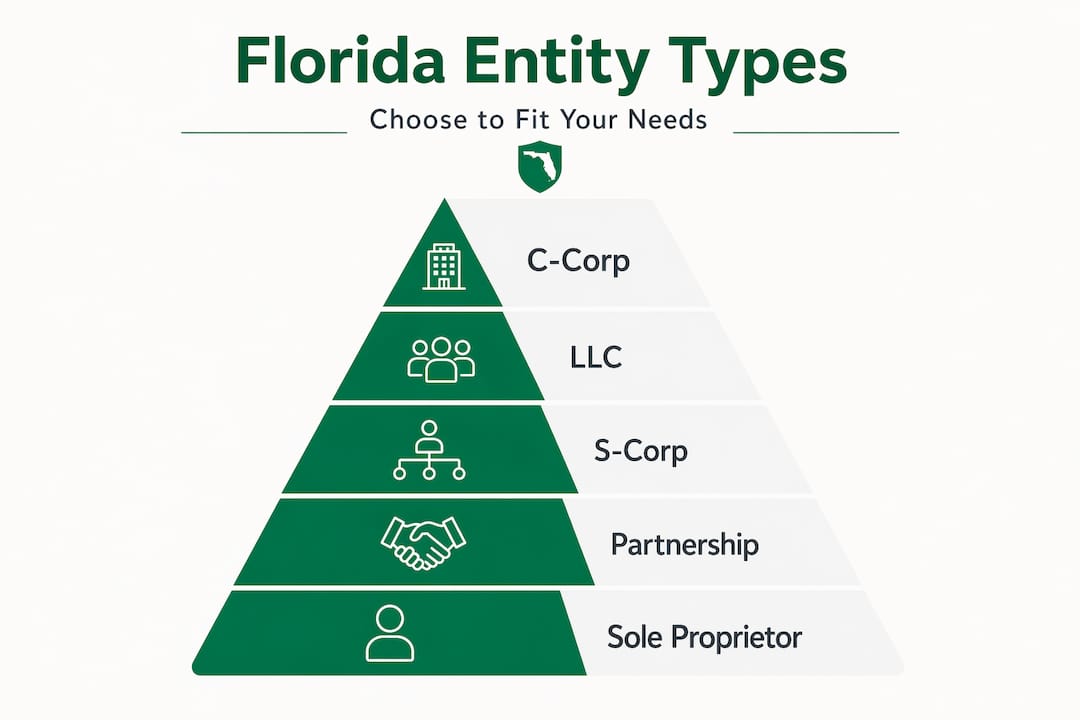
Partnerships cover two main forms: General Partnerships, where all partners share liability equally, and Limited Partnerships, where limited partners have liability capped at their investment. Both require a clear partnership agreement to avoid disputes later.
Here is a quick Florida business entity comparison at a glance:
| Entity Type | Liability Protection | Default Taxation | Best For |
|---|---|---|---|
| Sole Proprietorship | None | Personal income | Solo freelancers, low-risk work |
| LLC | Yes | Pass-through | Most small businesses |
| S-Corporation | Yes | Pass-through + payroll | Profitable small businesses |
| C-Corporation | Yes | Corporate + dividend | High-growth, investor-backed |
| Partnership | Varies | Pass-through | Multi-owner ventures |
Key factors that drive your entity decision
Choosing a corporation type in Florida or deciding between an LLC and a corporation is not just a paperwork decision. It has real financial and legal consequences.
-
Liability exposure. Ask yourself honestly: what could go wrong? If you work in a field with contract disputes, professional liability, or physical risk, personal asset protection is non-negotiable. An LLC or corporation creates a legal wall between your business debts and your home, savings, and personal accounts.
-
Tax structure. Florida has no personal state income tax, which makes pass-through entities especially attractive. Your federal tax picture, however, drives most of the decision. At lower profit levels, a standard LLC works fine. As profits grow, an S-Corp election can reduce self-employment taxes meaningfully.
-
Ownership and growth plans. Will you bring in partners or investors? LLCs handle flexible ownership well. C-Corps are built for outside investment. If you plan to stay small and owner-operated, an LLC or S-Corp election is almost always the better fit.
-
Administrative burden. C-Corps require board meetings, minutes, and formal governance. LLCs are far lighter. Florida also requires all registered entities to file annual reports, and the compliance calendar matters.
-
Florida-specific requirements. Every Florida LLC and corporation must maintain a registered agent with a physical Florida address. Annual report fees and deadlines apply uniformly across entity types, and ignoring them has real consequences.
Pro Tip: If you are unsure whether to elect S-Corp status, run the numbers at your projected net profit level with a CPA before you file. The break-even point where S-Corp savings outweigh the added payroll costs is typically around $40,000-$50,000 in net profit, though it varies by situation.
How to form your Florida business entity
Once you have picked your structure, the formation process is straightforward if you follow the steps in order.
-
Search your business name. Use the Florida Division of Corporations database at Sunbiz.org to confirm your name is available. LLCs must include “LLC” or “Limited Liability Company” in the name. Corporations must include “Inc.,” “Corp.,” or a similar designator.
-
File your formation documents. For an LLC, that means Articles of Organization. For a corporation, Articles of Incorporation. Both are filed through Sunbiz.org’s online system, which processes most filings in 2 to 5 business days.
-
Appoint a registered agent. A registered agent in Florida must have a physical Florida address and be available during business hours to receive legal documents. You can serve as your own agent, but many business owners use a registered agent service for privacy and reliability.
-
Pay the filing fees. Forming an LLC costs $125, which breaks down as a $100 filing fee and $25 for registered agent designation. Corporation filing fees are higher.
-
Obtain an EIN. Apply for a federal Employer Identification Number through the IRS website. You need this for banking, payroll, and tax filings regardless of entity type.
-
Elect S-Corp status if applicable. File IRS Form 2553 within 75 days of your tax year start. All shareholders must sign, and the eligibility rules are strict.
Here is a quick reference for key Florida formation fees and deadlines:
| Action | Fee | Deadline |
|---|---|---|
| LLC Articles of Organization | $125 | At formation |
| Corporation Articles of Incorporation | $70+ | At formation |
| Annual Report (LLC) | $138.75 | May 1 each year |
| Late Annual Report Penalty | $400 | After May 1 |
| S-Corp Election (Form 2553) | No fee | Within 75 days of tax year |
Pro Tip: File your annual report early. The May 1 annual report deadline applies to every Florida LLC regardless of when you formed it. Set a calendar reminder for April 1 to give yourself a full month of buffer.
Common mistakes to avoid
Even well-intentioned entrepreneurs make avoidable errors when forming and maintaining their Florida entities. Here are the ones that show up most often.
-
Choosing an entity on autopilot. Picking a structure without evaluating tax impacts is one of the most common regrets. Many business owners form an LLC, never consider the S-Corp election, and overpay self-employment taxes for years. Others rush into a C-Corp because it sounds more serious, then get hit with double taxation they did not anticipate.
-
Missing the annual report deadline. Missing the May 1 deadline triggers an automatic $400 late fee. If you miss it entirely, Florida can administratively dissolve your entity. That means your liability protection disappears until you reinstate, and reinstatement has its own costs and complications.
-
Botching the S-Corp election. The IRS Form 2553 filing must happen within 75 days of the start of the tax year you want the election to apply. Miss that window and you wait another full year. The eligibility rules also disqualify certain shareholders, so verify before you file.
-
Underestimating C-Corp complexity. C-Corps require formal governance, separate tax filings, and careful planning around distributions. Many Florida startups that do not need outside investment would be better served by an LLC with an S-Corp election.
-
Confusing registered agent rules. A P.O. box does not qualify. Your registered agent must have a physical Florida street address. Using an out-of-state address or a non-compliant agent can invalidate legal service of process on your business.
The entity you form on day one is not necessarily the entity you will need on day 1,000. Build in a review point at 12 months to assess whether your structure still fits your tax situation and growth trajectory.
Verifying your entity is working for you
Forming the entity is the beginning, not the end. Here is how to confirm your structure is actually doing its job.
-
Check your liability protection is intact. Keep personal and business finances completely separate. A single bank account used for both can pierce the corporate veil and expose you personally, regardless of your entity type.
-
Confirm your tax elections are filed and active. If you elected S-Corp status, verify the IRS accepted your Form 2553. Errors or missing signatures can void the election without any notice to you.
-
Track Florida state filing deadlines. Mark May 1 on your calendar every year. If your business grows and you add members or change ownership, update your registered agent and operating agreement accordingly.
-
Reassess as your business evolves. An LLC that made sense at $80,000 in revenue may not be optimal at $500,000. Consult with a business attorney or CPA annually. The cost of that conversation is almost always less than the cost of staying in the wrong structure.
-
Know when to get professional help. If you are dealing with investors, multiple owners, complex contracts, or disputes, a general internet search is not enough. The decisions you make at formation have consequences that can follow you for years. For deeper guidance on forming a business in Florida, working with a Florida business attorney is the most reliable way to get it right.
My take on entity selection after 20 years of practice
I have worked with hundreds of Florida entrepreneurs over two decades, and the pattern I see most often is this: business owners spend enormous energy on their product, their marketing, and their first hire, and then they pick their entity type in about ten minutes based on what their friend did.
That ten-minute decision can cost them tens of thousands of dollars. I have seen profitable LLCs that should have elected S-Corp status years earlier, still paying full self-employment taxes on every dollar of profit. I have also seen solo consultants who formed C-Corps because it sounded more credible, then discovered the double taxation problem when they tried to take money out.
The other thing I tell clients is this: Florida’s lack of personal income tax is genuinely useful, but it does not simplify your federal tax picture at all. Your entity choice is almost entirely a federal tax decision with a Florida compliance layer on top. Anyone who tells you otherwise is oversimplifying.
My honest recommendation is to spend the time and money to get this right before you file, not after. A one-hour consultation with a business attorney and a CPA, reviewed together, will almost always surface a detail that changes your decision. The LLC vs. corporation question is rarely as simple as it looks on a comparison chart.
— Matthew
Ready to choose the right structure for your Florida business?
The entity decision you make today shapes your taxes, your liability exposure, and your ability to grow for years to come. Getting it right the first time is far less expensive than fixing it later.

At Fornarolegal, Matthew Fornaro has spent over 20 years helping South Florida entrepreneurs and small business owners select, form, and maintain the right business entities for their specific situations. From comparing your LLC and corporation options to guiding you through formation and ongoing compliance, the firm provides practical legal guidance that saves you money and keeps you protected. Contact Fornarolegal today to get personalized advice tailored to your business goals and Florida’s specific legal requirements.
FAQ
What is the best business entity for startups in Florida?
For most Florida startups, an LLC is the best starting point because it offers liability protection, flexible management, and pass-through taxation without heavy administrative requirements. As the business grows and profits increase, an S-Corp election can reduce self-employment taxes significantly.
How much does it cost to form an LLC in Florida?
Forming a Florida LLC costs $125, which includes a $100 filing fee and $25 for registered agent designation, filed through Sunbiz.org with a processing time of 2 to 5 business days.
What is the Florida LLC annual report deadline?
All Florida LLCs must file their annual report by May 1 each year, regardless of when the LLC was formed. Missing this deadline triggers a $400 late fee and can result in administrative dissolution.
What is the difference between an LLC and an S-Corp in Florida?
An LLC is a state-level entity type, while S-Corp is a federal tax election that can be applied to an LLC or corporation. The S-Corp election can reduce self-employment taxes for profitable businesses by allowing owners to split income between salary and distributions.
Do I need a registered agent to form a business in Florida?
Yes. Every Florida LLC and corporation must designate a registered agent with a physical Florida address to receive legal documents. A P.O. box does not qualify, and the agent must be available during regular business hours.
Recommended
- Comprehensive Guide to Forming a Business in Florida: Legal Insights for Entrepreneurs » Matthew Fornaro, P.A.
- LLC vs. INC — Which Business Entity is Best for My Company? » Matthew Fornaro, P.A.
- Navigating Florida’s Unique Business Law Landscape: Essential Insights for Entrepreneurs » Matthew Fornaro, P.A.
- How Does My Business Get Paid? » Matthew Fornaro, P.A.


