Key Takeaways
- Florida business law protects companies from unfair competition, contract breaches, and partner disputes.
- Acting early saves time, money, and business relationships.
- An experienced business attorney helps you assess risk and choose the right legal strategy.
Property ownership in South Florida is rarely as straightforward as signing a deed and moving in. A real estate dispute is any legal conflict involving property rights, from a neighbor who builds a fence three feet onto your lot to a seller who hides known flood damage before closing. These conflicts are far more common than most owners expect, and the consequences range from costly delays to full-blown litigation. Understanding what triggers them, how they play out, and what your options are can save you significant time, money, and frustration.
Table of Contents
- Key takeaways
- What is a real estate dispute and who it affects
- Common types of real estate disputes
- What causes property disputes to start
- How to resolve property disputes
- South Florida’s special considerations
- Practical steps when you face a dispute
- My take on what most property owners get wrong
- How Fornarolegal helps South Florida property owners
- FAQ
Key takeaways
| Point | Details |
|---|---|
| Disputes cover more than ownership | Real estate conflicts include boundaries, contracts, leases, title defects, HOA rules, and construction issues. |
| Common causes are often preventable | Unclear documentation, undisclosed defects, and ambiguous contracts drive most South Florida property disputes. |
| Resolution options vary widely | Negotiation and mediation cost far less than litigation and often produce better long-term outcomes. |
| Commercial disputes carry unique risks | Eminent domain, lease clauses, and multi-party compensation issues make commercial disputes especially complex. |
| Early legal guidance changes outcomes | Getting an attorney involved early limits costs and protects rights before positions become entrenched. |
What is a real estate dispute and who it affects
At its core, a real estate dispute is any conflict where two or more parties disagree about property rights, responsibilities, or value. Disputes encompass conflicts over ownership, title defects, boundary issues, lease and contract breaches, and construction problems. That covers a wide range of situations, which is exactly why so many property owners in South Florida find themselves in one without ever expecting it.
These conflicts do not only affect buyers and sellers. Landlords, tenants, contractors, homeowners associations, and commercial leaseholders all face property disputes regularly. The South Florida market adds its own pressures: rapid development, dense urban neighborhoods, aging construction, a large rental market, and active HOA communities all create friction points that rarely exist to the same degree in slower real estate markets.

Understanding the definition is just the start. What matters more is knowing what form a dispute can take and how the conflict typically escalates from a misunderstanding to a legal battle.
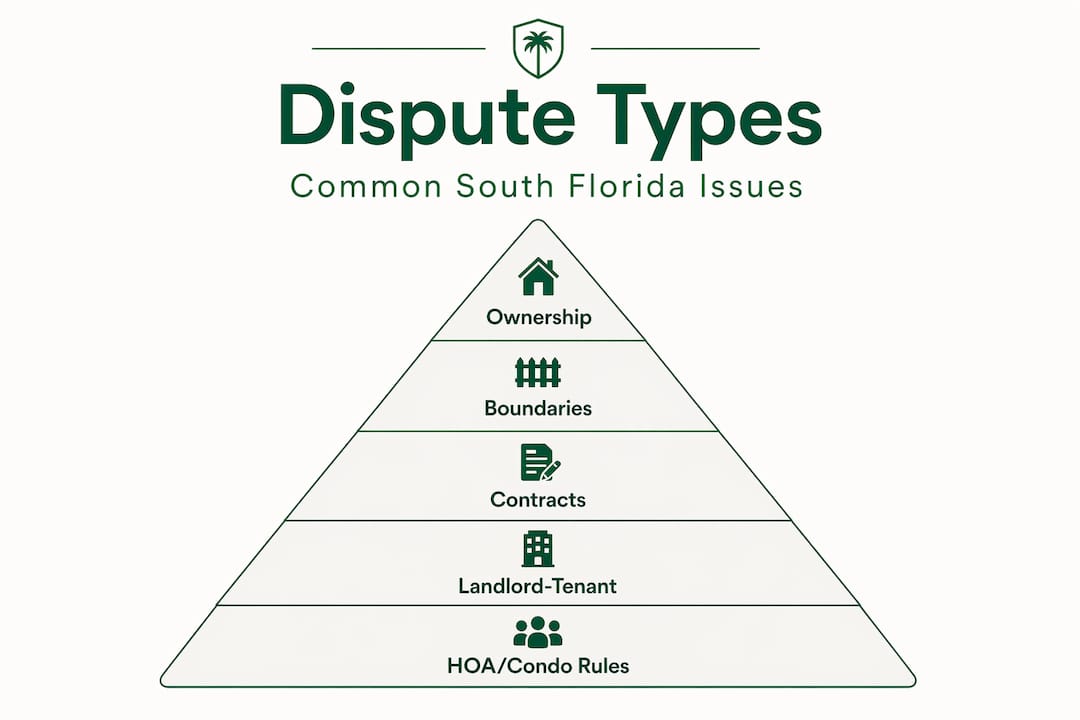
Common types of real estate disputes
The types of real estate disputes South Florida property owners face fall into several clear categories. Each carries different legal claims and remedies, which is why identifying the type of dispute early matters so much.
| Dispute Type | Common Legal Claims | Typical Remedies |
|---|---|---|
| Boundary and property line | Trespass, encroachment | Survey, quiet title action, injunction |
| Contract and purchase agreement | Breach of contract, fraud | Damages, specific performance |
| Landlord-tenant | Wrongful eviction, lease breach | Damages, possession, rent abatement |
| Title and ownership | Quiet title, forgery | Court-ordered title correction, damages |
| HOA and covenant enforcement | Violation of CC&Rs | Fines, injunction, compliance orders |
| Construction defects and liens | Negligence, mechanic’s lien | Repair costs, lien foreclosure |
Here is what each category looks like in practice:
- Boundary disputes happen when two neighbors disagree on where one property ends and another begins. This is common in older South Florida neighborhoods where original survey pins have been lost or moved.
- Contract breaches occur when a buyer walks away from a deal without cause, a seller misrepresents the property’s condition, or a party fails to meet a closing deadline.
- Landlord-tenant conflicts range from wrongful eviction claims to disputes over security deposits, unit condition, or lease renewal terms. South Florida’s high rental demand makes these especially frequent.
- Title defects include forged deeds, missing heirs with ownership claims, or errors in public records that cloud ownership.
- HOA disputes often involve selective enforcement of rules, unpaid assessments, or architectural approval disagreements in communities across Miami-Dade, Broward, and Palm Beach counties.
- Construction defect and mechanic’s lien cases arise when contractors do substandard work or go unpaid, which can affect a property’s title and marketability.
Some remedies like quiet title or injunctive relief require formal court action. Others, like damages for a contract breach, can often be settled through alternative dispute resolution.
What causes property disputes to start
Disputes frequently arise from unclear property lines, non-disclosure of defects, ambiguous contracts, and delays or defects in construction. Most of these triggers are preventable with the right documentation and professional review upfront.
The most common causes worth knowing:
-
Undocumented property lines. A neighbor installs a pool or adds a room without verifying the boundary. By the time the error is discovered, correcting it is expensive and contentious.
-
Failure to disclose known defects. Sellers in Florida are legally required to disclose known material defects. When they do not, buyers discover water damage, mold, or foundation problems after closing and file suit.
-
Ambiguous contract language. Vague terms around inspection periods, repair obligations, or contingencies create disagreements about what each party actually agreed to. Inconsistent communication during transactions is one of the most cited drivers of disputes in the industry.
-
Construction delays and defective work. A contractor who misses milestones or delivers substandard finishes creates both financial and legal exposure, particularly in South Florida’s active new construction market.
-
Commercial lease clause disagreements. Disputes over rent escalations, permitted use, or who bears the cost of tenant improvements are common in commercial leases throughout Miami and Fort Lauderdale.
Pro Tip: Before signing any property contract, have a real estate attorney review the inspection contingency, disclosure requirements, and any clauses that assign repair obligations. One unclear sentence in a contract can cost more to resolve than the attorney’s fee many times over.
How to resolve property disputes
Resolution methods range from negotiation to mediation, arbitration, and formal litigation. The right approach depends on the stakes, the relationship between the parties, and how far the conflict has already escalated.
Negotiation
Direct negotiation is the starting point for most disputes. It costs nothing beyond your time, preserves the relationship, and can resolve simple misunderstandings before attorneys get involved. The limitation is that it only works when both sides are willing to communicate in good faith.
Mediation
Mediation brings in a neutral third party to facilitate a negotiated settlement. Mediation is more effective than litigation for creating win-win solutions and preserving relationships between neighbors, business partners, or landlords and tenants. A judge is limited to legal remedies. A mediator can craft creative outcomes, like a shared fence cost or a modified lease term, that a court simply cannot order.
You can learn more about mediation versus litigation costs if you are weighing those options.
Arbitration
Arbitration is more formal than mediation. An arbitrator acts like a private judge and issues a binding decision. It is faster and more private than a courtroom trial, which matters in commercial real estate where confidentiality about deal terms or property valuations is valuable.
Litigation
Litigation is the last resort. Managing risk and cost is the goal, not simply winning. Court proceedings are public, expensive, and can take years in South Florida’s congested court system. Some disputes require litigation, particularly quiet title actions and injunctive relief cases. But most property conflicts that end up in court could have been resolved earlier at far lower cost.
- Negotiation: lowest cost, no guarantee of resolution
- Mediation: low-to-moderate cost, non-binding unless agreed in writing
- Arbitration: moderate cost, binding, faster than court
- Litigation: highest cost, unpredictable timeline, public record
Pro Tip: Check your real estate contract before a dispute escalates. Many purchase agreements and commercial leases already include mandatory mediation or arbitration clauses. Ignoring those clauses can waive your rights or trigger sanctions.
South Florida’s special considerations
South Florida has property dispute dynamics that do not exist everywhere else. Commercial landlords and tenants here face eminent domain risks as infrastructure projects and transit expansions continue across Miami-Dade and Broward counties. In those cases, lease and REA provisions often determine how compensation is split among the landlord, tenant, and lenders during condemnation proceedings, overriding what state default law would otherwise require.
Commercial real estate disputes also tend to involve multiple parties with conflicting interests, including lenders, subtenants, and easement holders. That complexity multiplies both the cost and duration of any unresolved conflict.
Several factors make South Florida disputes more financially consequential than in slower markets:
- Higher property values mean larger sums are at stake in every ownership or boundary dispute
- The active condo and HOA market creates dense community governance conflicts
- Commercial lease density in urban corridors like Brickell and downtown Fort Lauderdale generates frequent tenant-landlord friction
- Liquidity risk is a real concern: property taxes, mortgage payments, and maintenance costs continue while a dispute drags on, pressuring owners toward early settlement even when they have the stronger legal position
Early legal review of your lease, easement agreements, and any reciprocal easement agreements is not optional in complex commercial situations. It is the only way to know your rights before a conflict forces the issue.
Practical steps when you face a dispute
Knowing what to do in a real estate dispute matters as much as knowing what type of dispute you have. Effective resolution requires early evidence preservation, documented communication, and understanding when immediate legal action is needed.
Here is a clear action plan:
-
Stay calm and document everything. Write down what happened, when, and who said what. Keep copies of all emails, texts, letters, and contracts related to the conflict.
-
Get a professional survey or inspection. If the dispute involves property lines or construction defects, objective third-party documentation strengthens your position significantly.
-
Review your contract and community rules. Many disputes have clear answers in the documents you already signed. Read your purchase agreement, lease, HOA rules, or deed restrictions carefully.
-
Contact an experienced real estate attorney early. Early involvement protects your rights, helps you evaluate whether ADR or litigation is appropriate, and often resolves the dispute before it becomes a lawsuit. For contract-related issues, early resolution techniques can make a real difference.
-
Consider mediation before filing suit. Mediation costs a fraction of litigation and can produce a binding settlement within weeks rather than years.
-
Know when urgent action is required. If someone is actively trespassing, a property is heading toward foreclosure, or an imminent sale could extinguish your rights, filing a lis pendens or seeking a temporary injunction may be necessary immediately.
Pro Tip: Never ignore a legal notice or a demand letter related to your property. Failing to respond within applicable deadlines can waive defenses or create default judgments that are extremely difficult to undo.
My take on what most property owners get wrong
I have spent over two decades handling real estate disputes in South Florida, and the pattern I see most often is not complicated. People wait too long. They hope the other party will back down, they avoid the cost of getting an attorney involved early, and then they come in after months of escalation when options have narrowed considerably.
The other thing I see constantly is a misunderstanding about what “winning” means. Litigation in a property dispute is rarely a clear win for either side. By the time a case resolves, both parties have typically spent significantly on attorney fees, expert witnesses, and court costs. The party who “wins” in court often nets less than they would have accepted in mediation two years earlier. That is why I genuinely believe in alternative dispute resolution not as a concession, but as smart strategy.
What also surprises people is how much the financial pressure of a dispute can distort decision-making. When mortgage payments and taxes keep running on a property you cannot sell or lease because of a title cloud or pending litigation, the clock is always working against you. That pressure leads to bad settlements. The best way to protect yourself is to understand your position clearly from day one, with counsel who knows South Florida’s courts and property laws specifically.
I always tell clients: the goal is resolution, not a verdict.
— Matthew
How Fornarolegal helps South Florida property owners
When a real estate conflict arises, having experienced legal guidance on your side from the start changes the entire trajectory of the dispute.

At Fornarolegal, Matthew Fornaro brings more than 20 years of court-tested experience to residential and commercial property disputes across Miami-Dade, Broward, and Palm Beach counties. Whether you are dealing with a boundary conflict, a contract breach, a commercial lease dispute, or an eminent domain threat, the firm provides practical advice that protects your rights without unnecessary escalation. Understanding the value of early legal guidance is what separates property owners who resolve disputes efficiently from those who spend years in court. If you are facing a property conflict or want to reduce your exposure before one starts, contact Fornarolegal to schedule a consultation.
FAQ
What is a real estate dispute?
A real estate dispute is a legal conflict involving property rights, including ownership, boundaries, contracts, leases, title defects, or construction issues. These conflicts can be resolved through negotiation, mediation, arbitration, or litigation depending on complexity.
What are the most common types of real estate disputes?
The most common types include boundary and property line conflicts, contract breaches, landlord-tenant disagreements, HOA enforcement issues, title defects, and construction defect or mechanic’s lien claims.
How do you resolve a real estate business dispute?
Resolution typically starts with direct negotiation, followed by mediation or arbitration as cost-effective alternatives. Litigation is reserved for cases where legal remedies like quiet title actions or injunctions are specifically required.
When should I hire a real estate attorney?
You should involve an attorney as early as possible, ideally before signing any contract. If a dispute has already started, consult an attorney immediately to protect your rights, preserve evidence, and evaluate your best resolution path.
How long does a real estate dispute take to resolve?
Timelines vary widely. Negotiated settlements can close in weeks. Mediation typically resolves disputes within one to three months. Litigation in South Florida courts can take one to three years or longer depending on complexity and court schedules.