

Key Takeaways
- Florida business law protects companies from unfair competition, contract breaches, and partner disputes.
- Acting early saves time, money, and business relationships.
- An experienced business attorney helps you assess risk and choose the right legal strategy.
South Florida’s construction market moves fast, and when things go wrong, they go wrong expensively. Understanding construction dispute types in South Florida is not optional knowledge for contractors and property owners. It is a financial survival skill. From Miami-Dade to Broward and Palm Beach counties, projects routinely spiral into costly conflicts over payments, scope changes, and schedule overruns. The good news: most of these disputes are predictable, and knowing the type of conflict you are dealing with is the first step toward resolving it without destroying your project, your relationships, or your cash flow.
Table of Contents
- Key takeaways
- Common construction dispute types in South Florida projects
- 1. Payment disputes
- 2. Change order and scope creep disputes
- 3. Delay and scheduling disputes
- 4. Quality and defect claims
- 5. Contract and documentation disputes
- My perspective on handling South Florida construction disputes
- Protect your project with experienced South Florida legal counsel
- FAQ
Key takeaways
| Point | Details |
|---|---|
| Payment disputes dominate | Late payments and improper retainage trigger the most frequent and financially damaging construction conflicts. |
| Verbal changes are dangerous | Change orders approved without written documentation are among the leading causes of Florida construction litigation. |
| Documentation wins claims | Contemporaneous daily logs, schedules, and meeting minutes are what separate strong claims from losing ones. |
| Tiered resolution saves money | Starting with negotiation before moving to mediation or arbitration controls costs and project disruption. |
| Local expertise matters | Familiarity with Miami-Dade and Broward court tendencies gives parties a real strategic advantage. |
Common construction dispute types in South Florida projects
Before you can resolve a dispute, you need to identify what kind of dispute you actually have. That sounds obvious, but many contractors and owners waste months pursuing the wrong strategy because they misread the underlying conflict.
South Florida projects face a set of recurring dispute triggers that ambiguous contract language almost always sits at the center of. Poorly drafted contracts cause missed notices, blown deadlines, and procedural failures that weaken every claim you try to make later. The categories below are not isolated problems. Research shows that disputes are cumulative, building from small misalignments across the project lifecycle rather than from a single catastrophic event.
The most common factors that define dispute types in South Florida construction include:
- Ambiguous contract terms that leave scope, quality standards, and payment timelines open to interpretation
- Undocumented change orders and informal instructions that generate competing versions of what was agreed
- Schedule misalignment where owners and contractors use different baseline schedules to assess delay responsibility
- Communication breakdowns between general contractors, subcontractors, and design professionals
- Retainage and progress payment disagreements that escalate when cash flow tightens under South Florida’s project cycles
Pro Tip: Before signing any construction contract in Florida, have legal counsel review it specifically for dispute resolution procedures, notice requirements, and change order provisions. Gaps in these three areas cause the majority of construction claim types in Florida.
1. Payment disputes
Payment disputes are the most common and most damaging category of construction legal issues in South Florida. They also escalate faster than any other dispute type because construction runs on cash flow, and a single withheld payment can freeze an entire project.
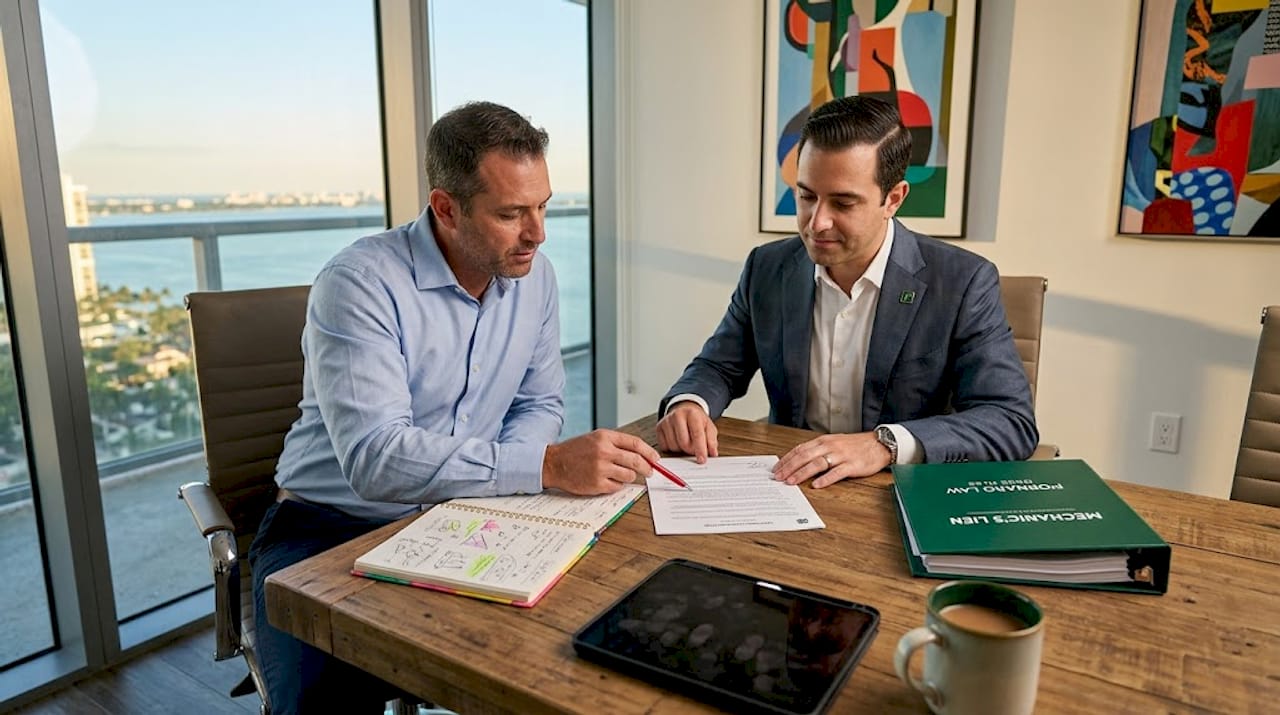
The most frequent payment triggers include late payments, disagreements over payment application terms, and improper retainage application. In South Florida, where subcontractors often carry thin margins across multiple simultaneous projects, a delayed draw from a general contractor does not just hurt one job. It creates a cascading effect across a subcontractor’s entire portfolio.
Florida’s mechanic’s lien law gives contractors and suppliers a powerful tool to secure payment, but it comes with strict notice deadlines and procedural requirements. Miss a notice deadline and you may lose your lien rights entirely, no matter how legitimate your claim is. That is a reality that catches many out-of-state contractors off guard when they first work in Florida.
Real-world scenarios in Miami-Dade and Broward regularly involve owners withholding payment over disputed work quality, then finding themselves hit with lien claims from subcontractors who were never paid downstream. Resolving these layered payment conflicts requires understanding both the contract terms and Florida’s statutory framework simultaneously.
2. Change order and scope creep disputes
Change order conflicts are the second most prevalent category, and they are entirely preventable with the right contract structure. Change orders were cited 43 times as dispute contributors in recent construction research, with ambiguous contracts cited 32 times. Those two factors almost always appear together.
The core problem is straightforward. An owner asks a contractor to do something extra, the contractor does it, and then the parties disagree over whether that instruction was ever authorized, what it was supposed to cost, or whether it was even a change at all. Verbal instructions without written confirmation are prime sources of Florida construction litigation, and South Florida’s fast-moving project culture makes verbal approvals dangerously common.
Steps to prevent scope creep disputes:
- Define the contract scope with precision, including a clear list of what is excluded
- Require written authorization before any change order work begins, no matter how small
- Specify a time limit within which the owner must respond to change order requests
- Include a pricing mechanism in the contract so cost disputes do not stall approvals
- Log every verbal instruction in writing immediately and confirm it to the other party
Pro Tip: Even if an owner verbally tells you to proceed, send a same-day email summarizing the instruction, the scope of work, and the expected cost. That email creates a paper trail that holds up in resolving construction conflicts far better than your memory will.
3. Delay and scheduling disputes
Delay disputes are arguably the most technically complex category of construction project disputes in South Florida. They require forensic schedule analysis, expert testimony, and detailed financial calculations to establish responsibility and quantify damages.
Common delay causes in South Florida include:
- Weather events including hurricanes, tropical storms, and the extended rainy season that affects outdoor work from June through October
- Supply chain disruptions that became endemic post-2020 and continue to affect specialty materials
- Permitting delays from overburdened building departments in Miami-Dade and Broward counties
- Labor shortages across skilled trades that push project timelines past agreed completion dates
- Differing site conditions particularly in coastal areas where soil and subsurface conditions vary dramatically
The financial damage from delay disputes extends well beyond a project’s completion date. Delay claims can include extended general conditions costs, labor inefficiency, acceleration costs, and lost profits. These numbers add up quickly on any South Florida commercial project.
| Delay type | Common cause | Documentation needed | Typical resolution path |
|---|---|---|---|
| Owner-caused delay | Late decisions, design changes | Correspondence, meeting minutes | Negotiation, mediation |
| Weather delay | Tropical storms, hurricanes | Weather records, project logs | Contract force majeure clause |
| Concurrent delay | Both parties contributed | Detailed schedule analysis | Arbitration or litigation |
| Subcontractor delay | Labor or material shortages | Delivery records, daily logs | Direct negotiation |
Contemporaneous records are not optional in delay claims. They are the difference between a credible claim and an unsubstantiated narrative. Daily logs, meeting minutes, schedule updates, and weather reports assembled in real time carry far more weight than reconstructed timelines built months later when the dispute is already in progress.
4. Quality and defect claims
Defect claims occupy a distinct category among types of building disputes because they typically emerge after substantial completion, often when an owner refuses final payment pending resolution of alleged defects. That timing makes them particularly contentious.
Defining what constitutes a defect requires looking at contract language, applicable building codes, industry standards, and sometimes manufacturer specifications. South Florida’s climate adds a regional layer: moisture intrusion, hurricane-resistance compliance, and corrosion from salt air are sources of defect claims that contractors in other regions rarely encounter.
Common defect dispute scenarios in South Florida include:
- Waterproofing failures in balconies, roofs, and below-grade construction
- Non-compliant hurricane strapping or impact window installation
- HVAC systems that meet specification but fail to maintain required humidity levels in South Florida’s climate
- Concrete spalling in coastal environments due to improper cover over reinforcing steel
When a defect claim intersects with a withheld payment, the dispute becomes two conflicts at once. The owner holds payment as leverage while the contractor disputes that a defect exists. Construction mediation in South Florida resolves many of these disputes faster than litigation, particularly when both sides agree on a neutral expert to assess the alleged defect. Construction arbitration in Florida is also a favored path where contracts specify it, offering more process control and confidentiality than courtroom litigation.
5. Contract and documentation disputes
Some disputes are not about what happened on the job site. They are about what the contract says, or what it fails to say. These are among the most avoidable construction legal issues in South Florida, yet they remain stubbornly common.
Contract disputes arise when parties interpret the same clause differently. Notice provisions are a prime example. Florida construction contracts often require that a party provide written notice within a specific number of days after a triggering event, such as a delay or differing site condition. Miss that window and your claim may be barred, regardless of its merit.
Sub-tier contract alignment is another frequent problem. A general contractor’s subcontract may contain terms that conflict with the prime contract, creating gaps that become dispute flashpoints. In South Florida’s submarket of international developers and diverse subcontractor pools, language and interpretation differences compound these gaps further.
Working with counsel who understands Florida business litigation before a dispute arises, rather than after, is the most cost-effective investment a contractor or property owner can make.
My perspective on handling South Florida construction disputes
I have spent over 20 years working with contractors, developers, and property owners in South Florida on transactions and disputes. If there is one pattern I see repeatedly, it is this: most people wait too long to get legal guidance, and by the time they call me, positions have hardened, documentation is incomplete, and options have narrowed.
The instinct to avoid lawyers and resolve disputes informally is understandable. But the local court tendencies in Miami-Dade and Broward are not intuitive if you have not spent time in those courtrooms. Judges and arbitrators here see construction disputes regularly and form clear expectations around documentation standards, notice compliance, and credibility of parties who come in with contemporaneous records versus those who do not.
My genuine advice is this: treat your project documentation as if every record will eventually be read by a judge. Log the weather. Confirm every verbal instruction by email. Photograph every stage of the work. A tiered resolution approach, starting with direct negotiation and moving through mediation before jumping to litigation, protects your cash flow and your relationships far better than going straight to court.
South Florida’s construction market is too competitive and too interconnected to burn bridges over disputes that proper contracts and early legal guidance could have prevented entirely.
— Matthew
Protect your project with experienced South Florida legal counsel
Construction disputes do not get easier with time. They get more expensive, more document-intensive, and harder to resolve the longer they sit unaddressed.

At Fornarolegal, Matthew Fornaro provides court-tested legal representation specifically for construction professionals and property owners across Miami-Dade, Broward, and Palm Beach counties. With over 20 years of experience in South Florida courts, the firm helps clients prevent disputes through solid contract drafting and resolves active conflicts through negotiation, mediation, arbitration, and litigation when necessary.
If you are facing an active dispute or want to protect your next project before it starts, early legal intervention is always your most cost-effective move. Contact Fornarolegal to discuss your situation and get a clear picture of your options before positions harden.
FAQ
What are the most common construction dispute types in South Florida?
Payment disputes, change order conflicts, and delay claims are the most frequent construction dispute types in South Florida. These categories account for the majority of Florida construction litigation across Miami-Dade, Broward, and Palm Beach counties.
How does Florida’s mechanic’s lien law affect payment disputes?
Florida’s mechanic’s lien law gives contractors and suppliers a statutory right to secure unpaid amounts, but it requires strict compliance with notice deadlines. Missing those deadlines can eliminate your lien rights regardless of the merit of your underlying payment claim.
Is construction arbitration or litigation better in Florida?
Arbitration and litigation differ in cost predictability, confidentiality, and appeal options. Arbitration is often faster and preferred where contracts specify it, but litigation may be necessary for complex multi-party disputes or when significant appellate rights matter.
How can contractors prevent change order disputes?
Require written authorization before starting any additional work and confirm every verbal instruction in writing the same day it is given. Clear contract language on change order pricing and approval timelines prevents the majority of scope creep conflicts before they escalate.
When should a property owner or contractor get legal help for a construction dispute?
You should seek legal guidance as soon as you identify a potential dispute, not after it has already escalated. Early legal intervention preserves your documentation, protects notice rights, and opens resolution options that disappear once positions harden and litigation begins.


