

Key Takeaways
- Florida business law protects companies from unfair competition, contract breaches, and partner disputes.
- Acting early saves time, money, and business relationships.
- An experienced business attorney helps you assess risk and choose the right legal strategy.
Table of Contents
- What Business Contract Disputes Really Cost You
- Business Contract Dispute Resolution Tips: A Step-by-Step Framework
- Alternative Dispute Resolution Methods Every Business Owner Should Know
- How Long Does Contract Litigation Take, and What Does It Cost?
- Using a Business Contract Dispute Settlement Agreement Template
- Preventing Contract Disputes: Best Practices for Small Business Owners
- The Psychological Impact of Disputes on Founders and What to Do About It
- Conclusion
Last Updated: May 27, 2026
Contract disputes can quietly destroy businesses that took years to build. The business contract dispute resolution tips in this guide are drawn from real-world commercial litigation experience, and Matthew Fornaro, P.A. has helped South Florida entrepreneurs resolve disputes at every stage, from the first demand letter to full commercial litigation in Broward County courts. Below, you will find a step-by-step framework, a practical decision matrix, and angles most legal guides skip entirely, including what a dispute does to the founder’s mental state and how digital evidence can make or break your case.
Here is what most guides get wrong: they treat dispute resolution as a reactive process. The businesses that come out ahead treat it as a system they build before a dispute ever starts.
What Business Contract Disputes Really Cost You
A breach of contract is more than a legal inconvenience. It threatens cash flow, strains business relationships, and consumes the time founders should be spending on growth. Commercial litigation in Florida courts can stretch across months or years, and legal expenses accumulate whether you win or lose.
The costs are rarely just financial. A contractual disagreement forces you to reconstruct communications, pull together evidence, and engage legal counsel, all while running your business. Many small business owners in Coral Springs and across Broward County underestimate this operational drag until they are already inside a dispute.
The risk is compounded when contracts lack clear dispute resolution clauses, governing law provisions, or liquidated damages terms. Without those provisions, every question, including which court has jurisdiction and what remedies are available, becomes a negotiation in itself.
What a contract dispute actually costs you:
- Direct legal expenses (attorney fees, filing costs, expert witnesses)
- Indirect costs: lost productivity, damaged vendor or client relationships
- Reputational exposure if the dispute becomes public record
- Opportunity cost: deals and projects deferred while management attention is consumed
Many small business owners assume verbal agreements carry the same weight as written contracts. In Florida, many verbal agreements are enforceable, but proving their terms in court is extraordinarily difficult. Always document contractual obligations in writing, no matter how trusted the relationship.
The financial stability of your business depends on treating contracts as your legal backbone, not just administrative paperwork.
Business Contract Dispute Resolution Tips: A Step-by-Step Framework
Effective contract dispute resolution follows a logical sequence. Skipping steps, especially the early ones, is the single most common mistake businesses make. Jumping straight to litigation when negotiation was available wastes money and goodwill. Here is how to approach it methodically.
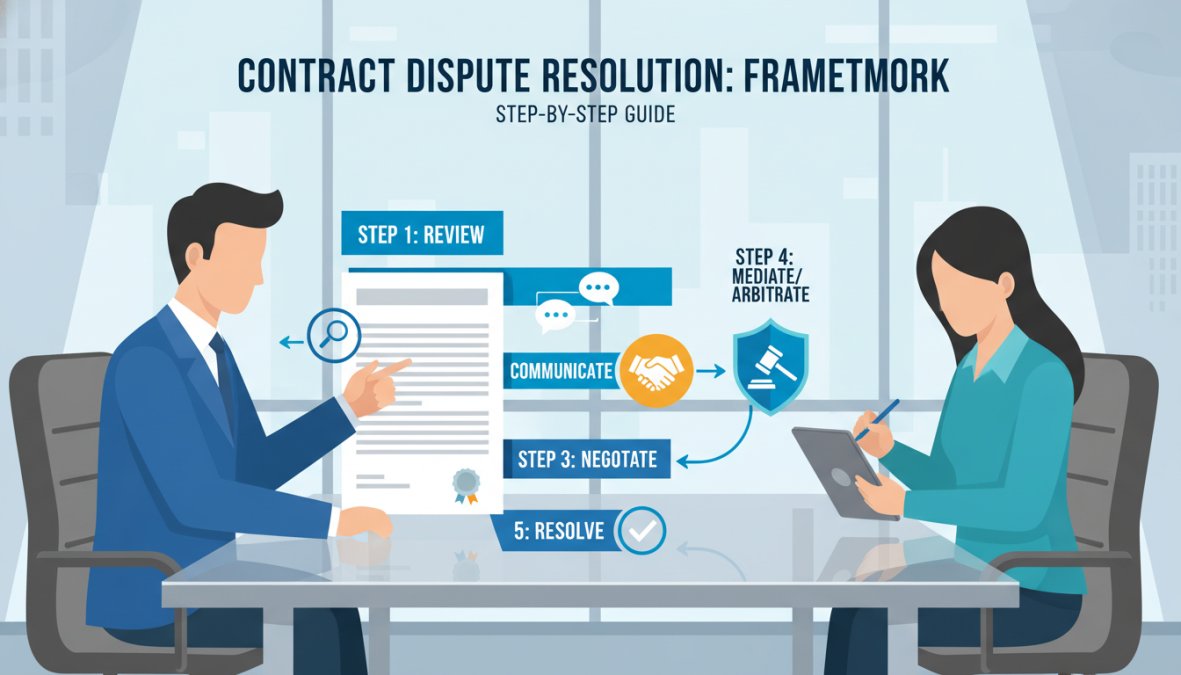
Step 1: Preserve All Evidence Before You Do Anything Else
Digital evidence management is the first and most overlooked step in contract dispute resolution. Before you send a single email or make a phone call about the dispute, lock down your records.
What to preserve immediately:
- The original signed contract and all amendments
- All email threads related to performance and delivery
- Text messages, Slack messages, or other digital communications
- Invoices, purchase orders, and payment records
- Meeting notes, call logs, and any written correspondence
- Screenshots of project management tools showing task status
- Any third-party investigation reports or audit trails
Courts treat spoliation, the destruction or alteration of evidence, as a serious issue. Even accidental deletion of relevant emails can damage your credibility. Set a litigation hold immediately: notify your team in writing that all communications related to the matter must be preserved.
Use a dedicated folder in your email client and cloud storage labeled with the dispute name and date. Export and save copies in at least two locations. If the dispute involves software platforms, take timestamped screenshots before any access is revoked.
Step 2: Review Contractual Obligations and the Governing Law Clause
Pull the contract and read it carefully before assuming you know what it says. Pay specific attention to the governing law clause, which determines which state’s laws apply, and the dispute resolution clause, which may require mediation or arbitration before litigation is permitted.
Check for:
- Performance and delivery timelines and whether they were met
- Notice requirements before a party can claim breach
- Cure periods that allow the breaching party to fix the problem
- Liquidated damages provisions that cap or define financial exposure
- Fiduciary duties if the other party is a partner or agent
A common mistake is assuming the dispute is clear-cut before reviewing these provisions. Many disputes that look like obvious breaches turn out to involve ambiguous timelines or cure periods that were never triggered.
Step 3: Attempt Negotiation and Amicable Resolution First
Most contract disputes, especially among parties with an ongoing business relationship, are best resolved through direct negotiation. An amicable resolution preserves the relationship, avoids legal expenses, and closes the matter faster than any formal process.
Send a written demand that clearly states the breach, the harm caused, and the specific remedy you are seeking. Keep the tone professional. The goal is a settlement agreement, not escalation.
Document every negotiation attempt. If the matter proceeds to arbitration or litigation, your good-faith efforts will matter.
Alternative Dispute Resolution Methods Every Business Owner Should Know
Once direct negotiation fails, most business owners face the same question: mediation, arbitration, or court? Every legal blog on the internet lists definitions for all three. What they rarely provide is a decision framework for choosing between them, which is the only thing that actually helps you. According to the American Bar Association’s resources on ADR, the majority of commercial disputes are resolved before trial, and the path you choose in the first 60 days shapes how expensive and how long that resolution takes.
Here is how to think about each option, and more importantly, when each one is the right call.
Mediation: Use It When the Relationship Still Has Value or the Facts Are Genuinely Disputed
Mediation is a facilitated negotiation in which a neutral third party helps both sides reach a voluntary agreement. Nothing is binding unless both parties sign a settlement. Sessions are confidential. The mediator does not issue a ruling, they help parties find common ground.
Choose mediation when:
- You have an ongoing business relationship you want to preserve (a key vendor, a long-term client, a joint venture partner)
- The facts are genuinely ambiguous and a judge or arbitrator could reasonably rule either way
- The dollar amount at stake does not justify the cost of arbitration or litigation
- Your contract requires mediation before any other formal process, many commercial contracts do, and skipping it can waive your rights or expose you to sanctions
Do not choose mediation when:
- The other party has shown bad faith and is using the process to delay
- You need injunctive relief (an emergency court order to stop ongoing harm), mediators cannot grant this
- The power imbalance between parties is so significant that the weaker party cannot negotiate freely
Mediation typically resolves in one to three sessions. Costs are shared between parties and are a fraction of arbitration or litigation fees.
Arbitration: Use It When You Need a Binding Decision Without the Cost of Court
Arbitration is a private adjudication process in which a neutral arbitrator, or a panel, hears both sides and issues a binding decision. Many commercial contracts include mandatory arbitration clauses, which means you may have already agreed to this path before the dispute started. Check your contract before assuming litigation is available.
Choose arbitration when:
- Your contract mandates it (you may have no choice)
- You need a binding, enforceable outcome but want to avoid the public record of court
- The dispute involves technical or industry-specific issues where an arbitrator with relevant expertise will reach a better-informed decision than a generalist judge
- You want a faster resolution than commercial litigation allows, arbitration typically concludes in months rather than years
Understand the trade-offs before you proceed:
- Appeal rights are extremely limited. If the arbitrator makes a legal error, you generally cannot overturn the decision. This cuts both ways: it protects you if you win, but it is a significant risk if you lose.
- Discovery is limited compared to litigation, which can be an advantage if you want to control costs, but a disadvantage if critical evidence is in the other party’s possession and you need formal discovery tools to obtain it.
- Arbitrator selection matters enormously. Both parties typically agree on an arbitrator from a panel provided by organizations like the American Arbitration Association (AAA) or JAMS. Research the arbitrator’s background and prior decisions before agreeing.
Commercial Litigation: Use It When the Stakes Justify the Cost or ADR Cannot Provide the Relief You Need
Commercial litigation is the appropriate path in a narrower set of circumstances than most business owners assume. It is not the default, it is the option of last resort or the option of necessity.
Choose litigation when:
- The other party refuses to participate in any ADR process in good faith
- You need injunctive relief, a court order to stop the other party from taking a specific action (transferring assets, using your intellectual property, soliciting your clients), that only a court can grant
- The financial stakes are large enough that the cost of full litigation is proportionate to the potential recovery
- You need the formal discovery process, depositions, subpoenas, document requests, to obtain evidence that the other party controls and will not voluntarily produce
- The dispute involves a question of law that needs a court ruling to establish precedent or protect your rights in future transactions
For Coral Springs and Broward County businesses, commercial litigation in Florida courts involves discovery, depositions, motions practice, and potentially a full trial. The process provides the strongest procedural protections and the broadest appeal rights, but it also carries the highest legal expenses and the longest timeline.
| Feature | Mediation | Arbitration | Litigation |
|---|---|---|---|
| Binding outcome | No | Yes | Yes |
| Average timeline | Weeks | Months | 1-3+ years |
| Cost level | Low | Moderate | High |
| Privacy | Yes | Yes | No (public record) |
| Appeals available | N/A | Very limited | Yes |
| Injunctive relief available | No | Limited | Yes |
| Discovery tools | None | Limited | Full |
| Relationship preservation | High | Moderate | Low |
The Decision You Actually Need to Make
The practical question is not "what is mediation?", you can find that in any legal dictionary. The practical question is: given where this dispute stands right now, which path gives me the best probability-weighted outcome at the lowest total cost?
A decision framework:
- Check your contract first. Does it require mediation before arbitration? Does it mandate arbitration and waive litigation? Your options may already be defined.
- Assess the other party’s posture. Are they engaging in good faith or stalling? Bad-faith actors use mediation as delay tactics. If that is the pattern, move to a binding process.
- Identify what relief you actually need. If you need money damages, arbitration is often faster and cheaper than litigation. If you need an injunction, you need a court.
- Run the cost-benefit math. See the settlement analysis section below. The right process is the one where the expected value of your outcome exceeds the cost of pursuing it.
- Consult counsel before the 30-day mark. The longer a dispute sits without a formal process, the more evidence degrades, the more leverage shifts, and the more expensive resolution becomes.
If your contract is silent on dispute resolution, you have maximum flexibility, but also maximum uncertainty. In that situation, propose mediation first in writing. It demonstrates good faith, creates a record, and costs you nothing if the other party refuses.
If your contract contains a mandatory arbitration clause, attempting to file in court first can result in the case being dismissed and may expose you to fee-shifting sanctions. Always review the dispute resolution clause with counsel before taking any formal action.
How Long Does Contract Litigation Take and What Does It Cost?
The honest answer to "how long will this take?" is: longer than you want, and the meter runs the entire time. Contract litigation in Florida typically takes one to three years from filing to resolution. Complex commercial cases involving multiple parties, significant discovery disputes, or appeals can run longer. Settlement before trial is common and can happen at any stage, after the initial demand, after mediation, after discovery closes, or on the courthouse steps.
But timeline is the wrong frame for the decision most business owners actually face. The right frame is this: at what point does settling become more valuable than continuing to fight, and how do you calculate that threshold before your emotions make the decision for you?
This is the analysis most legal guides skip. Here is a concrete framework for making it.
The Settlement vs. Trial Decision Framework
Before committing to full litigation, or before rejecting a settlement offer, work through each of these five variables with your attorney. The goal is to replace gut instinct with a probability-weighted financial analysis.
Variable 1: Your Best-Case Recovery at Trial
Start with the maximum damages you could realistically recover if you win at trial. This includes direct contract damages, any consequential damages your contract allows, and attorney’s fees if your contract or Florida law provides for fee-shifting. Be honest about what "realistic" means, not the number you want, but the number a neutral fact-finder is likely to award based on your evidence.
Variable 2: Your Probability of Winning
Your attorney should give you a candid probability estimate. If they will not, ask directly: "If ten judges heard this case, how many would rule in our favor?" A 70% win probability on a $200,000 claim produces an expected value of $140,000, before costs. A 40% win probability on the same claim produces an expected value of $80,000. The probability estimate is the most important number in the analysis, and it should be revisited as new evidence emerges.
Variable 3: Your Projected Legal Costs Through Trial
Get a realistic estimate of total legal expenses from your current position through a full trial verdict. This includes attorney fees, filing costs, deposition costs, expert witness fees, and any costs associated with appeals. In commercial litigation, these costs are substantial and front-loaded, you pay them regardless of outcome. A case that costs $80,000 in legal fees to pursue a $140,000 expected recovery leaves you with a net expected value of $60,000, and that assumes you win.
Variable 4: Indirect Costs
Quantify the costs that do not appear on your legal invoice:
- Management time diverted from revenue-generating activity (estimate hours per week multiplied by your effective hourly rate)
- Deferred business decisions while the dispute consumes bandwidth
- Reputational exposure if the dispute becomes a public court record
- Stress-related decision fatigue (addressed separately in this guide, but real and measurable in its business impact)
For most small business owners, indirect costs add 20-40% to the true cost of litigation beyond legal fees alone.
Variable 5: The Settlement Offer on the Table
Compare the current best settlement offer against your net expected value from trial (best-case recovery × win probability, minus projected legal costs, minus indirect costs). If the settlement offer exceeds your net expected value, the math favors settling, even if it feels like losing.
The Settlement Decision Checklist
Use this checklist at each major decision point in the dispute: before filing, after mediation, after discovery closes, and before trial.
- Have I calculated my best-case recovery at trial with my attorney’s honest input?
- Do I have a written probability estimate from counsel, not just an optimistic verbal assessment?
- Have I totaled projected legal costs from today through a trial verdict?
- Have I quantified indirect costs, including management time and opportunity cost?
- Is the current settlement offer greater than (best-case recovery × win probability) minus total projected costs?
- Has new evidence emerged since the last analysis that changes the probability estimate?
- Am I continuing to fight because the math supports it, or because I am emotionally invested in winning?
- Have I considered what happens if I win at trial but the other party cannot pay the judgment?
That last point is critical and frequently overlooked. A judgment is not cash. If the opposing party is insolvent, judgment-proof, or likely to appeal and delay enforcement for years, a trial victory may produce a piece of paper rather than a recovery. Factor collectability into your analysis.
When the Math Says Fight
There are circumstances where the cost-benefit analysis genuinely supports full litigation:
- The financial stakes are large enough that even a probability-discounted recovery significantly exceeds total litigation costs
- The other party’s conduct was egregious enough that punitive damages or fee-shifting provisions apply, materially improving the expected value
- You need a court ruling, not just money, to protect your business going forward (establishing a legal precedent, enforcing a non-compete, stopping ongoing harm)
- The other party is using delay tactics in ADR and litigation is the only way to force resolution
- Settlement would require you to accept terms that damage your business operations or reputation beyond the financial loss
When the Math Says Settle
Most practitioners find that settlement makes financial sense earlier than clients expect, particularly when:
- Legal costs are projected to consume more than 40-50% of the expected recovery
- The win probability is below 60% on the core claims
- The dispute is consuming disproportionate management time relative to the dollar amount at stake
- The other party has made a good-faith offer that covers your direct damages, even if it does not cover everything you want
- The collectability of a trial judgment is uncertain
According to Florida Courts’ official case management resources, the state has implemented case management programs to reduce commercial litigation timelines, but contested cases still move slowly relative to ADR alternatives. The longer a case runs, the more the indirect cost column grows, and the more the settlement math shifts in favor of resolution.
The decision between settlement and trial is a financial calculation, not a moral one. Your attorney should provide a probability-weighted analysis in writing before you commit to full litigation. Revisit the analysis at every major case milestone. Emotional investment in “winning” is the single most common driver of worse financial outcomes in commercial disputes, and it is entirely predictable, which means it is entirely preventable.
Ask your attorney to prepare a one-page settlement analysis memo at the start of the case and update it after each significant development, a key deposition, a ruling on a motion, or a new settlement offer. Having the math in front of you in writing makes it significantly easier to make clear-headed decisions under pressure.
Using a Business Contract Dispute Settlement Agreement Template
A settlement agreement is the document that formally ends a contract dispute. Getting it right matters as much as reaching the deal itself. A poorly drafted settlement can leave claims open, create ambiguity about what was released, or fail to address confidentiality.
A solid business contract dispute settlement agreement template should include:
- Full legal names and entity types of all parties
- A clear recitation of the underlying dispute and claims being released
- The specific settlement terms (payment amount, timeline, deliverables)
- A mutual release of all related claims, or a one-way release if appropriate
- Confidentiality provisions if the terms should remain private
- A non-disparagement clause if reputation is at issue
- The governing law and venue for any disputes over the settlement itself
- Representations that each party has authority to sign
Do not treat a settlement agreement as a formality. Courts enforce these documents strictly, and an ambiguous release can be interpreted against the party that drafted it. Have legal counsel review any settlement agreement before signing.
Preventing Contract Disputes: Best Practices for Small Business Owners
The most effective business contract dispute resolution tips are the ones you implement before a dispute arises. Proactive steps taken during contract drafting and relationship management dramatically reduce the probability of contractual disagreements reaching the litigation stage. As noted in the U.S. Small Business Administration’s guide to business contracts, clear written agreements are among the most important risk mitigation tools available to small business owners.
Preventive contract practices:
- Use written contracts for every business relationship, regardless of how well you know the other party
- Define performance and delivery obligations with specific, measurable terms
- Include a dispute resolution clause that specifies mediation before arbitration or litigation
- Add a governing law clause that designates Florida law and Broward County venue
- Specify notice requirements and cure periods for any claimed breach
- Review and update contracts annually, especially for long-term vendor or client relationships
Many Coral Springs small business owners operate on handshake deals or informal email threads that would never survive a legal challenge. Verbal vs. written agreements is not a theoretical distinction; it is the difference between a recoverable dispute and an unwinnable one.
Cross-Border and International Contract Nuances to Address Upfront
Cross-border contracts introduce layers of complexity that domestic agreements do not face. Governing law clauses become critical when parties are in different states or countries, because the applicable law determines everything from how damages are calculated to which defenses are available.
International contracts should address:
- Choice of law: Which country or state’s laws govern interpretation and enforcement
- Choice of forum: Where disputes will be resolved (and whether that forum will enforce judgments)
- Currency and payment terms: How exchange rate fluctuations affect payment obligations
- Force majeure clauses: What events excuse non-performance across different legal systems
- Arbitration vs. litigation: International arbitration (through bodies like the ICC or LCIA) is generally preferable because court judgments are harder to enforce across borders
South Florida businesses increasingly contract with partners in Latin America and the Caribbean. A contract drafted without these provisions creates significant legal exposure that becomes apparent only when something goes wrong.
The Psychological Impact of Disputes on Founders and What to Do About It
Most legal guides ignore this entirely. Contract disputes do not just strain your finances; they consume founders psychologically in ways that compound every other problem the dispute creates.

The combination of financial uncertainty, adversarial dynamics, and loss of control over outcomes creates a specific kind of stress that is difficult to compartmentalize. Founders often report difficulty sleeping, strained personal relationships, and reduced capacity for strategic decision-making precisely when clear thinking matters most.
What to do about it:
- Separate the business problem from your identity. A contract dispute is a commercial problem with a commercial solution. It is not a verdict on your competence or character.
- Set communication boundaries. Designate specific times to review dispute-related communications rather than monitoring them continuously. Constant exposure to adversarial content keeps your nervous system in a threat state.
- Delegate where possible. Your legal counsel handles the dispute. Your job is to keep the business running. Over-involvement in legal tactics by founders often backfires.
- Talk to someone outside the situation. A peer founder, mentor, or therapist provides perspective that people inside the dispute cannot offer.
- Track the end state, not the daily score. Disputes have inflection points, not daily progress. Measuring your emotional state against each procedural development is exhausting and misleading.
The businesses that resolve disputes most effectively are run by founders who stay operationally present throughout the process. That requires actively managing the psychological load, not just the legal strategy.
According to Harvard Business Review’s research on founder stress and decision quality, high-stress states measurably impair executive decision-making, which is precisely the capacity you need most during a dispute.
Conclusion
Contract disputes are one of the most disruptive challenges a small business owner can face, combining legal complexity, financial exposure, and psychological strain in ways that affect every part of the business. Matthew Fornaro, P.A. brings over two decades of experience helping Coral Springs and Broward County entrepreneurs resolve commercial disputes efficiently, with comprehensive support spanning negotiation, mediation, arbitration, and full commercial litigation. The firm’s focused practice on South Florida small business owners means you get practical, results-oriented guidance rather than generic legal advice. Call Matthew Fornaro, P.A. today to protect your business interests and move toward resolution with a clear strategy.
Frequently Asked Questions
What is the first step in resolving a breach of contract?
The first step in any business contract dispute resolution is to preserve all evidence, emails, invoices, signed agreements, and communications, before taking any formal action. Next, carefully review the contract itself, paying close attention to the dispute resolution clause, governing law provisions, and any liquidated damages terms. Only after this review should you reach out to the other party to attempt an amicable resolution. Consulting legal counsel early can prevent costly missteps.
What are the most common alternative dispute resolution methods for business contracts?
The two primary alternative dispute resolution methods are mediation and arbitration. Mediation is non-binding and uses a neutral third party to facilitate negotiation, it preserves business relationships and keeps legal expenses lower. Arbitration is typically binding and functions like a private court proceeding, offering a faster resolution than commercial litigation. Many contracts include a dispute resolution clause that specifies which method applies, so reviewing your agreement first is essential.
How long does contract litigation typically take for small businesses?
Contract litigation timelines vary significantly depending on case complexity, court backlog, and whether the parties pursue settlement. Simple commercial disputes may resolve in six to twelve months, while complex cases can extend two to four years or more. For small business owners, this timeline directly affects financial stability and business reputation. Pursuing alternative dispute resolution methods first can dramatically shorten resolution time and reduce legal expenses compared to a full trial.
When should a small business owner hire a lawyer for a contract dispute?
You should consult legal counsel as soon as a dispute involves a material breach of contract, significant financial exposure, or a party who has already retained their own attorney. Early involvement of a business attorney helps with evidence preservation, strategic insight into your contractual obligations, and evaluating whether a settlement agreement or litigation better serves your interests. Waiting too long can limit your legal options and weaken your position, especially if statutes of limitations apply.
How can you prevent contract disputes in the future?
Preventing contract disputes starts with written agreements that clearly define performance and delivery expectations, payment terms, governing law, and a dispute resolution clause. Avoid relying on verbal agreements. Include liquidated damages provisions where appropriate, and conduct periodic contract reviews with legal counsel. For businesses dealing with cross-border transactions, specifying jurisdiction and applicable law is critical. Proactive steps like these form the legal backbone of risk mitigation for any small business.
This article was written using GrandRanker

