Key Takeaways
- Florida business law protects companies from unfair competition, contract breaches, and partner disputes.
- Acting early saves time, money, and business relationships.
- An experienced business attorney helps you assess risk and choose the right legal strategy.
Florida business law is the body of state statutes, administrative rules, and local ordinances that govern how you form, operate, license, and close a business in the Sunshine State. Getting this right from day one protects your investment, your customers, and your ability to keep the doors open. The Florida Division of Corporations (Sunbiz), the Department of Business and Professional Regulation (DBPR), and the Florida Department of Revenue each enforce distinct layers of compliance. Miss any one layer and you face fines, forced closures, or administrative dissolution. Resources like OpenMyFloridaBusiness.gov exist precisely because the system is complex enough to trip up even experienced operators.
How Florida business laws define entity formation and registration
The first legal decision every Florida entrepreneur makes is choosing a business structure. That choice shapes your taxes, personal liability, and ongoing compliance obligations for the life of the company. Florida recognizes several entity types, and each carries different formation rules.
The most common structures are:
- LLC (Limited Liability Company): Formed by filing Articles of Organization with Sunbiz. Offers personal liability protection with pass-through taxation.
- Corporation (C-Corp or S-Corp): Formed by filing Articles of Incorporation. C-Corps pay Florida’s corporate income tax; S-Corps generally do not at the state level.
- General or Limited Partnership: Requires a Partnership Agreement and, for limited partnerships, a Certificate of Limited Partnership filed with Sunbiz.
- Sole Proprietorship: No state filing required, but you may need a fictitious name registration if operating under a name other than your own.
Registering with Sunbiz is the starting point, not the finish line. Every registered entity must also appoint a registered agent with a physical Florida address to receive legal documents on the company’s behalf. Skipping this step or letting the appointment lapse can result in missed lawsuits and default judgments against your business.
Florida also requires a fictitious name registration (commonly called a DBA) if your business trades under any name other than its legal registered name. The fee is modest, but operating without it is a violation of Florida Statute 865.09.

Pro Tip: Before you file anything with Sunbiz, run a name availability search on their database. Florida prohibits names that are deceptively similar to existing registered entities, and a rejected filing costs you both time and the filing fee.
For a detailed walkthrough of the formation process, the 2026 formation guide at Fornarolegal covers every step from name reservation through registered agent appointment.
What licenses and permits does your Florida business actually need?
Operating without required licenses can result in fines, forced closure, or criminal penalties in Florida. That warning from the state’s own Open My Florida Business guide reflects a reality many new owners discover too late: registration with Sunbiz does not mean you are licensed to operate.
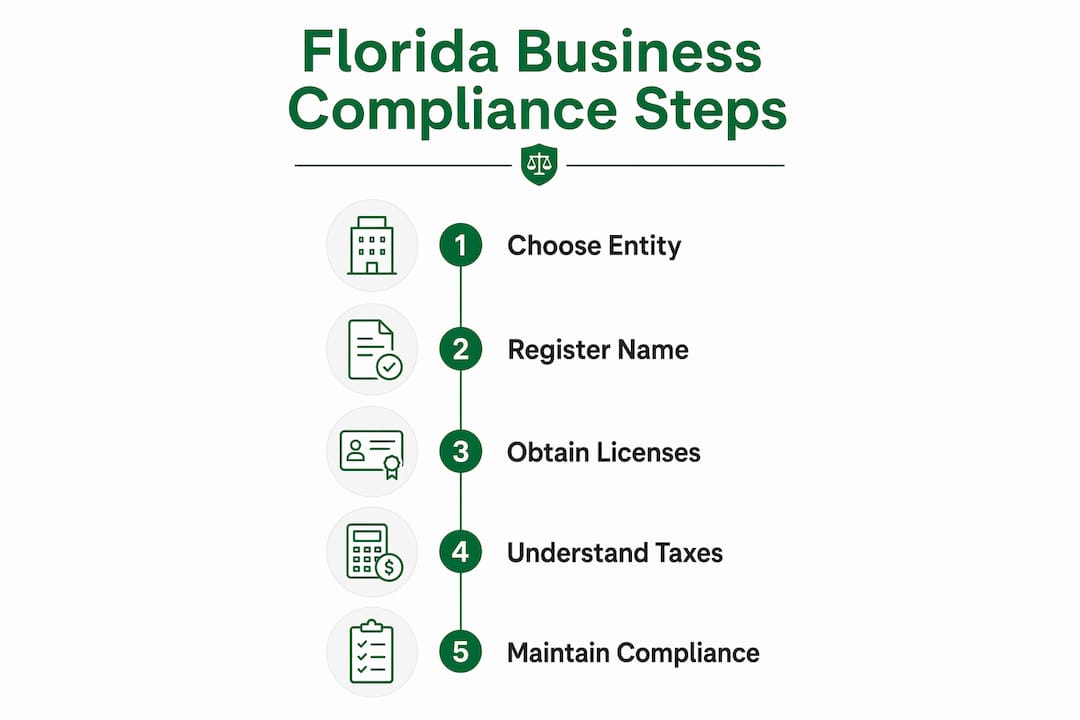
Florida business licensing operates across three distinct layers: entity formation and renewal, operational licensing specific to your industry, and local permits and business tax receipts. Each layer requires a separate audit to confirm compliance.
Here is how those layers break down in practice:
- State professional and industry licenses: The DBPR licenses dozens of professions, including contractors, real estate brokers, cosmetologists, home inspectors, and veterinarians. The Agency for Health Care Administration (AHCA) covers healthcare facilities. The Florida Department of Agriculture and Consumer Services regulates food businesses and nurseries.
- Operational permits: These cover environmental compliance, health department inspections, and fire safety certificates. A restaurant, for example, needs a food service license from the Department of Agriculture, a health inspection certificate, and a fire safety clearance before opening day.
- Local business tax receipts: Formerly called occupational licenses, these are issued by the county or municipality where you operate. They are separate from state licenses and must be renewed annually.
| License type | Issuing authority | Renewal frequency |
|---|---|---|
| Professional license (e.g., contractor, cosmetologist) | DBPR | Every 1-2 years |
| Food service license | FL Dept. of Agriculture | Annually |
| Business tax receipt | County or city | Annually |
| Zoning and building permits | Local municipality | Per project or annually |
Pro Tip: Use OpenMyFloridaBusiness.gov to generate a customized checklist of required licenses based on your business type, location, and number of employees. It takes about ten minutes and can save you months of back-and-forth with regulatory agencies.
Understanding local license requirements is especially important because county and city rules vary significantly across Florida, even for the same type of business.
Understanding Florida business tax obligations and employment compliance
Florida’s tax structure is one of the more business-friendly in the country, but it still carries real obligations that catch new owners off guard. Florida has no personal income tax, but C-corporations pay a 5.5% corporate income tax on net income exceeding $50,000. This makes entity structure a genuine tax planning decision, not just a liability question.
Sales tax is the most immediate obligation for most businesses. Florida requires you to register a sales tax permit with the Department of Revenue and collect the 6% state sales tax plus any applicable county surtaxes. Returns are filed monthly, quarterly, or annually depending on your sales volume. Online sellers face an additional rule: economic nexus applies to businesses exceeding $100,000 in annual sales into Florida, even without a physical location in the state.
Employment compliance adds another layer of obligations:
- Reemployment Assistance (unemployment insurance): Employers must register with the Department of Revenue and pay quarterly contributions based on payroll.
- Workers’ compensation insurance: Florida requires coverage for construction businesses with one or more employees and non-construction businesses with four or more employees. Penalties for non-compliance include stop-work orders and fines equal to twice the unpaid premium.
- E-Verify: As of July 2023, employers with 25 or more employees must use E-Verify to confirm employment eligibility. Non-compliance can trigger license suspension.
- New hire reporting: All employers must report new and rehired employees to the Florida New Hire Reporting Center within 20 days of the hire date.
Missing payroll tax deadlines or skipping workers’ compensation coverage are among the most common and costly compliance failures Florida businesses face. The fines accumulate quickly and the stop-work orders are immediate.
How do local city and county regulations affect your business?
Florida’s decentralized regulatory system means that state compliance alone does not make you legal to operate. Local governments routinely require business tax receipts, zoning permits, signage permits, and fire inspections, and these requirements vary by county and municipality. A business that is fully licensed at the state level can still face a shutdown order from a local code enforcement officer.
The practical impact of this varies significantly by city:
- Miami-Dade County requires a county-level business tax receipt in addition to any city-level receipt for businesses operating within incorporated municipalities like Miami or Coral Gables.
- Orlando has specific home occupation permit requirements for businesses operating out of residential addresses, with restrictions on signage, customer traffic, and employees on-site.
- Tampa requires separate fire inspection certificates for businesses in commercial spaces, renewed annually.
- Jacksonville consolidates city and county government (Duval County), which simplifies some permit processes but still requires industry-specific local approvals.
Short-term rental operators face some of the most layered local regulation in Florida. Cities like Miami Beach have imposed strict caps, registration requirements, and fines that operate entirely independently of state licensing.
Pro Tip: Before signing a commercial lease, contact the local zoning office to confirm the property is zoned for your intended use. Signing a lease on a space that cannot be permitted for your business type is an expensive mistake that happens more often than you would expect.
Many small business owners underestimate the impact of municipal codes on their operating licenses, which is why surprise fines and forced closures remain common even among businesses that believe they are fully compliant.
What happens when you fall out of compliance, and how to stay current?
Non-compliance with Florida business laws produces consequences that escalate quickly. Fines are the most common outcome, but stop-work orders, license revocations, and administrative dissolution are all on the table depending on the violation.
Annual report filing is one of the most overlooked obligations. Every Florida registered entity must file an annual report with Sunbiz by May 1. LLCs pay $138.75 and corporations pay $150.00. Miss that deadline and a $400 late fee applies automatically. Miss it long enough and Sunbiz administratively dissolves your entity, which means your business name becomes available to competitors and your liability protection disappears.
Maintaining compliance requires a structured approach:
- Conduct a tri-layer audit annually: Verify entity registration and annual reports via Sunbiz, confirm operational permits from DBPR or AHCA, and check local county and city permits including tax receipts and zoning compliance.
- Build a compliance calendar: Map every renewal deadline for licenses, permits, and insurance policies. Set reminders 60 days before each deadline.
- Track regulatory changes: Florida updates its licensing requirements regularly. DBPR and the Department of Revenue both publish rule changes on their websites.
- Consult legal counsel proactively: Early engagement with a business attorney consistently prevents expensive litigation and operational disruptions that reactive legal help cannot fully undo.
Pro Tip: Set a recurring calendar reminder for April 1 each year as your annual report prep date. That gives you 30 days to gather information and file before the May 1 deadline, with no risk of the $400 late fee.
Key takeaways
Florida business compliance requires simultaneous management of state, local, and federal obligations, and no single registration covers all three layers.
| Point | Details |
|---|---|
| Entity formation is just the start | Registering with Sunbiz does not grant operating authority. Separate licenses and permits are always required. |
| Three compliance layers exist | Entity registration, industry-specific state licenses, and local permits each require independent verification. |
| Annual reports are non-negotiable | Missing the May 1 Sunbiz deadline triggers a $400 late fee and risks administrative dissolution of your entity. |
| Employment rules carry serious penalties | Workers’ compensation violations result in stop-work orders and fines twice the unpaid premium amount. |
| Local rules vary dramatically | Miami, Orlando, Tampa, and Jacksonville each impose unique permit and zoning requirements beyond state law. |
What I’ve learned after 20 years of Florida business law
Most new business owners treat compliance as a one-time checklist. File with Sunbiz, get a business tax receipt, open the doors. That mindset is exactly how businesses end up with stop-work orders six months after launch.
The part that surprises people most is how disconnected the layers are. The state does not automatically notify you that you also need a county permit. The county does not tell you that your zoning classification requires a special exception. Each agency operates in its own lane, and the burden of connecting those lanes falls entirely on you as the business owner.
What I tell every client at the start of an engagement is this: your compliance obligation is not static. Florida updates licensing rules, local governments revise zoning codes, and employment law requirements shift. The business that was fully compliant in January can have a gap by October without anyone sending you a warning letter.
The most expensive calls I receive are from owners who have been operating for a year or two and just received a notice from a regulatory agency. By that point, the back penalties, the legal fees, and the operational disruption cost far more than a proper compliance review at the outset would have. Early legal guidance is not a luxury for established businesses. It is the most cost-effective investment a startup can make.
The right entity structure also matters more than most people realize at formation. Choosing an LLC when a corporation better fits your growth plan, or vice versa, creates restructuring costs later that a 30-minute conversation upfront would have avoided entirely.
— Matthew
Protect your Florida business before problems start

Florida’s layered regulatory system rewards businesses that get compliance right from the beginning and creates serious risk for those who do not. At Fornarolegal, Matthew Fornaro works directly with South Florida entrepreneurs and small business owners to review contracts, identify compliance gaps, and resolve disputes before they become litigation. With over 20 years of court-tested experience, the firm provides practical legal guidance tailored to how Florida businesses actually operate. If you are forming a new entity, expanding operations, or concerned about a regulatory gap, early legal counsel is the most direct way to protect what you are building.
FAQ
What is the first legal step to start a business in Florida?
The first step is choosing a business entity type and filing the appropriate formation documents with the Florida Division of Corporations (Sunbiz). Registration fees and required documents vary by entity type, and every registered business must appoint a Florida-based registered agent.
Do all Florida businesses need a state business license?
Florida does not issue a single general business license, but most businesses require at least one state-level license or permit depending on their industry. The DBPR, AHCA, and the Department of Agriculture each regulate specific business types, and operating without the required license carries fines and closure risk.
What is the Florida annual report deadline?
Every Florida LLC and corporation must file an annual report with Sunbiz by May 1 each year. LLCs pay $138.75 and corporations pay $150.00, with a $400 late fee applied automatically after the deadline.
Does Florida have a state income tax for businesses?
Florida has no personal income tax, but C-corporations pay a 5.5% corporate income tax on net income exceeding $50,000. LLCs, S-Corps, and partnerships generally pass income through to owners, who pay federal taxes but no Florida state income tax on that income.
When is E-Verify required for Florida employers?
Florida employers with 25 or more employees are required to use E-Verify for employment eligibility verification, a rule that took effect in July 2023. Non-compliance can result in license suspension under Florida law.
Recommended
- Florida Business Formation in a Fast‑Changing Market: Practical Legal Advice for 2026 » Matthew Fornaro, P.A.
- Legal Requirements for Florida Startups: The 2026 Founder’s Guide to Compliance » Matthew Fornaro, P.A.
- Florida Business Law for Entrepreneurs: The 2026 Legal Survival Guide » Matthew Fornaro, P.A.
- The Ultimate Legal Checklist for Starting a Business in Florida (2026 Edition) » Matthew Fornaro, P.A.