Key Takeaways
- Florida business law protects companies from unfair competition, contract breaches, and partner disputes.
- Acting early saves time, money, and business relationships.
- An experienced business attorney helps you assess risk and choose the right legal strategy.
Table of Contents
- What a Business Attorney in Florida Actually Does for You
- When to Hire a Business Attorney: A Business Lifecycle Legal Roadmap
- Florida Business Contract Disputes: What Small Business Owners Need to Know
- How to Hire a Business Lawyer in Florida the Right Way
- Cost of a Business Attorney in Florida: Fee Structures Explained
- DIY vs. Professional Legal Help: Where the Line Is for Florida Entrepreneurs
- Florida-Specific Regulatory Compliance Checklist for Business Owners
- Conclusion: Protecting Your Business Starts with the Right Legal Strategy
Last Updated: June 1, 2026
Choosing the right business attorney florida is one of the most consequential decisions a company founder will make, yet most owners wait until a crisis forces their hand. At Matthew Fornaro, P.A., we have spent over two decades watching preventable legal problems derail otherwise healthy businesses across Coral Springs, Parkland, and Broward County. This guide explains exactly what business legal counsel does, when you need it, and how to hire it without overpaying. Below, we cover the full business lifecycle from formation through litigation, including the fee structures most attorneys prefer you not ask about.
A business attorney florida is a licensed lawyer who advises companies on legal matters that affect their operations, ownership, and growth, including contracts, regulatory compliance, disputes, and transactions. That definition sounds simple. The practice is anything but.
What a Business Attorney in Florida Actually Does for You
Most people picture a business lawyer standing in a courtroom. The reality is that the majority of the work happens long before any dispute reaches a judge. A skilled Florida business attorney structures your company to minimize liability, drafts contracts that actually protect you, and identifies regulatory exposure before regulators do.
The scope is broad by design. Florida businesses face a layered legal environment: state statutes, local ordinances, federal regulations, and industry-specific rules that interact in ways that surprise even experienced operators. According to The Florida Bar’s official guidance on business law, business law in Florida encompasses everything from entity formation to complex commercial litigation, requiring attorneys to maintain current knowledge across multiple practice areas.
Business Formation and Entity Selection
Entity selection is where legal strategy starts. The choice between a sole proprietorship, LLC, S-corporation, or C-corporation has direct consequences for personal liability, tax treatment, and your ability to raise capital. A common mistake is treating this as a one-time administrative task rather than a strategic decision that should be revisited as the business grows.
In Florida, most small businesses register through Florida’s Division of Corporations (Sunbiz), the state’s official business registry. The filing itself is straightforward. Choosing the right structure, drafting an operating agreement that handles ownership disputes before they happen, and setting up asset protection mechanisms requires legal counsel that understands Florida-specific rules.
If you are forming a multi-member LLC in Florida, do not skip the operating agreement. Florida’s default LLC statutes fill gaps, but not always in ways that match what the owners actually intended. A customized agreement prevents the most common shareholder disputes before they start.
Contract Law, Business Transactions, and Corporate Counsel
Contract disputes are the most common reason small businesses end up in litigation. Most of those disputes trace back to contracts that were either missing entirely, copied from a template without customization, or drafted without understanding Florida’s specific requirements for enforceability.
Corporate counsel does more than draft agreements. A transactional attorney reviews vendor relationships, employment agreements, commercial leases, and purchase contracts to identify terms that shift risk onto your company in ways that may not be obvious at signing. This is the work that prevents litigation rather than resolves it.
When to Hire a Business Attorney: A Business Lifecycle Legal Roadmap
The biggest misconception about hiring a business attorney is that it is something you do reactively. Owners who treat legal counsel as an emergency resource consistently pay more in the long run than those who build legal strategy into each phase of growth.
 small business owner sitting across from a professional attorney at a desk reviewing documents, with a modern office setting and natural light coming through large windows](https://cdn.grandranker.com/articles/business-attorney-florida-a-2026-guide-for-owners-content-1-1780279056.jpg)
Here is how the legal needs of a Florida business evolve across its lifecycle:
Startup Phase: Formation, Sunbiz Registration, and Asset Protection
The startup phase is the highest-use moment for legal intervention. Decisions made at formation, including entity type, ownership percentages, intellectual property ownership, and buy-sell provisions, become exponentially harder to change once the business has revenue and multiple stakeholders.
Asset protection deserves particular attention here. Florida offers meaningful protections for certain business structures, but those protections only apply if the entity is properly maintained. Commingling personal and business funds, failing to hold required meetings, or operating without a formal agreement can pierce the corporate veil and expose personal assets to business creditors.
Growth Phase: Employment, Franchising, and Regulatory Compliance
Growth creates new legal exposure. Hiring employees triggers Florida and federal labor and employment obligations: wage and hour compliance, anti-discrimination policies, non-compete agreements, and workers’ compensation requirements. Many Coral Springs businesses discover these obligations only after a complaint is filed.
Franchising introduces a separate layer of complexity. Florida has specific franchise disclosure requirements, and franchise agreements are notoriously one-sided in favor of franchisors. A business attorney with franchise law experience can identify provisions that limit your exit options or expose you to unexpected fees before you sign.
Regulatory compliance is not optional and is not static. Industries from construction to healthcare to financial services face ongoing rule changes that require regular legal review to stay current.
Skipping an employment law review when you hire your first employee is one of the most common and costly mistakes Florida small business owners make. A single misclassification of a worker as an independent contractor can trigger back taxes, penalties, and litigation that far exceeds the cost of proper legal advice upfront.
Dispute Phase: Commercial Litigation and Shareholder Disputes
Commercial litigation is where the cost of earlier shortcuts becomes visible. Contract disputes, shareholder disputes, construction litigation, and liability defense all require a trial attorney who understands both the substantive law and Florida’s procedural rules.
Shareholder disputes are particularly damaging because they combine legal risk with operational disruption. When owners disagree about direction, compensation, or exit terms, the business often suffers regardless of who is legally correct. Early intervention through mediation or a well-drafted operating agreement resolves most of these situations faster and at lower cost than full litigation.
Florida Business Contract Disputes: What Small Business Owners Need to Know
Florida business contract disputes follow a predictable pattern, and understanding that pattern before a dispute arises is the single most useful thing a business owner can do. Most disputes do not begin with a dramatic breach, they begin with ambiguity. A payment term that both parties interpreted differently. A deliverable that was never defined precisely. A termination clause that one side read as automatic and the other read as requiring notice. The contract language that felt adequate at signing becomes the battlefield.
Florida courts apply a plain-meaning standard to contract interpretation: if the language is unambiguous, the court enforces it as written, regardless of what either party intended. That rule cuts both ways. It protects you when your contract is precise. It works against you when it is not.
The Four Contract Clauses That Drive Most Florida Business Disputes
After handling commercial disputes across Broward County and South Florida for over two decades, the same four clause categories appear repeatedly as the source of litigation:
1. Payment and Invoice Terms
Contracts that say "payment due upon completion" without defining what completion means, or that omit a late-payment interest rate, create disputes that are expensive to resolve and difficult to win cleanly. Florida Statute § 687.01 sets a default legal interest rate, but courts have discretion in applying it. Specifying your own rate, within legal limits, and defining a clear trigger for when it applies is far more protective.
2. Termination and Notice Provisions
Many Florida small business contracts are silent on how either party can exit the relationship. When a client stops paying or a vendor stops performing, the absence of a clear termination clause forces the non-breaching party into a legal gray area. Courts will look at course of dealing and industry custom to fill the gap, which means the outcome becomes unpredictable.
3. Limitation of Liability Clauses
Vendors and service providers routinely insert clauses capping their liability at the contract price or at a fixed dollar amount. These clauses are generally enforceable in Florida if they are conspicuous and not unconscionable. Business owners who sign vendor agreements without reviewing these provisions often discover, mid-dispute, that their damages are contractually capped far below their actual loss.
4. Dispute Resolution and Venue Clauses
Florida courts enforce mandatory arbitration clauses and forum-selection clauses, even when they are buried in boilerplate. A vendor contract that requires arbitration in a distant jurisdiction, or that designates a county far from your business, can make pursuing a legitimate claim economically impractical. These clauses are negotiable before signing and nearly impossible to undo after.
Florida-Specific Procedural Facts Every Business Owner Should Know
- Florida has a five-year statute of limitations for written contract claims (Florida Statute § 95.11(2)(b)) and four years for oral contracts, but the clock can be tolled or reset depending on the circumstances, which is why early legal consultation matters
- Florida’s offer of judgment rule (Florida Statute § 768.79) allows a party who makes a settlement offer that the other side unreasonably rejects to recover attorney’s fees if they ultimately win by a margin of 25% or more, a powerful tool that experienced litigators use strategically
- Pre-suit demand letters are not always legally required in contract cases, but they are almost always tactically valuable: they create a record, trigger the other party’s insurance obligations in some cases, and frequently resolve disputes before litigation costs accumulate
- Mediation is mandatory in most Florida civil cases before trial under Florida Rule of Civil Procedure 1.700, and commercial disputes settle at mediation at a high rate, meaning the quality of your mediation preparation often determines the outcome more than the strength of your legal arguments
- Electronic discovery, emails, text messages, Slack messages, and accounting software records, is now the primary evidence in most commercial disputes; courts expect parties to preserve this evidence the moment a dispute becomes reasonably foreseeable, and destruction of relevant records can result in sanctions
Assessing Your Position Before You Call a Lawyer
One of the most practical things a business owner can do when a contract dispute arises is conduct a quick self-assessment before the first attorney call. This makes the consultation more productive and helps you understand the realistic range of outcomes.
Ask yourself:
- Do I have a signed written agreement? If yes, locate it immediately and read the dispute resolution, notice, and governing law clauses before doing anything else.
- What does the contract say about the specific obligation that was breached? If the answer is "nothing" or "it’s unclear," that ambiguity is your first legal problem.
- Have I sent or received any written communications (emails, texts) that could be interpreted as modifying the original agreement? In Florida, written contracts can sometimes be modified by subsequent written communications, even informally.
- What are my actual, documentable damages? Courts award what you can prove, not what you lost in a general sense. Invoices, purchase orders, and financial records that quantify your loss are essential.
- Did I perform my own obligations under the contract? A party who is themselves in breach generally cannot enforce the contract against the other side, this is a threshold question that affects your entire legal position.
Do not send a formal demand letter, make written admissions, or agree to any modification of the disputed contract without legal review. Statements made in the heat of a dispute frequently become the most damaging evidence in subsequent litigation. Even a well-intentioned email offering to “split the difference” can be used against you.
The thing nobody tells you about contract disputes is that your legal position was largely determined at the moment you signed the agreement, sometimes years before the dispute arose. The businesses that consistently win commercial disputes are the ones that invested in precise contract drafting before the relationship began, not the ones that hired the best litigator after it broke down.
How to Hire a Business Lawyer in Florida the Right Way
Hiring a business lawyer in Florida is not the same as hiring any professional service provider. The relationship involves ongoing strategy across the life of your business, not a single transaction, so the fit matters as much as the credentials, and the credentials matter more than most owners realize when they are evaluating attorneys for the first time.
The single most common hiring mistake Florida business owners make is selecting an attorney based on a website or a referral without verifying that the attorney’s actual practice experience matches the specific legal problem at hand. A skilled estate planning attorney and a skilled commercial litigator may both call themselves "business attorneys." Their ability to help you in a contract dispute or a shareholder buyout is not equivalent.
Match the Attorney Type to Your Actual Need
Before evaluating any individual attorney, identify which category of legal work you need:
| Legal Need | Attorney Type to Prioritize |
|---|---|
| Forming an LLC, corporation, or partnership | Transactional / Business Formation |
| Drafting or reviewing contracts | Transactional / Contract Counsel |
| Buying or selling a business | M&A / Business Transactions |
| Employment agreements, non-competes, HR policies | Employment Law |
| Dispute with a vendor, client, or partner | Commercial Litigation |
| Shareholder or partnership dispute | Business Litigation / Dispute Resolution |
| Regulatory investigation or compliance issue | Regulatory / Administrative Law |
Many Florida business law firms handle multiple categories, but the attorney who leads your matter should have direct, recent experience in the specific area. Ask explicitly: "Who will be the primary attorney on my matter, and how many similar matters have they handled in the past two years?"
Board Certification and AV Rating: What These Credentials Actually Mean
Board Certified is a designation granted by The Florida Bar to attorneys who have met three requirements: a minimum number of years in practice, a demonstrated volume of experience in the specialty area, and a passing score on a written examination administered by The Florida Bar. Peer evaluations from judges and other attorneys are also required. The Florida Bar currently offers board certification in Business Litigation and Civil Trial Law, among other specialties.
Board certification is meaningful because it is independently verified and requires ongoing recertification. It is not a marketing designation, it is a credential that The Florida Bar controls and audits. When a Florida business attorney claims board certification, you can verify it directly through The Florida Bar’s attorney search tool.
AV Preeminent Rated is the highest rating available from Martindale-Hubbell, a legal rating organization that has evaluated attorneys since 1868. The AV designation reflects confidential peer evaluations from other attorneys and judges on both legal ability and professional ethics. It is not self-reported, the ratings are based on surveys sent to practitioners in the same geographic and practice area market.
Neither credential guarantees a specific outcome in your matter. But both provide a meaningful filter when you are evaluating attorneys you have not worked with before, because they reflect the judgment of other legal professionals rather than client reviews alone.
Red Flags to Watch for During the Evaluation Process
Most hiring guides tell you what to look for. Equally important is what to watch out for:
- Guarantees of outcome. No ethical attorney can promise you will win a dispute or that a transaction will close on specific terms. Attorneys who make outcome guarantees are either uninformed about the facts or unconcerned about professional responsibility rules.
- Reluctance to discuss fees in writing. Florida Bar rules require attorneys to communicate the basis of their fees to clients. An attorney who is vague about fee structure or unwilling to provide a written fee agreement before beginning work is a significant risk.
- Lack of clarity about who will actually work on your matter. In larger firms, partners bring in clients and associates do the work. That is not inherently a problem, but you should know exactly who will be handling your matter day-to-day and what their experience level is.
- No clear communication protocol. Ask directly: what is your standard turnaround time for returning calls and emails? If the attorney cannot give you a clear answer, assume the worst.
- Overpromising on timeline. Florida court dockets vary significantly by county and case type. An attorney who promises a specific resolution timeline without qualifying it based on court scheduling and opposing counsel is not being straight with you.
Free Consultation: How to Use It Strategically
Most Florida business attorneys offer a free initial consultation. The consultation is not just for the attorney to evaluate your matter, it is your primary opportunity to evaluate the attorney. Treat it as a structured interview, not a sales call.
Bring the following to the consultation:
- The core documents relevant to your matter (contracts, demand letters, corporate formation documents)
- A one-page written summary of the facts and your primary question
- A list of your questions, prepared in advance
Ask these questions directly and evaluate the quality of the answers:
- "How many matters substantially similar to mine have you personally handled in the past three years?" You want a specific number or range, not a general claim of experience.
- "What is the realistic range of outcomes in a matter like this, and what factors most affect which end of that range we land on?" A good attorney will give you a candid range, not a best-case scenario.
- "Who will be the primary attorney working on my matter day-to-day?" If it is not the person you are meeting with, ask to meet that person before you commit.
- "What is your fee structure for this type of matter, and what should I budget for total cost?" See the fee structure section below for how to interpret the answer.
- "What do you need from me to move this matter forward efficiently?" The answer tells you how organized and process-driven the attorney is.
An attorney who gives you vague, hedged answers to these questions during the consultation, when they are trying to earn your business, will not become more direct once you are a client.
If you are evaluating multiple attorneys, take notes immediately after each consultation using the same five questions as your scoring rubric. The differences in answer quality become much clearer when you compare them side by side rather than relying on memory.
Fee Structures: What Florida Business Attorneys Actually Charge and Why It Matters
Fee transparency is the area where most Florida law firm websites go silent, which is exactly why understanding it gives you a significant advantage as a buyer of legal services.
Hourly Billing is the most common structure for litigation and complex transactional work where the scope cannot be defined in advance. Rates vary based on the attorney’s seniority, the firm’s overhead structure, and the complexity of the matter. In South Florida markets including Broward County, rates for experienced business attorneys at established firms reflect the regional market. Solo practitioners and smaller boutique firms frequently offer competitive rates relative to larger firms without sacrificing substantive expertise.
The risk with hourly billing is scope creep. A matter that is estimated at a certain number of hours can expand significantly if discovery is contested, if the opposing party is uncooperative, or if new facts emerge. Protect yourself by requesting a written estimate of total expected cost, not just the hourly rate, and asking for a notification threshold if the estimate is likely to be exceeded.
Flat Fees are appropriate for defined-scope work: business formation, operating agreement drafting, contract review, trademark registration, and similar tasks where the attorney can reliably estimate the time required. Flat fees give you cost certainty and align the attorney’s incentive with efficiency. Ask whether the flat fee covers revisions and what happens if the scope expands.
Monthly Retainer Arrangements are well-suited for businesses that need ongoing legal access, regular contract review, employment policy updates, compliance questions, and lease negotiations. A retainer arrangement typically provides a defined number of hours per month at a fixed fee, with additional hours billed at an agreed rate. For businesses that use legal counsel regularly, retainers often reduce total annual legal spend compared to ad hoc hourly billing.
Contingency Fees are rare in business-to-business commercial disputes but available in some cases where the plaintiff’s damages are clear, the defendant has collectible assets, and the attorney is confident in the merits. If an attorney offers a contingency arrangement in a business dispute, understand that the attorney’s fee, typically a percentage of the recovery, will be significant, and that the attorney controls strategic decisions about settlement.
Always get a written fee agreement, called an engagement letter, before any billable work begins. Florida Bar rules require it for most representations, and it protects both parties. The engagement letter should specify the fee structure, the scope of representation, who will work on the matter, and the billing cycle. If an attorney resists providing one, that is a disqualifying red flag.
Cost of a Business Attorney in Florida: Fee Structures Explained
The cost of a business attorney in Florida varies significantly based on the type of matter, the attorney’s experience, and the fee structure used. Understanding fee structures before you hire prevents surprises that damage the relationship.
Common fee arrangements include:
- Hourly billing: The most common structure for litigation and complex transactional work. Rates in South Florida for experienced business attorneys generally range based on seniority, firm size, and matter complexity.
- Flat fees: Common for defined-scope work like business formation, contract drafting, and trademark registration. Predictable costs make budgeting straightforward.
- Retainer arrangements: A monthly or annual fee for ongoing access to legal counsel. Well-suited for businesses that need regular contract review, compliance guidance, or employment advice.
- Contingency fees: Rare in business litigation but available in some cases where the plaintiff’s damages are clear and the defendant has collectible assets.
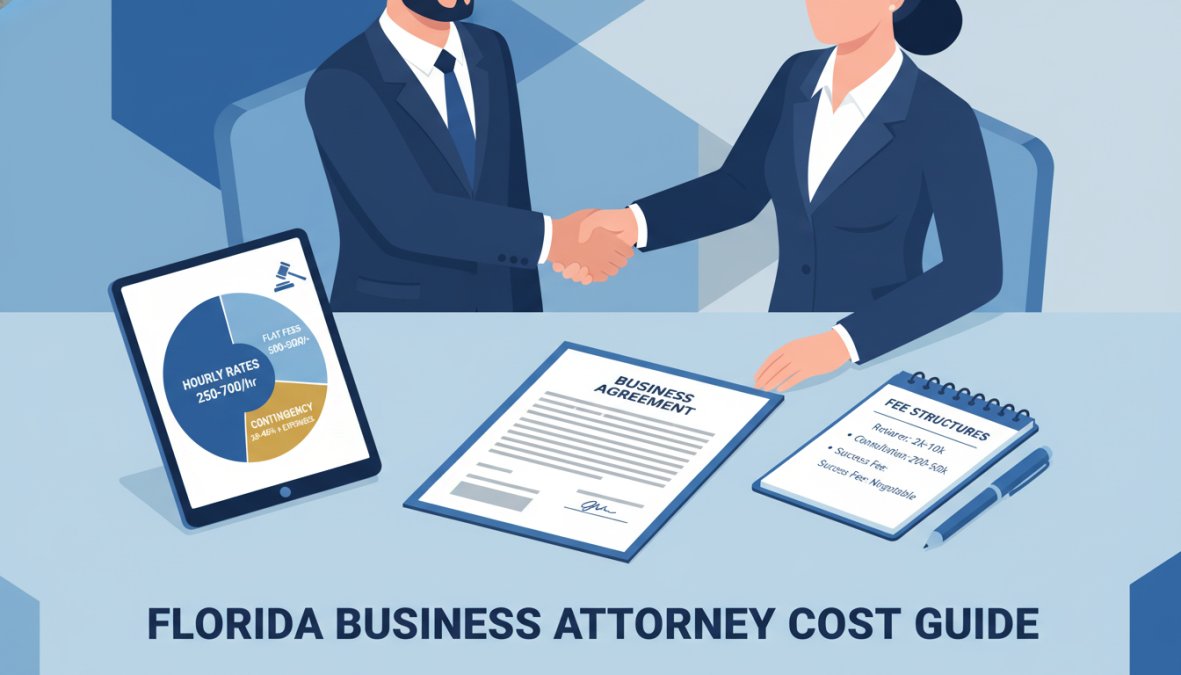
Flat fee arrangements work well for predictable, defined tasks. Hourly billing is appropriate for litigation and complex matters where scope is uncertain. Ask for a written fee agreement before work begins, regardless of which structure you choose.
The most overlooked cost factor is scope creep on hourly matters. Get a written estimate of the total expected cost, not just the hourly rate, and ask for a threshold notification if the estimate is likely to be exceeded.
DIY vs. Professional Legal Help: Where the Line Is for Florida Entrepreneurs
Many Florida entrepreneurs start with DIY legal tools for basic tasks, and for some things, that approach is defensible. Registering a sole proprietorship on Sunbiz, filing a DBA, or reviewing a simple vendor agreement with a free online template carries manageable risk for a very early-stage business with minimal assets.
The line shifts the moment any of the following conditions apply:
- You have a co-founder or business partner
- You are signing a commercial lease
- You are hiring employees or contractors
- You are entering a contract worth more than a few thousand dollars
- You have received a legal threat or demand letter
- You are considering a business acquisition or sale
At that point, the cost of a mistake exceeds the cost of professional legal help by a wide margin. A poorly structured partnership agreement, for example, can result in a shareholder dispute that costs tens of thousands of dollars to resolve. The professional advice that would have prevented it typically costs a fraction of that amount.
The real difference between DIY and professional legal help comes down to what you do not know you do not know. Templates cannot account for Florida-specific statutory requirements, local ordinances in Coral Springs or Broward County, or the particular facts of your business relationship.
Florida-Specific Regulatory Compliance Checklist for Business Owners
Florida imposes a specific set of regulatory requirements that apply to most businesses operating in the state. This checklist covers the most common compliance obligations that Coral Springs and South Florida business owners need to address.
Formation and Registration:
- Register with Florida Division of Corporations (Sunbiz)
- Obtain a Federal Employer Identification Number (EIN) from the IRS
- Register for Florida sales tax if selling taxable goods or services
- Obtain required local business tax receipts (formerly occupational licenses) from Broward County and the City of Coral Springs
- File annual reports with the Florida Division of Corporations by May 1 each year
Employment:
- Register with Florida Department of Revenue for reemployment tax
- Obtain workers’ compensation insurance if you have four or more employees (one or more in construction)
- Post required Florida and federal workplace notices
- Implement a written harassment and discrimination policy
- Classify workers correctly as employees or independent contractors
Ongoing Compliance:
- Maintain a registered agent with a Florida street address
- Keep corporate records, including meeting minutes and resolutions, current
- Review contracts annually for terms that may no longer reflect current business relationships
- Monitor industry-specific licensing requirements for renewal deadlines
- Consult legal counsel before making significant changes to ownership, structure, or operations
According to Florida Department of State guidance on annual report requirements, failure to file the annual report results in administrative dissolution of the business entity, which can have serious consequences for contracts and liability protection.
Many businesses in Coral Springs also benefit from reviewing their estate planning and wills and trusts documents in connection with their business succession planning. The overlap between personal estate planning and business continuity is often underestimated until a health event forces the issue.
Matthew Fornaro, P.A. works with South Florida entrepreneurs to address both the operational and succession dimensions of business legal planning, ensuring that the business you build is protected for the long term.
Conclusion: Protecting Your Business Starts with the Right Legal Strategy
Florida’s business environment rewards owners who treat legal counsel as a strategic asset rather than a reactive expense. The businesses that avoid costly disputes, maintain clean ownership structures, and scale without regulatory surprises are almost always the ones that established a relationship with qualified legal counsel early. Matthew Fornaro, P.A. brings over two decades of experience serving entrepreneurs and small businesses across Coral Springs, Parkland, and Broward County, with comprehensive support in business formation, commercial litigation, contracts, and compliance. If you are ready to protect what you have built, call today to schedule your consultation.
Frequently Asked Questions
Do I need a business attorney to start a business in Florida?
You are not legally required to hire a business attorney in Florida to form a company, but it is strongly advisable. An attorney helps you choose the right entity structure, draft operating agreements, and register properly through Sunbiz. Mistakes at the formation stage, such as inadequate liability protection or missing compliance filings, can be costly to fix later. For entrepreneurs investing real capital or taking on partners, professional legal counsel at the start is a sound investment.
How much does a business attorney cost in Florida?
The cost of a business attorney in Florida varies widely depending on the complexity of your matter and the attorney's experience. Hourly rates typically range from around $200 to $500 or more for experienced commercial attorneys. Many firms offer flat fees for defined services like business formation or contract drafting. Retainer arrangements are common for ongoing corporate counsel relationships. Always ask about fee structures during your free consultation so there are no surprises.
Can a business attorney help with contract disputes in Florida?
Yes. Florida business contract disputes are one of the most common reasons small business owners seek legal representation. A qualified business attorney can review the contract, assess your legal position, attempt to resolve the matter through negotiation or mediation, and if necessary, pursue or defend commercial litigation in court. Early legal involvement in a contract dispute often leads to faster, less expensive resolution and stronger outcomes than waiting until the situation escalates.
What is the difference between a business lawyer and a corporate lawyer?
The terms are often used interchangeably, but there is a practical distinction. A corporate lawyer, sometimes called a transactional attorney, typically focuses on business formation, mergers, acquisitions, and contract drafting. A business lawyer may also handle commercial litigation, contract disputes, and day-to-day legal strategy for small businesses and entrepreneurs. Many Florida business attorneys handle both transactional and litigation matters, making them versatile legal counsel for growing companies.
How do I find a reputable business attorney in Florida?
Start by looking for attorneys who are Florida Bar members with demonstrated experience in business law. Board Certified specialists in business litigation or business law carry a credential verified by The Florida Bar. AV Rated attorneys have been peer-reviewed for ethics and legal ability. Look for firms with local expertise in your area, such as Broward County or Coral Springs, and schedule a free consultation to evaluate fit, communication style, and fee transparency before making a decision.
This article is for informational purposes only and does not constitute legal advice. For guidance specific to your situation, consult a licensed Florida business attorney.
This article was written using GrandRanker