

Key Takeaways
- Florida business law protects companies from unfair competition, contract breaches, and partner disputes.
- Acting early saves time, money, and business relationships.
- An experienced business attorney helps you assess risk and choose the right legal strategy.
Commercial litigation is the civil-court process used to resolve disputes arising from business relationships and transactions. When a contract goes unpaid, a business partner acts in bad faith, or a competitor steals your trade secrets, commercial litigation is the formal legal mechanism that enforces your rights. For South Florida business owners, understanding this process means knowing when to act, which forum to use, and how Florida’s courts now manage these cases. This guide covers the commercial litigation definition, the types of disputes it handles, how the process works in Florida, and when arbitration may be the smarter path.
What is commercial litigation and why does it matter for your business?
Commercial litigation is the branch of civil law that handles disputes between businesses and individuals arising from commercial activity. It covers enforceable rights under contracts, fiduciary duties, and business dealings. Unlike criminal law, commercial litigation is driven by one party seeking money damages, injunctive relief, or specific performance from another.
The stakes in commercial disputes are rarely abstract. A Miami restaurant owner whose supplier breaches a delivery contract faces real revenue loss. A Fort Lauderdale startup whose co-founder diverts company funds faces an existential threat. Commercial litigation gives these business owners a structured path to enforce their rights and recover losses through the courts or through private arbitration forums like the American Arbitration Association (AAA).

What separates commercial litigation from general civil litigation is the business context. The disputes involve commercial contracts, business entities, trade relationships, and economic harm. A commercial litigation attorney focuses specifically on these business-to-business and business-to-individual conflicts, bringing knowledge of contract law, corporate governance, and Florida’s procedural rules to each case.
What are the common types of commercial litigation cases?
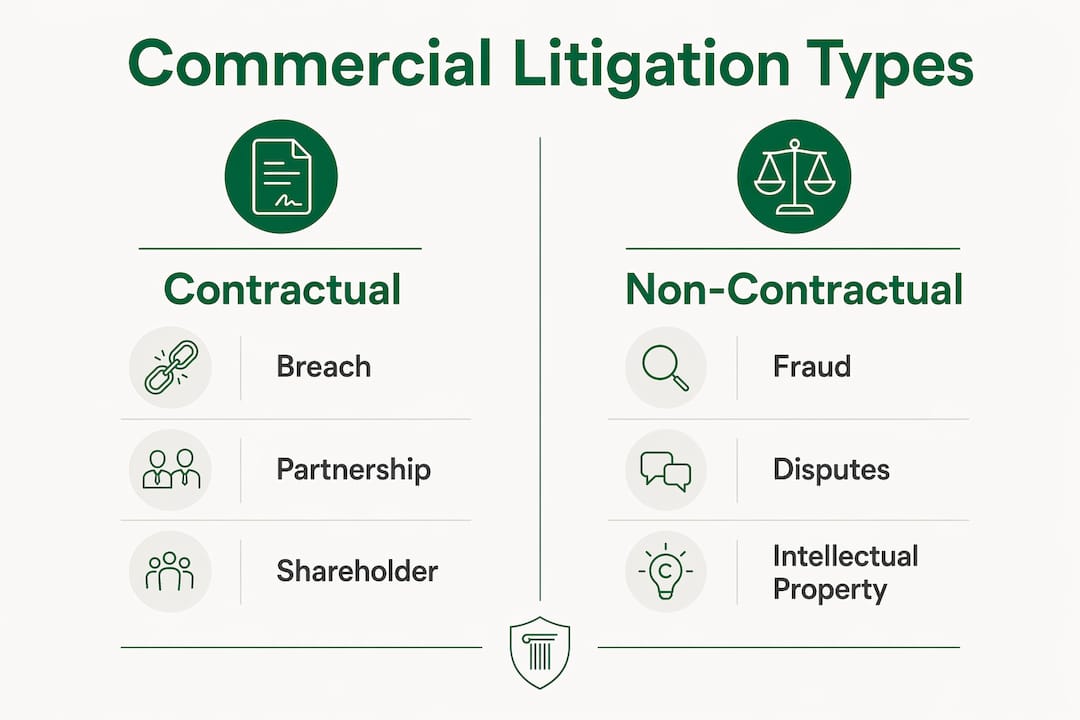
Commercial disputes span a wide range of business conflicts. Recognizing which category your dispute falls into helps you assess urgency, legal strategy, and likely costs before you ever file a complaint.
The most frequent types of commercial litigation cases include:
- Breach of contract. One party fails to perform obligations under a signed agreement. This is the single most common commercial dispute and covers everything from unpaid invoices to failed service agreements.
- Partnership and shareholder conflicts. Disputes over ownership rights, profit distributions, or management decisions between co-owners of a business.
- Fraud and misrepresentation. Claims that one party made false statements to induce a business deal, causing financial harm to the other party. Florida courts handle these in specialized fraud proceedings.
- Business torts. Wrongful interference with business relationships, unfair competition, or tortious interference with contracts.
- Intellectual property disputes. Unauthorized use of trademarks, trade secrets, or copyrighted materials in a commercial context.
- Construction and real estate disputes. Common in South Florida’s active development market, these involve contractor defaults, lien claims, and property transaction failures.
- Insurance coverage disputes. Conflicts between businesses and insurers over policy interpretation and claim payments.
Pro Tip: Identify your dispute category before your first attorney meeting. The category determines which statutes apply, what damages are available, and whether a pre-suit demand letter could resolve the matter without filing.
How does the commercial litigation process work in Florida?
The commercial litigation process in Florida follows a structured sequence of procedural stages. Each stage has specific deadlines, obligations, and strategic opportunities. Here is the typical progression:
- Pre-suit demand and investigation. Before filing, your attorney sends a formal demand letter and gathers evidence. Many disputes settle at this stage, saving both parties significant time and money.
- Complaint and service. The plaintiff files a complaint in the appropriate Florida circuit court, stating the legal claims and relief sought. The defendant is formally served and has 20 days to respond.
- Defendant’s answer and affirmative defenses. The defendant responds to each allegation and raises any defenses. Counterclaims against the plaintiff may also be filed at this stage.
- Discovery. Both sides exchange documents, answer written interrogatories, and conduct depositions. Early pleadings and discovery scope significantly influence which issues proceed to trial.
- Motions practice. Either party may file motions to dismiss, motions to compel discovery, or motions for summary judgment. Summary judgment can resolve entire claims without trial if the evidence clearly supports one side.
- Alternative dispute resolution (ADR). Florida courts often require mediation before trial. This is a structured negotiation with a neutral mediator and resolves a significant portion of commercial cases.
- Trial. If the case does not settle, it proceeds to either a bench trial (judge decides) or a jury trial. The plaintiff bears the burden of proof by a preponderance of the evidence.
- Post-trial and appeal. The losing party may appeal to Florida’s District Court of Appeal. Enforcement of a money judgment involves additional steps including asset discovery and collection.
Pro Tip: Your case track assignment under Florida Rule 1.200 happens within the first 120 days of filing. That assignment controls your discovery limits and trial timeline. Ask your attorney about track placement before you file, not after.
What are the differences between commercial litigation and arbitration?
Arbitration versus litigation is one of the most consequential choices a business owner faces when a dispute arises. Both resolve commercial conflicts, but they operate under fundamentally different rules, timelines, and cost structures.
| Factor | Court litigation | Arbitration |
|---|---|---|
| Timeline | Federal district court cases average 24.2 months to trial | AAA arbitration averages 11.6 months to resolution |
| Confidentiality | Court records are public | Proceedings and awards are private |
| Cost structure | Court fees are lower; attorney fees dominate | Arbitrator and AAA filing fees can be substantial |
| Appeal rights | Full appellate review available | Very limited grounds for appeal |
| Procedural rules | Florida Rules of Civil Procedure apply | Parties can customize procedures in the arbitration clause |
| Discovery | Broad discovery rights | Typically limited discovery |
The speed advantage of arbitration is real but conditional. Forum selection depends on clause drafting and procedural design more than the label “arbitration.” A poorly drafted arbitration clause can produce a process that is slower and more expensive than court. Conversely, a well-designed clause with clear scope, arbitrator selection criteria, and discovery limits can resolve a complex commercial dispute in under a year.
Confidentiality is arbitration’s most underappreciated advantage for South Florida businesses. A public lawsuit exposes your financial disputes, internal conflicts, and business practices to competitors, customers, and the press. Arbitration keeps those details private.
Pro Tip: Review every commercial contract you sign for an arbitration clause. If one exists, understand its scope before a dispute arises. If you are drafting contracts, work with counsel to design a clause that actually serves your interests rather than using a boilerplate provision.
How do Florida’s recent procedural rules impact commercial litigation cases?
Florida’s Rule 1.200 case management system, effective in 2025, restructured how commercial cases move through the state’s circuit courts. The rule assigns every civil case to one of three tracks within 120 days of the complaint being filed.
The three case tracks explained
The streamlined track applies to cases requiring minimal judicial attention. These cases have limited discovery and trials expected to last no more than three days. The general track covers the majority of commercial disputes with standard discovery and trial timelines. The complex track applies to cases involving multiple parties, extensive discovery, or novel legal issues requiring significant judicial management.
Track assignment is not based on the dollar value of the claim. A $50,000 breach of contract case with straightforward facts goes to the streamlined track. A $500,000 dispute with multiple defendants, third-party claims, and expert witnesses goes to the complex track. This distinction matters because it directly controls how much discovery you can conduct and how long you have before trial.
Why strict deadlines change litigation strategy
Florida’s 2025 case management rules enforce strict deadlines with real consequences. Amendments to case schedules require showing good cause, and trial continuances are governed by Rule 1.460, which sets a high bar for delay. This means a business owner who waits six months to gather documents or retain an expert witness may find those options foreclosed by the time they realize the deadline has passed.
The practical implication is that strategic planning must begin at the moment of filing, not after the first case management conference. Businesses that understand their track assignment early can front-load evidence gathering, identify key witnesses, and position for summary judgment before the opposing party has organized its case.
Key takeaways
Commercial litigation is the structured civil process Florida businesses use to enforce rights and resolve disputes, and understanding the process before a dispute escalates is the single most effective way to protect your business.
| Point | Details |
|---|---|
| Commercial litigation defined | It is the civil-court process for resolving business disputes involving contracts, torts, and fiduciary duties. |
| Common dispute types | Breach of contract, fraud, partnership conflicts, IP violations, and business torts are the most frequent cases. |
| Florida Rule 1.200 tracks | Cases are assigned to streamlined, general, or complex tracks within 120 days based on complexity, not dollar value. |
| Arbitration vs. litigation | AAA arbitration averages 11.6 months versus 24.2 months for federal court, but clause drafting determines actual efficiency. |
| Early strategy matters | Track assignment and discovery scope are set early, so legal planning must begin at or before the filing stage. |
What 20 years of South Florida disputes taught me about commercial litigation
Most business owners I work with come to me after a dispute has already hardened into a legal conflict. They waited to see if the other side would come around, avoided the cost of legal advice, or assumed the problem would resolve itself. It rarely does.
The single most expensive mistake I see is treating litigation as the default response to every business conflict. Court is the right tool for some disputes. For others, a well-structured demand letter, a mediation session, or a renegotiated contract term gets you to the same result in a fraction of the time and cost. The business owners who fare best are the ones who understand their options before they are forced to choose.
Florida’s Rule 1.200 changes have actually helped my clients in one unexpected way. The strict deadlines force both sides to get organized quickly, which tends to accelerate settlement discussions. When the opposing party realizes that discovery is limited and trial is six months away, the calculus on settlement shifts. That is a strategic advantage for a well-prepared plaintiff.
The other lesson I share consistently: your contracts are your first line of defense. A clear dispute resolution clause, a well-defined scope of work, and a payment terms provision that actually reflects your business reality will prevent more litigation than any attorney ever could. Build the protection in before you need it.
— Matthew
Protect your business before a dispute becomes a lawsuit

Most commercial disputes give early warning signs before they reach the courthouse. A vendor who stops responding, a partner who questions the books, a client who disputes an invoice without explanation. These are the moments when early legal guidance pays for itself many times over.
At Fornarolegal, Matthew Fornaro has spent over 20 years helping South Florida entrepreneurs and business owners resolve disputes efficiently and protect their operations from costly litigation. Whether you are facing a contract conflict or trying to prevent one, understanding the early warning signs of business litigation is the first step. For businesses that want to get ahead of disputes before they escalate, early legal guidance is the most cost-effective investment you can make.
FAQ
What is the commercial litigation definition?
Commercial litigation is the civil-court process used to resolve disputes arising from business relationships and transactions, including breach of contract, fraud, and business torts. It encompasses all procedural stages from complaint filing through trial and possible appeal.
What types of disputes fall under commercial litigation?
Common types of commercial litigation cases include breach of contract, partnership and shareholder conflicts, fraud and misrepresentation, intellectual property violations, business torts, and construction or real estate disputes.
How long does commercial litigation take in Florida?
Timeline depends on case complexity and track assignment under Florida Rule 1.200. Streamlined cases move faster with limited discovery, while complex cases can take several years from filing to final judgment.
Is arbitration better than court for Florida business disputes?
Arbitration averages 11.6 months to resolution compared to 24.2 months for federal district court cases, but its efficiency depends entirely on how the arbitration clause is drafted and which procedural rules govern the proceeding.
When should a South Florida business owner consult a commercial litigation attorney?
Consult an attorney at the first sign of a serious business dispute, before filing or responding to any legal action. Early assessment of your dispute type, available remedies, and forum options significantly affects both cost and outcome.
Recommended
- Navigating Commercial Litigation: A Strategic Guide for Florida Businesses » Matthew Fornaro, P.A.
- Commercial Litigation Attorneys: A Guide to Protecting Your Business » Matthew Fornaro, P.A.
- Understanding Commercial Litigation Law: A Guide for Florida Businesses » Matthew Fornaro, P.A.
- Understanding Complex Business Litigation: A Guide for Florida Business Owners » Matthew Fornaro, P.A.


