

Key Takeaways
- Florida business law protects companies from unfair competition, contract breaches, and partner disputes.
- Acting early saves time, money, and business relationships.
- An experienced business attorney helps you assess risk and choose the right legal strategy.
Table of Contents
- Why Generic Templates Fall Short for Your Business
- Legal Contract Automation Software: Smart Alternatives to DIY Templates
- Risks of Using Free Legal Templates Without Professional Review
- Business Contract Best Practices: When Templates Aren’t Enough
- Hybrid Legal Models: Balancing Cost and Professional Protection
- Professional Legal Counsel: When to Hire a Business Attorney
- Better Alternatives to Generic Online Business Contract Templates
- Post-Signature Contract Maintenance and Compliance Tracking
Last Updated: July 1, 2026
When Matthew Fornaro, P.A. works with South Florida entrepreneurs, we frequently encounter a common frustration: generic online business contract templates fail to address the specific needs of growing companies. Using a template designed for someone else’s business exposes you to significant legal liability, missed revenue opportunities, and unenforceable agreements when disputes arise.
This guide explores practical alternatives to generic online business contract templates, from legal contract automation software to hybrid legal models that balance cost with professional protection. Understanding when and how to move beyond basic templates is essential to protecting your business interests.
Why Generic Templates Fall Short for Your Business
Generic templates use boilerplate language designed to apply to dozens of industries and business models. When you sign a contract built on someone else’s assumptions, you’re accepting their risk allocation, definitions, and interpretation of common business scenarios. A service agreement template written for consulting firms may not account for the payment terms, intellectual property rights, or liability caps that matter in your specific industry.
Enforceability is another critical issue. Courts examine whether contract language is clear and specific to the parties involved. Vague terms like "reasonable effort" or "timely delivery" create ambiguity that leads to disputes. When you end up in litigation, you’ll spend thousands of dollars arguing what the contract actually meant instead of arguing the merits of your case.
Generic templates often lack jurisdiction-specific language required for enforceability in your state. A contract drafted for California may not meet Florida’s requirements for binding electronic signatures or dispute resolution, rendering the entire agreement unenforceable when you need it most.
Legal Contract Automation Software: Smart Alternatives to DIY Templates
Legal contract automation software represents a middle ground between free templates and hiring a lawyer for every agreement. These platforms combine document automation, e-signature functionality, and contract management to simplify the creation and execution of business contracts.
The key advantage is consistency. Automation software lets you build a template once with proper legal language and industry-specific clauses, then generate variations for different clients or scenarios without starting from scratch.
PandaDoc: Document Automation with Built-in E-Signatures
PandaDoc is an all-in-one document automation platform that combines contract creation, e-signatures, and payment collection. The drag-and-drop document builder lets you design contracts visually, and you can create reusable templates for recurring agreement types. Integrated workflows let you draft, send for signature, collect payment, and track everything from one dashboard.
PandaDoc works best for sales-driven service businesses needing proposals and contracts in one workflow. However, it can be more expensive than simple e-signature tools, and the feature set may be overkill if you only need basic contract signing.
Juro: AI-Powered Contract Lifecycle Management
Juro focuses on the entire contract lifecycle, not just creation and signing. The browser-native editor lets teams collaborate in real-time on contract negotiations, eliminating version control issues that plague email-based workflows. The AI-powered drafting engine suggests contract clauses and flags potential risks during review. Automated workflows handle approvals and send reminders for renewal dates.
Juro is built for high-growth tech teams and legal departments scaling beyond manual processes. The interface is intuitive for non-legal users, which matters when sales teams need to draft agreements independently.
Dropbox Sign: Simple, Affordable E-Signature Solution
For businesses that already have contracts drafted and just need a reliable way to collect signatures, Dropbox Sign delivers simplicity at a reasonable price point. Starting at $20 per month, it offers unlimited signing on paid plans with seamless integration into your existing Dropbox storage. Legally binding electronic signatures comply with e-signature regulations across jurisdictions, including Florida’s requirements.
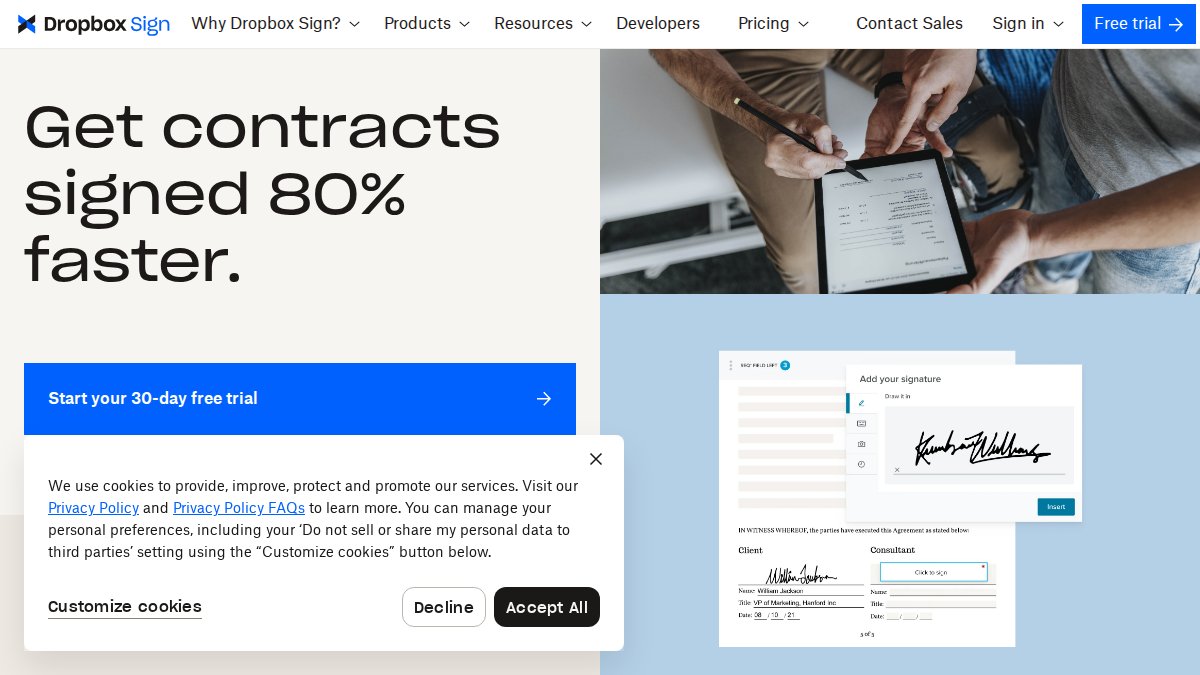
Dropbox Sign is best for businesses needing a simple, reliable way to send and sign documents without complex automation. However, it lacks advanced document creation and proposal features, you still need to create contracts elsewhere.
Zoho Contracts: Scalable Management for Growing Businesses
Zoho Contracts is a dedicated contract management solution that helps growing businesses organize, track, and manage the full lifecycle of their agreements. The centralized repository stores all contracts in one searchable location, and automated renewal tracking sends alerts before key dates pass. Customizable approval workflows let you define who must sign off on contracts before execution.
Zoho Contracts scales well as business needs grow and offers a good balance of features and affordability. It’s particularly valuable if you’re already using other Zoho products.
Risks of Using Free Legal Templates Without Professional Review
Free online contract generators come with real risks that cost far more than the price you saved.
The first risk is incomplete coverage. Free templates omit clauses critical to your specific business model. If you’re a consultant working with multiple clients simultaneously, a free contract might not address non-compete restrictions, confidentiality obligations, or how you handle client data.
The second risk is unenforceable language. Courts scrutinize contract terms to ensure they’re clear, specific, and not unconscionable. Vague language like "the contractor agrees to provide services" without defining what services, when, or to what standard creates ambiguity that a court might resolve against you.
The third risk is missing state-specific requirements. Each state has different rules about what makes an electronic signature valid, how contracts must be formatted to be binding, and what remedies are available if someone breaches. A template written for California might not meet Florida’s specific requirements.
Free templates often lack liability limitations and indemnification clauses that protect you if something goes wrong. Without these protections, you could be personally liable for damages far exceeding the contract value. A $5,000 project could expose you to $50,000 in liability claims if the contract doesn’t clearly define what you’re responsible for.
Business Contract Best Practices: When Templates Aren’t Enough
Certain situations demand professional legal counsel. Understanding when to hire a business attorney versus relying on templates protects your interests and prevents costly mistakes.
Essential Clauses Every Small Business Contract Needs
A clear scope of work or deliverables section defines exactly what you’re providing and what the client is paying for. Instead of "marketing services," specify "10 social media posts per month on platforms X, Y, and Z, with a response time of 24 hours for client feedback."
Payment terms must specify the amount, due date, late fees, and what triggers payment. In Florida, you can include reasonable late fees in your contract, which encourages on-time payment.
Limitation of liability clauses cap how much either party can owe if something goes wrong. A well-drafted limitation says "neither party’s liability shall exceed the total fees paid under this agreement," which protects both sides.
Intellectual property rights clauses clarify who owns the work product. If you’re a designer, does the client own the design files or just the finished deliverable? Can you use the work in your portfolio?
Dispute resolution clauses specify how conflicts get resolved, through mediation, arbitration, or litigation. You can require disputes to be resolved in your home state, which saves you from traveling across the country to defend yourself in court.
Industry-Specific Customization and Compliance
Generic templates fail because they don’t account for industry-specific risks and regulatory requirements. A healthcare provider needs HIPAA-compliant language. A contractor needs lien rights and bonding disclosures. A software company needs data security and API usage terms.
Customization starts with identifying what makes your business unique. What are your biggest liabilities? What compliance requirements apply? What terms do your clients typically push back on?
The cost of customization varies. Adding 2-3 industry-specific clauses to an existing template might cost $500-$1,500 from an attorney. But the investment pays for itself the first time a dispute arises and your contract actually protects you.
Hybrid Legal Models: Balancing Cost and Professional Protection
Many businesses benefit from a hybrid approach: use templates and automation for routine agreements, but hire an attorney to review and customize contracts for high-value deals or unusual situations.
This model works because most of your contracts probably follow a pattern. If you’re a consultant, 80% of your client agreements might be nearly identical. You can automate those 80% with a solid template or automation platform. For the remaining 20%, large contracts, unusual terms, or complex arrangements, you hire an attorney for a focused review.
The cost savings are significant. Instead of paying an attorney $3,000-$5,000 to draft every contract from scratch, you pay $500-$1,500 for a one-time template review and customization. Then you generate variations for different clients at minimal cost.
Professional Legal Counsel: When to Hire a Business Attorney

Hire an attorney when the contract value exceeds your risk tolerance. If you’re signing a $50,000 contract, spending $1,500 on legal review is 3% of the deal value, a worthwhile investment.
Hire an attorney when the terms are unusual or heavily favor the other party. If a client insists on broad indemnification, unlimited liability, or exclusive rights to your work, you need professional guidance to understand the implications and negotiate better terms.
Hire an attorney when you’re in a regulated industry. Healthcare, finance, real estate, and construction have specific compliance requirements that generic templates miss.
Hire an attorney when you’re dealing with intellectual property. If you’re licensing technology, creating custom software, or developing proprietary processes, the intellectual property language must be precise.
Hire an attorney when you’re entering a partnership or joint venture. These arrangements involve complex governance, profit-sharing, and exit clauses that require professional drafting.
At Matthew Fornaro, P.A., we work with entrepreneurs and small business owners in South Florida who need guidance on when to use templates versus when to invest in professional legal counsel. With over 20 years of experience in business law, we’ve seen how contract decisions affect business outcomes.
Better Alternatives to Generic Online Business Contract Templates
The alternatives to generic online business contract templates fall into three categories: automation platforms, hybrid legal models, and professional legal services.
Comparison of Top Alternatives
| Solution | Best For | Cost Model | Key Strength |
|---|---|---|---|
| Legal Automation Software (PandaDoc, Juro, Zoho) | Routine contracts with consistent terms | $20-$100/month | Speed and consistency |
| Hybrid Model (Templates + Attorney Review) | Growing businesses with variable contract types | $500-$2,000 initial + $20-$50/month | Cost-effective protection |
| Professional Legal Counsel | High-value deals and complex arrangements | $200-$400/hour or flat fee | Customization and risk mitigation |
| Contract Management Platforms (ContractSafe) | Organizing and tracking existing contracts | $30-$100/month | Organization and compliance tracking |
| AI-Assisted Drafting (Genie AI) | Startups and small businesses seeking free options | Free to $50/month | Accessibility and learning |
How to Choose the Right Solution for Your Business
Start by evaluating your contract volume and complexity. If you sign the same agreement repeatedly, automation software pays for itself quickly. If your contracts vary significantly, a hybrid model makes more sense.
Next, assess your risk tolerance. High-value contracts, regulated industries, and agreements involving intellectual property demand professional review. Routine service agreements for small amounts can rely on solid templates.
Consider your budget realistically. An attorney costs more upfront but prevents expensive disputes later. The hybrid model usually offers the best return on investment for growing businesses.
Post-Signature Contract Maintenance and Compliance Tracking
Signing a contract is just the beginning. Many business owners neglect post-signature management, which leads to missed renewal dates, forgotten obligations, and lost opportunities to renegotiate terms.
Effective contract management requires tracking key dates: renewal deadlines, payment terms, performance milestones, and termination windows. If you miss a renewal deadline by 30 days, you might automatically extend the contract for another year on unfavorable terms.
Contract management platforms like ContractSafe and Zoho Contracts automate this tracking. They send alerts before important dates, maintain searchable repositories of all agreements, and track which obligations have been fulfilled.
Review your contracts periodically, at least annually. Business circumstances change. A contract that made sense when you signed it might not reflect your current needs. Proactive renegotiation gives you leverage; waiting until renewal time forces you to accept whatever terms the other party proposes.
Navigating contract decisions is one of the most important responsibilities of business ownership. The choice between generic templates, automation software, and professional legal counsel directly impacts your liability, enforceability, and ability to resolve disputes. At Matthew Fornaro, P.A., we help South Florida entrepreneurs understand these trade-offs and build contract strategies that protect your business interests while staying within your budget. Call today to discuss how we can help you move beyond generic templates to contracts that actually protect your business.
Frequently Asked Questions
Are free online contract templates legally binding?
Free templates may be legally binding if they comply with your jurisdiction's contract law requirements, but enforceability depends on proper execution, clear terms, and whether they address your specific situation. Generic templates often lack critical clauses for indemnification, liability limitations, and dispute resolution that protect your interests. Without customization and legal review, you risk creating unenforceable agreements or exposing yourself to unexpected contractual obligations.
What are the main risks of using free legal templates?
Free legal templates carry significant risks including inadequate boilerplate language that doesn't reflect your industry, missing essential clauses for intellectual property rights or non-disclosure agreements, and gaps in jurisdiction-specific legal compliance. They may not address your unique business operations or client relationships. The biggest danger: a template that appears valid may fail in court or leave you liable for damages you thought were covered by indemnification clauses.
When should I hire a business attorney instead of using a template?
Hire a business attorney for high-value contracts, complex service agreements, intellectual property licensing, LLC formation, and any agreement involving significant financial risk or regulatory compliance. Also consult an attorney when customizing templates for your industry, negotiating terms with sophisticated parties, or if a dispute arises. For South Florida entrepreneurs, local counsel familiar with Florida contract law and your specific business type ensures enforceability and protects your interests.
How do legal contract automation software solutions compare to hiring a lawyer?
Automation software streamlines document creation, e-signatures, and management but lacks legal judgment. It works best for routine, standardized contracts. Lawyers provide customization, risk mitigation, and dispute resolution expertise. A hybrid approach, using automation for routine agreements and legal counsel for complex contracts, balances cost and protection. Automation software improves efficiency; attorney review improves enforceability and risk management.
What should I look for in contract management alternatives?
Evaluate alternatives on customization capability, industry-specific templates, e-signature integration, renewal tracking, and compliance features. Ensure the solution supports your jurisdiction's governing law requirements and includes audit trails for legal liability protection. Consider whether you need AI-assisted drafting, collaborative workflows, or just storage and organization. For small businesses, prioritize ease of use and scalability as your operations grow.
This article was written using GrandRanker


