

Key Takeaways
- Florida business law protects companies from unfair competition, contract breaches, and partner disputes.
- Acting early saves time, money, and business relationships.
- An experienced business attorney helps you assess risk and choose the right legal strategy.
Business defamation is defined as a false statement of fact, made to a third party, that damages a company’s reputation or economic interests. The legal term most attorneys use is “commercial defamation,” and it covers two forms: libel (written statements) and slander (spoken statements). For small business owners and entrepreneurs, understanding what is business defamation is not an academic exercise. A single false claim spread online or through a competitor’s network can cost you contracts, clients, and years of built trust. The stakes are real, and the legal clock starts ticking the moment that statement is published.
What are the legal elements required to prove business defamation?
Winning a business defamation claim requires proving four specific elements. Courts do not award damages based on hurt feelings or general unfairness. Each element must be supported by evidence.
-
False statement of fact. The statement must be objectively false, not just unflattering. A competitor saying your service is “overpriced” is an opinion. A competitor telling a client you failed a government safety inspection, when you did not, is a false statement of fact that can support a defamation claim.
-
Publication to a third party. The false statement must reach at least one person other than you. An email sent to a vendor, a post on a public forum, or a comment made at an industry event all qualify as publication.
-
Fault standard. You must show the speaker acted with negligence or, in cases involving public figures, with actual malice. Actual malice means the speaker knew the statement was false or acted with reckless disregard for the truth.
-
Economic harm. Most business defamation claims require proof of financial loss, such as lost contracts or clients. This is where thorough business records become critical.
One important exception applies to defamation per se. In these cases, the false statement is so serious that courts presume harm without requiring detailed economic proof. False criminal allegations fall into this category. In a 2025 case, a defendant was ordered to pay $25,000 in actual damages for a false kickback accusation against a business executive. That outcome shows courts take these claims seriously when the evidence is solid.
Pro Tip: Document every element from day one. Courts require proof of each element independently, so a strong claim that is missing one piece of evidence can still fail.

How does business defamation differ from personal defamation and disparagement?
These three claims protect different interests, and confusing them can weaken your legal position.
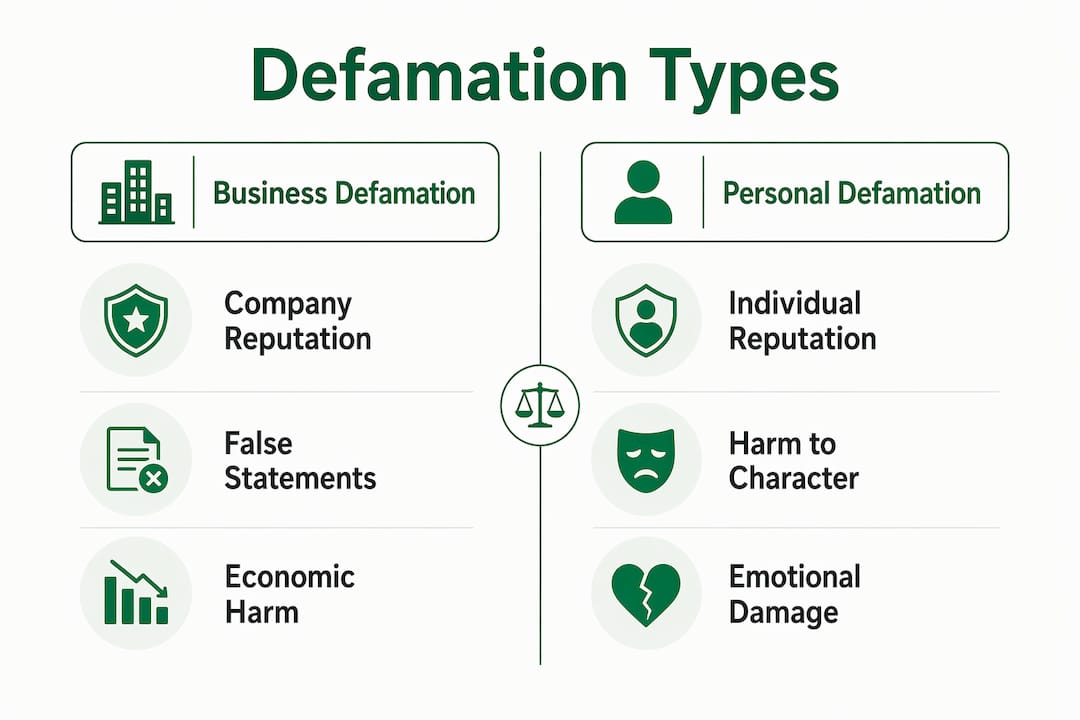
| Claim type | What it protects | Key requirement |
|---|---|---|
| Personal defamation | Individual reputation | False statement harming a person |
| Business defamation | Business reputation and goodwill | False statement harming a company |
| Business disparagement | Economic or commercial interests | False statement causing specific financial loss |
Personal defamation protects an individual’s reputation. Business defamation protects the reputation and goodwill of the business itself. Business disparagement, sometimes called trade libel, focuses narrowly on economic harm. The Texas Supreme Court draws a clear line: defamation actions protect personal reputation, while business disparagement protects economic interests.
The practical consequence is that you may need to file both a personal defamation claim and a business disparagement claim to get full protection. If a former partner spreads false rumors that you personally committed fraud and that your company delivers defective products, those are two separate legal injuries requiring two separate claims. Missing one means leaving part of your damages on the table.
Understanding this distinction before you file protects both you and your business from gaps in coverage.
What practical steps can business owners take to respond to defamation?
Speed and discipline matter more than emotion when you discover a defamatory statement. The steps below give you the best chance of preserving your claim and resolving the situation efficiently.
-
Document immediately. Take dated screenshots of every defamatory post, email, or review. Preserve the original URLs and record who said what, to whom, and when. Professional documentation is your strongest initial asset.
-
Avoid public emotional responses. Firing back publicly can create counterclaims and amplify the original statement’s reach. Stay quiet publicly while you build your case privately.
-
Send a legal demand letter. An attorney demand letter requesting removal or retraction is often the fastest path to resolution. Sending a demand letter can minimize reputation damage before the situation reaches a courtroom.
-
Negotiate confidentiality and non-disparagement clauses. If the other party is willing to settle, push for a confidentiality agreement and a clause preventing future disparaging statements. These terms protect your business long after the immediate dispute ends.
-
Assess litigation carefully. Court cases are expensive, time-consuming, and public. Litigation is often the least preferred option because of cost and the additional publicity it generates. Exhaust negotiation first.
-
Know when to file. If negotiation fails and the damage is severe, litigation becomes necessary. Review your timeline for filing carefully, because the statute of limitations can cut off your claim before you realize it.
Pro Tip: Bring in an experienced attorney before you respond publicly or send any written communication. Reckless or emotionally charged statements, even in emails, can create personal liability for executives beyond the corporate entity.
What damages and remedies can businesses expect in defamation cases?
Courts offer several types of relief in business defamation cases, and the amount you recover depends heavily on the quality of your evidence.
| Damage type | Description | Notes |
|---|---|---|
| Actual damages | Proven financial losses | Required for trade libel; must be documented |
| Presumed damages | Assumed harm without proof | Available in defamation per se cases |
| Punitive damages | Punishment for malicious conduct | Awarded in egregious cases |
| Injunctive relief | Court order to remove content | Available when ongoing harm is proven |
Actual damages require you to connect the defamatory statement directly to a measurable financial loss, such as a canceled contract or a lost client account. Courts require quantifiable proof of economic losses linked directly to the defamatory statements. Vague claims of general harm do not satisfy this standard.
Monetary awards in recent cases illustrate the range courts apply. In 2025, one case resulted in $25,000 in actual damages rising to $60,000 total when punitive damages were included. That spread reflects how much the severity of conduct and the strength of evidence influence the final award.
Beyond money, courts can order retractions, public apologies, and injunctions preventing the defendant from repeating the statement. These remedies matter for reputation recovery, not just financial compensation. Reviewing types of damages in business litigation before you file helps you set realistic expectations for what a court can actually deliver.
What legal limits and defenses should small businesses know?
Not every harmful statement is actionable, and several legal defenses can defeat an otherwise strong claim. Knowing these limits before you act saves time and money.
-
Statute of limitations. Business owners must file defamation claims within strict deadlines. The statute of limitations is typically one year from the date of publication in states like Texas and California. Missing this window ends your claim permanently, regardless of how strong your evidence is.
-
Fact versus opinion. Courts only treat verifiable false facts as defamation. Opinions and puffery are protected speech. “Company X produces inferior goods” is an opinion. “Company X failed a government inspection” is a factual claim and can be defamatory if false. The line between the two is not always obvious.
-
First Amendment protections. Statements classified as public discourse or opinion are rarely actionable. Courts are cautious about restricting speech, and attempting to suppress legal opinions can backfire by drawing more attention to the original statement.
-
Counterclaim risk. Aggressive or poorly timed legal action can invite counterclaims. If your demand letter is seen as harassment or your lawsuit lacks merit, the other party may file claims against you.
-
Amplification risk. Public responses to defamatory statements often spread the original claim further. Silence, combined with private legal action, is almost always the better short-term strategy.
The practical takeaway is that early legal guidance prevents the most common and costly mistakes: missing deadlines, responding publicly, and filing claims that do not meet the legal threshold.
Key Takeaways
Business defamation requires proof of a false factual statement, third-party publication, fault, and documented economic harm, and the statute of limitations in most states gives you just one year to act.
| Point | Details |
|---|---|
| Four elements are required | Prove a false statement, publication, fault, and economic harm to win a defamation claim. |
| Defamation per se skips economic proof | False criminal allegations allow courts to presume damages without detailed financial evidence. |
| Disparagement is a separate claim | Business disparagement protects economic interests; file both claims when both are harmed. |
| Document before you respond | Dated screenshots and preserved records are your strongest legal asset from day one. |
| The clock runs fast | Most states, including Texas and California, impose a one-year statute of limitations on defamation claims. |
What I’ve learned after 20 years of business defamation cases
The biggest mistake I see business owners make is waiting. They spend weeks monitoring the situation, hoping it resolves on its own, while the statute of limitations counts down and evidence disappears. By the time they call me, the window for the strongest possible claim has sometimes already narrowed.
The second most common mistake is responding publicly. I understand the instinct. When someone spreads a lie about your business, you want to correct the record immediately. But a public response, especially an emotional one, almost always makes things worse. It amplifies the original statement, creates a paper trail the other side can use, and signals that you are rattled.
What actually works is quiet, fast, and disciplined action. Document everything the moment you see it. Get an attorney involved before you send a single email or post a single reply. A well-crafted demand letter, sent early, resolves more defamation disputes than litigation does. Courts are expensive, slow, and public. Most business owners do not want their dispute aired in a courtroom any more than they want the original false statement circulating.
I also caution clients against assuming every negative statement is defamation. Courts protect opinions and public discourse for good reason. Filing a weak claim does not just fail. It can expose you to counterclaims and legal fees that dwarf the original harm. Know the threshold before you act, and get counsel who will tell you honestly whether your claim meets it.
— Matthew
How Fornarolegal helps businesses facing defamation risks
False statements about your business can move fast. The legal response needs to move faster.

Fornarolegal works with small businesses and entrepreneurs across South Florida to respond to defamation claims before they escalate into costly litigation. With over 20 years of court-tested experience, Matthew Fornaro helps clients document claims, send demand letters that get results, and build litigation-ready cases when negotiation fails. Early legal guidance is the single most effective way to protect your reputation and limit your exposure. If a false statement is already circulating about your business, the time to act is now. Contact Fornarolegal to discuss your situation and protect what you have built.
FAQ
What is business defamation in simple terms?
Business defamation is a false statement of fact, made to a third party, that harms a company’s reputation or causes financial loss. It covers both written statements (libel) and spoken statements (slander).
How do I prove a business defamation claim?
You must prove four elements: a false statement of fact, publication to at least one third party, fault on the part of the speaker, and documented economic harm such as lost contracts or clients.
What is the difference between business defamation and business disparagement?
Business defamation protects a company’s reputation and goodwill. Business disparagement, or trade libel, focuses specifically on economic harm and requires proof of direct financial loss caused by the false statement.
How long do I have to file a business defamation claim?
The statute of limitations for defamation is typically one year from the date of publication in states like Texas and California. Missing this deadline ends your legal claim permanently.
Can a negative online review count as business defamation?
A negative review can qualify as defamation if it states a verifiable false fact that causes financial harm. Pure opinions, such as “their service was disappointing,” are protected speech and are not actionable under defamation law.


