

Key Takeaways
- Florida business law protects companies from unfair competition, contract breaches, and partner disputes.
- Acting early saves time, money, and business relationships.
- An experienced business attorney helps you assess risk and choose the right legal strategy.
Contract assignment is defined as the legal transfer of contractual rights and benefits from one party to a third party, while the original contract stays fully in effect. For business owners, this matters in mergers, acquisitions, and everyday commercial deals where you need to transfer payment rights, service agreements, or licenses without tearing up the original deal. The three parties involved are the assignor (the party transferring rights), the assignee (the recipient), and the obligor (the party who must perform). Understanding what is contract assignment protects you from costly mistakes, including assuming you are released from liability when you are not.
What is contract assignment and how does it work?
Contract assignment transfers rights and benefits to a new party, but it does not automatically transfer duties. The assignor hands over the right to receive performance, such as payment or delivery of services, while the obligor now owes that performance to the assignee instead.

A practical example: you own a staffing company and hold a contract to supply workers to a hotel chain. You sell your business and assign that contract to the buyer. The hotel chain (obligor) now pays the buyer (assignee) directly. You (assignor) transferred the right to receive payment, but if the buyer fails to supply workers, you may still carry liability for the original obligation unless a novation was executed.
Rights that are commonly assigned include:
- Payment rights under service or supply contracts
- Licensing rights for software or intellectual property
- Lease rights in commercial real estate transactions
- Receivables in financing arrangements
- Rights under construction or vendor agreements
The original contract remains valid after assignment. The obligor’s obligations do not change. What changes is who receives the benefit of those obligations.
Pro Tip: Always confirm whether your contract requires the obligor’s consent before assigning. Assigning without required consent can void the assignment and expose you to a breach of contract claim.
What legal requirements govern the assignment of contracts?
Not every contract right is freely assignable. Rights are generally assignable unless the contract expressly prohibits it, the transfer would materially change the obligor’s risk or burden, or public policy or statute forbids it. Duties that require a unique skill cannot be delegated without the other party’s agreement.
Before assigning any contract, follow this seven-step review process:
- Analyze the original contract. Read the assignment clause, consent requirements, and any change-of-control provisions.
- Identify what is being transferred. Specify the exact rights, payment streams, or licenses you plan to assign.
- Determine if duties are included. If you are also transferring obligations, that is delegation, and it requires separate consent.
- Secure written consent if required. Counterparty silence is not consent. Active, written approval is necessary to avoid breach claims.
- Draft a formal assignment agreement. Include precise financial details such as outstanding balances, payment amounts, and active services as of the effective date.
- Execute and provide written notice. Deliver notice to all parties within any required notice period. Missing a notice deadline can invalidate the assignment.
- Maintain permanent records. Keep signed copies of the assignment agreement, consent letters, and all notices.
Reading the assignment clause alone is not enough. Related contract provisions such as definitions, notice requirements, and change-of-control sections can affect whether an assignment is valid, even when the assignment clause appears permissive on its face. A commercial contract review before you assign is the most reliable way to catch these traps.
Pro Tip: If your contract has a notice period for assignment, calendar the deadline the moment you decide to assign. Courts have enforced strict notice requirements even when the other party suffered no actual harm from late notice.
What are the differences between assignment, delegation, and novation?
Business owners frequently confuse these three concepts. Each one produces a different legal outcome, and choosing the wrong one can leave you exposed.
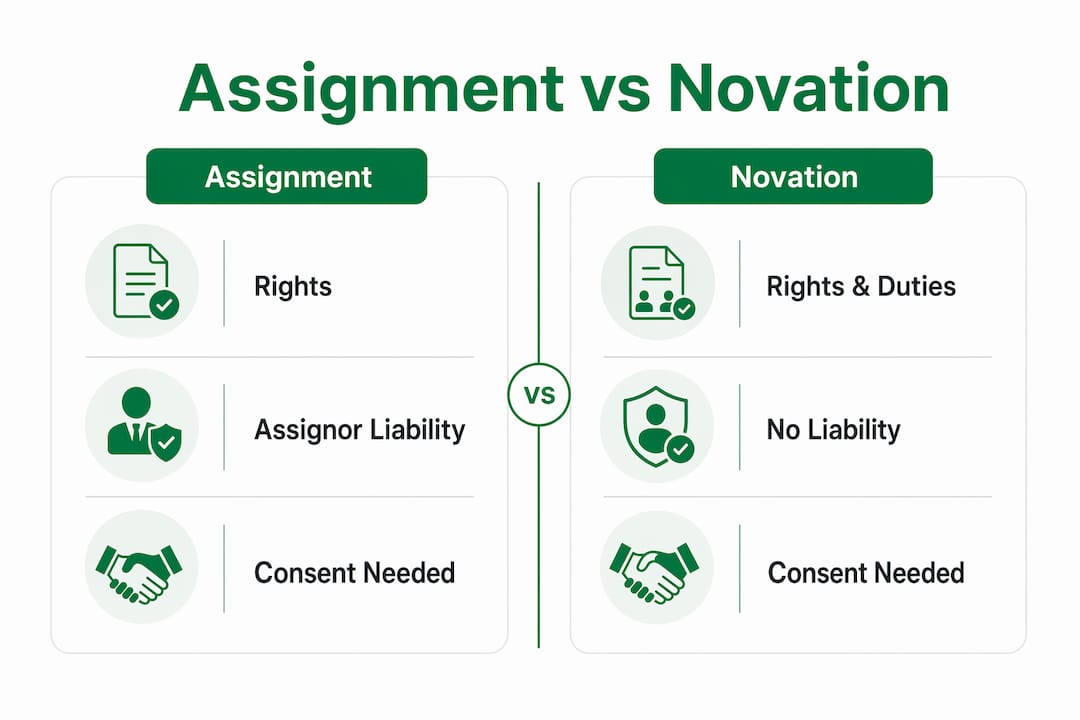
Assignment transfers rights to receive performance but does not release the assignor from liability for duties that were not delegated. Delegation transfers duties to a third party, but the original party remains responsible if the delegate fails. Novation replaces a party entirely, releasing the original party from all obligations, but it requires the consent of every party to the contract.
| Concept | What transfers | Assignor liability | Consent required |
|---|---|---|---|
| Assignment | Rights and benefits | Remains for non-delegated duties | Depends on contract |
| Delegation | Duties and obligations | Remains unless released | Usually required |
| Novation | Full party replacement | Released completely | Always required |
The practical difference is significant. If you sell your business and assign your contracts without novation, you may still face claims if the buyer defaults. Novation eliminates that risk, but it requires the other party’s active agreement. Many business owners assume assignment accomplishes what only novation can deliver. That assumption is one of the most common and expensive mistakes in commercial transactions.
What practical steps should business owners follow to assign a contract safely?
Safe contract assignment follows a clear process. Skipping steps creates disputes that are far more costly than the time spent getting it right.
- Review the contract in full. Do not read the assignment clause in isolation. Check definitions, notice provisions, and change-of-control language. These sections interact and can override a permissive assignment clause.
- Identify the exact scope of the assignment. Vague language such as “all rights under the contract” has been disputed in court. Name the specific rights, dollar amounts, and effective date. Precise financial details reduce ambiguity and litigation risk.
- Obtain consent in writing. Do not rely on verbal agreement or assume silence means approval. Get a signed consent letter from the obligor before the assignment takes effect.
- Draft a complete assignment agreement. The agreement should name all three parties, describe the rights being transferred, state the effective date, and address any financial obligations outstanding as of that date.
- Deliver written notice on time. Send notice to the obligor and any other required parties within the contractual notice period. Keep proof of delivery.
- Address partial assignments carefully. Partial assignment is valid only if the obligor can perform the assigned portion separately. If the obligor objects, neither the assignor nor the assignee can sue independently. They must join the lawsuit together.
- Get a legal review before signing. A qualified attorney can spot assignment restrictions, consent traps, and liability exposure that most business owners miss on a first read.
Pro Tip: When assigning a contract that involves ongoing payments, attach a schedule to the assignment agreement listing every outstanding balance and the payment terms as of the effective date. This single step prevents most financial disputes after the assignment closes.
Protecting your business from contract and ownership risk starts with knowing what you are signing over and what you are keeping. Lease assignments carry their own enforcement considerations, and enforcing assignment clauses in leases requires the same written consent and notice discipline as any commercial contract.
Key Takeaways
Contract assignment transfers rights and benefits to a new party, but the assignor typically remains liable for duties unless a full novation is executed and consented to by all parties.
| Point | Details |
|---|---|
| Assignment transfers rights, not duties | The assignor keeps liability for obligations unless delegation or novation is separately arranged. |
| Silence is not consent | Written approval from the obligor is required; assuming silence equals consent risks a breach claim. |
| Read the full contract, not just the assignment clause | Notice, definitions, and change-of-control provisions can override a permissive assignment clause. |
| Precise documentation prevents disputes | Include outstanding balances, payment terms, and the effective date in every assignment agreement. |
| Novation is the only full exit | Only novation releases the original party from all liability; assignment alone does not accomplish this. |
What I’ve learned about contract assignment after 20 years of business law
The most expensive mistake I see business owners make is treating contract assignment as a simple paperwork exercise. They find the assignment clause, see no prohibition, and assume they are free to proceed. Then a dispute surfaces six months later because they missed a consent requirement buried in the notice section, or they assumed the assignment released them from liability when it did not.
Assignment is a powerful tool when used correctly. It lets you transfer revenue streams, exit obligations in a sale, and restructure your business without renegotiating every contract from scratch. But it carries real legal weight. When you assign a contract, you implicitly warrant that the contract is valid and that you know of no reason the assignee cannot collect performance from the obligor. That warranty creates exposure if something goes wrong.
My advice is to treat every assignment like a mini transaction. Get the full contract in front of a lawyer before you sign anything. Identify whether you need consent, whether duties are being delegated, and whether novation is the smarter choice. The cost of a contract review is a fraction of what a breach of contract dispute costs in time, money, and business relationships. I have seen deals fall apart and partnerships dissolve over assignment disputes that a single review call would have prevented.
The businesses that handle assignment well are the ones that reduce contract risk early, before a dispute forces the issue.
— Matthew
How Fornarolegal helps Florida businesses with contract assignments
Contract assignment questions rarely arrive at a convenient time. They surface during a sale, a restructuring, or a deal that needs to close fast. That is exactly when a wrong assumption about consent or liability can turn a straightforward transaction into a costly dispute.

Fornarolegal works with small businesses, startups, and entrepreneurs across South Florida to review commercial contracts, identify assignment restrictions, and draft assignment agreements that hold up. With over 20 years of court-tested experience, Matthew Fornaro gives you a clear picture of what you are transferring, what you are keeping, and where your exposure lies. If you are facing a contract assignment question right now, early legal guidance is the most cost-effective step you can take before the deal closes.
FAQ
What is the contract assignment definition in plain terms?
Contract assignment is the legal transfer of one party’s contractual rights and benefits to a third party, while the original contract remains in force. The party transferring rights is the assignor, the recipient is the assignee, and the party who must perform is the obligor.
Can you assign a contract without the other party’s consent?
It depends on the contract. Rights are generally assignable unless the contract expressly prohibits it or the transfer would materially change the obligor’s risk. When consent is required, silence from the counterparty does not count as approval.
What is the difference between assignment and novation?
Assignment transfers rights but typically leaves the assignor liable for duties that were not delegated. Novation replaces the original party entirely and releases them from all liability, but it requires the written consent of every party to the contract.
What does contract transfer mean for my liability as the assignor?
Assigning a contract does not automatically release you from liability. You remain responsible for any duties that were not separately delegated, and you implicitly warrant that the contract is valid and collectible by the assignee.
What makes a contract assignment agreement enforceable?
A valid assignment agreement names all three parties, describes the specific rights being transferred, states the effective date, includes precise financial details, and delivers written notice to the obligor within any required notice period.
Recommended
- A Guide to Business Asset Sales » Matthew Fornaro, P.A. Coral Springs Parkland Business Law
- What Is a Business Contract? A Guide for Owners
- How to Protect Your Growing Florida Business from Contract, Ownership, and Lease Risk » Matthew Fornaro, P.A. Coral Springs Parkland Business Law
- Business Contract Attorney: A Guide for Florida Entrepreneurs » Matthew Fornaro, P.A.


