

Key Takeaways
- Florida business law protects companies from unfair competition, contract breaches, and partner disputes.
- Acting early saves time, money, and business relationships.
- An experienced business attorney helps you assess risk and choose the right legal strategy.
A fee dispute is a formal disagreement where a client contests charges or fees billed for services or products. Known in legal and financial contexts as a billing dispute, it arises when a client believes an invoice contains errors, unapproved charges, or terms that conflict with the original agreement. For South Florida business owners, understanding the fee dispute definition is not optional. Mishandled disputes damage cash flow, strain client relationships, and can escalate into litigation. This guide explains what causes fee disputes, how to resolve them, and how to prevent them before they cost you.
What is a fee dispute and when does it arise?
A fee dispute is a formal challenge to invoiced charges that occurs in both business-to-business and business-to-consumer relationships. The client disputes the amount billed, the basis for the charge, or the terms under which the service was delivered. These disagreements are bound by contract time limits and, in many cases, by federal and state procedural rules.
Fee disputes appear across nearly every industry in South Florida. A contractor bills for work the client says was never authorized. A law firm charges for hours the client says were excessive. A software vendor auto-renews a subscription the client believed was canceled. In each case, the core conflict is the same: one party believes the charge is wrong, and the other believes it is justified.

The term “billing dispute” is the standard industry label used by financial institutions, the American Bar Association, and state bar programs. “Fee dispute” is the more common phrase used in service contracts and professional relationships. Both terms describe the same underlying conflict, and both trigger the same legal protections when handled correctly.
What causes fee disputes and common examples in business settings
Fee disputes follow predictable patterns. Recognizing them early gives you the chance to resolve them before they escalate.
The most common causes include:
- Billing errors. Invoices with incorrect amounts, duplicate charges, or math errors are the most straightforward disputes. They are also the easiest to resolve when records are clear.
- Unapproved charges. A vendor adds a fee for a service the client never agreed to. Without a signed change order or written authorization, the charge is difficult to defend.
- Misunderstood contract terms. Vague language around scope, payment schedules, or cancellation policies creates room for conflicting interpretations. Both parties may be acting in good faith and still disagree.
- Subscription and auto-renewal overcharges. Clients dispute charges for services they believed were canceled or downgraded. These are especially common in software-as-a-service and membership-based businesses.
- Legal fee disagreements. Clients challenge attorney invoices based on hourly rates, time entries, or results. The Florida Bar operates a fee arbitration program specifically for these disputes.
- Service cancellation fees. A client terminates a contract early and disputes the penalty. The enforceability of that penalty depends entirely on how the contract was written.
Resolving fee disputes promptly preserves business relationships and financial health. Delayed resolution damages reputation and disrupts cash flow. For South Florida businesses operating in competitive markets, that cost compounds quickly.
How are fee disputes formally resolved?
Formal resolution follows a defined process. The right method depends on the amount in dispute, the relationship between the parties, and the contract terms.
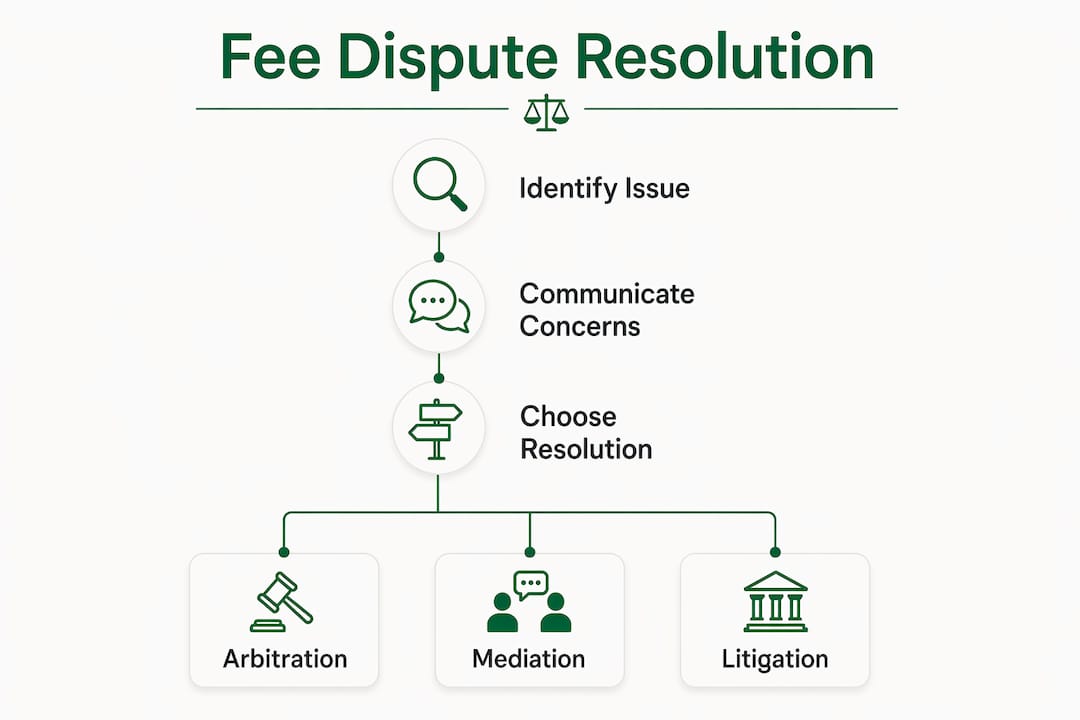
Arbitration
Arbitration is the most structured formal option outside of court. The Florida Bar and other professional bodies operate fee arbitration programs that use panels, sometimes including non-lawyers, to resolve client-attorney fee disagreements. The original fee agreement is the primary document reviewed.
The burden of proof in arbitration typically falls on the service provider. Attorneys must prove their charges are reasonable using ABA factors: time spent, complexity of the matter, local market rates, and results achieved. Evidence includes itemized billing records, the signed fee agreement, and proof of payment. The client does not need to prove the charges are wrong. The provider must prove they are right.
Arbitration can be binding or non-binding. Binding arbitration produces a final decision both parties must accept. Non-binding arbitration produces a recommendation either party can reject, though rejection often triggers litigation. Whether the outcome is binding depends on the original contract and whether both parties sign a submission agreement before the hearing.
Mediation
Mediation is a less formal alternative where a neutral third party helps both sides reach a voluntary agreement. It does not produce a binding decision unless both parties sign a settlement. Mediation works best when the relationship between the parties has value worth preserving. For South Florida businesses with long-term vendor or client relationships, arbitration vs. mediation is a real strategic choice, not just a procedural one.
Small claims court
- Gather all documentation: the original contract, invoices, payment records, and written communications.
- File a claim with the appropriate Florida small claims court. Filing fees range from $10 to $300, making this one of the most cost-accessible formal options.
- Serve the opposing party according to Florida procedural rules.
- Attend the hearing and present your evidence directly to the judge.
- Receive a judgment, which is enforceable through Florida courts.
Small claims court is designed for non-lawyers and handles disputes involving larger sums without the cost of full litigation. It is a practical option when direct negotiation and arbitration have failed.
Pro Tip: Always send dispute notices by certified mail with return receipt. Automated digital submissions lack the legal weight of a formally mailed dispute under federal law, and a paper trail protects your rights if the matter escalates.
Federal and state timelines that affect fee dispute rights
Timing controls everything in a fee dispute. Missing a deadline can eliminate your legal protections entirely.
| Rule | Requirement | Consequence of Missing |
|---|---|---|
| Fair Credit Billing Act | Dispute within 60 days of statement date | Loss of federal billing dispute protections |
| Bank investigation timeline | Bank must investigate within 45 days (90 days for new accounts) | Provisional credit required if investigation exceeds 10 business days |
| Written notice requirement | Dispute must be submitted in writing to trigger federal protections | Verbal complaints do not activate FCBA rights |
| Contract dispute clauses | Varies by agreement; often 30–90 days from invoice date | Waiver of right to contest the charge |
The Fair Credit Billing Act and the Electronic Fund Transfer Act set the federal floor for consumer billing dispute rights. These laws require written notice, mandate investigation timelines, and require provisional credits when investigations run long. State law and individual contracts can add additional requirements on top of these federal rules.
For business-to-business disputes, federal consumer protections may not apply directly. The contract governs. This is why contract dispute prevention starts with the fee agreement itself, not with the dispute process.
Pro Tip: If you are disputing a charge on a business credit account, check your card agreement. Business accounts often have shorter dispute windows and fewer automatic protections than consumer accounts under federal law.
Best practices to prevent fee disputes and manage them professionally
Prevention costs far less than resolution. The following practices reduce the frequency and severity of fee disputes for South Florida business owners.
- Write clear, specific fee agreements. Every engagement should have a written contract that defines scope, rates, payment terms, and what happens if scope changes. Vague language is the single biggest driver of fee disagreements. Lack of clear fee documentation is the most common pitfall that worsens disputes.
- Issue itemized invoices. Break down every charge by task, time, or unit. Clients who can see exactly what they are paying for dispute invoices far less often than those who receive lump-sum bills.
- Communicate proactively about cost changes. If a project is running over budget, tell the client before sending the invoice. Surprises on invoices generate disputes. Advance notice generates conversations.
- Respond to disputes in writing and promptly. When a client raises a concern, acknowledge it in writing within 24–48 hours. A written response creates a record and signals professionalism.
- Contact the other party directly before filing a formal dispute. Direct communication with the service provider resolves disputes faster than automated systems, which can take up to 90 days. Pick up the phone before filing a claim.
- Seek legal guidance early. Consulting an attorney before a dispute escalates is almost always cheaper than resolving it after litigation begins. Early advice shapes your documentation strategy and protects your position.
Reviewing your contracts and billing practices before a dispute arises is the most cost-effective risk management a South Florida business owner can do. A Florida business contract review catches the gaps that create disputes before a client ever sees an invoice.
Key Takeaways
A fee dispute is a formal billing challenge that is almost always preventable with a clear written agreement, itemized invoices, and timely communication.
| Point | Details |
|---|---|
| Fee dispute definition | A formal client challenge to invoiced charges, governed by contract terms and federal or state rules. |
| Most common cause | Vague or missing fee agreements create the conditions for nearly every serious billing dispute. |
| Arbitration burden of proof | The service provider must prove charges are reasonable; the client does not need to prove they are wrong. |
| Federal deadlines matter | Disputes on credit accounts must be filed within 60 days of the statement date to preserve federal protections. |
| Prevention beats resolution | Clear contracts, itemized billing, and proactive communication eliminate most disputes before they start. |
What 20 years of fee disputes taught me
Fee disputes rarely start with bad intentions. In my experience working with South Florida businesses, most disputes begin with a contract that was too vague, an invoice that was never explained, or a conversation that never happened. By the time a client formally contests a charge, the relationship has already been strained for weeks.
The biggest mistake I see is providers waiting too long to get legal input. A business owner calls me after a dispute has already been filed, after the deadline to respond has nearly passed, and after the documentation is incomplete. At that point, the options narrow fast. Early consultation, even a single conversation before sending a contested invoice, changes the outcome dramatically.
Arbitration programs like the Florida Bar’s fee arbitration process are genuinely useful, but they reward preparation. The provider who walks in with a signed fee agreement, itemized billing records, and a clear timeline wins far more often than the one who relies on memory and verbal agreements. Documentation is not just good practice. It is your entire defense.
My honest advice: treat every client engagement as if it will eventually be reviewed by an arbitration panel. Write the contract that way. Send the invoices that way. Communicate that way. You will have fewer disputes, and the ones you do have will resolve faster.
— Matthew
Fornarolegal helps South Florida businesses resolve fee disputes early
Fee disputes are expensive, time-consuming, and damaging to business relationships. The good news is that most of them are avoidable with the right contracts and the right legal guidance from the start.

Fornarolegal works with small businesses, startups, and established companies across South Florida to draft enforceable fee agreements, respond to billing disputes, and resolve conflicts before they reach arbitration or court. With over 20 years of AV®-rated, court-tested experience, Matthew Fornaro provides the kind of practical guidance that protects your business and your bottom line. If you are facing a fee disagreement or want to prevent one, early legal guidance is the most cost-effective step you can take right now.
FAQ
What is a fee dispute in simple terms?
A fee dispute is a formal disagreement where a client contests charges on an invoice, claiming the amount is wrong, unauthorized, or inconsistent with the original agreement.
How do I resolve a fee dispute with a service provider?
Start with direct written communication to the provider. If that fails, formal options include arbitration, mediation, and small claims court, depending on the amount and contract terms.
What evidence do I need for a fee dispute?
The original signed fee agreement is the strongest piece of evidence. Supporting documents include itemized invoices, payment records, written communications, and any change orders or amendments.
How long do I have to dispute a fee or billing charge?
Federal law under the Fair Credit Billing Act requires disputes on credit accounts to be filed within 60 days of the statement date. Contract-based disputes may have shorter or different deadlines depending on the agreement.
Can a fee dispute be resolved without going to court?
Yes. Most fee disputes resolve through direct negotiation, arbitration, or mediation. Small claims court is available for larger amounts, but formal litigation is rarely necessary when documentation is strong and disputes are handled promptly.
Recommended
- Arbitration, Mediation, or Litigation? Choosing the Right Path for Your Commercial Dispute in Florida » Matthew Fornaro, P.A. Coral Springs Parkland Business Law
- Mediation, Arbitration, or Litigation? Choosing the Right Path in a Florida Business Dispute » Matthew Fornaro, P.A. Coral Springs Parkland Business Law
- Attorney Fee Shifting Explained for South Florida Businesses
- Mastering Contract Disputes: A Guide for Florida Business Owners » Matthew Fornaro, P.A.

