

Key Takeaways
- Florida business law protects companies from unfair competition, contract breaches, and partner disputes.
- Acting early saves time, money, and business relationships.
- An experienced business attorney helps you assess risk and choose the right legal strategy.
How to Comply with Florida Business Regulations
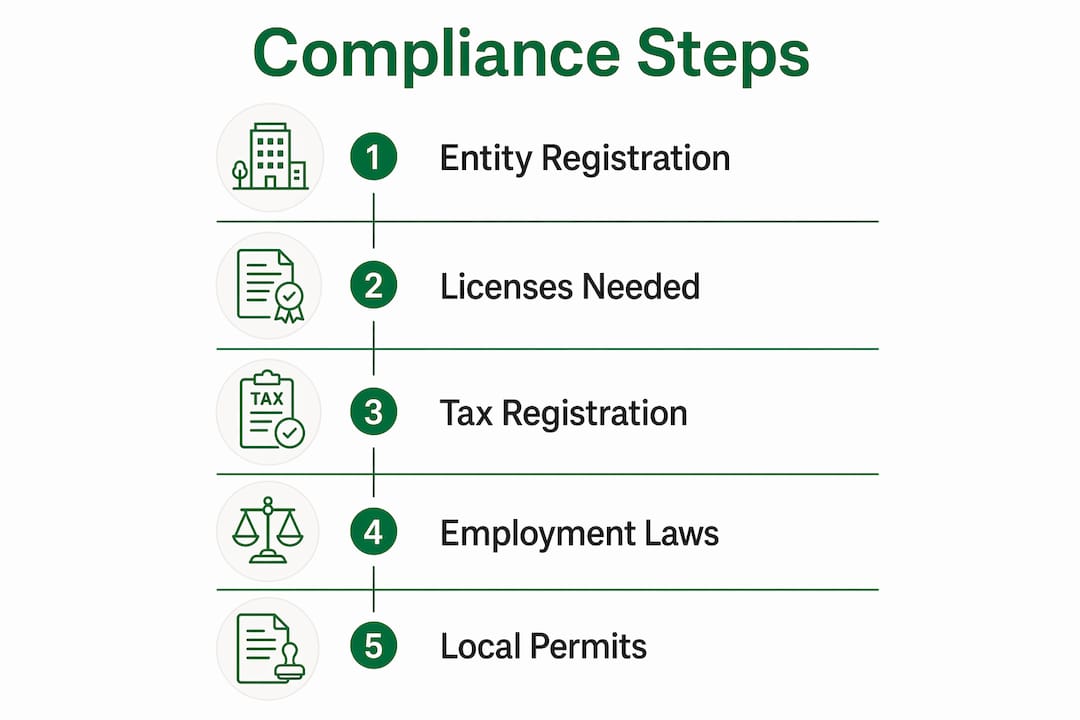
Complying with Florida business regulations means fulfilling a specific set of state and local requirements before you open your doors and every year after. Those requirements span entity registration with the Florida Division of Corporations (Sunbiz), professional licensing through the Florida Department of Business and Professional Regulation (DBPR), tax registration via Form DR-1 with the Florida Department of Revenue, employment verification through E-Verify, and local permit approvals from your county or municipality. Missing any one of these layers can trigger fines, license suspension, or administrative dissolution. This guide walks you through each obligation in plain language so you can protect your business and keep it running.
How to comply with Florida business regulations: entity registration
Every Florida business must register its legal entity before it begins operating. The Florida Division of Corporations, accessible at Sunbiz.org, handles Articles of Organization for LLCs and Articles of Incorporation for corporations. Registration is the foundation of your legal standing in Florida and determines how your business is taxed, sued, and governed.
After formation, you must file an annual report with Sunbiz every year by may 1. The annual report filing fee is $138.75 for LLCs and $150 for profit corporations. Missing that deadline triggers a $400 late fee. That penalty alone can wipe out a month of profit for a lean startup.
The consequences get worse if you ignore the report entirely. Entities that skip the annual report by the third Friday in september face administrative dissolution. Reinstatement for an LLC costs $100 plus $138.75 for each missed year, meaning a two-year lapse can cost over $375 before you even address the underlying issue.
One common mistake is treating the Sunbiz annual report as the same thing as a business license renewal. They serve different compliance functions and must both be managed separately. Confusing them is one of the fastest ways to end up non-compliant without realizing it.
- Register your entity with Sunbiz before any business activity begins
- File Articles of Organization (LLC) or Articles of Incorporation (corporation) online at Sunbiz.org
- Pay the annual report fee by may 1 each year to avoid the $400 late penalty
- Track the third Friday in september as your hard dissolution deadline
- Keep your registered agent information current at all times
Pro Tip: Set a recurring calendar reminder on january 1 each year to file your Sunbiz annual report early. Filing in january or february costs the same as filing on april 30, and it removes the risk of a missed deadline entirely.
What licenses does your Florida business need?
Licensing in Florida operates on two separate tracks: state licensing through the DBPR and local licensing through your county or city. You need both, and neither replaces the other.

The DBPR oversees licensing for professions including cosmetology, real estate, construction, and health care providers. Businesses in these regulated industries must maintain active professional licenses, meet continuing education requirements, and renew on the DBPR’s schedule. Operating without a required license exposes you to fines, cease-and-desist orders, and civil liability.
Local business tax receipts, formerly called occupational licenses, are a separate requirement. These receipts are mandatory in most Florida counties and municipalities, with fees that vary by location and business type. Failure to obtain one can result in fines or a business closure order from local code enforcement.
Here is a practical sequence for identifying and obtaining the licenses your business needs:
- Identify your industry’s regulated status by searching the DBPR license database at myfloridalicense.com
- Apply for any required state professional license before opening, since some approvals take 60–90 days
- Contact your county tax collector’s office to apply for a local business tax receipt
- Check with your city or municipality for any additional occupational permits specific to your location
- Note all renewal dates and continuing education deadlines in a single compliance calendar
- Review special permit requirements if your business involves food service, health care, construction, or financial services
Special sectors carry extra layers. A food service business needs a license from the Florida Department of Agriculture or the Department of Health, depending on the product. A mortgage broker needs approval from the Office of Financial Regulation. Knowing which agency governs your industry is the first step, and getting it wrong costs time and money.
What are Florida’s state tax registration requirements?
Tax registration is not optional and not automatic. Every Florida business that sells taxable goods or services, hires employees, or meets corporate income thresholds must register using Form DR-1 with the Florida Department of Revenue. Failure to register can result in misdemeanor or felony charges depending on the amount owed, with escalating penalties for repeat offenses.
Florida imposes a 6% state sales tax, with additional discretionary surtaxes that vary by county. Your filing frequency, whether monthly, quarterly, or semiannual, depends on your estimated tax liability at the time of registration. That estimate matters more than most owners realize.
Incorrect estimates on Form DR-1 can lead to significant penalties and lock you into the wrong filing frequency. Overestimating puts you on a monthly schedule when quarterly would suffice. Underestimating creates underpayment penalties. Get the projection right from the start.
One fact that catches many owners off guard: your initial tax registration is not permanent. Changes in location or ownership trigger new registration requirements. Moving your business across county lines or bringing in a new partner can reset your obligations entirely.
- File Form DR-1 with the Florida Department of Revenue before making your first taxable sale
- Register for reemployment (unemployment) tax if you hire employees
- Collect and remit sales tax at the correct combined state and county rate for each transaction location
- Confirm whether your business entity owes Florida corporate income tax (C-corporations generally do; most LLCs and S-corps do not)
- Update your registration immediately after any change in ownership, location, or business structure
Pro Tip: Before you file Form DR-1, project your monthly sales tax liability for a full year. That number determines your filing frequency, and getting it right from day one prevents both overpayment hassle and underpayment penalties.
How do Florida employment laws affect small business owners?
Employment compliance in Florida covers four distinct areas: eligibility verification, new hire reporting, workers’ compensation, and wage compliance. Each has its own deadline and enforcement mechanism.
Private employers with 25 or more employees must use E-Verify to confirm that every new hire is legally authorized to work in the United States. This requirement has been enforced since july 2023, with penalties including professional license suspension for non-compliance. Smaller employers are not legally required to use E-Verify, but many do voluntarily to reduce risk.
New hire reporting is a federal mandate implemented at the state level. All employers must submit new hire reports to the Florida New Hire Reporting Center within 20 days of each hire. The system supports child support enforcement and unemployment fraud prevention. Missing this window is a compliance violation even if the employee is otherwise properly onboarded.
Workers’ compensation requirements depend on your industry and headcount. Construction businesses with even one employee must carry coverage. Non-construction businesses generally need it once they reach four employees. Misclassifying workers as independent contractors to avoid this requirement is one of the most common and costly mistakes Florida employers make. For a full breakdown of your obligations, the Florida employer’s labor guide at Fornarolegal covers the specifics in detail.
- Enroll in E-Verify before hiring if you have 25 or more employees
- Report every new hire to the Florida New Hire Reporting Center within 20 days of their start date
- Verify workers’ compensation requirements for your industry and employee count before your first hire
- Check the Florida minimum wage rate published by the Department of Economic Opportunity each year, as it increases annually under a constitutional amendment
- Track separate wage rates for tipped employees and maintain accurate records of tips received
What local permits does your Florida business require?
State registration and licensing do not cover local requirements. Counties and municipalities in Florida each impose their own permit and approval processes, and they operate independently of Sunbiz or the DBPR.
Common local permits include zoning approvals, building permits, signage permits, fire safety inspections, and health department clearances. The specific list depends on your business type and physical location. A home-based business in Miami-Dade faces different requirements than a retail storefront in Broward County.
New state legislation is changing how local permitting works. Chapter 2026-63, effective july 1, 2026, requires expedited permit reviews under certain conditions for building permits and includes reforms for preapplication consultation services in jurisdictions above certain population thresholds. This legislation, stemming from HB 803 and HB 927, is designed to reduce permit processing delays that have historically frustrated small business owners.
Short-term rentals and commercial signage face particularly active local regulation. Many Florida municipalities have adopted specific ordinances governing Airbnb-style rentals, including registration fees, inspection requirements, and occupancy caps. Signage rules vary block by block in some cities. Always verify local codes before you spend money on build-out or marketing materials.
| Local permit type | Who typically requires it |
|---|---|
| Business tax receipt | County tax collector and/or city |
| Zoning approval | City or county planning department |
| Building permit | Local building department |
| Signage permit | City or county zoning office |
| Fire safety inspection | Local fire marshal |
| Health department clearance | County health department (food, health services) |
Key Takeaways
Florida business compliance requires managing entity registration, professional licensing, tax registration, employment verification, and local permits as separate, ongoing obligations.
| Point | Details |
|---|---|
| Annual report deadline | File with Sunbiz by may 1 each year or face a $400 late fee and eventual dissolution. |
| Licensing tracks | State DBPR licenses and local business tax receipts are separate requirements; you need both. |
| Tax registration | File Form DR-1 before your first taxable sale and update it after any ownership or location change. |
| Employment compliance | Report new hires within 20 days and use E-Verify if you have 25 or more employees. |
| Local permits | County and city permits are independent of state filings and must be obtained separately. |
What I’ve learned after 20 years of Florida business law
The most expensive compliance mistakes I see are not the dramatic ones. They are the quiet ones: a business owner who filed with Sunbiz in year one and assumed that was permanent, or an employer who hired a fifth worker without checking workers’ compensation thresholds. These are not failures of intent. They are failures of system.
Florida’s regulatory structure is layered by design. The state handles entity formation, professional licensing, and tax registration. Counties handle local tax receipts. Cities handle zoning and signage. Each layer has its own calendar, its own fee schedule, and its own enforcement office. No single agency sends you a reminder when something is due.
The owners who stay out of trouble treat compliance like accounting: they put it on a schedule, assign it to someone, and review it annually. The Florida Administrative Register publishes proposed rule changes for public comment, and monitoring it gives you advance notice of regulatory shifts before they become enforcement actions. Most business owners have never heard of it. The ones who read it avoid surprises.
My honest advice: get a legal review before you hire your first employee, before you sign your first commercial lease, and before you enter a new regulated industry. The cost of a one-hour consultation is a fraction of the cost of a reinstatement filing, a DBPR fine, or a workers’ compensation audit. Compliance is not a legal problem. It is a business operations problem, and the Florida business formation checklist at Fornarolegal is a good place to start building that system.
— Matthew
How Fornarolegal helps Florida businesses stay protected
Florida’s compliance requirements change every year, and the cost of getting them wrong compounds fast. Fornarolegal works with small business owners and entrepreneurs across South Florida to build compliance systems that hold up under scrutiny and prevent disputes before they start.

With over 20 years of court-tested experience, Matthew Fornaro provides practical legal guidance on entity structure, contract review, employment compliance, and risk management. Whether you are launching a new business or auditing an existing one, early legal guidance is the most cost-effective investment you can make. Contact Fornarolegal to schedule a consultation and get a clear picture of where your business stands.
FAQ
What is the annual report deadline for Florida businesses?
Florida businesses must file their annual report with the Florida Division of Corporations by may 1 each year. Missing this deadline triggers a $400 late fee and risks administrative dissolution by the third Friday in september.
Do all Florida businesses need a DBPR license?
Not all businesses require a DBPR license, but regulated industries including cosmetology, real estate, construction, and health care do. Check the DBPR license database at myfloridalicense.com to confirm whether your profession requires state licensure.
What is Form DR-1 and when do I need to file it?
Form DR-1 is the Florida Department of Revenue’s business tax registration form, covering sales tax, reemployment tax, and related obligations. You must file it before making your first taxable sale or hiring your first employee.
When must Florida employers report new hires?
Florida employers must submit new hire reports to the Florida New Hire Reporting Center within 20 days of each hire’s start date. This requirement applies to all employers regardless of size and supports child support enforcement at the state level.
Are local business tax receipts the same as state business licenses?
Local business tax receipts and state business licenses are separate requirements that serve different compliance functions. You must obtain both independently, as one does not satisfy the other.

