

Key Takeaways
- Florida business law protects companies from unfair competition, contract breaches, and partner disputes.
- Acting early saves time, money, and business relationships.
- An experienced business attorney helps you assess risk and choose the right legal strategy.
Table of Contents
- Is Florida E-Verify Mandatory for Small Business? The Short Answer
- What Is E-Verify and How Does It Work?
- E-Verify Threshold Florida: Who Must Comply
- Florida I-9 Compliance and E-Verify Integration
- Florida E-Verify Penalties: What Happens if You Don’t Comply
- Florida Department of Revenue E-Verify Certification
- Step-by-Step E-Verify Registration and Usage for Small Businesses
- Common Compliance Mistakes and How to Avoid Them
Last Updated: July 24, 2026
Is Florida E-Verify Mandatory for Small Business? The Short Answer
Is Florida E-Verify mandatory for small business? Yes, if your business has 25 or more employees. Florida Statutes Section 448.095 requires private employers with 25 or more employees to verify employment eligibility through E-Verify within three business days of hiring. Public agencies face the same requirement regardless of size. Non-compliance carries real consequences: business license suspension, fines, and potential debarment from state contracts. Many small business owners underestimate how quickly a growing team can cross the 25-employee threshold, leaving them suddenly out of compliance.
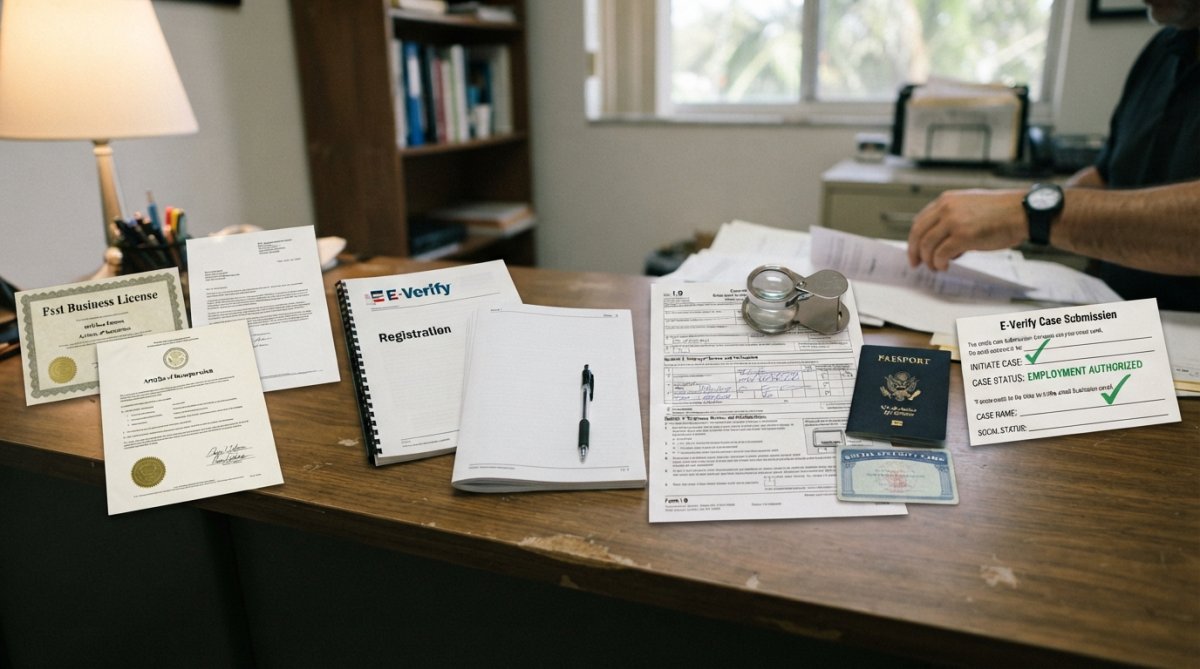
What Is E-Verify and How Does It Work?
E-Verify is a federal employment eligibility verification system operated jointly by the Department of Homeland Security (DHS) and the Social Security Administration (SSA). It allows employers to electronically confirm that newly hired employees are legally authorized to work in the United States.
The system works by cross-referencing employee information against DHS and SSA databases. When you submit Form I-9 data through E-Verify, the system compares the information to government records. Most cases resolve within seconds, returning either a confirmation of work authorization or a tentative nonconfirmation (TNC) that requires further action by the employee.
E-Verify works in conjunction with Form I-9, the federal employment eligibility form that all employers must complete for every hire. You cannot skip Form I-9 and go straight to E-Verify. The I-9 comes first, then E-Verify verifies the information provided on that form.
DHS and SSA Partnership
The Department of Homeland Security and Social Security Administration maintain the databases that power E-Verify. DHS checks immigration status and work authorization documents, while SSA verifies Social Security numbers and citizenship status. Employers cannot directly contact DHS or SSA to resolve discrepancies. Instead, the employee must initiate an appeal process if they receive a tentative nonconfirmation. This is a critical distinction: the burden falls on the employee to correct errors, not the employer.
E-Verify Threshold Florida: Who Must Comply
The 25-or-more-employees rule is the critical threshold in Florida’s E-Verify mandate. If your business has 25 or more employees at any point, you must enroll in E-Verify and verify all new hires within three business days of their start date.
The 25-or-More-Employees Rule
Florida Statutes Section 448.095 applies the mandate to private employers with 25 or more employees. This count includes full-time, part-time, and temporary workers. The effective date of July 1, 2023, means any business that reached 25 employees on or after that date must comply immediately. Growth can happen quickly, a successful hiring season can push you over the threshold without warning. Waiting until you’re forced into compliance creates a scramble to register, train staff, and verify existing employees retroactively.
Private Employers vs. Public Agencies
Private employers must comply only if they have 25 or more employees. Public agencies, including state agencies, local government, and school districts, must use E-Verify regardless of size. Public agencies face state-level enforcement through the Florida Department of Law Enforcement (FDLE) and Florida Department of Revenue (FDOR). Private employers face enforcement primarily through business license suspension and revocation. The FDOR can suspend or revoke your business license if you fail to comply with E-Verify requirements or if you knowingly hire unauthorized aliens.
Contractors, Subcontractors, and Casual Labor
Federal contractors and subcontractors must use E-Verify regardless of employee count. If your business holds a federal contract, you’re subject to federal E-Verify requirements, which are stricter than Florida’s state-level mandate. Subcontractors working on federal projects must also verify employment eligibility, creating cascading compliance obligations down the supply chain.
Casual labor still requires Form I-9 and E-Verify verification if you’re a covered employer. The duration of employment doesn’t exempt you from the requirement, only the size threshold does.
Florida I-9 Compliance and E-Verify Integration
Form I-9 is the foundation of employment eligibility verification. Every employer in the United States must complete an I-9 for every employee, regardless of E-Verify requirements. E-Verify simply verifies the information provided on that form.
Form I-9 Requirements and Timeline
Form I-9 must be completed within three business days of the employee’s start date. The employee must present original documents proving identity and work authorization. Acceptable documents include a passport, driver’s license, Social Security card, or a combination of documents that collectively prove identity and eligibility.
Many employers make the mistake of collecting documents but not completing the I-9 form itself. The form documents which documents you reviewed, the document numbers, and expiration dates. Incomplete or improperly completed I-9s create compliance gaps that audits will expose.
Three Business Days for E-Verify Submission
Once you complete Form I-9, you have three business days to submit the employee information to E-Verify. Weekends and federal holidays don’t count toward the three-business-day window. If an employee starts on Friday, your deadline is Tuesday. Building buffer time into your hiring process, collecting documents a day early, completing I-9s the same day, prevents deadline misses.
Florida E-Verify Penalties: What Happens if You Don’t Comply
Non-compliance with Florida’s E-Verify mandate carries escalating penalties.
Civil Penalties and Fines
Florida law imposes civil penalties for knowingly hiring unauthorized aliens. A first violation carries a fine of between $500 and $1,000 per unauthorized employee. A second violation within five years increases the penalty to between $1,000 and $5,000 per unauthorized employee. These penalties are per employee, not per occurrence. A business with five unauthorized workers faces penalties of $2,500 to $5,000 on a first violation, or $5,000 to $25,000 on a second violation. The penalties apply even if you didn’t knowingly hire an unauthorized worker. Using E-Verify in good faith is your primary defense against liability.
Business License Suspension and Revocation
Beyond fines, the FDOR can suspend or revoke your business license for E-Verify non-compliance. A suspension temporarily halts operations. A revocation is permanent, requiring you to reapply for a license and meet all requirements from scratch. The FDOR can also deny license renewal if you fail to certify E-Verify compliance.
Debarment from State Contracts
Businesses that violate E-Verify requirements can be debarred from state contracts. Debarment means you’re ineligible to bid on or receive contracts with Florida state agencies, local governments, or public institutions. For businesses that rely on government contracts, debarment is a business-ending penalty.
Florida Department of Revenue E-Verify Certification
Compliance certification ties directly to business license renewal and reemployment tax reporting. The FDOR requires employers to certify that they’ve complied with E-Verify requirements before renewing their business license.
Compliance Certification Requirements
When you renew your business license with the FDOR, you must certify that you’ve enrolled in E-Verify and verified all new hires. False certification is a serious offense. If you certify compliance but haven’t actually enrolled in E-Verify, you’ve committed fraud. The FDOR can deny license renewal, assess penalties, and refer the matter to law enforcement.
Reemployment Tax Return and FDOR Audits
The FDOR also verifies E-Verify compliance through reemployment tax return audits. When you file your reemployment tax return, the FDOR may cross-reference your employee count and E-Verify enrollment status. Audits typically focus on whether you’ve enrolled in E-Verify if you’re a covered employer and whether you’ve verified all new hires. Maintaining clear E-Verify records prevents audit complications.
Step-by-Step E-Verify Registration and Usage for Small Businesses
For businesses approaching or exceeding the 25-employee threshold, understanding the mechanics of E-Verify enrollment and use is essential.
Creating Your E-Verify Account
To enroll in E-Verify, visit the official E-Verify website and create an employer account. You’ll need your Employer Identification Number (EIN), business name, address, and contact information. The registration process takes approximately 15-20 minutes. After submitting your application, E-Verify sends a confirmation email with your username and temporary password.
E-Verify requires at least one designated employer representative who can access the system and verify employees. You can designate multiple representatives, which is practical for larger HR departments. Before you can verify your first employee, you must complete the E-Verify tutorial and pass a brief assessment. This typically takes 30-45 minutes.
Submitting Employee Information
Once your account is active, you submit employee information through the E-Verify portal. You enter the employee’s name, Social Security number, date of birth, and document information from their I-9 form. The system accepts information for employees hired within the past three business days. You cannot submit information for employees hired more than three days ago.
After you submit information, E-Verify typically returns a result within seconds. Most cases receive immediate confirmation. Some cases return a tentative nonconfirmation (TNC), which requires the employee to take action. Keep detailed records of all E-Verify submissions. The FDOR may request these records during audits or license renewal.
Handling Tentative Nonconfirmations (TNCs)
A tentative nonconfirmation means the employee’s information doesn’t match government records. This doesn’t automatically mean the employee is unauthorized, it means there’s a discrepancy that needs resolution. When an employee receives a TNC, they have the right to contest it. The employee must contact E-Verify’s employee hotline and request a case review.
The employee has eight calendar days to contest the TNC. During this period, you cannot terminate the employee based on the TNC alone. If the employee doesn’t contest within eight days, the TNC becomes a final non-confirmation, and you must terminate employment. Common reasons for TNCs include name changes, recent marriages, Social Security number errors, or immigration status changes.
As the employer, your role is to inform the employee of the TNC and provide them with the notice and appeal instructions. You don’t participate in the appeal process. However, you must maintain records of the TNC, the notice provided, and the eventual outcome.
Terminating an employee immediately upon receiving a TNC is illegal. You must allow the employee the full eight-day contest period. Premature termination exposes you to discrimination claims and wrongful termination lawsuits.
Common Compliance Mistakes and How to Avoid Them
Small business owners often make preventable mistakes that create compliance problems.
Waiting until the deadline to submit to E-Verify. Build in a one-day buffer, complete I-9s and submit to E-Verify by day two.
Incomplete or improperly completed I-9 forms. Use the official I-9 form and follow the instructions precisely. The form is updated regularly, and you must use the current version.
Failing to designate authorized E-Verify representatives. Designate at least two authorized representatives so the system continues functioning if someone departs.
Not maintaining E-Verify records. Retain E-Verify records for at least three years. If audited and unable to produce records, the FDOR presumes non-compliance.
Verifying existing employees retroactively. Florida’s law requires E-Verify for new hires going forward. If you hire someone after July 1, 2023, and you’re a covered employer, you must verify them.
Set a calendar reminder for your business license renewal date. Before renewal, audit your E-Verify enrollment and verification records. Confirm that you’ve enrolled and verified all new hires.
Misunderstanding the three-business-day window. The clock starts on the employee’s first day of work. Weekends and federal holidays don’t count.
Treating E-Verify as optional for small businesses. Even if you’re under 25 employees, if you’re a federal contractor, E-Verify is mandatory.
Navigating Florida’s E-Verify requirements doesn’t have to be complicated. The rules are clear: if you have 25 or more employees, you must enroll and verify new hires within three business days. The consequences of non-compliance, fines, license suspension, and debarment, are serious enough to warrant immediate attention.
For South Florida small business owners facing these requirements, Matthew Fornaro, P.A. provides practical legal guidance on employment compliance, business formation, and regulatory obligations. With over two decades of experience working with entrepreneurs in Coral Springs, Parkland, and Broward County, the firm helps businesses understand their legal responsibilities and implement compliant hiring practices. Getting compliance right from the start protects your business license and your reputation. Florida Statutes Section 448.095 outlines the specific requirements, and the E-Verify official system and employer resources provides enrollment and training materials. For personalized guidance tailored to your business situation, contact Matthew Fornaro, P.A. to discuss your employment law obligations and build a compliant hiring process that scales with your growth.
| Compliance Element | Timeline | Responsibility | Consequence of Delay |
|---|---|---|---|
| Complete Form I-9 | Within 3 business days of hire | Employer | Federal violation; liability for unauthorized employment |
| Submit to E-Verify | Within 3 business days of hire | Employer | State violation; license suspension risk |
| Respond to TNC | Employee has 8 calendar days to contest | Employee initiates; employer provides notice | TNC becomes final; employee must be terminated |
| Certify compliance at license renewal | Upon business license renewal | Employer | License renewal denial |
| Maintain E-Verify records | Retain for 3+ years | Employer | Presumed non-compliance in audits |
Frequently Asked Questions
What is the employee threshold for E-Verify in Florida for private businesses?
Under Florida Statutes Section 448.095, private employers with 25 or more employees are required to use E-Verify for all new hires. Businesses with fewer than 25 employees are not currently mandated to use the system, though they may voluntarily participate. The threshold applies to the total number of employees on the payroll, regardless of whether they work full-time or part-time.
What are the penalties for not using E-Verify in Florida?
Employers who fail to comply with Florida's E-Verify mandate face serious consequences, including civil penalties and fines, suspension or revocation of business licenses by the Florida Department of Revenue, and potential debarment from state contracts and employment. The penalties escalate with repeated violations, making compliance critical for avoiding business disruption and financial liability.
When did Florida's E-Verify law for private employers take effect?
Florida's E-Verify requirement for private employers took effect on July 1, 2023, following the passage of SB 1718. Employers with 25 or more employees were required to begin using E-Verify for all new hires on this date. Those with fewer than 25 employees are not subject to the mandate unless their workforce grows to meet the threshold.
How do I handle a Tentative Nonconfirmation (TNC) on E-Verify?
When E-Verify returns a Tentative Nonconfirmation, you must notify the employee in writing and provide them with a notice of their right to contest the finding. The employee has eight federal working days to contact SSA or DHS to resolve the discrepancy. During this period, you may not take adverse action against the employee. If the TNC is not resolved, you must terminate employment. Document all steps and maintain records for compliance and potential audits by the Florida Department of Law Enforcement.
EXTERNAL CITATIONS VERIFICATION:
- [EXTERNAL_LINK: Florida Statutes Section 448.095 employment eligibility verification requirements | flsenate.gov]
- [EXTERNAL_LINK: E-Verify official system and employer enrollment guide | uscis.gov]
- [EXTERNAL_LINK: Department of Homeland Security E-Verify employer resources | dhs.gov]
This article was written using GrandRanker


