

Key Takeaways
- Florida business law protects companies from unfair competition, contract breaches, and partner disputes.
- Acting early saves time, money, and business relationships.
- An experienced business attorney helps you assess risk and choose the right legal strategy.
Table of Contents
- Understanding Florida Statutes Chapter 720 and HOA Regulatory Compliance
- Florida HOA Board Member Requirements and Fiduciary Duties
- HOA Financial Transparency Florida: Reporting and Audit Requirements
- Assessment Collection Policies and Tax Obligations
- Florida HOA Rules Enforcement and Covenant Compliance
- Website Requirements and Record Inspection Access
- Practical Compliance Checklist for Board Members
- Technology Integration and Developer Transition Compliance
Last Updated: July 28, 2026
Understanding HOA regulatory compliance in Florida requires navigating state statutes, fiduciary duties, and operational requirements that boards must follow to keep their communities functioning legally and ethically. At Matthew Fornaro, P.A., we’ve worked with numerous HOA boards across South Florida to ensure they stay compliant with these regulations. This guide covers the essential framework boards need to implement to protect their associations, maintain member trust, and avoid costly enforcement actions.
Understanding Florida Statutes Chapter 720 and HOA Regulatory Compliance
Florida Statutes Chapter 720 is the foundational law governing homeowners associations throughout the state. This statute establishes the rights and responsibilities of both associations and parcel owners, covering formation, governance, financial management, and dispute resolution.
Chapter 720 applies to residential communities with restrictive covenants, whether they’re condominiums, planned communities, or traditional homeowners associations. One critical aspect many boards overlook is that Chapter 720 creates statutory duties that cannot be contracted away. Board members cannot defer to a Community Association Manager (CAM) and claim ignorance of violations, the fiduciary duty belongs to the board.
According to Florida Legislature’s official Chapter 720 statute, the law requires associations to maintain specific records, adopt budgets, collect assessments, and enforce covenants and restrictions. These are mandatory obligations that expose boards to liability if ignored.
Many boards assume that hiring a professional CAM transfers all compliance responsibility to that manager. In reality, the board retains ultimate fiduciary duty. Always verify that your CAM is implementing Chapter 720 requirements correctly, and document board oversight of compliance tasks.
Florida HOA Board Member Requirements and Fiduciary Duties
Board members in Florida carry legal responsibilities that extend beyond attending monthly meetings. The statute imposes fiduciary duties on all directors, meaning they must act in the association’s best interest and exercise reasonable care in making decisions affecting the community.
Education and Certification Standards
Florida law requires that board members complete education on Chapter 720 requirements within one year of taking office. This is a statutory mandate, not a suggestion. The education must cover the association’s financial documents, policies, and the provisions of Chapter 720 that apply to the association’s type.
Officers (president, treasurer, secretary, vice president) must complete specific financial training if they oversee financial matters. This requirement recognizes that financial mismanagement is one of the most common sources of HOA disputes and litigation.
A board member who completes education late or not at all creates personal liability exposure. Courts have found individual board members personally responsible for losses resulting from their failure to complete mandatory education. This is one of the easiest compliance violations to prevent, yet many boards still miss it.
Fiduciary Responsibilities and Conflict of Interest
Board members owe three core fiduciary duties: the duty of care, the duty of loyalty, and the duty of obedience. The duty of care requires that board members act with the care a reasonably prudent person would exercise. The duty of loyalty requires that board members act in the association’s best interest, not their own. The duty of obedience requires that board members follow the association’s governing documents and applicable law.
Conflict of interest rules prohibit board members from voting on matters where they have a personal financial interest. A board member who contracts with the association for services, sells property to the association, or receives payments from vendors must disclose this conflict and typically recuse themselves from voting on related matters. Chapter 720 requires that conflicts of interest be documented in board meeting minutes, creating a clear record that the board addressed the conflict appropriately.
HOA Financial Transparency Florida: Reporting and Audit Requirements
Financial transparency is the cornerstone of HOA regulatory compliance in Florida. Members have a statutory right to inspect financial records, and boards must maintain accurate, complete financial documentation.
Annual Financial Statements and Fiscal Year-End Procedures
Every association must prepare annual financial statements showing income, expenses, reserves, and liabilities in accordance with generally accepted accounting principles (GAAP) or the accounting method the association has consistently used.
For associations with annual revenues exceeding $150,000, an independent audit or review is required. The audit must be conducted by a certified public accountant (CPA) and completed within 120 days of fiscal year-end. The auditor’s report must be provided to all members within 21 days of completion.
Chapter 720 requires that financial records be maintained for at least seven years. Boards should implement a records management system that preserves financial documents in a searchable, organized format.
The most common financial compliance failure is incomplete or delayed financial reporting. Boards that miss the 120-day audit deadline or provide incomplete financial statements to members face member complaints, regulatory action, and potential litigation. Establish a fiscal year-end timeline with specific deadlines for each task, and assign responsibility to a specific board member or manager.
Reserve Funding and Budget Adoption
Florida law requires that associations fund reserves for major components that will need replacement or repair, including roofs, structural elements, parking areas, and other common area components with a useful life of more than one year.
Associations can fully fund reserves or partially fund reserves if they disclose the funding percentage to members and explain the funding plan. The budget adoption process requires that the board prepare a proposed budget, provide it to members for review, and hold a meeting to discuss the budget before adoption. Members have the right to speak about the proposed budget and challenge proposed assessment increases.
Assessment Collection Policies and Tax Obligations
Assessments are the primary revenue source for most associations. Collecting assessments on time and in full is essential to maintaining adequate cash flow for operations and reserves.
Assessment Calculation and Notice Requirements
Assessments must be calculated consistently and fairly across all properties based on criteria specified in the association’s governing documents. Before assessments become due, the association must provide written notice to all members at least 14 days in advance, including the amount, due date, payment address, and information about late fees or collection procedures.
Special assessments require additional notice and, in many cases, member approval. The notice must explain the reason for the special assessment and how the funds will be used.
Collection Procedures and Enforcement
When assessments are not paid on time, the association can impose late fees of up to 10 percent of the unpaid assessment, though some governing documents specify lower amounts. If assessments remain unpaid, the association can place a lien on the property, giving the association a legal claim that can be foreclosed to force sale of the property and satisfy unpaid assessments.
Many associations use collection agencies or attorneys to pursue unpaid assessments. These professionals can accelerate collection and reduce administrative burden on the board while ensuring that collection procedures comply with Chapter 720.
Florida HOA Rules Enforcement and Covenant Compliance
Enforcing community rules and covenants maintains property values and ensures that all members follow the same standards. However, enforcement must be conducted fairly and consistently, with proper notice and opportunity for members to respond to alleged violations.
Rule-Making Authority and Covenants and Restrictions
The board has authority to make rules governing the use of common areas and, in some cases, individual properties. Rules must be consistent with the association’s governing documents and cannot conflict with state law or local ordinances.
Covenants and restrictions are typically recorded in the property deed and are binding on all owners. Before adopting new rules, the board must follow the procedures specified in the governing documents, which often require notice to members and a comment period before rules become effective.
Dispute Resolution and Private Mediators
Chapter 720 encourages associations and members to resolve disputes through mediation before resorting to litigation. When a member disputes an enforcement action or other board decision, the member can request mediation. A private mediator will meet with both parties and attempt to reach a mutually acceptable resolution.
If mediation fails, the member can pursue litigation or file a complaint with the Department of Business and Professional Regulation (DBPR). Boards should document all enforcement actions, including the notice provided to the member, the member’s response, and the board’s decision, creating a clear record that the board acted consistently and fairly.
Website Requirements and Record Inspection Access
Chapter 720 requires that associations maintain a website (or provide records in electronic format) and make certain documents available to members online, including governing documents, meeting minutes from the past three years, financial statements, budget, reserve study, and rules and regulations.
The website must be secure and accessible only to members who can verify their membership. Members have the right to request copies of any association record within 10 business days of the request. The association can charge a reasonable copying fee.
The statute also requires that associations provide notice of meetings, budget adoption, and other significant events through the website or electronic means, ensuring that all members receive notice.
Practical Compliance Checklist for Board Members
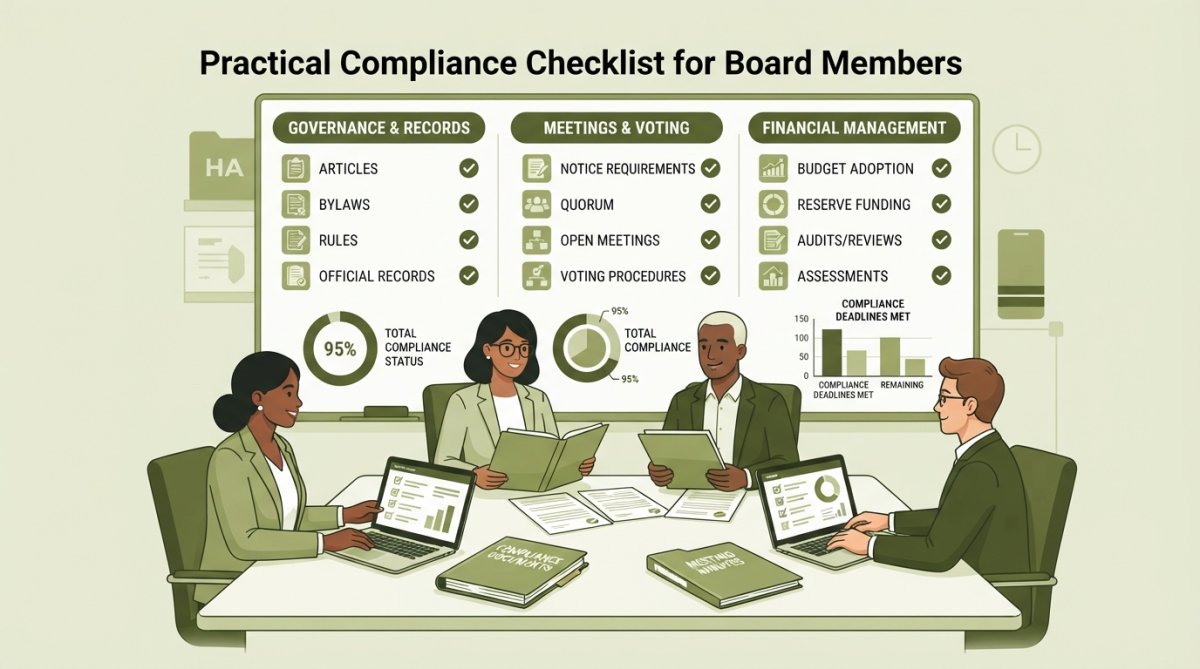
Staying compliant with Chapter 720 requires consistent attention to specific tasks throughout the year.
Monthly, Quarterly, and Annual Compliance Tasks
Monthly Tasks:
- Review financial statements and bank reconciliations
- Verify that assessments are being collected on schedule
- Document all board decisions in meeting minutes
- Review any member complaints or disputes
Quarterly Tasks:
- Review reserve funding adequacy
- Verify that all vendors are properly insured
- Review enforcement actions and member disputes
- Assess whether special assessments will be needed
Annual Tasks:
- Complete annual audit or review and provide to members
- Adopt next year’s budget and provide to members for review
- Verify that all board members have completed required education
- Conduct reserve study update or full reserve study
- Review and update insurance coverage
- Conduct annual meeting and election of officers
| Task | Frequency | Deadline |
|---|---|---|
| Financial statement review | Monthly | End of month |
| Meeting minutes distribution | Within 30 days | 30 days after meeting |
| Assessment collection follow-up | Monthly | Ongoing |
| Audit completion and distribution | Annual | 120 days after fiscal year-end |
| Budget adoption and member notice | Annual | 14 days before fiscal year-end |
| Board member education completion | Within 12 months | 12 months from taking office |
| Reserve study update or renewal | Every 3 years | Per schedule |
| Annual meeting and election | Annual | Per governing documents |
Common Mistakes to Avoid
The most frequent compliance mistakes boards make are missing audit deadlines, failing to provide financial statements to members, not documenting board decisions in minutes, and skipping board member education. Boards that attempt to enforce rules without providing clear notice to the member violate Chapter 720 and expose themselves to litigation.
Boards also frequently fail to maintain adequate reserves. While fully funding reserves is not always required, boards must disclose the funding percentage to members and have a plan to increase funding over time.
One overlooked mistake is failing to update the reserve study regularly. A reserve study that is more than three years old is essentially useless for budgeting purposes. Boards should commission a new reserve study every three years at minimum, and annually update the existing study to reflect actual component deterioration and cost inflation.
Technology Integration and Developer Transition Compliance
Modern associations increasingly rely on software to manage compliance tasks, track records, and communicate with members. Selecting the right technology and implementing it correctly can significantly reduce compliance burden.
Software Solutions for Regulatory Tracking
Community association management software handles many compliance tasks automatically, including assessment collection, financial reporting, meeting scheduling, document storage, and member notices. When selecting software, boards should verify that the platform supports Chapter 720 requirements specifically and can generate the financial reports required by law.
The software should also provide secure member access to records and documents, reducing administrative burden on staff and ensuring that members can access information 24/7.
Transitioning from Developer to Homeowner Control
When associations transition from developer control to homeowner control, the developer must turn over all association records, financial statements, and governing documents to the newly elected homeowner board. The new homeowner board should conduct a comprehensive audit of the association’s finances and operations, which often reveals issues with reserve funding, vendor contracts, or compliance procedures that the developer board overlooked.
The new board should also review all contracts entered into by the developer and evaluate whether to continue, renegotiate, or terminate these contracts.
Board members navigating HOA regulatory compliance in Florida face substantial legal and fiduciary obligations, but these obligations become manageable when boards implement systematic compliance procedures and stay informed about statutory requirements. Matthew Fornaro, P.A. helps HOA boards throughout Coral Springs, Parkland, and Broward County understand their Chapter 720 obligations, structure governance procedures, and resolve compliance disputes. With over 20 years of experience in business law and community association matters, the firm provides practical, results-oriented guidance that protects board members from personal liability and keeps associations operating within legal boundaries. Contact the firm today to discuss your association’s specific compliance challenges and develop a strategy that protects your community.
Frequently Asked Questions
What are the main requirements under Florida Statutes Chapter 720 for HOA regulatory compliance?
Chapter 720 establishes the legal framework governing homeowners associations in Florida, covering board governance, financial reporting, assessment collection, record access, and dispute resolution. HOAs must maintain fiduciary duty, provide statutory disclosures, adopt budgets, conduct audits when required, and ensure parcel owners have access to common area records. Compliance involves following notice requirements, maintaining proper documentation, and adhering to rule-making and enforcement procedures outlined in the statute.
What are the educational requirements for Florida HOA board members?
Florida HOA board member requirements include completing education on Chapter 720 obligations and community association management principles. New board members must complete an approved education course within specific timeframes. The Community Association Manager (CAM) certification is required for professional managers. Board members should understand fiduciary duties, financial management, dispute resolution, and enforcement authority. Ongoing education helps ensure compliance with evolving statutory requirements and reduces liability exposure for the association.
How does HOA financial transparency Florida impact homeowner trust and regulatory compliance?
HOA financial transparency Florida requires associations to provide regular financial reporting, including annual financial statements and reserve funding disclosures. Parcel owners must have access to budget documents, audit procedures results, and fiscal year-end statements. Transparency builds homeowner confidence, reduces fraud risk, and demonstrates proper stewardship of assessments. Clear financial communication, accessible website information, and timely disclosure of reserve funding decisions are essential compliance elements that protect both the association and individual homeowners.
What steps should an HOA take when transitioning from developer control to homeowner governance?
Developer turnover requires careful documentation and compliance procedures. The developer must transfer control of the board to homeowners, provide all financial records, reserve studies, and governing documents. The association must conduct a thorough audit, establish new assessment collection policies, and ensure all statutory disclosures are current. A new board should immediately implement compliance procedures, review covenants and restrictions enforcement, establish proper record-keeping systems, and conduct board member education. Legal counsel should oversee the transition to prevent gaps in governance.
This article was written using GrandRanker


