

Key Takeaways
- Florida business law protects companies from unfair competition, contract breaches, and partner disputes.
- Acting early saves time, money, and business relationships.
- An experienced business attorney helps you assess risk and choose the right legal strategy.
Most entrepreneurs assume that forming an LLC automatically cuts their tax bill. It doesn’t. The real difference in the sole proprietorship vs LLC decision comes down to liability exposure, not immediate tax savings. Without an S-Corp election, both structures pay the same self-employment tax on net profit. What you’re actually choosing between is personal financial risk on one side and added compliance on the other. This article breaks down both structures clearly so you can make an informed choice before you start, scale, or restructure your business.
Table of Contents
- Key Takeaways
- Sole proprietorship vs LLC: understanding the basics
- Side-by-side comparison of both structures
- Tax differences between LLC and sole proprietorship
- How to choose business structure for your situation
- My take on this decision after 20 years with small businesses
- Ready to form your business the right way?
- FAQ
Key Takeaways
| Point | Details |
|---|---|
| LLC does not cut taxes by default | Without an S-Corp election, both structures pay the same 15.3% self-employment tax on profits. |
| Liability protection is the real benefit | An LLC legally separates your personal assets from business debts and lawsuits. |
| Formation costs differ significantly | Sole proprietorship costs nothing to form; LLC filing fees range from $50 to $500. |
| Income level should guide your choice | S-Corp election and LLC structure typically become worthwhile above $50,000 in net profit. |
| Compliance is non-negotiable with an LLC | Mixing personal and business finances can void your liability protection entirely. |
Sole proprietorship vs LLC: understanding the basics
Before you can compare the two, you need to understand what each structure actually is and how each one treats you legally.
What is a sole proprietorship?
A sole proprietorship is not a legal entity separate from you. You and your business are the same thing in the eyes of the law. There is no paperwork to file, no state registration required, and no formation fee. When you start freelancing, consulting, or selling products without filing anything, you are automatically operating as a sole proprietor.
From a tax standpoint, your business income flows directly to your personal tax return. The IRS taxes it as ordinary income, and you owe self-employment tax on top of that. The process is simple. The exposure is not.
Here’s what you need to keep in mind with a sole proprietorship:
- Zero formation cost (outside of an optional DBA filing if you operate under a trade name)
- Pass-through taxation with income reported on Schedule C of your personal return
- Unlimited personal liability for all business debts, contracts, and lawsuits
- Simple operations with no separate bank account legally required (though still smart practice)
- No annual state filings or compliance requirements
The simplicity is real. But so is the risk. If a client sues your sole proprietorship and wins, they can go after your personal savings, your car, and your home. There is no legal wall between you and the business.
Pro Tip: If you are operating as a sole proprietor under a name other than your own legal name, file a “Doing Business As” (DBA) registration with your county or state. It’s inexpensive and protects your brand name locally.
What is an LLC?
An LLC, or limited liability company, is a state-registered legal entity that exists separately from you. When you form one, you are creating a distinct legal person that can own property, enter contracts, and be sued on its own. That separation is the entire point.

Forming an LLC costs between $50 and $500 depending on your state, and it requires filing Articles of Organization with your state’s division of corporations. In Florida, that process is handled through the Florida Department of State.
Key characteristics of an LLC include:
- Limited liability protection that shields personal assets from business debts and lawsuits
- State registration with Articles of Organization and a registered agent
- Ongoing compliance requirements including annual reports and state fees
- Default pass-through taxation as a disregarded entity (for single-member LLCs)
- Flexible management structure with an operating agreement
Approximately 42.9% of small U.S. businesses operate as LLCs in 2026, which reflects how widely entrepreneurs value that liability protection. The LLC’s main value rests on the legal wall it builds between your personal finances and your business obligations.
The trade-off is real too. Compliance costs range from $50 to $500+ annually regardless of whether the business made a profit. That is money out the door even in a slow year.
Pro Tip: Florida LLCs must file an annual report with the state every year by May 1st. Missing this deadline triggers a $400 late fee, and failure to file can result in administrative dissolution of your LLC.
Side-by-side comparison of both structures
Understanding each structure individually is one thing. Seeing them next to each other makes the decision much clearer.
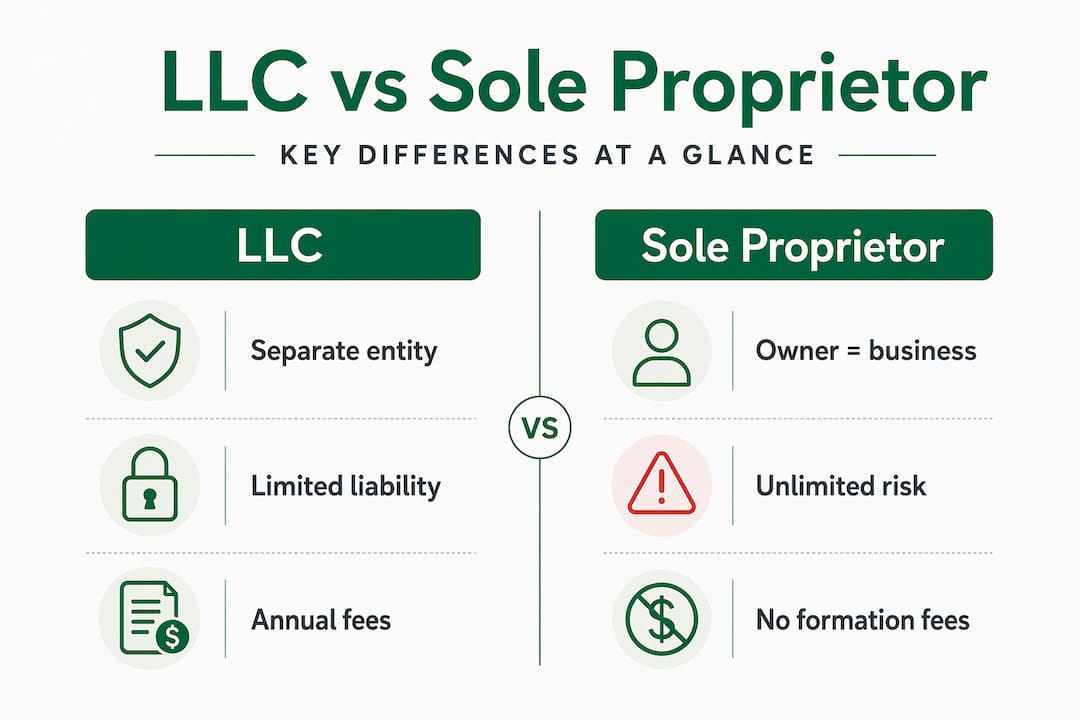
| Category | Sole Proprietorship | LLC |
|---|---|---|
| Legal identity | Owner and business are the same | Separate legal entity |
| Personal liability | Unlimited | Limited to your investment |
| Formation cost | $0 | $50 to $500 (state filing) |
| Annual compliance | None required | Annual reports, registered agent, state fees |
| Default taxation | Schedule C, personal return | Same as sole proprietorship |
| S-Corp election available | No | Yes |
| Separate bank account required | No (but recommended) | Yes, to preserve liability protection |
| Credibility with clients/lenders | Lower perceived formality | Higher perceived legitimacy |
The liability column is where these two structures diverge most sharply. Both pay the same taxes by default. Both report income on a personal return. But one protects your personal assets and one leaves them completely exposed.
On costs, the gap is not just the formation fee. The administrative burden of an LLC, including compliance and recordkeeping, is a necessary trade-off for the significant reduction in personal financial risk. A freelance graphic designer earning $25,000 per year may find the annual compliance overhead genuinely burdensome. A consultant billing $200,000 per year would find it negligible.
Pro Tip: When comparing LLC vs sole proprietorship for funding purposes, many banks and investors simply will not take a sole proprietor as seriously. An LLC signals that you are running a real business, not a side project.
Tax differences between LLC and sole proprietorship
Here is where most of the confusion lives. Many entrepreneurs believe that forming an LLC is a tax strategy. It is not, at least not by default.
Both sole proprietors and single-member LLC owners pay 15.3% self-employment tax on all net profit. A single-member LLC is treated as a disregarded entity by the IRS, which means the tax treatment is identical to a sole proprietorship out of the box. You do not save a single dollar in taxes simply by filing Articles of Organization.
The tax differences in LLC vs sole proprietorship only appear when you make an active election. Here is how the math works:
- Default single-member LLC: 15.3% self-employment tax on 100% of net profit. Same as a sole proprietor.
- S-Corp election: You pay yourself a reasonable salary and take remaining profit as a distribution. Payroll taxes apply only to the salary portion, not the distribution.
- Example: If your LLC nets $120,000 and you pay yourself a $70,000 salary, you owe self-employment taxes on $70,000 instead of the full $120,000. That gap can represent several thousand dollars in annual savings.
The catch is the overhead. S-Corp status requires running payroll, filing separate business tax returns, and potentially hiring an accountant. Those costs add up. S-Corp election and LLC structure generally become worthwhile above $50,000 in net profit. Below that threshold, the administrative costs often exceed the tax savings.
The S-Corp election option is not available to sole proprietors without first forming a separate legal entity. So if you want that flexibility in the future, forming an LLC now keeps the door open.
How to choose business structure for your situation
Knowing the differences is only half the work. You still need to apply this to your specific situation. Here is a practical framework to guide that decision.
-
Assess your liability exposure. Do you work with clients in person? Do you have employees? Do you sell physical products? Any of these scenarios create meaningful risk of lawsuits. If your personal assets could be at stake, the benefits of LLC protection become much harder to ignore.
-
Look at your income projections. If you are earning under $30,000 net, the LLC formation and compliance costs may not justify the tax advantage. If you are near or above $50,000 net, the S-Corp path starts to make financial sense. Run the numbers with an accountant before deciding.
-
Consider your growth timeline. Planning to bring on a partner, raise funding, or hire employees within the next two years? Start as an LLC. Converting from sole proprietorship later is possible but creates transition costs and potential gaps in protection.
-
Be honest about your willingness to handle compliance. An LLC requires a separate bank account, proper recordkeeping, annual state filings, and maintaining a registered agent. Mixing personal and business finances can pierce the corporate veil and void your liability protection entirely. If you know you will not stay organized, that protection evaporates.
-
Factor in your credibility needs. If you are pitching corporate clients, applying for business loans, or working in professional services, an LLC signals legitimacy. That perception has real business value beyond the legal protections. You can review the step-by-step legal entity guide if you need a deeper walkthrough of what formation actually involves.
The honest answer for many early-stage entrepreneurs is this: start as a sole proprietor to validate the business, then convert to an LLC before the money gets real. That is a legitimate path. Just do not stay a sole proprietor past the point where the risk outweighs the convenience.
Pro Tip: If you are forming an LLC in Florida, draft an operating agreement even if you are the only member. It is not legally required for a single-member LLC, but it reinforces the legal separation between you and the business, which matters if you ever face litigation.
My take on this decision after 20 years with small businesses
I’ve watched entrepreneurs make both mistakes. Some form an LLC on day one for a side project generating $500 a month, pay the annual fees and compliance costs, and get nothing meaningful in return. Others run significant operations as sole proprietors for years, accumulating personal assets and business risk in the same unprotected bucket, and then face a lawsuit that threatens everything they built.
In my experience, the question people should ask first is not “which structure saves me more money?” It’s “what do I stand to lose if something goes wrong?” A sole proprietorship formation guide will tell you the process is free. What it won’t tell you is the cost of defending yourself personally in a business dispute while your home equity sits exposed.
I’ve seen the LLC protection argument dismissed by entrepreneurs who think their industry is low-risk, only to face contract disputes they never anticipated. The personal liability exposure in a sole proprietorship is not hypothetical. It’s something I have seen play out in real cases.
The tax savings from S-Corp election are real, but they require discipline. You need to run payroll correctly, file on time, and pay yourself a salary the IRS considers reasonable for your industry. Get that wrong and the IRS can reclassify your distributions as wages and hit you with back taxes and penalties. The savings are worth pursuing above the right income level, but not without proper guidance.
Form the LLC before you need it. The cost of formation is minor compared to the cost of a single lawsuit against an unprotected sole proprietor.
— Matthew
Ready to form your business the right way?
Choosing between a sole proprietorship and an LLC is one of the most consequential early decisions you will make as a business owner. Getting it right means understanding not just the costs but the legal exposure that comes with each path.

At Fornarolegal, we work with entrepreneurs and small business owners across South Florida to get business formation right from the start. Whether you need help preventing business litigation before a dispute arises or guidance on forming your Florida business with the right structure, Matthew Fornaro provides practical, AV®-rated legal counsel with over 20 years of experience. Contact us today for a consultation tailored to your specific Florida business needs.
FAQ
What is the main difference between a sole proprietorship and an LLC?
The primary difference is liability protection. A sole proprietorship offers no separation between you and your business, meaning personal assets are exposed to business debts and lawsuits. An LLC creates a separate legal entity that shields your personal finances.
Does forming an LLC reduce your taxes automatically?
No. A single-member LLC is taxed identically to a sole proprietorship by default. Both structures pay 15.3% self-employment tax on net profit. Tax savings only come through an active S-Corp election, which works best above $50,000 in annual net profit.
How much does it cost to form an LLC vs a sole proprietorship?
A sole proprietorship costs nothing to form, while LLC state filing fees range from $50 to $500. LLCs also carry ongoing annual compliance costs that typically run $50 to $500 or more per year.
Can a sole proprietor convert to an LLC later?
Yes. Many entrepreneurs start as sole proprietors and convert to an LLC as income and risk grow. However, converting later involves transition steps including new contracts, updated bank accounts, and state filings, so doing it proactively is generally cleaner.
When does it make sense to stay a sole proprietor?
A sole proprietorship makes practical sense when you are in early validation mode, earning under $30,000 in net profit, operating in a low-liability field, and not yet ready to manage compliance. Once income grows or personal assets accumulate, the benefits of LLC protection typically outweigh the costs.
Recommended
- Navigating Your Florida Startup: Choosing the Right Legal Entity » Matthew Fornaro, P.A.
- Choosing the Right Business Entity for Your Florida Startup: A Step-by-Step Guide » Matthew Fornaro, P.A.
- Comprehensive Guide to Forming a Business in Florida: Legal Insights for Entrepreneurs » Matthew Fornaro, P.A.
- The Ultimate Legal Checklist for Florida Entrepreneurs: Successfully Forming Your New Business » Matthew Fornaro, P.A.


