Key Takeaways
- Florida business law protects companies from unfair competition, contract breaches, and partner disputes.
- Acting early saves time, money, and business relationships.
- An experienced business attorney helps you assess risk and choose the right legal strategy.
Starting a business with someone you trust feels natural. You share a vision, divide the work, and get moving. But if you have not put a written partnership agreement in place, you are leaving one of the most important aspects of your business to chance. A partnership agreement is a legally binding document that defines how two or more people will own, operate, and share in a business. For small business owners and entrepreneurs in South Florida, understanding this document is not optional. It is the foundation of a business relationship that can either protect you or expose you to serious financial and legal risk.
Table of Contents
- Key takeaways
- What is a partnership agreement under Florida law
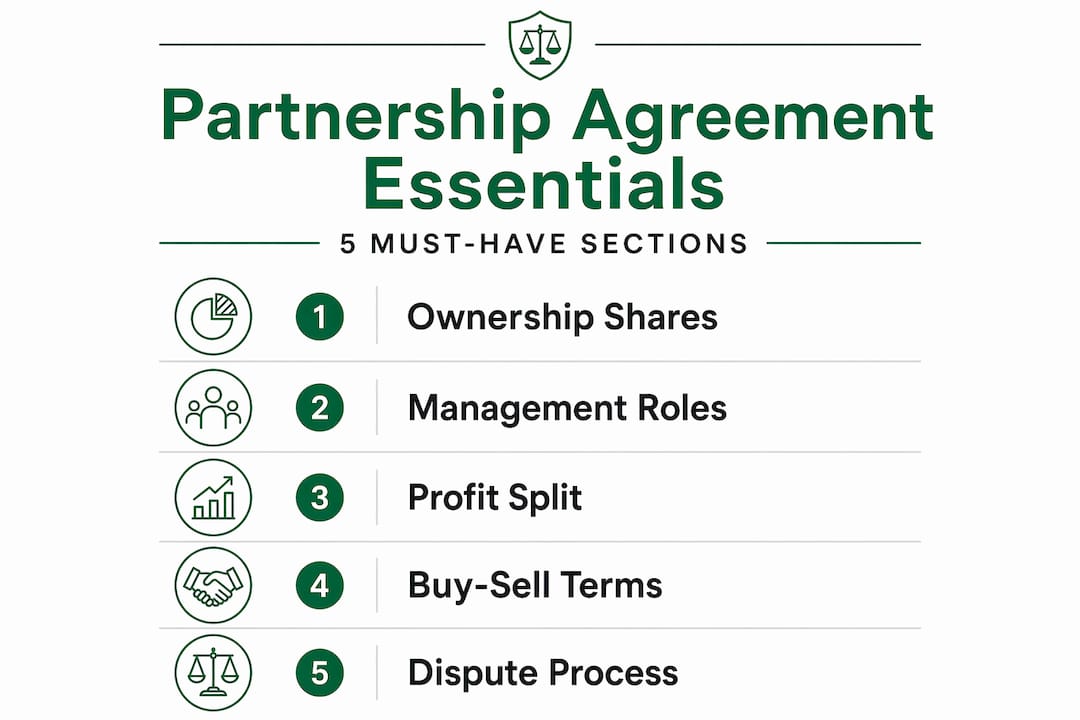
- What to include in a partnership agreement
- Florida’s legal limits on what you can agree to
- Common risks when partnership agreements go wrong
- How to create a partnership agreement step by step
- My perspective on partnership agreements after 20 years
- Work with a South Florida business attorney
- FAQ
Key takeaways
| Point | Details |
|---|---|
| Written agreements protect you | Verbal deals rely on memory and trust; written agreements are enforceable in Florida courts. |
| Florida law fills in the gaps | Without a written agreement, Florida’s default partnership rules apply, which may not match your intentions. |
| Non-waivable duties exist | Florida Statute 620.8103 prohibits eliminating loyalty and good faith duties, even in written agreements. |
| Exit terms prevent litigation | Defining buyout and exit procedures upfront is the single best way to avoid costly disputes later. |
| Legal review is non-negotiable | Generic templates do not account for Florida law or your specific business structure. |
What is a partnership agreement under Florida law
A partnership agreement, in its simplest form, is a contract between two or more people who agree to run a business together for profit. The partnership agreement meaning goes beyond a handshake or a conversation. It is a written document that legally governs the relationship between partners, covering everything from who owns what percentage of the business to how disputes get resolved.
Under Florida law, a partnership agreement defines ownership stakes, management roles, profit and loss distribution, and the processes for resolving conflicts. Without one, Florida’s default rules under Chapter 620 of the Florida Statutes step in automatically. Those default rules assume equal ownership, equal management authority, and equal profit sharing, regardless of how much money or labor each partner contributed.
Here is why that matters for you. Say you put in $80,000 to launch a restaurant in Miami while your partner contributed $20,000 and their industry contacts. Without a written agreement, Florida law may treat you as equal owners with equal say. If a dispute arises, you have no document to point to. The default state laws govern the relationship in ways you probably never intended.

The legal aspects of partnership agreements also include binding obligations. Florida courts treat these documents as enforceable contracts. Once signed, they are not suggestions. They are the rules both parties agreed to follow, and courts will hold both partners to what the document says.
Key functions a partnership agreement serves:
- Clarifies each partner’s ownership stake and capital contributions
- Defines management authority and decision-making procedures
- Establishes how profits and losses are divided
- Sets out procedures for adding or removing partners
- Provides a framework for resolving disputes without going to court
What to include in a partnership agreement
Knowing the partnership contract essentials before you draft anything saves you from costly revisions later. A well-built agreement covers every significant area of the business relationship, not just the optimistic ones.
-
Ownership and capital contributions. State clearly what percentage of the business each partner owns and how much each contributed in cash, property, or services. Courts enforce what is written, so unclear ownership terms create real legal exposure when partners disagree.
-
Management roles and authority limits. Specify who can make day-to-day decisions and who needs partner approval for major moves. In Florida, general partnerships share management equally by default, but your agreement can change that to reflect the actual structure of your business.
-
Profit and loss sharing. A simple “50/50” split sounds fair but often does not reflect the real economics of the business. Detail the formula, the timing of distributions, and whether retained earnings are reinvested or distributed.
-
Decision-making and voting rights. Define what percentage of partner votes is needed for routine decisions versus major ones like taking on debt, adding a partner, or selling the business.
-
Dispute resolution. Your agreement can require mediation before arbitration and arbitration before litigation. Mediation before court preserves relationships and significantly reduces legal costs.
-
Exit, buyout, and dissolution terms. This is the section most partnerships skip and later regret. Exit strategies defined early protect both partners and the business from sudden, expensive dissolution battles.
Pro Tip: Include a buy-sell provision that specifies how a departing partner’s interest is valued and purchased. This one clause can prevent a years-long legal fight over what a business is actually worth.
Florida’s legal limits on what you can agree to
One of the most misunderstood aspects of partnership law in Florida is that you cannot simply write whatever you want into a partnership agreement and expect it to hold up. Florida Statute 620.8103 sets firm boundaries on what partners can modify or eliminate through their agreement.
Here is what the law allows and prohibits:
| Provision | Can be modified? |
|---|---|
| Duty of loyalty | Can be defined but not eliminated if manifestly unreasonable |
| Duty of good faith and fair dealing | Cannot be eliminated |
| Notice of dissociation | Can be adjusted |
| Management structure | Fully customizable |
| Profit and loss allocation | Fully customizable |
| Dispute resolution process | Fully customizable |
The non-waivable duties under Florida law mean that even a perfectly drafted agreement cannot strip a partner of their right to honest, fair dealing from co-partners. Courts have voided provisions that tried to do exactly that.
What this means practically is that when you sit down to write or review an agreement, you need to know which terms are fixed by Florida law and which are yours to define. If you include a clause that violates a non-waivable provision, that clause may be unenforceable. Worse, it could affect the enforceability of other parts of the agreement.
Understanding the difference between contracts and agreements in a legal sense also matters here. All partnership agreements are contracts, but not every document labeled an “agreement” between partners rises to the level of an enforceable contract. For a partnership agreement to be legally binding in Florida, it needs offer, acceptance, consideration, and mutual assent. Generic documents downloaded from the internet often fail on at least one of those elements when tested by a court.
Common risks when partnership agreements go wrong
Most partnership disputes do not start with bad intentions. They start with vague agreements, overlooked provisions, or templates that were never designed for a business like yours.
The risks are more predictable than most entrepreneurs realize:
- Generic templates. Courts enforce what is written, and relying on generic templates can introduce unintended liabilities. A template built for a tech startup in California is not built for a service business in Broward County operating under Florida law.
- No exit or buyout provisions. Without these, a partner who wants out can force a full dissolution of the business. That is not a hypothetical. It happens regularly, and it destroys otherwise viable businesses. You can learn more about hidden contract risks specific to Florida business owners.
- Ambiguous language. Words like “reasonable,” “majority,” or “significant contribution” mean nothing without specific definitions. Every vague term is a future argument waiting to happen.
- No dispute resolution clause. Without one, any disagreement defaults to litigation. Litigation is slow, expensive, and damaging to business relationships.
- Failure to update. A partnership agreement signed when you had two partners and $50,000 in revenue is not the right document for a seven-partner firm doing $3 million a year.
Pro Tip: Review your partnership agreement any time there is a material change in the business, including new partners, significant asset acquisition, or a shift in business model. Set a calendar reminder to review it annually.
How to create a partnership agreement step by step
Knowing what is supposed to be in the document is only part of the process. Here is how South Florida entrepreneurs should approach actually creating one.
-
Start with honest partner conversations. Before anything is drafted, every partner should articulate their expectations on ownership, role, compensation, and exit. Disagreements surfaced here are far cheaper to resolve than disagreements surfaced in court.
-
Outline your business goals and structure. Define your business type, how it will be taxed, and what each partner brings to the table. This context shapes every provision in the agreement.
-
Draft with your business in mind. Use a framework or template as a starting point only. Every clause needs to be reviewed for fit with your actual business, your state of Florida, and the specific relationship between your partners. A Florida business formation guide can help you understand the broader legal context before you draft.
-
Incorporate Florida’s legal requirements. Confirm that your agreement complies with Chapter 620, includes non-waivable duties, and properly addresses dissociation and dissolution procedures.
-
Get a professional legal review. This is not optional if you are serious about protecting your business. A Florida business attorney will catch provisions that would be unenforceable, flag missing clauses, and tailor language that actually holds up in court.
-
Sign with all partners present. All partners should sign the final version, ideally in front of a notary, and each should retain a copy.
-
Schedule regular reviews. Set a date at least once a year to revisit the agreement and update it as the business evolves. You can also consult the legal checklist for Florida entrepreneurs to make sure nothing gets missed during formation or growth stages.
My perspective on partnership agreements after 20 years
I have seen what happens when South Florida business owners skip the written agreement. What I have learned is that it almost never goes wrong during the good times. The problems surface when a partner gets sick, wants to leave, stops contributing, or disagrees about the direction of the company. By then, there is no document to guide the resolution, and every conversation becomes a legal argument.
The handshake deal is not just risky. It is optimistic in a way that real businesses cannot afford. I have worked on partnership disputes where two people who genuinely liked each other spent more in attorney fees fighting over an unwritten understanding than they ever made together as partners. That outcome was entirely avoidable.
What I tell every entrepreneur I work with is this: write the exit before you write the business plan. If you and your partner cannot agree on how you would part ways under the worst circumstances, you have not finished planning the business. The importance of proactive legal strategies cannot be overstated when it comes to partnership structures. A clear, Florida-specific agreement is not a sign of distrust. It is the mark of a serious business owner.
— Matthew
Work with a South Florida business attorney

If you are forming a partnership or reviewing an existing agreement in South Florida, working with an experienced attorney is the most direct way to protect your investment and your business relationships. At Fornarolegal, Matthew Fornaro has over 20 years of experience helping entrepreneurs in Miami-Dade, Broward, and Palm Beach counties draft and review partnership agreements that hold up when they are tested. Whether you are starting from scratch or fixing an agreement that no longer fits your business, the right legal guidance upfront costs far less than a partnership dispute later. Get started by reviewing your options for preventing business litigation with an attorney who knows Florida law.
FAQ
What is a partnership agreement in simple terms?
A partnership agreement is a written contract between two or more people who co-own a business, covering ownership, roles, profits, and how disputes are handled. Without one, Florida’s default laws govern those decisions instead.
Does a partnership agreement need to be in writing in Florida?
Florida law does not always require a written agreement, but oral agreements are extremely difficult to enforce. Courts apply default statutory rules when no clear written agreement exists, which often does not reflect what the partners actually intended.
What happens if there is no partnership agreement?
Florida’s default rules under Chapter 620 apply automatically, treating all partners as equal owners with equal management authority and equal profit shares, regardless of actual contributions or intent.
Can a partnership agreement override Florida law?
Partners have broad freedom to customize their agreement, but Florida Statute 620.8103 prohibits eliminating duties like loyalty and good faith. Any clause that violates these non-waivable provisions may be struck down by a court.
How often should a partnership agreement be updated?
Review your agreement annually and any time there is a material change in the business, such as a new partner, a major acquisition, or a shift in ownership structure. Stale agreements create the same risks as no agreement at all.
Recommended
- How To Expand Your Business From A Legal Perspective » Matthew Fornaro, P.A.
- LLC vs. INC — Which Business Entity is Best for My Company? » Matthew Fornaro, P.A.
- What is Included in a Traditional Business Plan? Business Law Parkland
- Transform Your Small Business with Strategic Legal Insights » Matthew Fornaro, P.A.