

Key Takeaways
- Florida business law protects companies from unfair competition, contract breaches, and partner disputes.
- Acting early saves time, money, and business relationships.
- An experienced business attorney helps you assess risk and choose the right legal strategy.
Arbitration is a binding, private dispute resolution process where a neutral arbitrator renders a final decision enforceable under Florida law. For small business owners in Florida, knowing how to arbitrate a business dispute in Florida is one of the most practical legal skills you can develop. The Florida Arbitration Code, codified under Chapter 682 of the Florida Statutes, governs all commercial arbitration proceedings and produces awards that carry the same weight as circuit court judgments. Arbitration offers speed, confidentiality, and cost control that traditional litigation rarely delivers.
What must be in place before you arbitrate a business dispute in Florida
Before you file anything, you need to confirm that arbitration is actually available to you. The answer almost always lives in your contract.
Review your arbitration clause first. Florida courts strictly enforce dispute resolution clauses exactly as written. If your contract requires negotiation, then mediation, then arbitration, skipping a step can trigger costly threshold disputes before the real fight even begins. Pull the contract, read the dispute resolution section word for word, and map out every required step.
Here is what to confirm before you proceed:
- Scope: Does the clause cover the type of dispute you have? Some clauses exclude intellectual property claims or fraud allegations.
- Binding vs. non-binding: Confirm whether the clause calls for binding arbitration under Chapter 682 or a non-binding process with different consequences.
- Administering organization: Many contracts specify the American Arbitration Association (AAA), JAMS, or the International Centre for Dispute Resolution (ICDR). Each has its own rules, fee schedules, and arbitrator rosters.
- Number of arbitrators: High-value disputes often require a three-arbitrator panel. Smaller disputes typically use a single arbitrator.
- Seat and governing law: Confirm the arbitration is seated in Florida and governed by Florida law, which determines procedural rights and enforcement.
If your contract has no arbitration clause, you and the other party can still agree to arbitrate by signing a submission agreement. Both parties must consent in writing before the process begins.
Pro Tip: If your contract requires mediation before arbitration, treat that step seriously rather than as a formality. A well-run mediation session with a skilled Florida mediator can resolve the dispute entirely, saving you the time and expense of a full arbitration hearing.
Choosing the right arbitration administrator matters more than most business owners realize. AAA and JAMS both offer arbitration services in Florida with established procedural rules, online case management, and vetted arbitrator panels. AAA’s Commercial Arbitration Rules are the most commonly referenced in Florida business contracts, so familiarize yourself with them early.

How does the Florida arbitration process work step by step?
The Florida arbitration process follows a predictable sequence. Understanding each stage removes the uncertainty that causes most business owners to dread it.
-
File a demand for arbitration. Submit a written demand to the administering organization (AAA, JAMS, or another provider) and serve it on the opposing party. The demand must describe the dispute, the relief you seek, and the contractual basis for arbitration.
-
Pay the filing fee. AAA’s filing fees scale with the amount in dispute. For a $300,000 claim, expect an initial filing fee in the range of several thousand dollars. Both parties typically share administrative costs, though the arbitrator can reallocate fees in the final award.
-
Select the arbitrator(s). The administering organization provides a list of candidates. Each party ranks and strikes names. The organization appoints the arbitrator from the remaining candidates. For complex commercial disputes, parties sometimes agree on a specific arbitrator directly.
-
Attend the preliminary conference. The arbitrator holds an initial conference to set the schedule, define the issues, and establish rules for document exchange and witness disclosures. This is your first opportunity to shape the process.
-
Exchange evidence and conduct discovery. Arbitration discovery is narrower than court litigation. Expect document requests and depositions of key witnesses, but not the sprawling discovery that adds years to circuit court cases.
-
Prepare for and attend the hearing. Arbitration hearings function as condensed bench trials with relaxed but still applicable Florida Rules of Evidence. You present opening statements, direct and cross-examine witnesses, and submit documentary evidence. The compressed schedule demands trial-level preparation.
-
Submit post-hearing briefs. After the hearing, the arbitrator may request written briefs summarizing each party’s legal and factual arguments.
-
Receive the written award. Under AAA Commercial Arbitration Rules, the arbitrator issues a written award within 30 days after the hearing closes. Under Florida Rule 1.830, the arbitrator must serve a decision within 10 days in certain voluntary binding arbitration proceedings.
-
Confirm and enforce the award. Florida courts confirm arbitration awards under Florida Statute 682.15, converting them into enforceable judgments. Appeals are limited to specific statutory grounds and must be filed within 30 days of the award.
Pro Tip: Request a reasoned award rather than a bare award whenever the rules allow it. A reasoned award explains the arbitrator’s logic, which is valuable if you need to enforce the award in another jurisdiction or assess appeal options.
| Stage | Typical timeline |
|---|---|
| Filing to arbitrator appointment | 4 to 8 weeks |
| Preliminary conference to hearing | 2 to 6 months |
| Hearing to written award | 30 days (AAA rules) |
| Total process (filing to final award) | 3 to 12 months |
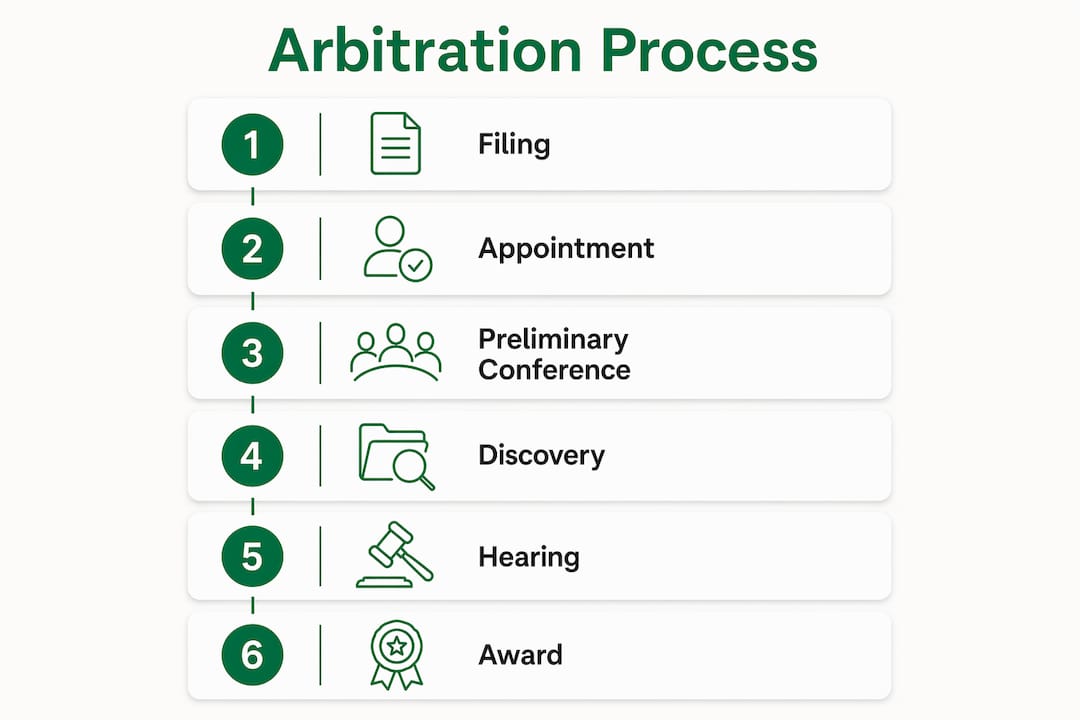
Most Florida commercial arbitrations conclude within 3 to 12 months from filing. Compare that to the 2 to 4 years a contested circuit court case typically requires, and the time advantage becomes obvious.
What are common challenges and mistakes in Florida business arbitration?
Knowing the pitfalls before you step into the process is worth more than any post-hearing strategy.
-
Ignoring the contract’s dispute resolution roadmap. Florida courts compel arbitration when a valid clause exists and stay any pending litigation until arbitration concludes. But if you file suit before exhausting required pre-arbitration steps, you hand the other side a procedural weapon.
-
Underestimating evidence preparation. Because hearings are compressed, there is no room to find missing documents or locate witnesses after the hearing starts. Prepare your evidence file and witness list as if you are going to trial.
-
Misreading non-binding arbitration risks. If your contract calls for non-binding arbitration, understand the 25% rule before rejecting an award. Rejecting a non-binding award and then failing to improve your position by at least 25% at trial means you may owe the opposing party’s costs. That financial exposure changes the calculus significantly.
-
Choosing the wrong arbitrator. Arbitrator selection is the single most consequential decision in the process. Research candidates’ published decisions, industry backgrounds, and reputations within the Florida legal community before ranking your list.
-
Ignoring cost exposure. Florida commercial arbitration costs typically range from $5,000 to $50,000 or more depending on dispute size, provider, and arbitrator fees. A two-day AAA arbitration of a $300,000 dispute can cost between $15,000 and $50,000. Budget for this before you file, not after.
“Business owners must review dispute resolution clauses early; failure to comply may increase costs and delay resolution significantly.” Alternative Dispute Resolution Florida Guide
How does arbitration compare to other business dispute resolution options?
Florida business owners have four primary paths when a dispute arises: litigation, mediation, non-binding arbitration, and binding arbitration. Each serves a different purpose.
| Method | Binding? | Confidential? | Typical timeline | Relative cost |
|---|---|---|---|---|
| Circuit court litigation | Yes | No | 2 to 4 years | High |
| Mediation | No (unless settled) | Yes | Days to weeks | Low |
| Non-binding arbitration | No | Yes | 3 to 9 months | Moderate |
| Binding arbitration | Yes | Yes | 3 to 12 months | Moderate to high |
Mediation is a facilitated negotiation where a neutral mediator helps parties reach a voluntary settlement. It produces no binding decision unless the parties sign a settlement agreement. Mediation works well when the relationship matters and both sides want to preserve it. For a deeper look at when to choose one over the other, the arbitration vs. mediation comparison for Florida SMEs is worth reviewing.
Binding arbitration is the right tool when you need a final, enforceable decision and cannot afford years of litigation. It suits contract disputes, vendor conflicts, partnership disagreements, and commercial claims where confidentiality matters. The Florida Arbitration Code makes the award enforceable as a circuit court judgment, so the winning party has real collection power. For a detailed side-by-side analysis, the arbitration vs. litigation guide from Fornarolegal covers the practical tradeoffs Florida business owners face.
Non-binding arbitration occupies a middle ground. It produces an advisory award that either party can reject. The risk, as noted above, is the 25% rule. Legal counsel adds significant value when assessing whether to accept or reject a non-binding award, particularly when the gap between the award and your trial expectations is narrow.
Key takeaways
Binding arbitration under Florida’s Chapter 682 is the fastest, most confidential path to a final, enforceable resolution for most Florida business disputes.
| Point | Details |
|---|---|
| Review your contract first | Arbitration clauses are strictly enforced; confirm scope, administrator, and required pre-steps before filing. |
| Follow the process sequentially | Filing to final award typically takes 3 to 12 months when each stage is handled correctly. |
| Prepare like it is a trial | Arbitration hearings are condensed bench trials; evidence and witness prep must be thorough before the hearing date. |
| Understand the 25% rule | Rejecting a non-binding award and failing to improve by 25% at trial can result in paying the opposing party’s costs. |
| Confirm and enforce the award | Florida courts convert arbitration awards into enforceable judgments under Florida Statute 682.15. |
What I have learned after two decades of Florida business arbitration
After more than 20 years handling business disputes across South Florida, I have one consistent observation: the outcome of an arbitration is usually determined before the hearing begins.
The business owners who do well in arbitration are the ones who read their contracts before a dispute arises, not after. They know which administrator governs their clause, whether mediation is required first, and what the arbitrator selection process looks like. When a dispute surfaces, they are not scrambling to understand the rules. They are already three steps ahead.
The owners who struggle are the ones who treat arbitration as a faster version of litigation and assume the process will be more forgiving. It is not. Compressed schedules mean you cannot recover from poor preparation. A missing document or an unprepared witness in a two-day hearing is far more damaging than it would be in a multi-week trial.
I also see business owners underestimate arbitrator selection. In circuit court, the judge is assigned. In arbitration, you have real input. Spend time on this decision. Research the candidates’ backgrounds, their published awards if available, and their reputations in the specific industry involved in your dispute. The right arbitrator does not guarantee a win, but the wrong one can cost you one.
Finally, do not dismiss mediation as a box to check before arbitration. I have seen disputes that looked destined for a full hearing resolve in a single mediation session because both parties finally sat in the same room with a skilled neutral. Arbitration is a powerful tool. Use it when you need it. But know when a less adversarial path serves your business better.
— Matthew
How Fornarolegal can help you resolve your Florida business dispute

Fornarolegal works with small business owners and entrepreneurs across South Florida who need practical, experienced legal counsel for business disputes. Whether you are reviewing a contract before signing, preparing a demand for arbitration, or trying to enforce an award, Matthew Fornaro brings over 20 years of court-tested experience to your situation. The firm’s arbitration and mediation services are built specifically for Florida businesses that need disputes resolved efficiently without sacrificing their legal position. For a full picture of available support, visit the legal services page to see how Fornarolegal can protect your contracts and operations from the start.
FAQ
Is arbitration legally binding in Florida?
Yes. Binding arbitration under Florida Statutes Chapter 682 produces a final award enforceable as a circuit court judgment. Florida courts confirm and enforce these awards under Florida Statute 682.15.
How long does the Florida arbitration process take?
Most Florida commercial arbitrations conclude within 3 to 12 months from filing, significantly faster than circuit court litigation, which typically takes 2 to 4 years.
What does Florida arbitration cost?
Costs vary with dispute size and provider. A two-day AAA arbitration of a $300,000 dispute typically costs between $15,000 and $50,000, which is generally less than comparable circuit court litigation.
Do I need a lawyer to arbitrate a business dispute in Florida?
You are not legally required to have an attorney, but legal counsel adds measurable value in preparing evidence, selecting the arbitrator, and evaluating appeal risks, particularly in disputes involving significant money or complex contracts.
What happens if the other party ignores an arbitration clause?
Florida courts will compel arbitration when a valid clause exists and stay any pending litigation until the arbitration concludes. The opposing party cannot simply opt out of a binding arbitration agreement.
Recommended
- How to Respond to a Business Dispute Before It Escalates in Florida » Matthew Fornaro, P.A.
- Arbitration’s Growing Role in Florida Business Disputes: What Small and Medium Businesses Need to Know » Matthew Fornaro, P.A.
- Arbitration vs. Litigation in Florida: A Practical Guide for Business Owners » Matthew Fornaro, P.A.
- Arbitration vs. Mediation for Florida SMEs: Faster, Smarter Business Dispute Resolution » Matthew Fornaro, P.A.


