

Key Takeaways
- Florida business law protects companies from unfair competition, contract breaches, and partner disputes.
- Acting early saves time, money, and business relationships.
- An experienced business attorney helps you assess risk and choose the right legal strategy.
An insurance coverage dispute is a formal disagreement between your business and its insurer over whether a claim is covered, how much should be paid, or whether the policy even applies to your loss. When you’re staring at a denial letter after paying premiums for years, the instinct is to panic or immediately call a lawyer. Neither is the right first move.
The most effective way to handle a business insurance coverage dispute starts with three actions: request the denial in writing, pull out your policy, and compare the two side by side. Prompt written notice is itself a policy condition, and delays in reporting often trigger automatic reductions or outright denials regardless of whether the underlying claim is valid. Your broker or agent is also an underused resource at this stage. They know the policy language, they have relationships with the insurer’s claims team, and they can advocate on your behalf before the dispute hardens into a formal fight.
Start here before anything else:
- Request a written denial letter if you haven’t received one.
- Read the denial against your actual policy terms, exclusions, and definitions.
- Notify your insurance agent or broker immediately and loop them into all communications.
- Document every phone call, email, and conversation with the insurer from this point forward.
- Take photos, gather receipts, and preserve any physical evidence related to the loss.
Pro Tip: Treat every communication with your insurer as a permanent record. Insurers often use your own statements and correspondence to build their denial rationale, so write and speak carefully, and always follow up verbal conversations in writing.
What causes most business insurance coverage disputes?
Most disputes don’t come from bad luck. They come from predictable, avoidable friction points between how businesses operate and what policies actually require.
Delaying notification is the single most common and avoidable error. Many business owners wait to see if they can absorb a loss before alerting their insurer, not realizing that policies often require prompt notice of an incident. Miss that window and the insurer has grounds to deny the claim entirely, even if the loss is otherwise covered.
Beyond timing, the most frequent dispute triggers include:
- Unclear or ambiguous policy language. Insurers often interpret ambiguous terms in their favor to limit payouts.
- Policy exclusions. Flood, earthquake, and certain cyber events are commonly excluded from standard commercial policies, catching owners off guard at claim time.
- Insufficient documentation. A claim for a damaged roof submitted with only ground-level photos, or a business interruption claim with no revenue records, gives adjusters easy grounds for denial.
- Failure to update the policy. Equipment purchased after the policy was written, new locations, or expanded operations may not be covered if the policy was never amended.
- Unpaid premiums. A lapsed specialty policy at the time of a loss is almost impossible to recover.
- Disagreements over coverage limits. Even when coverage exists, disputes arise over the maximum payable amount or how depreciation is calculated.
- Bad faith conduct. Lowball settlement offers, unreasonable delays, and failure to investigate are all potential bad faith violations under state law.
The common thread is that most of these disputes are preventable with better documentation habits and a clearer understanding of what your policy actually says before a loss occurs.
How to resolve an insurance coverage dispute step by step
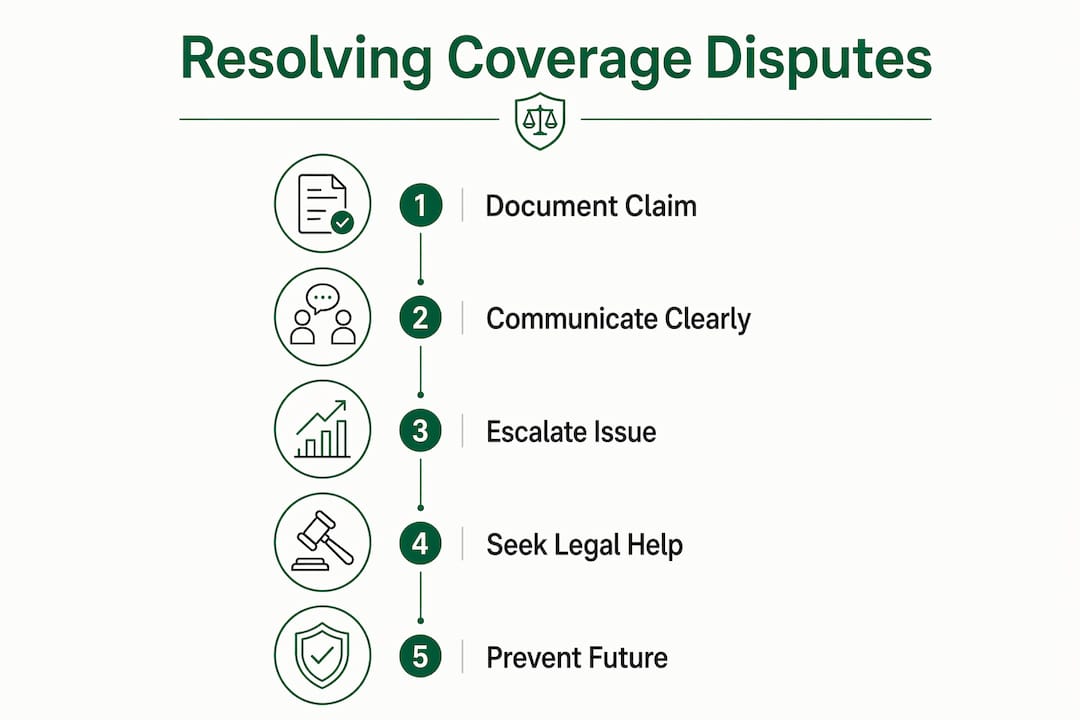
The business insurance claims process has a natural escalation ladder. Work it from the bottom up before jumping to litigation.
-
Read the denial letter carefully. The letter must explain the specific reason for denial. Match each reason against your policy’s exact language, not your memory of what you thought the policy covered.
-
Gather and organize your evidence. Photos, videos, incident reports, receipts, invoices, contractor estimates, and any prior correspondence all belong in a single organized file. Independent damage assessments from a licensed public adjuster or contractor give you less disputable evidence than the insurer’s own adjuster produced.
-
Engage your broker or agent. They can clarify coverage details, push for reconsideration internally, and help you frame the appeal. This step costs nothing and often moves things faster than a formal appeal.
-
File a formal appeal. Most insurers have an internal appeals process. Write a clear, factual appeal letter that addresses each denial reason with specific policy language and supporting evidence. Insurers have a good faith obligation to reconsider denied claims when presented with new compelling evidence, and a well-organized rebuttal frequently triggers re-evaluation before the dispute escalates further.
-
Fulfill your duty to mitigate. You are required to take reasonable steps to prevent further damage after a loss. Failure to mitigate gives the insurer grounds to reduce or deny your claim. Document every mitigation action with dated receipts.
-
Consider Alternative Dispute Resolution. Mediation brings both parties to the table with a neutral third party who facilitates a voluntary agreement. Mediation preserves business relationships by keeping the process less adversarial than litigation. Arbitration is more formal: an arbitrator hears both sides and issues a decision, which may be binding or nonbinding depending on your policy’s terms. Negotiation, handled directly or through attorneys, gives both parties the most control over the outcome.
-
File a regulatory complaint. State insurance departments can investigate insurer conduct and enforce compliance. Filing a complaint with your state’s insurance regulator costs nothing and puts the insurer on notice that a government agency is watching.
-
Consult legal counsel. If the dispute involves a large sum, complex policy language, or signs of bad faith, an attorney who specializes in insurance coverage disputes can interpret the policy, negotiate directly with the insurer, and advise on whether litigation makes sense. For guidance on protecting your business early, the earlier you involve counsel, the more options you preserve.
Pro Tip: Keep a running claim log from day one: date, time, who you spoke with, what was said, and what was promised. An organized claim history is one of the strongest tools you have if the dispute escalates to arbitration or litigation.

What happens when a coverage dispute goes to court?
Litigation is a last resort, and experienced attorneys consistently recommend exhausting internal appeals, ADR, and regulatory complaints before filing suit. Courts are slow, expensive, and unpredictable, and the insurer’s legal team has handled hundreds of these cases before yours.
That said, litigation is sometimes the only path to a fair outcome, particularly when an insurer has acted in bad faith, denied a high-value claim without proper investigation, or ignored material facts. Courts can review policy language, determine the intent of the contract, and rule on what is legally required under its terms. Unlike binding arbitration, litigation also preserves your right to appeal.
The typical stages of a coverage dispute lawsuit look like this:
- Pre-litigation demand. Your attorney sends a formal demand letter outlining the claim, the denial, and the legal basis for coverage.
- Regulatory complaint. Filing with your state insurance department before or alongside litigation can accelerate resolution or strengthen your legal position.
- Filing suit. A complaint is filed in civil court alleging breach of contract and, where applicable, bad faith.
- Discovery. Both sides exchange documents, take depositions, and gather evidence. This phase is where thorough documentation pays off.
- Motions and hearings. Either side may file motions to narrow the issues before trial.
- Trial or settlement. Most cases settle before trial once the insurer sees the strength of your documented position.
- Appeal. If you lose at trial, you can appeal. In binding arbitration, this option is extremely limited.
One caution: operational disruption during litigation is real. Depositions, document requests, and court appearances pull key people away from running the business. Specialized legal representation matters here, both to manage the process efficiently and to avoid procedural missteps that could cost you the case.
How a coverage dispute can damage your business beyond the claim
The financial hit from a denied claim is obvious. The downstream effects are less visible but often more damaging.
Cash flow takes the first blow. If the claim was meant to fund repairs, replace equipment, or cover lost revenue during a shutdown, a denial or underpayment leaves you funding those costs out of pocket. For a small business, that can mean drawing on credit lines, delaying payroll, or deferring vendor payments.
Operational downtime compounds the problem. A property claim in dispute means repairs may stall while you wait for resolution, extending the period your business can’t operate at full capacity. Employee morale suffers when the future feels uncertain, and key staff sometimes leave rather than wait out a prolonged dispute.
The ripple effects on relationships are harder to quantify:
- Vendors and suppliers may tighten credit terms if they see your business struggling to recover from a loss.
- Customers lose confidence when service disruptions drag on without a clear timeline for resolution.
- Lenders may reassess credit facilities if a major unresolved claim appears on your financial statements.
- Reputation takes a hit if the dispute becomes public, particularly in industries where financial stability signals trustworthiness.
- Legal and administrative costs pile up even before you file suit, including public adjuster fees, expert assessments, and attorney consultations.
The longer a dispute runs, the more it costs in ways that don’t show up in the original claim amount.
How to prevent insurance coverage disputes before they start
The best dispute resolution strategy is avoiding the dispute entirely. Most coverage conflicts are predictable and preventable with consistent habits.

Review your policy at least once a year, and again whenever your business changes significantly. New equipment, additional locations, more employees, or a shift in operations can all create coverage gaps if the policy isn’t updated to reflect them. Ask your broker specifically whether your current activities fall within the policy’s covered scope.
Build documentation habits before you need them:
- Keep an updated inventory of all business property with photos and purchase records.
- Store copies of contracts, invoices, and financial records in a secure, off-site or cloud-based location.
- Train staff on claim reporting protocols so the right people know exactly what to do and when.
- Set calendar reminders for premium due dates to prevent lapses in specialty coverage.
Pro Tip: Proactive risk management, including regular policy audits and clear internal claim procedures, reduces the likelihood of disputes by closing the gaps insurers use to deny claims. A business that can demonstrate consistent compliance with policy conditions is a much harder target for a denial.
Choose your insurer carefully. Before renewing or switching, research the carrier’s reputation for claims handling. An insurer known for fair, responsive claims processing is worth paying a slightly higher premium for. The cheapest policy is rarely the best value when a major loss hits.
Clear, documented communication with your insurer throughout the policy period also helps. Transparency during the application and renewal process reduces the chance of disputes over what was disclosed. A good relationship with your broker and your insurer’s account team can make a real difference when a claim is filed.
Who can help you resolve a coverage dispute?
You don’t have to fight an insurer alone, and in most serious disputes, you shouldn’t.
- Insurance brokers and agents are your first call. They understand the policy, know the insurer’s internal processes, and can advocate informally before a dispute becomes formal.
- Public adjusters work exclusively for the policyholder, not the insurer. They assess the damage independently and negotiate on your behalf, which is particularly valuable when the insurer’s adjuster has undervalued the loss.
- State insurance departments handle formal complaints against insurers. Every state has one, and filing a complaint triggers an investigation that can pressure the insurer to reconsider. In some states, regulatory programs also offer mediation for certain types of disputes.
- Independent appraisers and expert witnesses provide third-party valuations that are harder for insurers to dismiss than their own adjuster’s estimate.
- Insurance coverage attorneys interpret complex policy language, identify bad faith conduct, negotiate settlements, and represent you in arbitration or litigation. Legal guidance is particularly valuable when the dispute involves a large claim, ambiguous exclusions, or an insurer that has stopped responding in good faith.
For legal advice on insurance disputes, understanding what legal expenses coverage can and cannot do is worth knowing before a dispute escalates. On the regulatory side, state insurance departments in every US jurisdiction have consumer assistance divisions specifically designed to help policyholders navigate claim disputes, and using them costs nothing.
The combination of a knowledgeable broker, an independent adjuster, and experienced legal counsel gives you the strongest possible position in any coverage dispute. Each professional brings a different angle: the broker knows the relationship, the adjuster knows the numbers, and the attorney knows the law.
Key Takeaways
Resolving a business insurance coverage dispute requires prompt action, thorough documentation, and a clear escalation path from internal appeals through ADR to litigation only when necessary.
| Point | Details |
|---|---|
| Act immediately on denial | Request a written denial letter and compare it line by line against your policy terms and exclusions. |
| Document everything from day one | Photos, receipts, incident reports, and a communication log all strengthen your position at every stage. |
| Exhaust ADR before litigation | Mediation, arbitration, and regulatory complaints are faster and less costly than court, and should come first. |
| Mitigate losses promptly | Failing to take reasonable steps to prevent further damage gives the insurer grounds to reduce or deny your claim. |
| Prevention beats resolution | Annual policy reviews, updated coverage, and trained staff reduce the gaps insurers use to justify denials. |
Fornarolegal can help you protect your business

A denied or underpaid insurance claim can threaten everything you’ve built. Fornarolegal has spent over 20 years helping South Florida businesses manage exactly these situations: disputes that start as a letter in the mail and can escalate into litigation if not handled correctly from the start.
Matthew Fornaro provides direct, practical legal guidance on preventing business litigation and resolving disputes before they become expensive court battles. Whether you’re facing a coverage denial, a bad faith delay, or an underpayment you know doesn’t reflect your actual loss, the right legal counsel at the right moment changes the outcome.
If your business is facing an insurance coverage conflict, contact Fornarolegal for a consultation. The earlier you get experienced representation, the more options you have.
Recommended
- How to Protect Your Business When a Dispute Is Just Beginning » Matthew Fornaro, P.A.
- How to Respond to a Business Dispute Before It Escalates in Florida » Matthew Fornaro, P.A.
- Don’t Be Afraid: Contact Your Insurance Company for Business Incidents » Matthew Fornaro, P.A.
- How to Respond to a Business Dispute Before It Escalates in Florida » Matthew Fornaro, P.A.


