

Key Takeaways
- Florida business law protects companies from unfair competition, contract breaches, and partner disputes.
- Acting early saves time, money, and business relationships.
- An experienced business attorney helps you assess risk and choose the right legal strategy.
Table of Contents
- What Is a Shareholder Agreement and Why Does It Matter?
- Key Clauses Every Shareholder Agreement Should Include
- Good Leaver and Bad Leaver Provisions Explained
- Minority Shareholder Protection: What the Agreement Must Cover
- Shareholder Dispute Resolution: Deadlock, Arbitration, and Mediation
- Tax Implications and Jurisdiction-Specific Nuances in Florida
- Using a Shareholder Agreement Template: What to Know Before You Sign
- What Is a Shareholder Agreement Missing Without Legal Review?
Last Updated: June 7, 2026
What Is a Shareholder Agreement and Why Does It Matter?
Understanding what is a shareholder agreement is one of the most practical steps any business owner can take before accepting a co-investor, bringing on a partner, or issuing equity. At Matthew Fornaro, P.A., we work with entrepreneurs across Coral Springs, Parkland, and Broward County who discover, often too late, that their corporate structure has no mechanism for handling disputes, exits, or deadlocks. A shareholder agreement is a private contract between the shareholders of a company that governs their rights, obligations, and relationships with each other and with the legal entity itself. It fills the gaps that standard incorporation documents leave open.
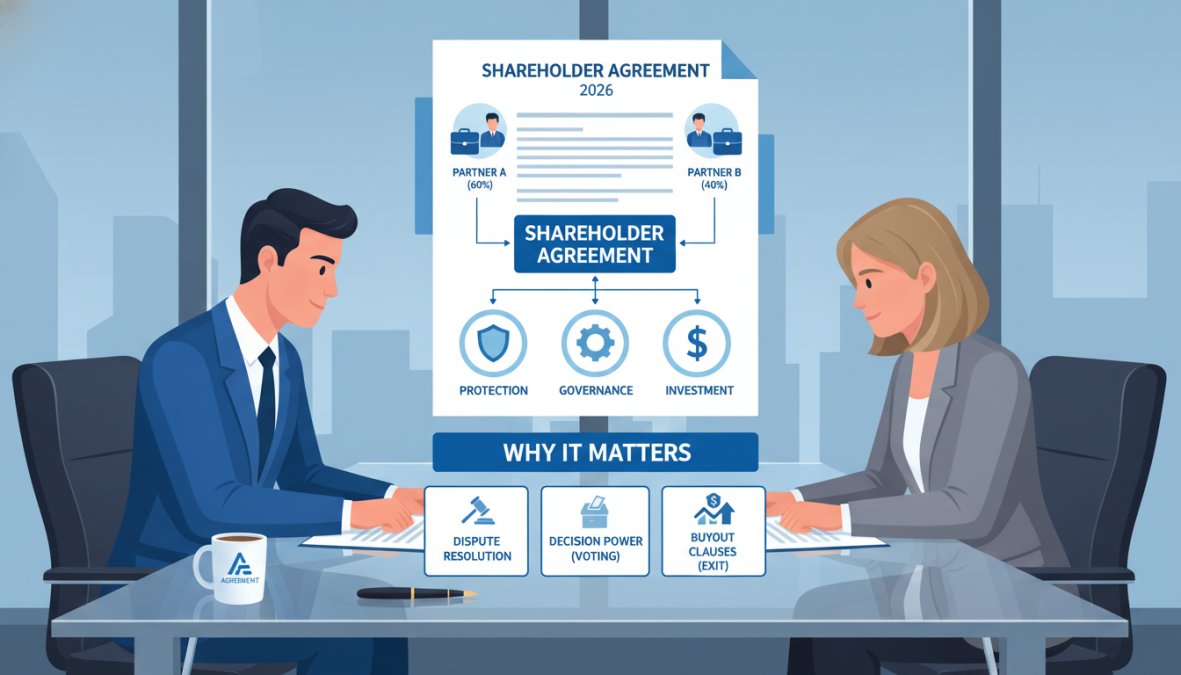
Most guides treat the shareholder agreement as optional paperwork. It is not. Without one, a minority shareholder has no contractual protection beyond what state law provides, and Florida’s default corporate rules rarely reflect what the founders actually intended. The agreement controls everything from how shares can be transferred to how the company makes decisions when the board is deadlocked.
Shareholder Agreement vs. Articles of Association
Articles of Association and corporate bylaws are public documents filed with the state, establishing the company’s formal legal framework. A shareholder agreement is a private contract binding only on the shareholders who sign it, not filed publicly.
Bylaws govern the company as a legal entity; the shareholder agreement governs the relationships between the people who own it. You need both. As documented in Florida Division of Corporations guidance on corporate governance, the state’s default rules apply when no private agreement exists, and those defaults rarely favor minority shareholders.
Never assume your bylaws cover the same ground as a shareholder agreement. Many Coral Springs business owners form an LLC or corporation, file their articles, and stop there. When a dispute arises, they discover that Florida’s default statutory rules govern the outcome, not the deal they thought they had negotiated.
Key Clauses Every Shareholder Agreement Should Include
A well-drafted shareholder agreement is not a generic template. Each clause addresses a specific risk, and omitting even one can create serious exposure.
Voting Rights, Board Composition, and Decision-Making
Voting rights and board composition clauses define who controls the company. The agreement should specify which decisions require a simple majority, a supermajority, or unanimous consent. Decisions typically requiring unanimous consent include issuing new shares, taking on significant debt, selling the company, or amending the agreement itself.
Board composition provisions address how many directors each shareholder class can appoint and under what circumstances those appointments can be removed. Equity dilution protections are closely tied to these provisions, which is why pre-emptive rights belong in this same section.
A common mistake is drafting voting thresholds without defining quorum requirements. If your agreement requires 75% approval for major decisions but does not specify what constitutes a valid shareholder meeting, a minority shareholder can obstruct business by simply not showing up.
Share Transfer Restrictions: Tag-Along, Drag-Along, and Right of First Refusal
Share transfer restrictions control who can become a shareholder and on what terms.
Right of first refusal gives existing shareholders the right to purchase shares before a selling shareholder can transfer them to a third party. Tag-along rights protect minority shareholders: if a majority shareholder sells their stake, minority shareholders have the right to join the transaction on the same terms. Drag-along rights allow a majority shareholder to compel minority shareholders to sell in an acquisition, preventing a minority from blocking a beneficial sale. Founder vesting schedules, typically a one-year cliff followed by three to four years of gradual vesting, protect the company if a founder leaves early.
| Provision | Who It Protects | Core Function |
|---|---|---|
| Right of First Refusal | All shareholders | Limits outside entry |
| Tag-Along Rights | Minority shareholders | Ensures equal exit terms |
| Drag-Along Rights | Majority shareholders | Enables clean acquisition |
| Founder Vesting | Company / co-founders | Prevents early-exit windfalls |
| Pre-Emptive Rights | Existing shareholders | Prevents equity dilution |
Dividend Distribution and Capital Contribution Rules
Dividend distribution provisions specify how and when profits are distributed. Without clear rules, majority shareholders can vote to retain earnings indefinitely, denying minority shareholders any return. A well-drafted clause sets a minimum distribution threshold or a process requiring input from all shareholders.
Capital contribution rules address what happens when the company needs more money, whether shareholders are obligated to contribute, on what terms, and what happens if one cannot. Failure to address this creates deadlock risk with no mechanism to resolve it.
For companies in Coral Springs and South Florida with seasonal revenue cycles, consider building a minimum cash reserve threshold into the dividend distribution clause. This prevents distributions that leave the company undercapitalized during slow periods, which is a common source of shareholder friction.
Good Leaver and Bad Leaver Provisions Explained
A good leaver exits for reasons beyond their control or in an agreed acceptable manner, death, serious illness, redundancy, or retirement after a specified tenure, and typically receives fair market value for their shares. A bad leaver exits in circumstances treated as a breach, resignation without notice, termination for cause, or violation of a non-compete, and typically receives a lower or nominal price as a deterrent.
The definitions matter enormously. A vague agreement that does not precisely define "bad leaver" scenarios ends up in litigation. According to Florida Bar guidance on business dispute resolution, contract ambiguity is one of the leading drivers of commercial litigation in closely held companies.
The practical advice: define every triggering event explicitly. Do not rely on general language like "material breach." List the specific acts that constitute bad leaver status and confirm your legal counsel has reviewed them against Florida employment law.
Minority Shareholder Protection: What the Agreement Must Cover
A shareholder holding less than 50% of the equity has limited power under default corporate law. The shareholder agreement is their primary tool for negotiating meaningful rights. Effective minority shareholder protection provisions typically include:
- Veto rights on reserved matters: Decisions such as changing the company’s core business or issuing new share classes require minority shareholder consent regardless of voting percentage.
- Information rights: Contractual access to financial statements, board minutes, and management accounts on a regular schedule.
- Anti-dilution protections: Pre-emptive rights to participate in new share issuances.
- Board representation: Even a 20% shareholder may negotiate the right to appoint one director or observer.
- Exit mechanisms: Right of first refusal combined with tag-along rights provides a realistic path to liquidity.
These rights are almost impossible to negotiate after the company is already operating. The time to secure them is before you sign the original shareholder agreement.

Shareholder Dispute Resolution: Deadlock, Arbitration, and Mediation
Deadlock occurs when shareholders cannot reach the required majority or unanimous decision on a critical matter and the company cannot move forward. It is the scenario most founders refuse to plan for, and the one that destroys companies most reliably.
IMAGE: A [business attorney and two clients seated at a round table in a modern law office, engaged in a calm discussion with documents spread in front of them, natural light from a window behind them | section:Shareholder Dispute Resolution: Deadlock, Arbitration, and Mediation]
A well-drafted dispute resolution clause addresses deadlock through a tiered process: first, a cooling-off period and direct negotiation; second, mediation with a neutral third party; third, arbitration or litigation if mediation fails. Arbitration is private, faster than court proceedings, and keeps sensitive financial information out of the public record, advantages many Florida business owners near Coral Springs value.
The agreement should also include a deadlock resolution mechanism for governance decisions. Common approaches include:
- A casting vote given to the chairman or a neutral director
- A "buy-sell" or "shotgun" clause, where one shareholder offers to buy the other’s shares at a stated price, and the receiving shareholder must either accept or buy at the same price
- A forced sale mechanism triggered after a defined deadlock period
As noted in American Arbitration Association commercial dispute resources, parties with pre-agreed arbitration clauses resolve disputes significantly faster than those relying on court proceedings.
A shareholder agreement without a deadlock resolution mechanism is incomplete. The absence of one does not prevent deadlock; it just guarantees that when deadlock happens, the only resolution is expensive litigation.
Tax Implications and Jurisdiction-Specific Nuances in Florida
Dividend distribution policies have direct tax consequences. In a C corporation, dividends are taxed at the corporate level and again at the individual level. In an S corporation or LLC, profits pass through to shareholders’ individual returns. The choice of entity structure, which should be addressed before the shareholder agreement is drafted, determines how distribution clauses interact with tax obligations.
Founder vesting schedules also carry tax implications. Under Section 83 of the Internal Revenue Code, restricted shares are generally taxed as ordinary income at vesting based on fair market value at that point. Founders can file an 83(b) election within 30 days of receiving restricted shares to be taxed on the current lower value instead. Missing the 83(b) window is a costly and irreversible mistake.
Florida has no state income tax, but the state’s corporate law has specific rules governing close corporations, shareholder oppression remedies, and dissolution proceedings. The Florida Statutes Chapter 607 on business corporations sets the default rules that apply when no private agreement addresses a given situation. For companies with shareholders in multiple states, the choice of governing law clause matters and should be specified explicitly.
Using a Shareholder Agreement Template: What to Know Before You Sign
A shareholder agreement template can be a useful starting point, but treating it as a finished product is a significant risk. Generic templates do not account for your specific equity structure, your industry, Florida’s corporate statutes, or the particular dynamics between your shareholders.
The most common problems with off-the-shelf templates include:
- Vague good leaver and bad leaver definitions that create ambiguity
- Missing deadlock resolution mechanisms
- No jurisdiction-specific language for Florida corporate law
- Boilerplate confidentiality agreement and non-compete clause provisions that may not be enforceable under Florida law
- Dividend distribution clauses that conflict with the company’s chosen entity structure
A template is a checklist, not a contract. Use it to identify the issues you need to address, then work with qualified legal counsel to draft language that actually reflects your agreement. The Matthew Fornaro, P.A. team has reviewed hundreds of shareholder agreements for South Florida businesses and consistently finds that agreements drafted without legal review contain at least two to three provisions that would produce unintended outcomes if triggered.
Post-Agreement Maintenance: Keeping Your Agreement Current
Most shareholder agreements are signed once and never reviewed again. The agreement is a living document that should be revisited whenever a material change occurs in the company’s structure, ownership, or operations.
Situations that typically require an amendment include:
- A new shareholder joins the company
- An existing shareholder’s role changes significantly
- The company raises external funding and issues new share classes
- A shareholder dies or becomes incapacitated
- The company enters a new line of business
- A shareholder’s marital status changes (relevant to community property considerations)
- The company’s valuation changes substantially, affecting buy-sell pricing mechanisms
- Florida law changes in ways that affect the agreement’s enforceability
Annual review is a reasonable standard for most closely held companies. Build the review into your calendar alongside your annual corporate filings.
What Is a Shareholder Agreement Missing Without Legal Review?
The honest answer: quite a lot. A shareholder agreement without proper legal review is likely missing jurisdiction-specific enforceability language, correctly structured arbitration clauses, and provisions that align with Florida’s current corporate statutes.
The gaps that surface in litigation include undefined valuation methodologies for buy-sell provisions, non-compete clauses that do not meet Florida’s enforceability requirements under [Florida Statutes Section 542.335 on non-compete agreements(/drafting-enforceable-non-compete-agreements-florida/) | leg.state.fl.us], and dispute resolution clauses too vague to compel a specific process. Each omission can turn a straightforward shareholder exit into a multi-year commercial dispute.
The shareholder agreement is not the place to cut costs. For Coral Springs entrepreneurs and small business owners, a properly drafted agreement is one of the highest-return legal expenditures you can make, because it defines the rules of the game before anyone has an incentive to argue about them.
Shareholder disputes are among the most disruptive and expensive legal challenges a small business can face, and the majority are preventable with a properly drafted agreement in place. Matthew Fornaro, P.A. brings over 20 years of experience helping South Florida entrepreneurs structure their businesses for long-term stability, from initial formation through complex commercial litigation. If you are forming a new company, bringing on a co-founder, or reviewing an existing agreement, contact Matthew Fornaro, P.A. today for practical, results-oriented guidance that protects your equity and your business interests. Call today to schedule a consultation with our Coral Springs team.
Frequently Asked Questions
Is a shareholder agreement legally required?
A shareholder agreement is not legally required in most jurisdictions, including Florida. However, operating without one exposes co-owners to significant risk. Without this private contract in place, disputes over voting rights, share transfers, dividend distribution, and exit strategies are governed only by default corporate law, which may not reflect what the shareholders actually intended. For any business with more than one owner, having a formal agreement is strongly advisable.
What is the difference between a shareholder agreement and Articles of Association?
Articles of Association are a public legal document filed during incorporation that establishes the company's corporate structure and governance framework. A shareholder agreement is a private contract between shareholders that supplements the Articles, covering more sensitive topics like founder vesting schedules, non-compete clauses, deadlock resolution, and exit strategies. The shareholder agreement can be amended more flexibly and confidentially, while changes to Articles of Association typically require formal legal filings.
What happens if you don't have a shareholder agreement?
Without a shareholder agreement, minority shareholder protection is limited, share transfer restrictions may not exist, and deadlock situations can paralyze the business with no clear resolution path. Disputes that could have been resolved through agreed arbitration or mediation clauses may instead become costly litigation. Founders also lose the ability to enforce pre-emptive rights, vesting schedules, or confidentiality obligations, leaving critical equity and business interests unprotected.
What are the most important clauses in a shareholder agreement?
The most critical clauses typically include share transfer restrictions such as right of first refusal, tag-along and drag-along rights, voting rights and board composition rules, dividend distribution policies, founder vesting schedules, good leaver and bad leaver provisions, non-compete and confidentiality obligations, and a clearly defined dispute resolution mechanism. For Florida businesses, it is also important to address jurisdiction-specific requirements and any tax implications tied to equity dilution or buy-sell agreement triggers.
Can a shareholder agreement be changed after it is signed?
Yes, a shareholder agreement can be amended, but the process typically requires the unanimous consent of all parties or a defined supermajority, depending on how the amendment clause is drafted. This is why post-agreement maintenance matters, as the business grows, adds investors, or changes its corporate structure, the agreement should be reviewed and updated accordingly. Working with a business attorney ensures amendments are properly executed and legally enforceable.
Who should sign a shareholder agreement?
All shareholders in the company, including founders, investors, and any party holding an equity stake, should sign the shareholder agreement at the time of incorporation or when they first acquire shares. Some agreements also require the company itself to be a party. In Florida, it is common for close corporation owners and small business partners to execute the agreement simultaneously with other formation documents to ensure all shareholder obligations and rights are established from day one.
This article was written using GrandRanker


