

Key Takeaways
- Florida business law protects companies from unfair competition, contract breaches, and partner disputes.
- Acting early saves time, money, and business relationships.
- An experienced business attorney helps you assess risk and choose the right legal strategy.
Table of Contents
- Why the Trademark Registration Process Matters for Small Business Owners
- Using a Trademark Search Tool Before You Apply
- Step-by-Step Trademark Registration Process for Small Business
- Common Trademark Rejection Reasons and How to Avoid Them
- Trademark Registration Cost: USPTO Fees and Budget Planning
- How Long Does Trademark Registration Take?
- Post-Registration: Maintenance, Enforcement, and International Expansion
- Conclusion
Last Updated: June 11, 2026
The trademark registration process for small business owners is one of the most overlooked steps in building a lasting brand. At Matthew Fornaro, P.A., we’ve guided South Florida entrepreneurs through this process for over two decades, and the pattern is consistent: businesses that register early protect more, spend less defending their brand, and grow with confidence. Below, we’ll walk you through every stage, from your first trademark search to post-registration enforcement, covering what most guides skip.
Here’s what most guides get wrong: they treat trademark registration as a formality. It isn’t. It’s a strategic decision that determines whether your brand name, logo, or slogan belongs to you or remains vulnerable to anyone willing to file first.
Why the Trademark Registration Process Matters for Small Business Owners
Federal trademark registration is the single most effective way a small business can secure exclusive rights to its brand identity nationwide. Without it, your protection is limited to the geographic area where you actually use the mark, a fragile position in any competitive market.
A trademark is a word, phrase, symbol, logo, or slogan that functions as a source identifier, distinguishing your goods and services from competitors’. Common law rights exist but won’t stop a competitor in another state from registering the same name federally and demanding you stop using it. The registered trademark symbol (®) deters infringement before it starts and gives you legal standing to pursue damages in federal court, something common law rights do not provide.
Trademark vs. Copyright vs. Patent: What Protects What
These three forms of intellectual property protect different things, and confusing them is a costly mistake.
- Trademark protects brand identity: names, logos, slogans, and other source-indicating marks used in commerce.
- Copyright protects original creative works: written content, music, artwork, software code. It arises automatically upon creation.
- Patent protects inventions and functional processes, requiring a separate USPTO application with strict novelty requirements.
A business name registration with your state (LLC, corporation) does NOT give you trademark rights. A domain name registration does NOT give you trademark rights. These misconceptions leave business owners believing they’re protected when they aren’t.
Common Law Rights vs. Federal Registration
Common law trademark rights arise from actual use in commerce. They’re real, but geographically limited and harder to enforce. Federal registration creates a legal presumption of ownership nationwide, establishes a public record of your claim, and provides access to federal court remedies including statutory damages and attorney’s fees. For any Coral Springs business with growth ambitions beyond Broward County, federal registration isn’t optional. It’s foundational.
Using a Trademark Search Tool Before You Apply
The clearance search is where most DIY applicants cut corners, and where most problems originate. Filing without a thorough search is the single most avoidable mistake in the trademark registration process for small business owners. A clearance search reveals whether a confusingly similar mark already exists and protects you from inadvertently infringing on someone else’s rights.
Skipping the clearance search doesn’t just risk rejection. If you build a brand on a name someone else already owns, you may be forced to rebrand entirely, website, signage, packaging, and marketing materials. The cost of rebranding almost always exceeds the cost of a proper search.
How to Run a Clearance Search on USPTO’s Trademark Center
The USPTO Trademark Center search tool is the starting point for any clearance search. Here’s how to use it effectively:
- Go to the USPTO Trademark Center and access the trademark search function.
- Search your exact mark first, then phonetic equivalents and common misspellings.
- Filter by the relevant International Class covering your goods and services.
- Review both live and dead marks. A dead mark can be revived or may indicate a pattern of use.
- Look for marks that are "confusingly similar", not just identical. The USPTO applies a multifactor test considering sound, appearance, and meaning.
The TM symbol can be used by anyone claiming rights to a mark, registered or not. Only ® requires federal registration. A professional clearance search goes beyond the USPTO database to include state trademark registries, common law use, and domain name records. For marks with significant brand value, this deeper search is worth the investment.
Step-by-Step Trademark Registration Process for Small Business
The trademark registration process follows a defined sequence through the USPTO. Understanding each step reduces errors, shortens timelines, and improves approval odds.
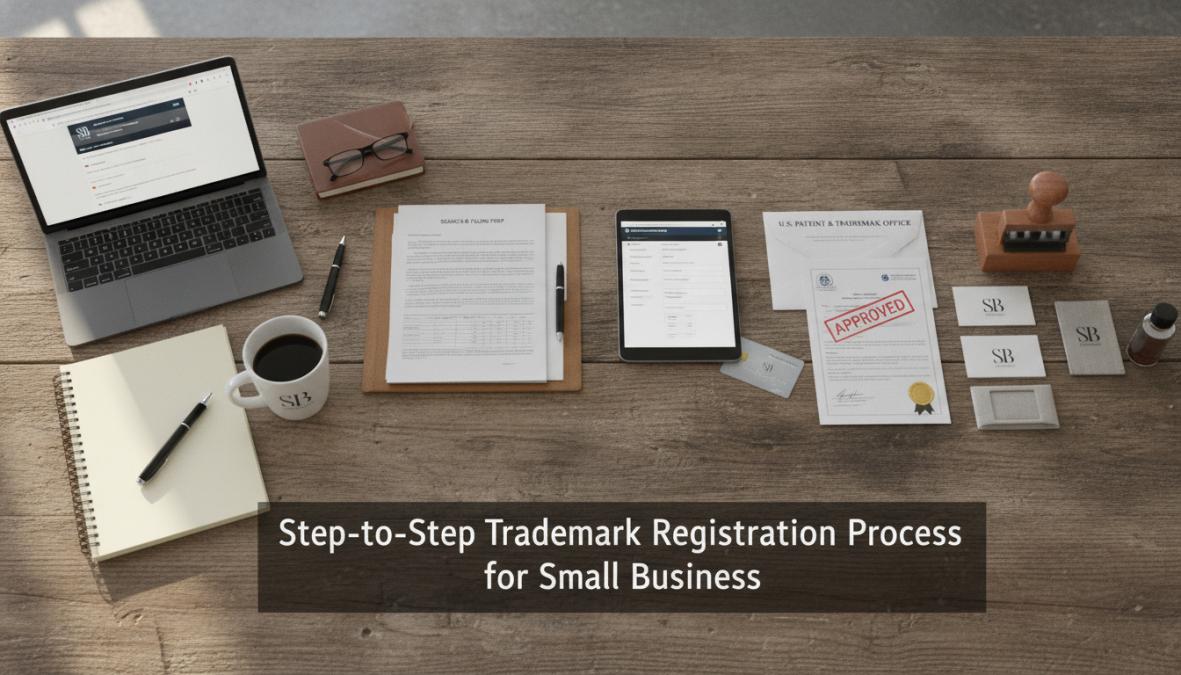
Total estimated time: 12-18 months from filing to registration.
Step 1: Identify Your Mark and Goods or Services Class
Before filing, lock down the exact form of your mark and the International Class covering your specific goods and services. The USPTO uses the Nice Classification system, organizing goods and services into 45 classes. Filing in the wrong class is a common rejection reason, and adding classes later requires additional fees.
Marks that are merely descriptive face rejection, "Cold Ice Cream" for an ice cream shop won’t register, while an arbitrary mark like "Häagen-Dazs" is highly protectable. The more distinctive your mark, the stronger the protection.
Step 2: File Through TEAS on the USPTO Trademark Center
The Trademark Electronic Application System (TEAS) is the online filing portal for all USPTO trademark applications. You’ll choose between two filing bases:
- Use in Commerce (1(a)): You’re already using the mark in interstate commerce.
- Intent to Use (1(b)): You haven’t used the mark yet but have a bona fide intent to do so.
The application requires a precise description of goods and services, a specimen showing the mark in use (for 1(a) applications), and payment of filing fees. Accuracy in the goods and services description is critical, overly broad descriptions get rejected; overly narrow ones limit your protection.
File under “Intent to Use” if your product or service isn’t commercially available yet. This secures your priority date while you prepare to launch. You’ll file a Statement of Use once the mark is in commerce, but your protection starts from the original filing date.
Step 3: Respond to an Office Action If Issued
An Office Action is a formal communication from a USPTO examining attorney raising objections to your application. Receiving one doesn’t mean denial, it means you need to respond. Common issues include likelihood of confusion, merely descriptive refusal, specimen defects, and goods/services description problems. Responses must be filed within three months (extendable to six months for a fee). This is where having an attorney familiar with USPTO practice pays for itself.
Step 4: Publication, Registration Certificate, and the ® Symbol
If approved, your application is published in the Official Gazette for a 30-day opposition period. If no opposition is filed, the USPTO issues a registration certificate, typically 3-4 months after publication for 1(a) applications. For 1(b) applications, you must file a Statement of Use first. Once registered, you’re authorized to use ®. Using ® before registration is a federal violation. Use TM in the meantime.
Common Trademark Rejection Reasons and How to Avoid Them
Most rejections are preventable. The trademark registration process for small business applicants fails most often for these reasons:
| Rejection Reason | Why It Happens | How to Avoid It |
|---|---|---|
| Likelihood of confusion | Similar mark already registered in same class | Thorough clearance search before filing |
| Merely descriptive | Mark describes the product directly | Choose arbitrary or suggestive marks |
| Primarily geographic | Mark is mainly a location name | Add distinctive elements; prove secondary meaning |
| Specimen defective | Specimen doesn’t show mark in actual commerce | Use a real product photo or website screenshot |
| Wrong goods/services class | Filed in incorrect International Class | Research Nice Classification carefully |
| Ornamental refusal | Mark appears as decoration, not source identifier | Show evidence of consumer recognition |
The most common rejection, likelihood of confusion, is entirely avoidable with a proper clearance search. Two marks don’t need to be identical; if they sound alike, look alike, or convey the same meaning in related markets, rejection is likely. According to USPTO trademark application statistics, a significant portion of applications receive at least one Office Action.
Trademark Registration Cost: USPTO Fees and Budget Planning
Trademark registration cost varies depending on filing basis, number of classes, and whether you use an attorney. Here’s the realistic breakdown for 2026:
- TEAS Plus application: Lower filing fee per class (requires selecting pre-approved goods/services descriptions)
- TEAS Standard application: Higher filing fee per class (allows custom goods/services descriptions)
- Statement of Use (Intent to Use applications): Additional fee per class
- Extension requests: Fee per class, per extension period
- Response to Office Action: No USPTO fee, but attorney time applies
Filing in multiple classes multiplies fees proportionally. For current fee schedules, refer to USPTO trademark fee schedule.
The USPTO filing fee is just one component of total trademark registration cost. Budget separately for the clearance search, attorney fees, and potential Office Action responses. Underfunding the process leads to abandoned applications and wasted filing fees.
DIY Filing vs. Hiring a Trademark Attorney
DIY filing works for straightforward marks in uncrowded classes with no clearance issues. It fails most often when applicants underestimate the complexity of the goods/services description, miss a confusingly similar mark, or can’t respond effectively to an Office Action.
An experienced trademark attorney adds value at three specific points:
- The clearance search (professional searches are more thorough than DIY USPTO searches)
- Drafting the goods/services description (precision here affects the scope of your protection)
- Responding to Office Actions (a well-argued response can save an application a layperson would abandon)
For Coral Springs and Broward County businesses investing in brand development, professional guidance typically costs a fraction of what a failed application, rebrand, or infringement dispute would cost later.
How Long Does Trademark Registration Take?
Trademark registration typically takes 12 to 18 months from filing to registration for a straightforward application. Office Actions or opposition proceedings can extend the timeline to two to three years or longer.
General timeline:
- Filing to first examination: Approximately 3-5 months
- Office Action response period: Up to 6 months (if issued)
- Publication in Official Gazette: 30-day opposition window
- Registration certificate issued: 3-4 months after publication (for 1(a) applications)
- Statement of Use (1(b) applications): Filed after the mark is in commercial use; extensions available
Monitor your application status through the USPTO Trademark Center using your serial number. Missing a response deadline results in abandonment with no automatic reinstatement.
Post-Registration: Maintenance, Enforcement, and International Expansion
Registration isn’t the finish line, it’s the starting point for active brand protection. A registered trademark can be cancelled if you fail to maintain it or stop using it in commerce.

Section 8 and 15 Declarations and Ongoing Maintenance Filings
Federal trademark registrations require periodic maintenance filings to remain active. Key milestones:
- Between years 5 and 6: File a Section 8 Declaration of Continued Use (and optionally a Section 15 Declaration of Incontestability, which significantly strengthens your rights)
- Between years 9 and 10: File a combined Section 8 and 9 Renewal
- Every 10 years thereafter: Continued Section 8 and 9 renewals
The Section 15 Declaration of Incontestability limits the grounds on which others can challenge your registration and is one of the most underused tools in trademark law.
Enforcing Your Trademark Against Infringement
Trademark infringement is the unauthorized use of a mark likely to cause consumer confusion. Registration gives you the tools to act; common law rights do not. Enforcement options range from a cease-and-desist letter to federal litigation, depending on severity and commercial damage. You have an obligation to police your mark, failure to act against known infringers can weaken your rights over time. For Coral Springs business owners who discover infringement, the first call should be to a trademark attorney.
Expanding Internationally with the Madrid Protocol
U.S. registration protects your mark only in the United States. For businesses expanding internationally, the Madrid Protocol offers a simplified path to protection in over 130 countries through a single international application filed through the USPTO. Each designated country still examines your application under its own standards, but the process is consolidated and significantly more cost-effective than filing separate national applications. According to WIPO Madrid System overview, the Madrid System is the most widely used international trademark filing mechanism globally. For Florida businesses with export markets or e-commerce customers outside the U.S., filing through Madrid should be part of your brand protection strategy from the start.
Protecting your brand name is one of the most consequential decisions a small business owner makes, and the trademark registration process for small business owners is more complex than most realize. Matthew Fornaro, P.A. brings over two decades of intellectual property and business law experience to clients throughout Coral Springs, Parkland, and Broward County, offering practical guidance at every stage from clearance search to post-registration enforcement. If you’re ready to protect what you’ve built, call Matthew Fornaro, P.A. today and speak with an attorney who understands what’s at stake.
Frequently Asked Questions
How much does it cost to register a trademark for a small business?
The USPTO trademark registration cost depends on the application type and number of classes filed. TEAS Plus applications generally carry a lower filing fee per class than TEAS Standard applications. Beyond USPTO filing fees, if you work with a trademark attorney you will also pay legal fees. Budgeting for at least one class of goods or services, plus potential Office Action responses, gives you a realistic picture of total trademark registration cost before you begin.
How long does the trademark registration process take?
How long trademark registration takes depends on several factors. After filing through the USPTO Trademark Center, an examining attorney typically reviews the application within several months. If no Office Action is issued and the mark passes publication without opposition, registration can be completed in roughly 12 to 18 months under normal circumstances. Complications such as Office Actions, oppositions, or application errors can extend the timeline significantly, so filing accurately from the start matters.
What are the most common trademark rejection reasons?
Common trademark rejection reasons include likelihood of confusion with an already-registered mark, the mark being merely descriptive of the goods or services, and failure to use the mark in commerce. Procedural issues such as an incorrect identification of goods and services or problems with the specimen submitted can also trigger an Office Action. Running a thorough clearance search using a trademark search tool before filing helps identify potential conflicts and reduces the risk of rejection.
Do I need a lawyer to register a trademark, or can I file myself?
You can file a trademark application yourself through the USPTO's TEAS system, and many small business owners do. However, the trademark registration process for small business involves legal judgments, such as selecting the right goods and services class, responding to Office Actions, and avoiding likelihood-of-confusion rejections, where attorney guidance adds real value. A filing mistake can cost you the application fee with no refund. For brand names, logos, or slogans central to your business, consulting a trademark attorney is generally worth the investment.
What is the difference between a trademark and a business name registration or LLC?
Registering a business name with your state or forming an LLC establishes your legal business entity but does not give you intellectual property rights to your brand name. A trademark registration with the USPTO grants exclusive rights to use a brand name, logo, or slogan as a source identifier for specific goods and services, and provides nationwide protection. You can have an LLC without a trademark, and vice versa, they serve different legal purposes and both may be necessary for complete brand protection.
What happens after my trademark is registered, are there ongoing requirements?
Yes. Trademark registration is not a one-time event. To keep your registration active, you must file maintenance filings with the USPTO at specific intervals, including Section 8 declarations confirming continued use and, if desired, Section 15 declarations for incontestability. Failing to file on time can result in cancellation of your registration. You are also responsible for monitoring and enforcing your trademark against potential infringement, as the USPTO does not police trademark use on your behalf.
This article was written using GrandRanker


