

Key Takeaways
- Florida business law protects companies from unfair competition, contract breaches, and partner disputes.
- Acting early saves time, money, and business relationships.
- An experienced business attorney helps you assess risk and choose the right legal strategy.
A partnership dispute is a formal or informal conflict between two or more business partners over finances, roles, decision-making authority, or the direction of their shared enterprise. These disagreements range from minor friction over expense reimbursements to full-scale legal battles over ownership and control. Understanding what a partnership dispute involves, and how to address one before it escalates, is the single most important thing you can do to protect both your business and your investment in it.
Partnership conflicts are more common than most partners expect. Most disputes escalate slowly from unresolved misalignments in vision or finance, which means the warning signs appear long before anyone calls a lawyer. The legal term you will encounter in most court filings and statutes is “partnership dispute,” and it covers everything from breach of fiduciary duty to disagreements about profit distributions. Fornarolegal works with South Florida business owners at every stage of this process, from drafting agreements that prevent conflicts to representing partners when litigation becomes unavoidable.
What is a partnership dispute, and why does it happen?
A partnership dispute arises when the expectations, obligations, or interests of two or more partners diverge in a way that cannot be resolved through ordinary conversation. Common triggers include misunderstandings about finances, workload imbalances, unclear roles, and differences in business vision. Each of these categories deserves a closer look because the root cause shapes the right solution.
Financial disagreements are the most frequent source of conflict. Partners argue over profit distributions, capital contributions, expense approvals, and how revenue should be reinvested. When one partner believes they are contributing more capital or labor than the other, resentment builds quickly.

Role ambiguity and accountability gaps create a second major category. Undefined decision-making authority leads to operational disputes and accountability issues that complicate daily business operations. When no one knows who has final say on hiring, vendor contracts, or pricing, every decision becomes a potential flashpoint.
Breach of fiduciary duties represents the most legally serious category. Partners owe duties of loyalty and care to each other, and breaches can lead to personal liability even when not explicitly stated in the partnership agreement. State laws like the Revised Uniform Partnership Act (RUPA) impose these duties to fill gaps in informal agreements. Self-dealing, competing with the partnership, or diverting business opportunities all qualify as breaches.
Personal conflicts and communication breakdown round out the picture. Partnership dynamics resemble marriages in one important way: explicit roles and protocols are necessary to prevent unilateral decisions from undermining trust. When communication stops, minor disagreements harden into entrenched positions.
Pro Tip: Keep a shared digital log of all major business decisions, including who made them and why. This single habit prevents more disputes than any clause in a partnership agreement.
How to resolve partnership disputes: methods ranked by cost and control
The four primary resolution mechanisms are informal negotiation, mediation, arbitration, and litigation, ranked from lowest to highest formality and cost. Choosing the right method depends on the severity of the dispute, the state of the relationship, and what your partnership agreement requires.
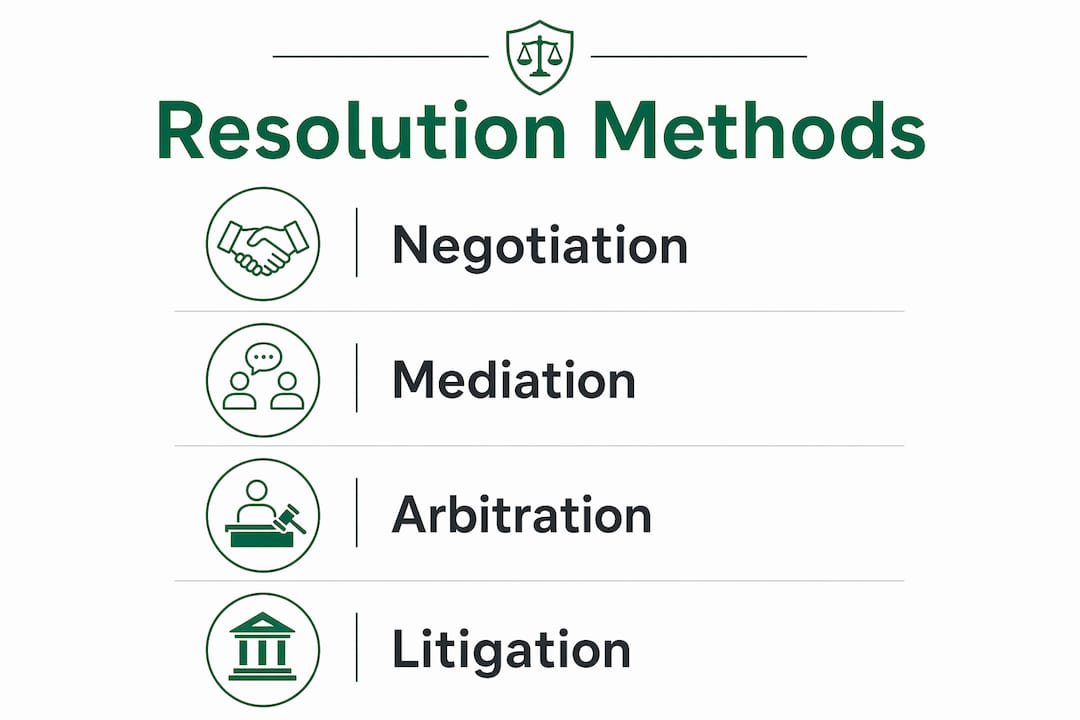
| Method | Cost | Privacy | Control | Best for |
|---|---|---|---|---|
| Negotiation | Lowest | Full | Highest | Early-stage, minor conflicts |
| Mediation | Low to moderate | Full | High | Relationship preservation |
| Arbitration | Moderate | Full | Moderate | Binding resolution without court |
| Litigation | Highest | Public | Lowest | Unresolvable disputes, fraud |
Negotiation is the starting point for almost every dispute. Partners sit down, often with their attorneys present, and attempt to reach a mutually acceptable resolution. This method costs the least and preserves the most goodwill, but it only works when both parties are willing to engage honestly.
Mediation brings in a neutral third party to facilitate dialogue without imposing a decision. Mediation offers privacy and control over outcomes that public, adversarial litigation cannot match. The mediator helps partners identify shared interests and craft solutions that a judge would never have the authority or creativity to order. For South Florida business owners, mediation is often the fastest path to a workable agreement.
Arbitration produces a binding decision from a neutral arbitrator, similar to a private judge. It is faster and less expensive than litigation, and the proceedings remain confidential. Many partnership agreements include mandatory arbitration clauses precisely because arbitration keeps disputes out of the public record.
Litigation is the last resort. Court proceedings are public, expensive, slow, and adversarial. They destroy working relationships in almost every case. Litigation becomes necessary when fraud is involved, when one partner refuses to participate in any other process, or when injunctive relief is needed to stop immediate harm to the business.
Pro Tip: If your partnership agreement includes a dispute resolution clause, read it before you do anything else. The clause may require mediation before arbitration, or arbitration before litigation. Skipping a required step can waive your rights.
How to prevent and manage partnership disputes before they escalate
Prevention is significantly cheaper than resolution. Early and clear documentation combined with legal counsel can prevent many disputes from escalating to litigation. The following steps give you the strongest foundation.
-
Draft a detailed partnership agreement from day one. A well-crafted agreement covers profit distribution, capital contributions, decision-making authority, and what happens when partners disagree. Review it every two to three years or after any major business change. Fornarolegal’s guide on what to include in a partnership agreement covers the specific clauses that prevent the most common conflicts.
-
Define roles and responsibilities in writing. Every partner should have a written job description that specifies their authority, their obligations, and the limits of their unilateral decision-making power. Vague titles like “co-founder” or “managing partner” without defined scope create the exact ambiguity that fuels disputes.
-
Build in an exit strategy. The absence of exit strategies in partnership agreements makes dissolving partnerships costly and emotionally draining. Your agreement should specify how the business will be valued, how a departing partner will be bought out, and what happens to their ownership stake. Without these terms, a single partner’s departure can paralyze the entire business.
-
Schedule regular financial reviews. Quarterly reviews of profit and loss statements, capital accounts, and expense reports keep all partners informed and reduce the chance that financial surprises become financial accusations.
-
Establish a communication protocol. Agree in advance on how major decisions get made, who gets notified, and what constitutes a “major” decision requiring full partner approval versus a routine operational call.
-
Engage legal counsel early. An attorney who specializes in business partnerships can spot ambiguous contract language, flag missing clauses, and advise on dispute resolution before a conflict hardens into a legal claim.
Pro Tip: Treat your partnership agreement as a living document, not a one-time filing. The agreement that made sense when you launched a two-person startup may be completely inadequate once you have employees, investors, or multiple revenue streams.
What to do when a partnership dispute arises
When a dispute surfaces, the sequence of your response matters as much as the substance of your position.
- Review your partnership agreement immediately. Locate the dispute resolution clause and identify any required steps, deadlines, or notice requirements. Missing a contractual deadline can limit your legal options.
- Document everything from this point forward. Save emails, text messages, meeting notes, and financial records. Written documentation is the foundation of every successful resolution, whether through negotiation or litigation.
- Attempt direct negotiation first. When informal communication fails, mediation is the preferred next step. But direct negotiation, done respectfully and with clear goals, resolves a significant number of disputes before they require outside intervention.
- Consider mediation or arbitration early. The earlier you engage a neutral third party, the more options you have. Partners maintain more outcome control through mediation than through court litigation. Waiting until the relationship has completely broken down reduces the chance that mediation will succeed.
- Evaluate restructuring or buyout options. If the partnership cannot continue in its current form, a negotiated buyout or restructuring may preserve the business even if the partnership does not survive. This is often a better outcome than dissolution or litigation.
- Know when litigation is unavoidable. Fraud, theft, or a partner who refuses to engage in any resolution process may leave litigation as the only viable path. At that point, specialized legal counsel is not optional.
Fornarolegal’s resource on Florida partnership legal options walks through each of these steps in the context of Florida law, which has specific procedural requirements that affect your timeline and strategy.
Key takeaways
Partnership disputes are best resolved through the method that preserves the most control for both parties, which means starting with negotiation and escalating only when necessary.
| Point | Details |
|---|---|
| Definition is broad | A partnership dispute covers financial, operational, legal, and personal conflicts between partners. |
| Fiduciary duties are automatic | Duties of loyalty and care apply under RUPA even without a written agreement. |
| Resolution has four tiers | Negotiation, mediation, arbitration, and litigation increase in cost and formality in that order. |
| Prevention beats resolution | A detailed, updated partnership agreement with exit strategies prevents most costly disputes. |
| Act early | Disputes that escalate slowly are best interrupted early, before positions harden into legal claims. |
What twenty years of partnership disputes taught me
Most of the partnership disputes I have seen in South Florida did not start with fraud or malice. They started with a handshake deal, a vague email thread, and two people who trusted each other so much that they skipped the paperwork. By the time they called me, the trust was gone and the documentation was thin.
The misconception I encounter most often is that a dispute means the partnership has failed. It does not. Disputes are common and normal in partnerships, and addressing them early can preserve both business value and the relationship itself. The partners who come out ahead are the ones who treat the first sign of friction as a signal to communicate more clearly, not less.
What I tell every client at the start of an engagement is this: the agreement you sign today is a prediction about how you will behave when things go wrong. If that agreement is vague, you are predicting chaos. If it is specific, you are predicting a manageable disagreement. The difference between those two outcomes is usually a few hours of legal work done before the business launches, not after the dispute begins.
I also push back on the instinct to litigate quickly. Litigation is public, expensive, and permanent. It ends relationships and sometimes ends businesses. Mediation and arbitration give you a chance to resolve the dispute on your terms, in private, with a result you helped shape. That is almost always worth trying first.
— Matthew
Protect your partnership before a dispute costs you more

A partnership dispute does not have to mean the end of your business. At Fornarolegal, Matthew Fornaro has spent over 20 years helping South Florida entrepreneurs and business owners resolve conflicts efficiently and protect what they have built. Whether you need a partnership agreement reviewed before a dispute starts or legal representation after one has already begun, the firm offers court-tested guidance tailored to your specific situation. Early legal involvement is the single most cost-effective step you can take. Learn how early legal guidance can prevent a disagreement from becoming a lawsuit, and reach out to Fornarolegal to discuss your options.
FAQ
What is the legal definition of a partnership dispute?
A partnership dispute is a conflict between business partners involving finances, roles, fiduciary duties, or business direction that cannot be resolved through ordinary communication. Under laws like RUPA, these disputes may trigger legal obligations regardless of what the written agreement says.
What are the most common causes of partnership disagreements?
Financial disagreements, unequal workloads, unclear roles, and differences in long-term business vision are the most frequent causes. Role ambiguity and the absence of defined decision-making authority accelerate most conflicts from minor friction to formal disputes.
How do mediation and arbitration differ in partnership disputes?
Mediation uses a neutral facilitator to help partners reach a voluntary agreement, while arbitration produces a binding decision from a neutral arbitrator. Mediation preserves more partner control over the outcome; arbitration is faster and more final than litigation but less flexible than mediation.
Does a partnership agreement prevent disputes?
A well-drafted agreement significantly reduces the frequency and severity of disputes by defining roles, financial terms, and resolution procedures. However, no agreement eliminates conflict entirely. Agreements that include exit strategies and dispute resolution clauses resolve conflicts far more efficiently than those without them.
When should I contact a lawyer about a partnership dispute?
Contact a business attorney as soon as you identify a recurring disagreement that direct communication has not resolved. Early legal guidance protects your rights, clarifies your options, and often prevents a manageable conflict from escalating into costly litigation.
Recommended
- Partnership Disputes in Florida: Legal Options for Business Owners » Matthew Fornaro, P.A.
- How to Protect a Florida Business from Partnership Disputes » Matthew Fornaro, P.A.
- Resolve Business Partner Disputes in Florida: 2026 Guide » Matthew Fornaro, P.A.
- Partnership Dispute Lawyer South Florida: A Guide for Business Owners » Matthew Fornaro, P.A.


