

Key Takeaways
- Florida business law protects companies from unfair competition, contract breaches, and partner disputes.
- Acting early saves time, money, and business relationships.
- An experienced business attorney helps you assess risk and choose the right legal strategy.
A void contract is defined as an agreement with no legal force from the moment it is created. Courts treat it as if it never existed. That distinction matters enormously if you are a business owner or individual in South Florida who has signed, or is about to sign, an agreement with a potential defect. Understanding what makes a contract void, how it differs from a voidable contract, and what the consequences are can save you from serious financial and legal exposure before a dispute ever reaches a courtroom.
What is a contract void: core elements and common causes
A void contract lacks legal force from inception due to missing essential elements like capacity or lawful subject matter. Courts do not enforce its terms and treat the agreement as non-existent. No damages are available, and no obligations arise from it.

Every valid contract requires five elements: offer, acceptance, consideration, legal capacity, and a lawful subject matter. Remove any one of these, and the agreement may collapse entirely. Florida courts apply these requirements strictly, and business owners often discover the problem only after they have invested time and money.
The most common causes of contract voidness include:
- Illegal subject matter. An agreement to pay someone to commit fraud, violate a zoning ordinance, or perform an unlicensed service is void from the start. Florida courts will not assist either party in enforcing it.
- Impossibility of performance. A contract requiring a party to deliver something that cannot legally or physically exist is void. An example is a contract to sell property the seller does not own and cannot acquire.
- Lack of legal capacity. Agreements involving minors or legally incapacitated parties are void from the start and cannot be ratified or corrected later.
- Mutual mistake about a fundamental fact. When both parties operate under a false assumption about the core subject of the contract, courts may treat the agreement as void.
These contracts cannot be fixed after the fact. No amendment, ratification, or court order can breathe life into a void agreement.
Pro Tip: Before signing any business contract in South Florida, verify that the subject matter is legal under both Florida state law and any applicable local ordinances. A single illegal clause can void the entire agreement, not just that clause.
How does a void contract differ from a voidable contract?
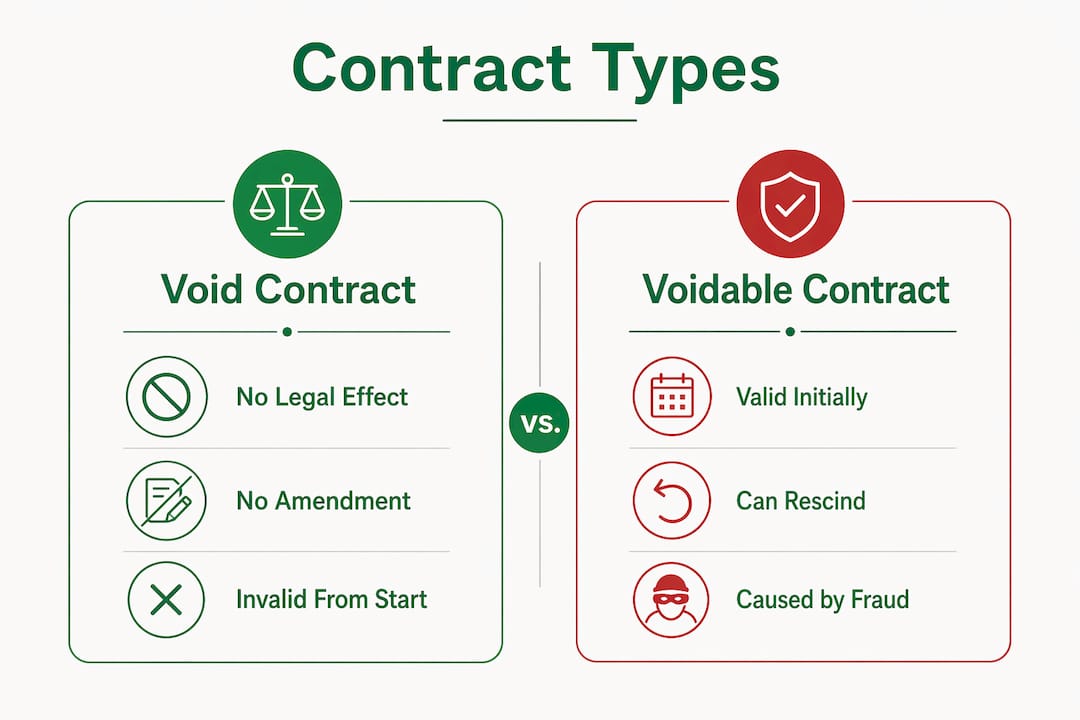
Void contracts have no legal effect from the start, whereas voidable contracts are valid and enforceable until the affected party chooses to rescind them. That is a critical distinction with real consequences for how you respond to a defective agreement.
A voidable contract arises when one party has a legal right to cancel the agreement due to circumstances like fraud, duress, undue influence, or a minor’s participation. The contract stands until that party acts. If the affected party does nothing, the contract becomes fully binding through ratification.
An unenforceable contract occupies a third category. An unenforceable contract may have been valid but fails on a technical requirement, such as the Statute of Frauds, which requires certain agreements to be in writing. Unlike a void contract, an unenforceable agreement did exist. It simply cannot be taken to court.
| Feature | Void contract | Voidable contract | Unenforceable contract |
|---|---|---|---|
| Legal existence | Never existed | Exists until rescinded | Exists but cannot be enforced |
| Who can act | No one. No action needed | Affected party only | Neither party in court |
| Can it be ratified? | No | Yes | No |
| Remedies available | None | Rescission, damages | Limited equitable relief |
| Common cause | Illegal subject matter, incapacity | Fraud, duress, minor’s contract | Missing written form requirement |
Pro Tip: If you suspect a contract is voidable rather than void, act quickly. Failing to rescind a voidable contract in a timely manner results in ratification, and you lose the right to cancel it entirely.
Practical consequences for South Florida business owners
Florida courts treat void contracts as legal nullities, meaning parties cannot sue for breach or recover damages. That outcome is far more damaging than a lost lawsuit. It means the law offers you no help at all, regardless of how much you spent or how much work you performed.
The practical fallout for South Florida business owners includes:
- No recovery for work performed. If you delivered services under a void contract, you generally cannot sue for payment. The court will not enforce an agreement it treats as non-existent.
- No damages for breach. Courts refuse equitable remedies in cases involving illegality or impossibility, reinforcing public policy against unlawful agreements.
- Loss of investment. Void contracts create a legal vacuum, leaving parties without remedies for lost investment or effort. A contractor who builds on a void land-sale agreement may lose both the property and the construction costs.
- Reputational and regulatory risk. In South Florida’s competitive commercial market, being party to a void contract involving illegal subject matter can trigger regulatory scrutiny beyond the civil dispute.
- Cascading contract failures. A void master agreement can render all dependent subcontracts and purchase orders unenforceable as well.
Courts scrutinize the five essential contract elements strictly, and business owners consistently underestimate how the court’s refusal to enforce a void contract causes financial loss. The damage is not just the failed deal. It is every dollar spent in reliance on an agreement that the law never recognized.
Reviewing your contract risk exposure before problems surface is the most cost-effective protection available to any Florida business owner.
How to identify and avoid contract voidance risks
Preventing a void contract is far simpler than recovering from one. The following steps apply directly to South Florida business owners and individuals entering commercial agreements.
-
Verify legal capacity before signing. Confirm that every party has the legal authority to enter the contract. For businesses, that means checking that the signatory has corporate authorization. For individuals, confirm they are of legal age and not under a legal incapacity order.
-
Confirm the subject matter is lawful. Review the contract’s purpose against Florida statutes and local regulations. Agreements tied to unlicensed contractor work, certain non-compete arrangements, or prohibited financial arrangements are common void-contract traps in South Florida.
-
Check all five formation elements. Use a contract formation checklist to confirm offer, acceptance, consideration, capacity, and legality are all present and clearly documented.
-
Review critical clauses for compliance. Certain contract clauses can void an entire agreement if they conflict with Florida law. Penalty clauses, indemnification terms, and non-compete provisions all carry specific legal requirements in this state.
-
Engage legal counsel before execution, not after. The single most effective step is having an attorney review the agreement before you sign. Thorough due diligence before signing, including verifying capacity, legality, and proper formation, reduces contract risk significantly. Discovering a void contract after performance has begun is far more costly than a pre-signing review.
-
Watch for red flags in the other party’s conduct. Pressure to sign quickly, refusal to provide documentation of authority, or vague descriptions of the subject matter are signs that a contract may have formation problems worth investigating.
Key Takeaways
A void contract has no legal existence from the moment it is created, and no court action, ratification, or amendment can make it enforceable.
| Point | Details |
|---|---|
| Void means legally non-existent | Courts treat void contracts as if they never existed, leaving parties with no remedies. |
| Five elements must all be present | Offer, acceptance, consideration, capacity, and lawful subject matter are all required for a valid contract. |
| Void differs from voidable | Voidable contracts are valid until rescinded; void contracts require no action because they never had legal effect. |
| Financial risk is severe | Parties who perform under a void contract cannot recover payment, damages, or investment. |
| Prevention is the only reliable protection | Legal review before signing is the most cost-effective way to avoid void contract exposure in Florida. |
What I’ve learned about void contracts after 20 years in South Florida
The most common mistake I see is business owners treating contract review as a formality rather than a risk assessment. They focus on the deal terms, the price, and the timeline. They skim the legal language or skip it entirely. Then, months later, they discover the agreement was void from day one because the other party lacked authority to sign, or the subject matter violated a Florida statute they had never heard of.
What surprises most clients is that discovering the defect does not automatically protect them. If the contract is voidable rather than void, waiting too long to act means ratification. The window closes, and the defective contract becomes fully binding. That timing distinction is one of the most consequential and least understood concepts in contract law.
South Florida’s commercial environment adds specific complexity. The real estate, construction, and service industries here operate under a dense web of state licensing requirements, local ordinances, and federal regulations. An agreement that looks perfectly reasonable on its face can be void because one party lacked the required license to perform the work. I have seen this destroy deals that took months to negotiate.
My advice is direct: get legal eyes on a contract before you sign it, not after something goes wrong. The cost of a pre-signing review is a fraction of what litigation costs, and litigation is what happens when a void contract surfaces after money has changed hands. Reducing contract risk before a dispute starts is always the right move.
— Matthew
Protect your Florida business with contract review that works
Void contracts do not announce themselves. They look like ordinary agreements until the moment a court refuses to enforce them, and by then the financial damage is already done.
Fornarolegal has represented South Florida businesses and individuals in contract disputes and commercial litigation for over 20 years. Matthew Fornaro, P.A. holds an AV® rating and brings court-tested experience to every contract review and dispute. Whether you need a pre-signing review or guidance after a contract problem surfaces, early legal guidance is the most reliable way to protect your investment and avoid costly litigation. Contact Fornarolegal to schedule a consultation and get clarity on your agreements before they become liabilities.
FAQ
What is a void contract in simple terms?
A void contract is an agreement that has no legal effect from the moment it is created. Courts treat it as if it never existed, and neither party can enforce it or claim damages under it.
What makes a contract void vs. voidable?
A void contract is invalid from the start due to missing essential elements like lawful subject matter or legal capacity. A voidable contract is valid until the affected party chooses to rescind it, typically due to fraud, duress, or a minor’s involvement.
Can a void contract be fixed or ratified?
No. A void contract cannot be ratified, amended, or corrected after the fact. Because it never had legal existence, no action by either party can make it enforceable.
What are the signs of a void contract?
Common signs include an illegal purpose, a party who lacks legal authority or capacity to sign, a subject matter that is impossible to perform, or a complete absence of consideration. Florida business owners should watch for unlicensed contractors and unauthorized signatories as specific local red flags.
What happens if I perform work under a void contract?
You generally cannot recover payment or damages for work performed under a void contract. Florida courts will not enforce the agreement or provide equitable relief, which means your investment of time, money, and resources may be unrecoverable.
Recommended
- Florida Business Contract Attorney: Protecting Your South Florida Venture in 2026
- Florida Breach of Contract Lawyer: A Strategic Guide for Businesses (2026) » Matthew Fornaro, P.A.
- South Florida Lawyer for Contract Disputes: Protecting Your Business in 2026 » Matthew Fornaro, P.A.
- Common Real Estate Contract Disputes in South Florida


