

Key Takeaways
- Florida business law protects companies from unfair competition, contract breaches, and partner disputes.
- Acting early saves time, money, and business relationships.
- An experienced business attorney helps you assess risk and choose the right legal strategy.
A business entity is the legal structure that determines how your business is organized, taxed, and held liable under the law. Getting this decision right from the start protects your personal assets, shapes your tax bill, and defines how much paperwork you face every year. The IRS recognizes five primary structures used by small business owners: sole proprietorship, partnership, LLC, S corporation, and C corporation. Sole proprietorships alone account for about two thirds of all small businesses in the United States. With business entity types explained clearly, you can make a choice that fits your goals today and your growth plans tomorrow.
What are the common business entity types and their characteristics?
The five main legal structures each carry distinct rules on ownership, liability, and taxation. Understanding the differences in business types before you file saves you from expensive corrections later.
Sole proprietorship
A sole proprietorship is the simplest structure available. You and the business are the same legal person, which means there is no separation between your personal bank account and your business debts. Formation requires no state filing in most cases, just a local business license and, if you use a trade name, a fictitious name registration. The tradeoff is unlimited personal liability. If your business is sued, your home, car, and savings are all fair game.

Partnership
A general partnership forms automatically when two or more people go into business together without filing any formal documents. Like a sole proprietorship, general partnerships offer no separation between personal and business assets. A limited partnership adds at least one limited partner whose liability is capped at their investment, but it requires a formal state filing. Both partnership types pass profits and losses directly to partners, who then report them on personal tax returns.
Limited liability company (LLC)
An LLC is a state-level legal entity that gives you liability protection without the full complexity of a corporation. Your personal assets stay separate from business debts in most circumstances. The IRS does not treat “LLC” as a tax classification on its own. An LLC owner must elect a tax status separately, choosing to be taxed as a sole proprietor, partnership, or corporation. That flexibility makes the LLC the most popular structure for small business owners who want protection without heavy administrative overhead.
S corporation and C corporation
A C corporation is a fully separate legal and tax entity. It pays corporate income tax on its profits, and shareholders pay personal income tax on dividends, creating what tax professionals call double taxation. C corporations suit businesses targeting venture capital or public investment because they can issue multiple classes of stock. An S corporation avoids double taxation by passing income directly to shareholders, but it caps ownership at 100 shareholders and restricts who can own shares. Both require articles of incorporation, bylaws, a board of directors, and regular shareholder meetings.
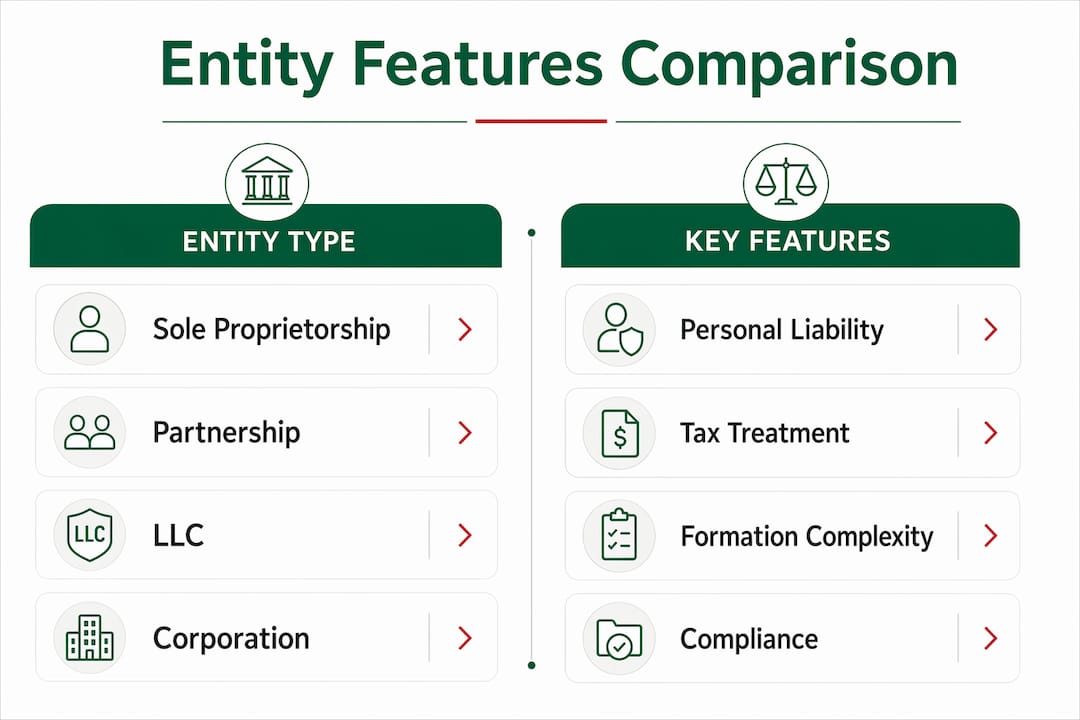
Quick comparison of entity features
| Entity type | Personal liability | Tax treatment | Formation complexity | Ongoing compliance |
|---|---|---|---|---|
| Sole proprietorship | Unlimited | Personal return | Very low | Minimal |
| General partnership | Unlimited | Pass-through | Low | Low |
| LLC | Protected | Elected separately | Moderate | Moderate |
| S corporation | Protected | Pass-through | High | High |
| C corporation | Protected | Corporate + personal | High | Very high |
How do liability protection and taxes vary by entity type?
Liability protection is the clearest reason most entrepreneurs move beyond a sole proprietorship. When your business faces a lawsuit or cannot pay a debt, the entity type determines whether creditors can reach your personal assets.
- Sole proprietorship and general partnership. No legal wall exists between you and the business. A judgment against the business is a judgment against you personally.
- LLC. State law creates a liability shield. Creditors of the business generally cannot pursue your personal assets, provided you keep business and personal finances separate and follow basic formalities.
- S corporation. Shareholders receive the same liability protection as LLC members. The S corp structure also avoids the self-employment tax on distributions, which can produce meaningful savings for profitable businesses.
- C corporation. Shareholders are protected from business debts. The corporation pays its own taxes at the corporate rate, and shareholders pay again on dividends received.
Tax treatment follows a similar pattern. Sole proprietors and partners report all business income on Schedule C or Schedule E and pay self-employment tax on net earnings. LLC members follow the same path unless they elect corporate taxation. S corp shareholders pay self-employment tax only on their salary, not on profit distributions. C corps pay the flat corporate tax rate on profits before any distributions reach shareholders.
A critical misconception trips up many new business owners: your legal structure and your tax status are not the same thing. The IRS does not recognize LLC as a tax classification. You must file a separate election to choose how your LLC is taxed. Skipping this step means the IRS defaults you to sole proprietor or partnership treatment, which may not be what you intended.
Pro Tip: Consult a tax professional before finalizing your entity choice. The self-employment tax savings from an S corp election can be significant, but the IRS scrutinizes unreasonably low salaries paid to owner-employees, so the math needs to be done carefully.
What does it cost to form and maintain each entity type?
Formation costs are only part of the picture. Ongoing compliance expenses catch many business owners off guard and can lead to penalties if ignored.
Formation costs by entity type:
- Sole proprietorship: typically $0 to $100 for a local business license and fictitious name filing
- General partnership: $0 to $200 for a partnership agreement and any required state filings
- LLC: state filing fees range from $50 to several hundred dollars, plus optional legal fees for an operating agreement
- S corporation or C corporation: state filing fees plus legal fees for articles of incorporation, bylaws, and initial organizational documents, often totaling $500 to $2,000 or more
Ongoing annual requirements to budget for:
- Annual report filings with your state’s division of corporations
- Registered agent fees (required for LLCs and corporations in most states)
- Franchise taxes or annual fees charged by the state regardless of revenue
- Corporate minutes and resolutions for corporations
- Separate business bank account maintenance and bookkeeping
Most business owners underestimate ongoing compliance costs, which vary by state and entity type. Missing an annual report deadline can result in administrative dissolution of your entity, which strips away your liability protection until you reinstate it.
Pro Tip: When comparing entity options, calculate the total five-year cost, not just the filing fee. A $50 LLC formation fee in one state may come with $400 annual fees, while another state charges $125 upfront and $50 per year.
How do you choose the right business entity for growth?
Choosing a business entity is not a one-time decision. Entity choice is often revisited as companies grow, with many entrepreneurs moving from sole proprietorships to LLCs or S corps as revenue and risk increase. The right structure for a freelance consultant differs sharply from the right structure for a product company seeking outside investors.
Key factors to weigh when choosing a business entity:
- Liability tolerance. If your business carries meaningful risk of lawsuits or large debts, an LLC or corporation is the minimum acceptable structure.
- Tax efficiency. High-profit businesses often benefit from S corp elections. Businesses planning to reinvest profits may prefer C corp treatment.
- Capital needs. Only C corporations can issue preferred stock, which is the standard instrument for venture capital investment. If you plan to raise outside equity, a C corp is the practical choice.
- Administrative capacity. Corporations require board meetings, minutes, and formal resolutions. If you are a solo operator, that burden may outweigh the benefits.
- Number of owners. S corporations cap shareholders at 100 and restrict ownership to U.S. citizens and permanent residents. LLCs have no such limits.
Changing your structure after formation is possible but carries real costs. Altering an existing entity typically involves legal dissolution and creation of a new entity, which can trigger tax liabilities and require contract reassignment. Vendors, landlords, and lenders may need to sign updated agreements. Planning your structure correctly from the start avoids this disruption entirely.
For Florida entrepreneurs, the state-specific rules on LLC formation, annual reports, and registered agents add another layer of complexity. Reviewing the formation risks in Florida before you file protects you from compliance gaps that are easy to miss when using generic online guides.
Legal and financial advice is essential when selecting a business entity because state laws and individual tax situations vary too widely for a generic checklist to cover. What works for a tech startup in Miami may be the wrong call for a construction company in Fort Lauderdale.
Key Takeaways
Your entity type is the single most consequential legal decision you make at formation, because it controls your personal liability, your tax bill, and your ability to raise capital.
| Point | Details |
|---|---|
| Sole proprietorships carry full personal risk | No legal separation exists between your assets and business debts. |
| LLCs require a separate tax election | The IRS does not treat LLC as a tax status; you must file a separate election. |
| Formation fees are only the start | Annual reports, registered agent fees, and compliance filings add recurring costs. |
| Changing entities is expensive | Dissolution and re-formation can trigger tax liabilities and require contract reassignment. |
| C corps are required for venture capital | Only C corporations can issue preferred stock, the standard instrument for outside equity. |
What I have seen after 20 years of business formation work
After two decades of helping South Florida entrepreneurs form and restructure their businesses, the pattern I see most often is this: owners choose the cheapest and fastest option at formation, then pay far more to fix it later.
The most common mistake is treating the LLC as a complete solution without thinking through the tax election. An LLC taxed as a sole proprietor gives you liability protection, which is valuable. But if your net profit is substantial, you are paying self-employment tax on every dollar. An S corp election, done correctly, can reduce that burden significantly. The problem is that most business owners do not know this election exists until they are already two or three years in and have overpaid considerably.
The second mistake I see is underestimating what “maintaining” an entity actually means. Florida requires annual reports. Miss the deadline and your LLC or corporation goes into administrative dissolution. At that point, you have been operating without liability protection, potentially for months, without knowing it. That is not a hypothetical risk. I have seen it create real exposure in contract disputes and litigation.
My honest advice: do not treat entity formation as a filing exercise. Treat it as a legal and financial decision that deserves the same attention you give your biggest contracts. The cost of getting it right upfront is a fraction of the cost of correcting it later.
— Matthew
Working with Fornarolegal on your entity formation
Selecting the wrong business structure creates problems that compound over time, from unexpected tax bills to gaps in liability protection that only surface when a dispute arises.

Fornarolegal works with small business owners and entrepreneurs across South Florida to select, form, and maintain the right legal structure for their situation. With over 20 years of AV-rated, court-tested experience, Matthew Fornaro provides practical guidance on entity selection, operating agreements, and ongoing compliance. Getting early legal guidance before you file is the most cost-effective step you can take. Contact Fornarolegal to discuss your business structure and make sure your foundation is built correctly from day one.
FAQ
What is a business entity?
A business entity is the legal structure under which a business operates, determining ownership, liability, and tax treatment. The IRS recognizes five primary types: sole proprietorship, partnership, LLC, S corporation, and C corporation.
What is the difference between an LLC and a corporation?
An LLC is a state-level entity with flexible tax treatment and fewer formalities, while a corporation is a more complex structure with its own tax obligations and formal governance requirements. C corporations can issue multiple stock classes; LLCs cannot.
Does forming an LLC protect all personal assets?
An LLC protects personal assets from most business debts and lawsuits, but only if you maintain separate finances and follow state compliance requirements. Commingling personal and business funds can void that protection.
Can I change my business entity type after formation?
Yes, but changing business structures involves legal dissolution of the existing entity and formation of a new one, which can trigger tax consequences and require updating contracts, licenses, and bank accounts.
Which entity type is best for raising outside investment?
C corporations are the preferred structure for venture capital and outside equity because they can issue preferred stock and accommodate unlimited shareholders. LLCs and S corporations face ownership restrictions that make institutional investment difficult.
Recommended
- How to Choose a Business Entity » Matthew Fornaro, P.A. Coral Springs Parkland Business Law
- How to Choose the Right Business Entity in Florida » Matthew Fornaro, P.A.
- Florida Business Formation: A Step-by-Step Legal Guide for SMBs » Matthew Fornaro, P.A.
- Choosing a Business Entity in Florida: A Strategic Guide for 2026 » Matthew Fornaro, P.A.


