

Key Takeaways
- Florida business law protects companies from unfair competition, contract breaches, and partner disputes.
- Acting early saves time, money, and business relationships.
- An experienced business attorney helps you assess risk and choose the right legal strategy.
A dispute settlement agreement is a binding contract that resolves a legal conflict between two parties without going to trial. For small business owners in South Florida, the ability to negotiate dispute settlement agreement terms effectively can mean the difference between a resolved conflict and a years-long lawsuit that drains your time, money, and focus. The standard industry term for this process is “settlement negotiation,” and it draws on risk analysis, behavioral economics, and precise legal drafting. This guide covers every step, from preparation through final signature.
What do you need before negotiating a dispute settlement agreement?
Preparation is the single biggest predictor of settlement success. Owners who walk into negotiations without data are at the mercy of whoever made the first offer.
Build a risk analysis foundation first. Decision trees are the most practical tool for this. A decision tree maps every possible outcome of litigation, assigns a probability to each, and calculates an expected value. Risk analysis tools like decision trees reveal a settlement zone where resolving the case beats going to trial for both sides financially. A $200,000 dispute, for example, may have a rational settlement range between $2,510 and $202,510 once litigation costs and probabilities are factored in. That range is your negotiating field.
Most business owners dramatically overestimate their odds in court. A case that looks like a 75% winner at every stage only has a 24% total success probability once five sequential hurdles are multiplied together. That math alone makes early settlement worth serious consideration.
Anchor your opening offer with objective data. The anchoring effect is a behavioral economics principle: the first meaningful number in a negotiation heavily shapes the final outcome. Anchors backed by objective data, such as contract provisions or independent expert valuations, are far harder for the other side to dismiss than arbitrary figures. Gather invoices, contracts, expert appraisals, and comparable case outcomes before you make or respond to any offer.
Protect your deadlines with a tolling agreement. Negotiations take time, and Florida’s statutes of limitations do not pause while you talk. A written standstill or tolling agreement suspends limitation periods while negotiations proceed. Without one, you risk losing your legal rights entirely if talks drag on past a filing deadline.
Pre-negotiation checklist:
- Completed decision tree with probability-weighted outcomes
- Written tolling or standstill agreement signed by both parties
- Copies of all relevant contracts, invoices, and correspondence
- Independent expert opinion or comparable case benchmarks
- Clear internal authority: know your walk-away number before you sit down
Pro Tip: Set your opening anchor 15–25% above your target number. This gives you room to make concessions that feel meaningful to the other side while still landing where you need to be.
How should you execute settlement negotiation strategies step by step?
Knowing your numbers is necessary. Knowing how to present them is what closes deals.
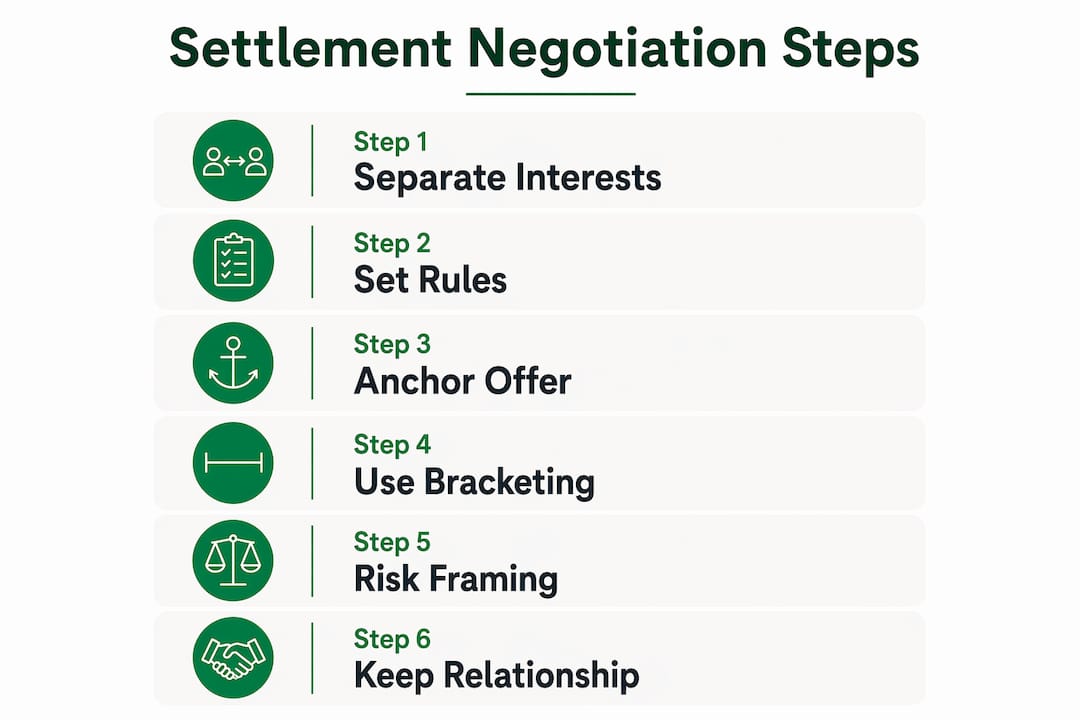
Step 1: Separate interests from positions. A position is what someone says they want. An interest is why they want it. Focusing on interests rather than rigid positions breaks deadlocks and opens creative solutions. A vendor demanding $50,000 may actually need cash flow by a specific date. Knowing that lets you offer a payment structure that works for both sides.

Step 2: Set the rules of the road upfront. Agreeing on how negotiations will run, including who can attend, whether experts will participate, and how offers will be exchanged, increases perceived fairness. Defining clear negotiation procedures upfront reduces the chance that one side feels ambushed or manipulated, which is a common reason talks collapse.
Step 3: Make an anchored opening offer. Use your objective data to frame the first number. Present it with a brief explanation tied to contract terms or market benchmarks. Never apologize for your number or immediately signal flexibility. Confidence in your anchor forces the other side to justify any departure from it.
Step 4: Use bracketing to break impasses. When talks stall, blind bracketology is a mediation technique that lets both sides explore settlement ranges without showing their hand. A neutral mediator presents confidential brackets to each party. If the ranges overlap, both sides reveal them simultaneously. This technique breaks deadlocks without either party losing face or leverage.
Step 5: Frame proposals around risk, not concessions. Telling the other side “I’m willing to come down” signals weakness. Telling them “a trial carries a 24% success probability after five stages of litigation” signals data. Frame every movement in your position as a response to shared risk, not as a favor.
Step 6: Keep the relationship in view. South Florida is a tight business community. A settlement that leaves the other party humiliated can cost you referrals, vendor relationships, or future contracts. Successful settlements happen when neither side feels like they lost. Aim for that outcome deliberately.
Pro Tip: Before each session, write down your best alternative to a negotiated agreement (BATNA). Knowing your fallback position keeps you from accepting a bad deal under pressure.
What are the common pitfalls in dispute settlement negotiations?
Even well-prepared owners make mistakes that cost them money or legal rights. Recognizing these traps early keeps you in control.
- Binding yourself accidentally. A legally binding settlement can form the moment essential terms are confirmed in writing, even before a formal agreement is signed. Early email or text confirmations can legally bind parties in certain jurisdictions, including Florida. Never confirm numbers or terms in writing unless you are ready to be held to them.
- Letting emotions drive the process. Positional bargaining, where each side digs in and refuses to move, is almost always driven by ego rather than economics. Recognize when a conversation has shifted from problem-solving to point-scoring, and redirect it.
- Misreading a lowball offer. A low opening offer is a negotiation tactic, not an insult. Respond with your data-backed anchor and a calm explanation. Reactive devaluation, the tendency to reject any offer from the other side simply because they made it, is a well-documented cognitive bias that kills settlements.
- Ignoring the clock. Even with a tolling agreement in place, limitation periods require active management. Know your deadlines and build them into your negotiation timeline.
- Failing to plan for a stalemate. Know in advance at what point you will stop negotiating and file or mediate. Having a clear dispute resolution path prevents you from negotiating indefinitely out of uncertainty.
“Parties undervalue the emotional and strategic costs of litigation. Agreeing upfront on expert selection and legal participation smooths negotiations and increases the likelihood of a fair resolution.” — Harvard Program on Negotiation
How do you draft and finalize a settlement agreement that holds up?
Reaching a verbal agreement is not the finish line. A settlement only protects you once it is properly documented and signed.
-
Confirm essential terms in writing immediately. As soon as the parties reach agreement on the core terms, put them in a written summary and send it to the other side. This prevents either party from later claiming the deal was different or never final.
-
Include a full release of claims. The release clause defines exactly which claims are being resolved. A vague release creates future disputes. Specify the claims, the parties, and the time period covered. Florida courts enforce releases that are clear and specific.
-
Add a confidentiality clause. Most business settlements include a mutual confidentiality provision. This protects both parties from public disclosure of the dispute terms, which matters for reputation and future business relationships.
-
Address costs, fees, and implementation steps. Specify who pays legal fees, how and when payment will be made, and what each party must do to complete the resolution. Ambiguity on these points is the most common source of post-settlement disputes.
-
Have qualified legal counsel draft or review the final agreement. A poorly worded release can leave you exposed to future claims on the same issue. Key contract clauses in settlement agreements require precise legal language to be enforceable. An attorney with experience in South Florida business disputes will catch ambiguities that a non-lawyer will miss.
Building dispute prevention clauses into your future contracts, such as mandatory mediation before litigation, is the smartest follow-up step after any settlement. It reduces the cost and friction of the next disagreement before it starts.
Key Takeaways
Effective settlement negotiation requires data-backed preparation, interest-focused communication, and precise legal documentation to produce agreements that hold up and protect your business.
| Point | Details |
|---|---|
| Run a decision tree first | Quantify your litigation risk before making or responding to any offer. |
| Anchor with objective data | Use contract terms or expert valuations to set your opening number. |
| Protect your deadlines | Sign a tolling agreement before negotiations begin to preserve your legal rights. |
| Focus on interests, not positions | Ask why the other side wants what they want. Creative solutions follow. |
| Document terms immediately | Confirm agreed terms in writing right away. Verbal agreements are hard to enforce. |
What 20 years of South Florida disputes taught me about settlements
Most business owners come to me after a dispute has already gotten expensive. They have exchanged angry emails, made verbal offers they cannot take back, and spent weeks in positional bargaining that went nowhere. The pattern is consistent, and it is almost always avoidable.
The biggest mistake I see is treating negotiation as a contest. Owners focus on winning the argument instead of solving the problem. After more than two decades handling business disputes across South Florida, I can tell you that the settlements that stick are the ones where both sides walked away feeling the outcome was fair. That is not idealism. It is practical. A resentful counterparty finds ways to make implementation difficult, dispute the release, or damage your reputation in the market.
The second mistake is underestimating how much litigation actually costs, not just in legal fees, but in owner time, employee distraction, and lost opportunities. When you run the numbers honestly through a decision tree, settlement almost always looks better than it did before you did the math.
My advice to any South Florida entrepreneur facing a dispute: get the numbers right, protect your deadlines, and bring in experienced counsel before you make your first written offer. The hidden costs of business disputes compound quickly once litigation starts. Early, well-structured negotiation is almost always the better path.
One more thing: build dispute resolution procedures into every contract you sign going forward. A mandatory mediation clause costs nothing to add and can save you tens of thousands of dollars the next time a business relationship goes sideways.
— Matthew
Fornarolegal helps South Florida businesses settle disputes efficiently
Fornarolegal works with small business owners and entrepreneurs across South Florida to negotiate, document, and finalize dispute settlement agreements. Matthew Fornaro brings over 20 years of court-tested experience to every case, from the initial risk analysis through final agreement drafting.
Whether you are facing a contract dispute, a vendor conflict, or a partnership breakdown, Fornarolegal provides the practical legal guidance you need to resolve it without unnecessary litigation. Start with the Florida owner’s dispute checklist to assess where your situation stands, then contact Fornarolegal to discuss your options with an attorney who knows South Florida business law from the inside out.
FAQ
What is a dispute settlement agreement?
A dispute settlement agreement is a binding written contract that resolves a legal conflict between two parties without going to court. It defines the terms of resolution, including payments, releases of claims, and any ongoing obligations.
When does a settlement agreement become legally binding in Florida?
A settlement agreement can become binding as soon as essential terms are confirmed in writing, including by email or text message. Florida courts have enforced settlements based on written communications exchanged before a formal document was signed.
How do I negotiate a settlement without giving too much away?
Use a data-backed anchor as your opening offer and frame every position around shared litigation risk rather than personal concessions. Techniques like blind bracketology let you explore settlement ranges through a mediator without revealing your bottom line.
What clauses must a settlement agreement include?
A solid settlement agreement includes a full release of claims, a confidentiality provision, payment terms with a clear timeline, and a description of any steps each party must take to complete the resolution. Vague language in any of these areas creates future disputes.
Should I use a lawyer to negotiate a settlement agreement?
Yes. An experienced business attorney identifies ambiguous language, protects your legal rights during negotiations, and drafts a release that actually closes the dispute. For South Florida business owners, working with local business counsel familiar with Florida courts adds a practical advantage.
Recommended
- Contract Dispute Resolution: A Practical 2026 Guide » Matthew Fornaro, P.A. Coral Springs Parkland Business Law
- How to Handle a Vendor Dispute Without Making It Worse: A Florida Business Owner’s Guide » Matthew Fornaro, P.A.
- Before a Business Disagreement Becomes a Lawsuit: A Florida Owner’s Checklist » Matthew Fornaro, P.A.
- How to Respond to a Business Dispute Before It Escalates in Florida » Matthew Fornaro, P.A.


