

Key Takeaways
- Florida business law protects companies from unfair competition, contract breaches, and partner disputes.
- Acting early saves time, money, and business relationships.
- An experienced business attorney helps you assess risk and choose the right legal strategy.
Reviewing vendor contracts is the process of carefully examining supplier agreement terms to confirm the deal protects your business, controls costs, and limits legal exposure. 43% of small business owners sign contracts without any legal review, and those owners face significantly higher dispute rates as a result. Vendor agreements routinely account for 20–30% of operating costs, which means a single poorly negotiated contract can quietly drain your budget for years. This guide gives you a practical, cost-efficient framework to review vendor contracts as a small business owner, covering the critical clauses, a step-by-step process, and the pitfalls that trip up even experienced operators.
What are the essential elements to review in a vendor contract?
The most important areas to examine in any supplier agreement are scope of services, pricing, renewal terms, termination rights, and liability provisions. Pricing, renewal, and termination clauses cause the majority of vendor contract problems for small businesses. Focusing your review on these three areas first cuts your cost exposure and reduces the risk of getting locked into unfavorable terms.
Scope of services
The scope of work clause defines exactly what the vendor will deliver, by when, and to what standard. Vague scope clauses are the leading cause of vendor disputes. Every deliverable must include a measurable outcome and a deadline. “Marketing support” is not a deliverable. “Ten social media posts per month, delivered by the 5th of each month” is.
Pricing, payment terms, and renewal
Confirm the exact price, any scheduled increases, and the payment schedule. Watch for automatic price escalation clauses buried in renewal provisions. Many vendors include a clause that renews the contract at a higher rate unless you give written notice 60 or 90 days before the end date. Missing that window locks you in for another full term.

Termination rights and exit clauses
A contract without a clear exit clause is a trap. You need the right to terminate for cause (vendor failure) and, ideally, for convenience (your business needs change). Notice periods of 30 days are standard for lower-risk agreements. Contracts requiring 180-day notice periods for termination deserve extra scrutiny before you sign.
Liability, indemnity, and insurance
Liability caps limit how much a vendor owes you if something goes wrong. Indemnity clauses can shift legal costs onto you even when the vendor is at fault. Check whether the contract requires the vendor to carry adequate liability insurance coverage and name your business as an additional insured. This one step protects you from paying for a vendor’s mistakes.
Data, IP, and confidentiality
Any contract involving your customer data, proprietary processes, or creative work must address ownership clearly. Confirm that your business retains ownership of any work product created under the agreement. Confidentiality provisions should cover both parties and survive contract termination.
| Contract element | Common risk | Best practice |
|---|---|---|
| Scope of services | Vague deliverables cause disputes | Require measurable outcomes and deadlines |
| Pricing and payment | Hidden escalation clauses | Confirm fixed pricing or cap annual increases |
| Renewal terms | Auto-renewal at higher rates | Calendar notice deadlines immediately after signing |
| Termination rights | Long notice periods trap you | Negotiate 30-day termination for convenience |
| Liability and indemnity | Costs shift to your business | Cap liability and require vendor insurance |
| Data and IP ownership | Vendor retains your work product | Confirm written ownership assignment |
Pro Tip: Read the definitions section of every contract first. Vendors often define key terms like “services,” “deliverables,” or “business day” in ways that narrow their obligations significantly.
How can small businesses review contracts without excessive legal costs?
The answer is a tiered review process that separates low-risk contracts from high-risk ones before spending any legal budget. Risk-based review scoring helps small businesses allocate legal expenses efficiently. Not every vendor agreement needs a full attorney review. A $500 annual software subscription carries different risk than a $50,000 manufacturing supply agreement.
The triage approach
Score each incoming contract on three factors: total contract value, length of commitment, and scope of liability. Assign a simple low, medium, or high risk rating. Low-risk contracts get an internal checklist review. High-risk contracts go straight to a legal professional. This tiered risk analysis prevents wasting expensive legal time on agreements that pose minimal financial threat.
When to escalate to legal review
Escalate any contract that includes personal guarantees, uncapped liability, intellectual property transfers, or terms governed by a state other than your own. A small business contract review attorney becomes cost-effective the moment a contract’s potential downside exceeds what you can absorb. Paying for one hour of legal review is far cheaper than resolving a dispute that exceeds the contract’s total value.
Using AI tools for initial review
AI-assisted contract analysis combined with targeted legal review reduces both time and cost. AI tools flag unusual clauses, missing provisions, and one-sided terms in minutes. Use them for triage, not as a substitute for legal judgment on high-stakes agreements.
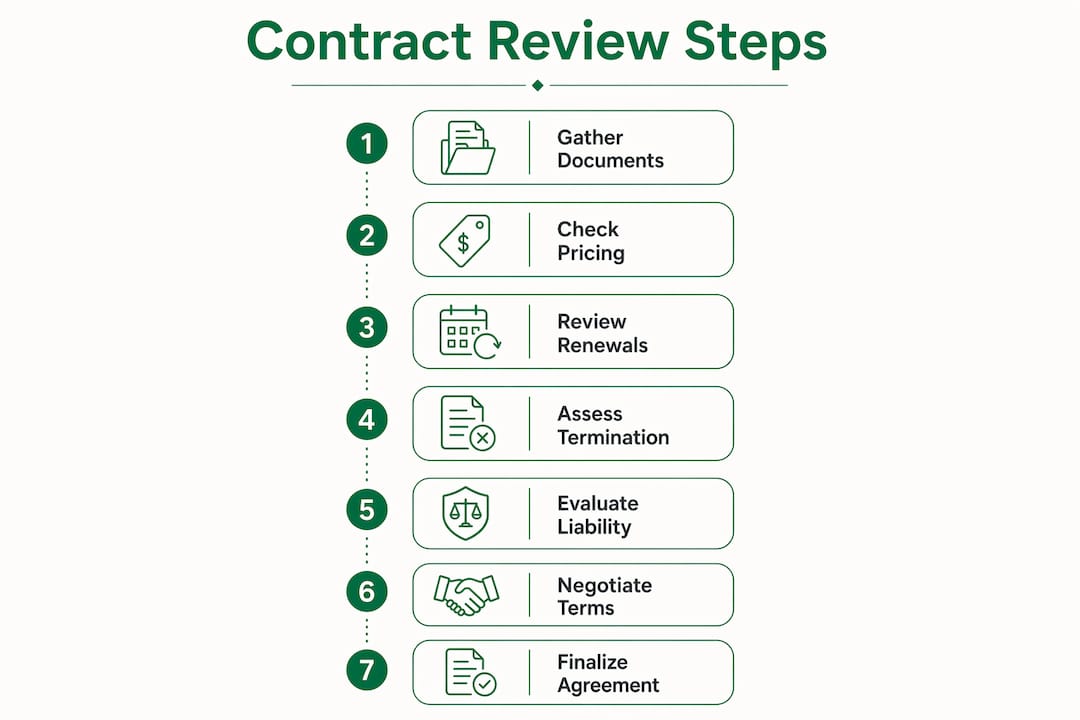
- Collect all contract documents, exhibits, and any prior correspondence with the vendor.
- Score the contract using your triage criteria (value, term length, liability scope).
- Run an AI-assisted review to flag unusual or missing clauses.
- Complete your internal checklist covering the six core elements above.
- Escalate to legal review if the contract scores high risk on any single factor.
- Calendar all key dates immediately after signing.
Pro Tip: Set calendar reminders 90 days, 60 days, and 30 days before every contract renewal or notice deadline. Missing a single notice window can cost you an entire additional contract term.
Step-by-step process to review and negotiate vendor contracts
Effective contract negotiation for small businesses starts before you open the document. Gather the vendor’s proposal, any prior invoices, and your internal requirements list first. Reviewing a contract without knowing what you actually need leads to accepting terms that look standard but do not fit your operation.
Reviewing the contract in sequence
Check pricing and payment terms first, then renewal and termination provisions, then liability and indemnity. This sequence mirrors where most vendor contract problems originate. Flag every clause you do not understand or that gives the vendor unilateral rights. A clause that lets the vendor change pricing with 10 days’ notice is a red flag, not a standard term.
Negotiating unfavorable terms
Vendors expect negotiation. Most standard vendor agreements are written to favor the vendor, and most terms are movable. Start with a shorter initial term than the vendor proposes. A 12-month agreement with renewal options gives you more flexibility than a 36-month commitment. Push for specific deliverables, defined SLAs, and a clear process for resolving disputes before they escalate. For practical guidance on negotiating business contracts to reduce litigation risk, a structured approach makes a measurable difference.
Documenting agreed changes
Every negotiated change must appear in the signed contract or a written amendment. Email confirmations are not enough. Verbal agreements are not enforceable. If a vendor agrees to waive a termination fee or reduce a notice period, get it in writing before you sign the original document.
| Negotiation point | Vendor default | Target outcome |
|---|---|---|
| Contract term | 36 months | 12 months with renewal option |
| Termination notice | 90–180 days | 30 days for convenience |
| Price escalation | Annual increase, uncapped | Fixed price or capped at 3% annually |
| SLA remedies | Vendor discretion | Credit or refund for missed SLAs |
| Dispute resolution | Vendor’s home jurisdiction | Mutual agreement or local jurisdiction |
Pro Tip: Ask vendors for a redlined version of your proposed changes rather than a new draft. It keeps negotiations focused and prevents vendors from reintroducing removed clauses in a clean rewrite.
What are the most common vendor contract pitfalls?
Contract disputes rank among the top five legal challenges for small businesses, and resolution costs frequently exceed the contract’s total value. Most of those disputes trace back to a short list of avoidable mistakes.
“Most vendor contract problems arise from a small set of practical terms, not hidden clauses. Owners who focus their review on pricing, renewal, termination, and scope catch the vast majority of risks before they sign.”
The five pitfalls that generate the most disputes and financial loss are:
- Auto-renewal traps. Missing renewal notice deadlines is one of the most common and costly mistakes. Calendar every deadline the day you sign.
- Vague scope of work. Accepting descriptions like “ongoing support” or “as needed” creates disputes the moment you and the vendor disagree on what was promised.
- Uncapped liability. Contracts that expose your business to unlimited liability for vendor errors can exceed your insurance coverage and threaten your entire operation.
- Unclear data ownership. Failing to specify who owns customer data, creative assets, or software built under the contract creates expensive disputes after the relationship ends.
- No ongoing monitoring process. Signing a contract and filing it away is not contract management. Assign someone to track performance, deadlines, and renewal dates for every active agreement. Review common vendor agreement mistakes that put Florida businesses at risk to build a stronger monitoring process.
Key Takeaways
Small businesses that systematically review vendor contracts before signing experience significantly fewer disputes, lower operating costs, and stronger vendor relationships than those that sign without review.
| Point | Details |
|---|---|
| Focus on three clauses first | Pricing, renewal, and termination terms cause most vendor contract problems. |
| Use a tiered review process | Score contracts by risk level and escalate only high-risk agreements to legal review. |
| Calendar all key dates immediately | Set reminders 90, 60, and 30 days before every renewal or notice deadline. |
| Negotiate before signing | Shorter initial terms, defined SLAs, and written amendments protect your flexibility. |
| Monitor contracts actively | Assign responsibility for tracking performance and deadlines across all active agreements. |
What I’ve learned after 20 years of vendor contract disputes
Most small business owners treat contract review as a formality. They skim the document, sign it, and move on. That approach works fine until it doesn’t, and when it fails, it fails expensively.
The pattern I see most often is not a hidden clause or a predatory vendor. It is an owner who accepted vague language because the relationship felt solid and the vendor seemed trustworthy. Relationships matter in business. They do not substitute for written terms. A vendor who genuinely values your business will not resist putting clear deliverables and fair exit rights in writing.
The other pattern I see is owners who avoid legal review because of cost, then spend ten times that amount resolving a dispute that a one-hour contract review would have prevented. Proactive review is not a legal expense. It is a financial control. The businesses I work with that treat contracts as living documents, monitoring them actively and renegotiating at renewal, consistently outperform those that treat contracts as paperwork.
My practical advice: build a simple contract register. List every active vendor agreement, the renewal date, the notice deadline, and the contract value. Review that register quarterly. You will catch problems before they become disputes, and you will negotiate from a position of awareness rather than surprise.
— Matthew
When professional contract review makes financial sense
Small business owners who want to protect their vendor relationships and operating budget without spending on unnecessary legal fees benefit most from a structured, professional review process.

Fornarolegal works with small businesses, startups, and entrepreneurs across South Florida to review vendor agreements, flag unfavorable terms, and negotiate changes before signing. With over 20 years of court-tested experience, the firm offers practical guidance that fits your budget and your timeline. Whether you need a full contract risk management review or a focused assessment of a specific clause, Fornarolegal provides clear answers without the legalese. If a vendor dispute is already developing, the Florida owner’s dispute checklist is a practical first step before the situation escalates.
FAQ
What does it mean to review a vendor contract?
Reviewing a vendor contract means examining every clause to confirm the terms protect your business interests, define deliverables clearly, and limit your financial and legal exposure before you sign.
Which contract clauses cause the most disputes for small businesses?
Pricing, renewal, and termination clauses generate the majority of vendor contract disputes. Focusing your review on these three areas first reduces the most significant risks.
How often should small businesses review active vendor contracts?
Review active contracts at least 90 days before each renewal date. This gives you enough time to negotiate changes or issue a termination notice without missing the deadline.
When does a small business need an attorney to review a vendor contract?
Any contract involving personal guarantees, uncapped liability, intellectual property transfers, or a term exceeding 12 months warrants legal review. The cost of one attorney hour is almost always less than the cost of resolving a dispute.
What is the biggest mistake small businesses make with vendor contracts?
Failing to calendar renewal and notice deadlines immediately after signing is the most common and costly mistake. Missing a single notice window can lock your business into an unwanted contract term.
Recommended
- When to Hire a Small Business Contract Review Attorney » Matthew Fornaro, P.A. Coral Springs Parkland Business Law
- How to Draft a Vendor Contract: A Step-by-Step Guide » Matthew Fornaro, P.A. Coral Springs Parkland Business Law
- Florida Business Contract Review Checklist: What Owners Must Verify Before Signing » Matthew Fornaro, P.A. Coral Springs Parkland Business Law
- Florida Business Owners: A Practical Guide to Reviewing Contracts Before You Sign » Matthew Fornaro, P.A.


