

Key Takeaways
- Florida business law protects companies from unfair competition, contract breaches, and partner disputes.
- Acting early saves time, money, and business relationships.
- An experienced business attorney helps you assess risk and choose the right legal strategy.
Florida employment law is defined as the body of state and federal rules governing how businesses hire, pay, manage, and separate from employees within the state. For small business owners, understanding these rules is not optional. Failing to comply with key Florida workplace regulations exposes you to fines, lawsuits, and license suspensions that can cripple an operation. This guide covers the core obligations you face right now, including recent updates to minimum wage, E-Verify, and whistleblower protections, so you can navigate Florida employment law basics with confidence.
What foundational employment laws must Florida small business owners know?
Florida employment law rests on a few core pillars that every business owner must understand before hiring a single employee. Getting these right from the start prevents the most common and costly mistakes.
At-will employment is the default rule in Florida. Either party can end the employment relationship at any time, for any lawful reason, or for no reason at all. Florida’s at-will doctrine is among the strongest in the country, with few implied contract exceptions. That strength benefits employers in termination decisions, but it does not shield you from discrimination claims.

Minimum wage is a moving target in Florida. The state minimum wage reaches $15.00 per hour for non-tipped employees as of september 30, 2026. After that date, annual increases will track the Consumer Price Index. Tipped employees may receive a tip credit, but their total combined pay must still meet the full minimum wage.
Anti-discrimination law applies once you reach 15 employees. The Florida Civil Rights Act prohibits discrimination based on race, color, religion, sex, national origin, age, disability, and marital status. Federal Title VII covers the same protected classes, so most Florida employers face obligations under both frameworks simultaneously.
E-Verify became mandatory for private employers with 25 or more employees starting july 1, 2023, under Florida’s SB 1718. Enforcement began in july 2024. Violations carry fines of $1,000 per day and potential license suspensions. You must create an E-Verify case within 3 business days of a new hire’s start date.
Workers’ compensation thresholds differ sharply by industry. Coverage is required for construction businesses with just one employee, general industry businesses with four or more employees, and agricultural operations with six or more regular employees or 12 or more seasonal workers. Construction owners are frequently caught off guard by this threshold.
Pro Tip: Review your workers’ compensation coverage every time you add a new employee, especially if you operate in construction. The threshold triggers faster than most owners expect.
What are employer responsibilities for wages, hours, and leave in Florida?
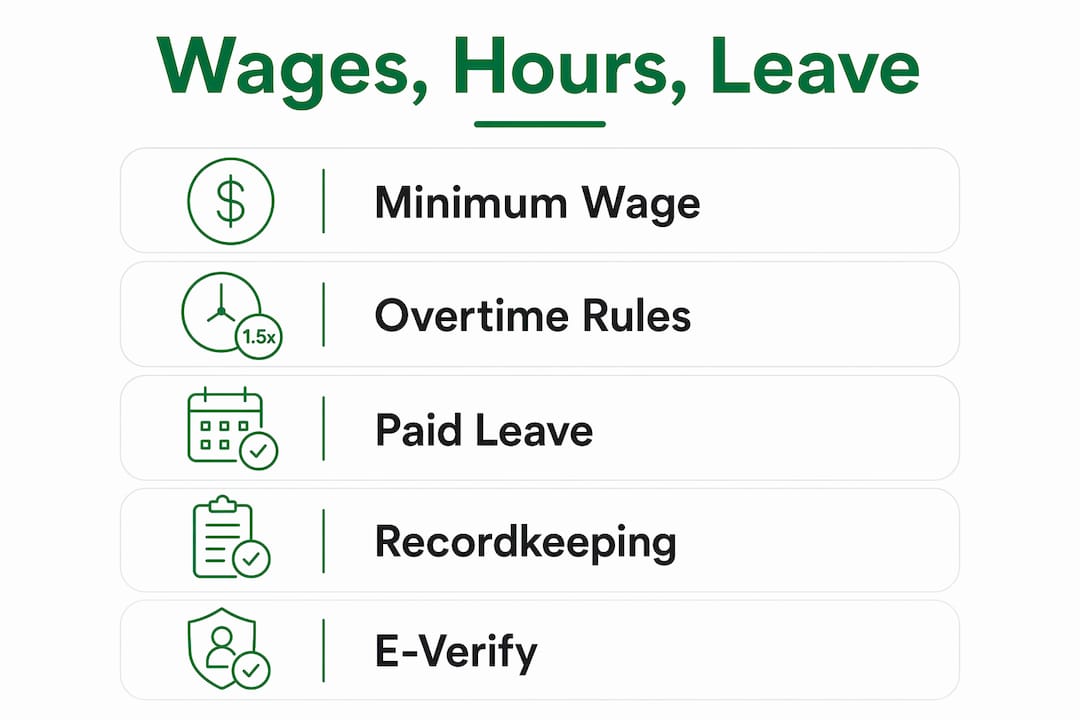
Florida’s wage and hour rules blend state minimums with federal overtime law. Understanding where state law ends and federal law begins saves you from compliance gaps.
Florida minimum wage vs. federal minimum
Florida’s minimum wage of $15.00 per hour already exceeds the federal minimum of $7.25 per hour. The state rate controls because it is higher. Post-2026 adjustments will be indexed to inflation, so budget for annual increases going forward.
Overtime and break rules
Florida has no state overtime law. The federal Fair Labor Standards Act applies exclusively, requiring 1.5 times the regular rate for all hours worked beyond 40 in a workweek. There is no daily overtime trigger in Florida. Adult employees in the private sector also have no state-mandated meal or rest breaks. Minor employees are a different matter and are covered under Florida’s child labor statutes, which require specific break periods.
Leave entitlements
Florida mandates no paid sick leave, no paid vacation, and no paid holiday pay. The state preempts local sick leave ordinances, meaning no city or county can impose paid leave requirements either. Any paid leave you offer is a voluntary benefit, not a legal obligation. Federal law still applies, including the Family and Medical Leave Act for employers with 50 or more employees.
Recordkeeping and pay stubs
Florida does not require employers to provide pay stubs. Federal FLSA recordkeeping rules do require you to maintain accurate records of hours worked and wages paid for at least two years. Employers must also report new hires to the Florida Department of Revenue within 20 days of their start date. Independent contractors earning $600 or more are also reportable under this rule.
| Obligation | Florida Rule | Federal Rule |
|---|---|---|
| Minimum wage | $15.00/hour (2026) | $7.25/hour |
| Overtime | No state law | 1.5x after 40 hours/week |
| Paid sick leave | Not required | Not required (FMLA unpaid) |
| Meal/rest breaks (adults) | Not required | Not required |
| Pay stubs | Not required | Records must be kept |
| New hire reporting | Within 20 days | Federal database required |
How can Florida small business owners avoid common compliance pitfalls?
Knowing the law is one thing. Applying it correctly under real business conditions is another. These are the areas where Florida small business owners most often get into trouble.
-
Mishandling E-Verify timing. SB 1718 requires you to initiate an E-Verify case within 3 business days of a new hire’s first day of work, not the date of the job offer. Missing this window, even by one day, creates a documented violation. Build the E-Verify step into your onboarding checklist so it runs automatically.
-
Misclassifying employees as independent contractors. Florida courts and the IRS both apply multi-factor tests to determine true worker status. Misclassification means you owe back payroll taxes, workers’ compensation premiums, and potentially overtime pay. The financial exposure compounds quickly.
-
Treating employee handbooks as contracts. Florida courts do not treat handbook policies as binding contracts unless the document contains clear promissory language. Most handbooks do not. Still, inconsistent application of handbook policies creates discrimination exposure, so enforce your written policies uniformly.
-
Ignoring the 2025 whistleblower expansion. Florida Statute § 448.102 now protects private-sector employees who report violations of any law, rule, or regulation, not just certain categories. Retaliating against an employee who raises a compliance concern, even informally, creates serious legal liability.
-
Skipping legal review of non-compete agreements. Florida enforces non-compete clauses more readily than most states, but courts still scrutinize the scope, duration, and geographic limits. An overbroad clause may be reformed rather than voided, which can produce an outcome you did not intend.
Pro Tip: Audit your independent contractor agreements annually. If a contractor works set hours, uses your equipment, and follows your direction, a court may reclassify them as an employee regardless of what the contract says.
What legal challenges do Florida employers face and how do you manage them?
Employment disputes follow predictable patterns. Knowing those patterns lets you build defenses before a claim is filed.
-
Discrimination and wrongful termination claims are the most common disputes Florida employers face. Florida’s strong at-will doctrine reduces wrongful termination exposure, but it does not eliminate discrimination claims. The evidentiary burden in discrimination cases falls on the employee initially, but poor documentation shifts that burden quickly. Every performance issue should be documented in writing at the time it occurs, not reconstructed after a termination decision.
-
Wage theft claims arise most often from misclassification, unpaid overtime, or improper tip credit calculations. Florida’s minimum wage enforcement mechanism allows employees to file private lawsuits. A single wage claim can trigger a class action if the practice affects multiple workers.
-
Early legal counsel prevents the most expensive disputes. Consulting an employment law attorney before you terminate a difficult employee costs a fraction of defending a wrongful termination suit. The same logic applies to drafting offer letters, non-compete agreements, and severance packages.
-
Mediation resolves most employment disputes faster than litigation. Florida courts encourage mediation, and many employment claims settle at this stage. Choosing mediation over litigation preserves business relationships and keeps legal costs manageable.
-
Open communication and consistent policy enforcement reduce litigation risk more than any single legal document. Employees who feel heard and treated fairly are far less likely to file claims. A written complaint procedure, consistently followed, demonstrates good faith in any subsequent legal proceeding.
Key Takeaways
Florida small business owners face a dual compliance burden: state-specific rules on wages, E-Verify, and workers’ compensation, combined with federal FLSA and anti-discrimination obligations that apply simultaneously.
| Point | Details |
|---|---|
| At-will employment | Florida’s at-will rule is strong but does not protect against discrimination or retaliation claims. |
| Minimum wage timeline | Florida’s minimum wage reaches $15.00/hour by september 30, 2026, with CPI-indexed increases after that. |
| E-Verify compliance | Employers with 25+ employees must create E-Verify cases within 3 business days of hire or face $1,000/day fines. |
| No mandatory paid leave | Florida requires no paid sick leave, vacation, or holiday pay, and preempts local ordinances. |
| Whistleblower exposure | Florida Statute § 448.102 now covers any legal violation disclosure, expanding employer liability since 2025. |
What I’ve learned about Florida employment law after 20 years of advising small businesses
Florida gets labeled “employer-friendly,” and that label is accurate. But I’ve watched that reputation create a dangerous blind spot for small business owners. They assume fewer regulations mean fewer obligations. They are wrong.
The state’s lean regulatory framework does not reduce your federal exposure. The FLSA, Title VII, the Americans with Disabilities Act, and the Family and Medical Leave Act all apply in Florida just as they do in California or New York. What Florida’s employer-friendly environment actually means is that you have fewer state-level add-ons. You still carry the full federal load.
The second pattern I see repeatedly is owners treating compliance as a one-time project. They set up payroll, draft a handbook, and assume the work is done. Florida’s minimum wage adjusts annually. Whistleblower protections expanded in 2025. E-Verify enforcement began in 2024. The legal environment shifts, and businesses that do not monitor those shifts get caught.
My practical advice is to treat employment law compliance as a recurring operational cost, not a startup expense. A Florida employer’s guide is a useful starting point, but it does not replace a relationship with counsel who tracks legislative changes and applies them to your specific business structure. The cost of staying current is always less than the cost of catching up after a violation.
— Matthew
How Fornarolegal helps Florida small businesses stay ahead of employment law risk
Florida’s employment law obligations are manageable when you have the right guidance from the start.
Fornarolegal works with small business owners across South Florida to build compliance frameworks that hold up under scrutiny. With over 20 years of court-tested experience, Matthew Fornaro helps you structure hiring practices, review employment agreements, and respond to disputes before they escalate. Whether you are setting up your first payroll system or facing a wage claim, early legal guidance is the most cost-effective investment you can make. Reach out to Fornarolegal to schedule a consultation and protect what you have built.
FAQ
What is the Florida minimum wage in 2026?
Florida’s minimum wage reaches $15.00 per hour for non-tipped employees as of september 30, 2026. After that date, annual increases are tied to the Consumer Price Index.
Does Florida require employers to provide paid sick leave?
Florida requires no paid sick leave, paid vacation, or paid holiday pay. The state also preempts local ordinances that would impose such requirements, so no city or county can mandate paid leave either.
Who must use E-Verify in Florida?
Private employers with 25 or more employees must use E-Verify for all new hires under Florida’s SB 1718, which took effect july 1, 2023. Enforcement began in july 2024, with fines of $1,000 per day for violations.
When does workers’ compensation coverage become mandatory in Florida?
Construction businesses need coverage with just one employee. General industry businesses need coverage at four or more employees. Agricultural operations reach the threshold at six regular employees or 12 seasonal workers.
Can an employee handbook create a binding contract in Florida?
Florida courts do not treat employee handbooks as binding contracts unless the document contains clear and specific promissory language. Standard policy language does not meet that threshold, but inconsistent enforcement of handbook policies can still create discrimination exposure.
Recommended
- Florida Business Formation: A Step-by-Step Legal Guide for SMBs » Matthew Fornaro, P.A.
- A Florida Employer’s Guide to Labor and Employment Law » Matthew Fornaro, P.A.
- Understanding Florida’s Legal Landscape for Small and Medium Businesses: A Practical Guide for Coral Springs and Parkland » Matthew Fornaro, P.A.

