

Key Takeaways
- Florida business law protects companies from unfair competition, contract breaches, and partner disputes.
- Acting early saves time, money, and business relationships.
- An experienced business attorney helps you assess risk and choose the right legal strategy.
Filing a business lawsuit in South Florida means submitting a legally sufficient complaint, paying court filing fees, and serving the defendant within 120 days under Florida Rules of Civil Procedure. The formal term for this process is commercial litigation, and it covers everything from breach of contract claims to business torts and collection disputes. Florida’s courts require plaintiffs to use the state’s mandatory electronic filing portal for most documents after the initial pleading. Miss a deadline or format a document incorrectly, and you risk dismissal. This guide walks you through every step, so you can move forward with confidence.
What do you need before you file a business lawsuit in south florida?
Before you file a single document, you need three things: a valid legal claim, the right court, and the right county. Skipping any one of these creates delays that cost you money and leverage.
Identifying a valid legal claim
A valid claim is the foundation of any commercial litigation case. Common grounds for business disputes in South Florida include breach of contract, fraud, tortious interference, unpaid invoices, and partnership disagreements. You must be able to identify the specific harm, the party responsible, and the legal theory that supports your claim. Without all three, a court will dismiss your case before it starts.

Choosing the right court and venue
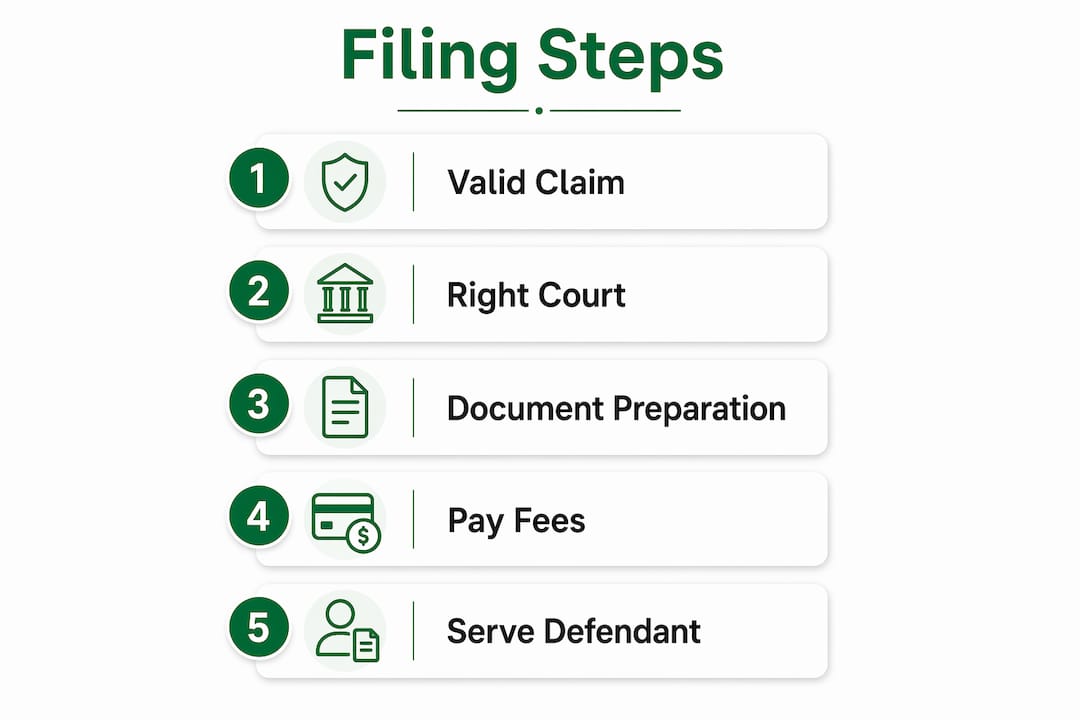
Choosing the correct jurisdiction and venue in South Florida is critical to avoid delays and leverage advantages in business disputes. The choice comes down to state versus federal court and which county handles your case.
Key factors that determine your court:
- Federal court handles cases where the parties are from different states and the amount in dispute exceeds $75,000 under diversity jurisdiction.
- State court handles the majority of business disputes, including contract claims, fraud, and collection matters regardless of dollar amount.
- Miami-Dade, Broward, and Palm Beach counties each have their own circuit courts. Some have specialized business court dockets that move faster than general civil divisions.
- Venue rules generally require filing where the defendant resides, where the contract was performed, or where the injury occurred.
- Forum selection clauses in contracts can override default venue rules and lock you into a specific court or county.
Choosing the wrong venue does not automatically kill your case, but it forces a transfer motion that burns time and money before the real dispute even begins.
How do you file the lawsuit: complaint, clerk, and fees?
Filing a lawsuit in Florida follows a defined procedural sequence. Each step builds on the last, and errors at any stage can delay your case by weeks.
-
Draft the complaint. The complaint must identify the parties, state the facts clearly, and specify each legal claim in a separate count. Florida courts require the complaint to demand a specific remedy, whether that is monetary damages, an injunction, or both. A poorly drafted complaint invites a motion to dismiss from the defendant.
-
Prepare the civil cover sheet and summons. Florida requires a civil cover sheet with every new case. The summons is the official court document that notifies the defendant of the lawsuit. The clerk issues the summons after you file, and you are responsible for serving it on the defendant.
-
File through Florida’s e-filing portal. Florida mandates electronic filing for most civil documents. You submit the complaint, cover sheet, and any exhibits through the Florida Courts E-Filing Portal. The clerk reviews the submission, assigns a case number, and issues the summons electronically.
-
Pay the filing fee. Filing fees in South Florida circuit courts vary by the amount in controversy. A claim under $8,000 falls in county court; claims above $30,000 go to circuit court with higher fees. Payment is accepted online through the portal.
-
Receive your case number and summons. Once the clerk processes your filing, you receive a stamped complaint, a case number, and a signed summons. Your clock for serving the defendant starts the moment the complaint is filed.
Pro Tip: Format all documents as text-based PDFs, not scanned images. The Florida Courts E-Filing Portal rejects image-only PDFs, and a rejected filing does not stop your deadlines from running.
How do you serve the defendant after filing?
Service of process is where many business lawsuits stall or fail. Florida requires service of the initial process on defendants within 120 days of filing the complaint, or the case risks dismissal without prejudice. That 120-day clock starts the moment you file, not when you decide to act.
Key rules for serving defendants in South Florida:
- Who can serve: A certified process server or a sheriff’s deputy must physically deliver the summons and complaint. You cannot serve the defendant yourself.
- Personal service on an individual means delivering documents directly to the defendant or a person of suitable age at their residence.
- Service on a business is completed by delivering documents to the company’s registered agent. If the registered agent cannot be located, service on corporations can be made through the Florida Secretary of State.
- Proof of service must be filed promptly and detail the date and hour service occurred to avoid procedural dismissal. The proof of service is an affidavit signed by the process server and becomes part of the court record.
- Extensions require showing good cause or excusable neglect to the court. Judges grant them, but not automatically.
“Experienced litigators prioritize service logistics in the first week to avoid dismissal or removing parties.” Failing to meet the 120-day service deadline often resets case leverage and may force re-filing, delaying resolution by months.
Track your process server’s progress actively. Do not assume service happened because you hired someone. Confirm receipt of the affidavit of service before the deadline passes.
How does florida’s e-filing system affect your litigation workflow?
Florida’s mandatory electronic filing and service system changes how documents move through a case after the initial complaint is filed. Florida mandates electronic filing and service for most civil documents after the initial pleading under Rules 1.080 and 2.516. This applies to motions, discovery requests, notices, and orders.
| Document Type | Filing Method | Service Method |
|---|---|---|
| Initial complaint | E-Filing Portal | Physical process server |
| Motions and responses | E-Filing Portal | Electronic email service |
| Discovery requests | E-Filing Portal | Electronic email service |
| Proposed orders | E-Filing Portal | Electronic email service |
| Subpoenas | E-Filing Portal | Physical or electronic |
Electronic service by email has strict formatting requirements. Email subject lines must start with “SERVICE OF COURT DOCUMENT” followed by the case number and case style abbreviation. Documents must be attached as PDFs. Failure to follow this format means the service is defective, which can invalidate your filing timeline.
Lawyers often set up automated e-filing workflows to avoid missed e-service and filing deadlines that can jeopardize cases. As a small business owner managing your own dispute, you need a calendar system that tracks every deadline tied to each filing and service event.
Pro Tip: Create a dedicated email address solely for court service. This prevents service notices from getting buried in a general business inbox, which is one of the most common and costly administrative mistakes in Florida commercial litigation.
Should you consider mediation before or during a lawsuit?
Mediation is not a sign of weakness. For many South Florida small business disputes, it is the faster and cheaper path to resolution. Mediation communications in Florida are confidential and generally inadmissible in later court proceedings under Florida’s Chapter 44 framework. That confidentiality protection encourages honest negotiation without fear that your statements will be used against you in court.
Consider mediation when:
- The business relationship has value worth preserving, such as a vendor, partner, or long-term client.
- The dispute involves a contract with a mediation clause that requires it before litigation.
- You want a binding resolution faster than the 12–24 month timeline of a typical circuit court case.
- The cost of litigation exceeds the amount in dispute.
Pre-suit mediation sessions in Florida generally last 4–8 hours and aim for confidentiality and binding settlements. The process involves exchanging brief written positions, private caucusing with the mediator, and signing a legally enforceable mediated settlement agreement if both sides reach a deal.
Arbitration is a separate option. Unlike mediation, an arbitrator issues a binding decision. Many commercial contracts in South Florida include mandatory arbitration clauses, so check your agreement before filing in court. You can learn more about arbitration versus mediation to decide which path fits your situation.
The decision between mediation, arbitration, and litigation depends on your contract terms, the amount at stake, and how quickly you need resolution. A business litigation attorney in South Florida can help you map out the right strategy before you spend money on court fees.
Key takeaways
Filing a business lawsuit in South Florida requires a valid legal claim, the correct court, strict compliance with the 120-day service rule, and proper use of Florida’s mandatory e-filing system.
| Point | Details |
|---|---|
| Serve within 120 days | Florida dismisses cases without prejudice if service is not completed within 120 days of filing. |
| Choose the right court | Federal court applies above $75,000 with interstate parties; state circuit court handles most business disputes. |
| Use the e-filing portal | All documents after the initial complaint must be filed and served electronically through Florida’s portal. |
| Format email service correctly | Subject lines must begin with “SERVICE OF COURT DOCUMENT” followed by the case number and style. |
| Consider mediation early | Pre-suit mediation under Chapter 44 is confidential, binding when settled, and often faster than litigation. |
What 20 years in south florida courts has taught me
The single biggest mistake I see small business owners make is treating the lawsuit filing as the finish line. Filing is the starting gun. The real work begins the moment the complaint hits the portal.
Service is where cases die quietly. I have seen well-drafted complaints get dismissed because the plaintiff assumed the process server handled everything without following up. In South Florida, with its dense population and high volume of registered agents, service delays are common. I tell every client the same thing: confirm your affidavit of service is in hand before day 90, not day 119.
The electronic filing system trips up business owners who handle their own cases. The formatting rules under Rule 2.516 are not suggestions. A defective email service notice can unravel a motion timeline you spent weeks building. The fix is simple: treat e-filing like a compliance function, not an afterthought.
My honest view on mediation is that most business disputes should go there first. Courts in Miami-Dade, Broward, and Palm Beach are busy. A mediated settlement reached in one day is almost always better than a judgment you wait two years to collect. The mediation first approach preserves relationships and gives you control over the outcome. Litigation hands that control to a judge or jury.
Build a procedural checklist before you file anything. Know your service deadline, your e-filing obligations, and your first response deadline. The businesses that win in court are almost always the ones that treated procedure as seriously as the merits of their claim.
— Matthew
How Fornarolegal helps south florida businesses file and win
South Florida business owners face real procedural risk every time they initiate a lawsuit without experienced legal guidance. Fornarolegal has represented entrepreneurs, startups, and established companies in commercial disputes across Miami-Dade, Broward, and Palm Beach counties for over 20 years.

Matthew Fornaro’s AV-rated practice covers the full litigation lifecycle, from drafting the initial complaint and managing service logistics to navigating Florida’s e-filing system and representing clients in mediation or court. If you want to understand your options before a dispute escalates, start with early legal guidance that helps you prepare before the first filing deadline arrives. Schedule a consultation with Fornarolegal to get a clear picture of your legal position and the steps ahead.
FAQ
What is the deadline to serve a defendant in florida?
Florida requires service of process within 120 days of filing the complaint under Fla. R. Civ. P. 1.070. Missing this deadline risks dismissal without prejudice, which forces re-filing and resets your timeline.
Can i file a business lawsuit without an attorney in south florida?
Florida allows businesses to represent themselves in court, but corporations and LLCs generally must be represented by a licensed attorney in circuit court proceedings. A solo entrepreneur filing as an individual plaintiff may proceed without counsel, though procedural errors are costly.
What court handles business disputes in south florida?
Claims under $8,000 go to county court; claims above $30,000 go to circuit court. Federal court applies when parties are from different states and the dispute exceeds $75,000. Miami-Dade and Broward counties have specialized business court dockets for complex commercial cases.
Is mediation required before filing a business lawsuit in florida?
Mediation is not always required before filing, but many commercial contracts include mandatory pre-suit mediation clauses. Florida courts may also order mediation after a case is filed. Pre-suit mediation under Chapter 44 is confidential and can produce a binding settlement in a single session.
How does electronic service work in florida business cases?
After the initial complaint, all documents must be served electronically by email under Rule 2.516. The email subject line must begin with “SERVICE OF COURT DOCUMENT” followed by the case number and case style. Documents must be attached as PDFs, and failure to follow this format renders service defective.
Recommended
- Business Litigation Attorney in Fort Lauderdale » Matthew Fornaro, P.A.
- Business Litigation Coral Springs Parkland Broward» Matthew Fornaro, P.A. Coral Springs Parkland Business Law
- Fort Lauderdale Business Litigation Attorney for Small Businesses » Matthew Fornaro, P.A.
- Effective Litigation Strategies for South Florida SMEs: Protect, Prepare, and Prevail » Matthew Fornaro, P.A.


