

Key Takeaways
- Florida business law protects companies from unfair competition, contract breaches, and partner disputes.
- Acting early saves time, money, and business relationships.
- An experienced business attorney helps you assess risk and choose the right legal strategy.
Alternative dispute resolution (ADR) is the recognized industry term for the methods that let you resolve a business dispute without court involvement, including negotiation, mediation, and arbitration. For South Florida small business owners, these options matter because litigation takes 12–24 months and drains resources you need to run your business. ADR gives you faster timelines, lower costs, and outcomes a judge legally cannot order, such as restructured payment schedules or revised supplier terms. The American Arbitration Association (AAA) and programs like the Florida Dispute Resolution Center make these tools accessible right here in South Florida.
How to resolve business disputes without court: start with preparation
Strong preparation is the difference between a dispute that settles quickly and one that drags on for months. Before you pick up the phone or send a demand letter, take these five steps.
- Review your contracts first. Mandatory dispute clauses in existing agreements often dictate which ADR method you must use and in what order. Skipping this step can void your rights or trigger procedural errors before you even start.
- Build a chronological record. Collect every email, invoice, text message, and meeting note related to the dispute. Organize them by date. A clear timeline is your most persuasive tool in any ADR setting.
- Initiate calm, early communication. Contact the other party before tensions escalate. A brief, professional message stating your concern and your desire to resolve it often opens the door to direct settlement without any formal process.
- Document every negotiation attempt. If you reach any preliminary agreement, put it in writing and have both parties sign it. Verbal understandings disappear fast when a dispute heats up.
- Use digital tools to stay organized. Platforms like Google Workspace or Microsoft SharePoint let you store and share dispute records securely, which matters if you later move to mediation or arbitration.
Pro Tip: Before any ADR session, prepare a one-page summary of your position, your minimum acceptable outcome, and your best alternative if no agreement is reached. Attorneys call this a BATNA (Best Alternative to a Negotiated Agreement). Knowing your floor prevents you from accepting a bad deal under pressure.
What is negotiation and how does it work as a first step?

Negotiation is direct, party-to-party discussion aimed at reaching a mutually acceptable solution without any third party involved. It costs nothing beyond your time and preserves the most control over the outcome. For most South Florida business owners, it should be the first method you try.
Follow these steps to keep negotiations productive:
- Separate interests from positions. Your position is what you want. Your interest is why you want it. A vendor who demands full payment may actually need cash flow, not the specific dollar amount. Understanding the “why” opens creative solutions.
- Set your goals in advance. Know your ideal outcome, your acceptable middle ground, and your walk-away point before the conversation starts.
- Choose the right setting. A neutral location, such as a shared conference room or a video call, reduces territorial tension and keeps both parties focused.
- Keep the tone professional. Stick to facts and business impact. Emotional language shuts down productive dialogue faster than any disagreement over money.
- Confirm agreements in writing immediately. Once you reach a resolution, draft a short written summary and have both parties sign it the same day. Memory fades and interpretations shift.
- Recognize when to escalate. If two or three direct conversations produce no movement, stop. Continuing to negotiate from a stalled position weakens your leverage. Move to mediation instead.
Pro Tip: Record the date, time, participants, and key points of every negotiation session in a shared document. If the dispute later moves to mediation or arbitration, that log demonstrates good-faith effort, which matters to mediators and arbitrators.
What is mediation and when should you use it?
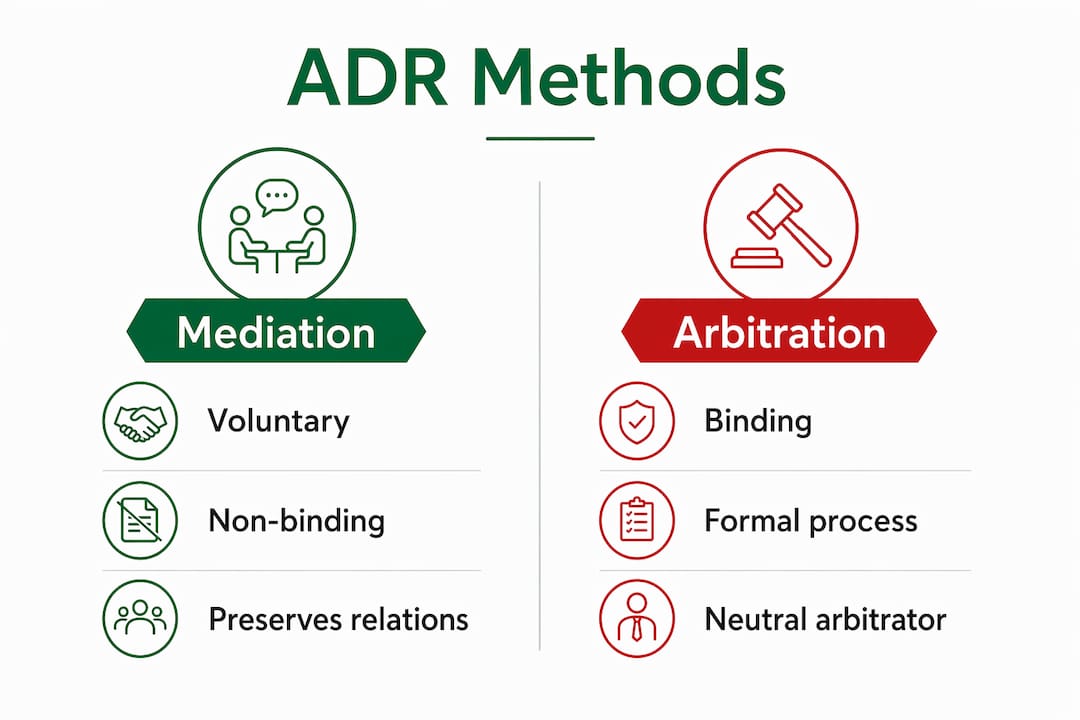
Mediation is a structured process where a neutral third party facilitates discussion between disputing parties but does not impose a decision. The mediator guides the conversation, helps each side understand the other’s perspective, and works toward a voluntary agreement. No judge. No ruling. No public record.
Mediation fits best when:
- You have an ongoing business relationship you want to preserve, such as a long-term supplier or a key client.
- Both parties are willing to talk but cannot reach agreement on their own.
- You need a creative outcome that goes beyond what a court can order, such as a revised contract, a phased payment plan, or a new service arrangement.
- Speed and confidentiality are priorities.
The typical mediation process moves through four stages. First, both parties submit a brief written summary of their position to the mediator before the session. Second, each side presents their view in a joint opening session. Third, the mediator holds private sessions called caucuses with each party separately to explore interests and test possible solutions. Fourth, if agreement is reached, the mediator helps draft a written settlement.
“Experienced mediators not only facilitate cooperation but also help parties reality-test the strengths and weaknesses of their positions, often triggering settlement breakthroughs.” (Mediation expert insight)
Mediation suits disputes requiring preserved relationships and open communication. It is non-binding, meaning either party can walk away before signing anything. That flexibility is both its strength and its limit. If one party refuses to engage honestly, mediation stalls. At that point, you need a process with teeth. For Florida-specific guidance on when to start mediation, the context of your contract and relationship matters enormously.
How does arbitration work as a binding alternative to court?
Arbitration is a private, formal process where a neutral arbitrator acts as a private judge, reviews evidence, hears testimony, and issues a binding decision. Arbitration decisions are confidential, binding, and have limited appeal options, making it a preferred substitute for court when finality matters. The American Arbitration Association administers thousands of business arbitrations each year under established commercial rules.
The process is less formal than a courtroom but more structured than mediation. Both parties submit documents, present witnesses, and make legal arguments. The arbitrator then issues an award, typically within weeks of the hearing rather than months or years.
| Feature | Mediation | Arbitration |
|---|---|---|
| Decision maker | Parties (voluntary agreement) | Arbitrator (binding ruling) |
| Outcome | Non-binding until signed | Binding, enforceable by courts |
| Formality | Low, conversational | Moderate, trial-like |
| Appeal rights | Not applicable | Very limited |
| Best for | Relationship preservation | Finality and technical disputes |
Parties can choose arbitrators with specific industry expertise, such as construction, technology, or finance. That specialization produces more informed decisions than a generalist judge who may have no background in your industry. For a direct comparison of costs and timelines, Fornarolegal’s resource on arbitration vs. litigation breaks down the numbers for Florida businesses.
Pro Tip: If your contract already contains an arbitration clause, you may be required to arbitrate rather than litigate. Read that clause carefully before taking any other step. The clause often specifies the administering body, the number of arbitrators, and the governing rules.
What other ADR options exist and how do you choose?
Beyond negotiation, mediation, and arbitration, several additional methods give South Florida business owners more tools for non-litigation dispute resolution.
- Early neutral evaluation (ENE): A neutral expert reviews each side’s case and provides a non-binding assessment of likely outcomes. ENE works well early in a dispute to calibrate expectations and encourage settlement before costs mount.
- Online dispute resolution (ODR): Platforms like Modria and Smartsettle conduct the entire process digitally. ODR suits lower-value commercial disputes and cross-border transactions where in-person meetings are impractical.
- Ombudsman programs: Industry-specific ombudsmen, common in banking and insurance, investigate complaints and recommend resolutions. They are free to use and carry reputational weight with the responding company.
- Med-Arb: The Med-Arb hybrid process combines mediation’s collaborative approach with arbitration’s binding fallback. If mediation fails, the same neutral shifts to arbitrator and issues a binding decision. This prevents escalation to full litigation while preserving the settlement opportunity.
Choosing the right method comes down to four questions:
- Do you need to preserve the business relationship? Choose mediation or negotiation.
- Do you need a binding, enforceable outcome? Choose arbitration or Med-Arb.
- Is the dispute highly technical? Choose arbitration with an industry expert arbitrator.
- Does your contract mandate a specific process? Follow it, or risk waiving your rights.
ADR is increasingly standard practice for managing business disputes, and selecting neutrals with industry expertise produces far better outcomes than defaulting to court. For a full breakdown of ADR options for Florida SMEs, the choice between methods often hinges on what your contract says and what your relationship with the other party is worth.
Financial considerations also shape the decision. Managing your business finances during a dispute affects which resolution path is realistic. Arbitration costs more than mediation upfront but far less than litigation. Mediation can sometimes be completed in a single day. Knowing your budget before you choose a method prevents you from starting a process you cannot finish.
Key takeaways
The most effective way to settle disputes out of court is to match the ADR method to your specific dispute, prepare thoroughly, and get legal guidance before the process starts.
| Point | Details |
|---|---|
| Review contracts first | Mandatory dispute clauses dictate which ADR method applies and in what order. |
| Negotiation costs nothing | Direct discussion is the fastest, cheapest first step before any formal process. |
| Mediation preserves relationships | A neutral mediator facilitates voluntary agreement without imposing a decision. |
| Arbitration delivers finality | Binding arbitration awards are enforceable and have very limited appeal rights. |
| Legal advice prevents mistakes | An attorney helps you choose the right method and avoid procedural errors that cost you leverage. |
What I’ve learned after 20 years of business disputes in South Florida
Most business owners I work with come to me after a dispute has already escalated. They tried to handle it themselves, the other party stopped responding, and now they are staring at a lawsuit they did not want and cannot afford. The pattern is consistent, and it is almost always preventable.
The single biggest mistake I see is ignoring the dispute resolution clause in the original contract. Business owners sign agreements without reading that section carefully, then discover they are required to arbitrate in a specific city under specific rules. That discovery, made after a conflict erupts, costs them time and leverage they cannot recover.
The second mistake is treating ADR as a last resort instead of a first tool. Non-court dispute resolution gives parties control over rules, timing, and solutions that courts simply cannot provide. A judge is constrained by law. A mediator is constrained only by what both parties are willing to agree to. That flexibility produces outcomes I have seen save business relationships that looked completely broken.
Mediation, in particular, surprises people. I have watched parties who refused to be in the same room reach creative settlements within a single afternoon session. The mediator’s ability to reality-test each side’s position, privately and without judgment, changes the dynamic entirely.
That said, ADR is not right for every dispute. If the other party is acting in bad faith, hiding assets, or needs to be stopped by court order, litigation is the correct tool. Knowing which path fits your situation is exactly why early legal guidance matters. Waiting until you are already in a fight to call an attorney is like calling a contractor after the roof has collapsed.
— Matthew
How Fornarolegal helps South Florida businesses stay out of court
South Florida business owners face real commercial disputes: unpaid invoices, broken vendor agreements, partnership conflicts, and contractor failures. Fornarolegal has spent over 20 years helping entrepreneurs and small businesses resolve these disputes efficiently, without the cost and delay of litigation.
Matthew Fornaro provides direct, practical guidance on negotiation strategy, mediation preparation, and arbitration representation. Whether your contract requires a specific ADR process or you need help choosing the right path, Fornarolegal builds a strategy around your business goals, not just the legal facts. Early legal guidance is the most cost-effective investment you can make before a dispute becomes a lawsuit. Contact Fornarolegal to discuss your situation and protect what you have built.
FAQ
What is the fastest way to resolve a business dispute?
Negotiation is the fastest method because it requires no third party and no formal process. If direct discussion fails, mediation can often produce a resolution in a single session.
Is mediation legally binding in Florida?
Mediation itself is not binding until both parties sign a written settlement agreement. Once signed, that agreement is enforceable as a contract under Florida law.
Can I be forced to arbitrate instead of going to court?
Yes. If your contract contains a mandatory arbitration clause, a court will typically enforce it and dismiss any lawsuit you file. Always review your contracts for dispute resolution clauses before taking any action.
What is the difference between mediation and arbitration?
Mediation builds consensus and preserves relationships through a voluntary, non-binding process. Arbitration is a private, binding alternative to court where an arbitrator issues an enforceable decision.
When should a South Florida business owner hire an attorney for a dispute?
Hire an attorney before you start any formal ADR process. An attorney reviews your contract, identifies your rights, and prevents procedural mistakes that can eliminate your leverage before the dispute is even heard.
Recommended
- Business Dispute Lawyers: A Guide to Resolving Commercial Conflicts » Matthew Fornaro, P.A.
- Mastering Contract Disputes: A Guide for Florida Business Owners » Matthew Fornaro, P.A.
- Business Contract Dispute Resolution Tips That Work » Matthew Fornaro, P.A.
- Arbitration vs. Litigation in Florida: A Practical Guide for Business Owners » Matthew Fornaro, P.A.


