

Key Takeaways
- Florida business law protects companies from unfair competition, contract breaches, and partner disputes.
- Acting early saves time, money, and business relationships.
- An experienced business attorney helps you assess risk and choose the right legal strategy.
Table of Contents
- Why Online Legal Templates Create a False Sense of Security
- Pros and Cons of DIY Legal Contracts
- State-Specific Legal Requirements for Contracts: Why One Size Doesn’t Fit All
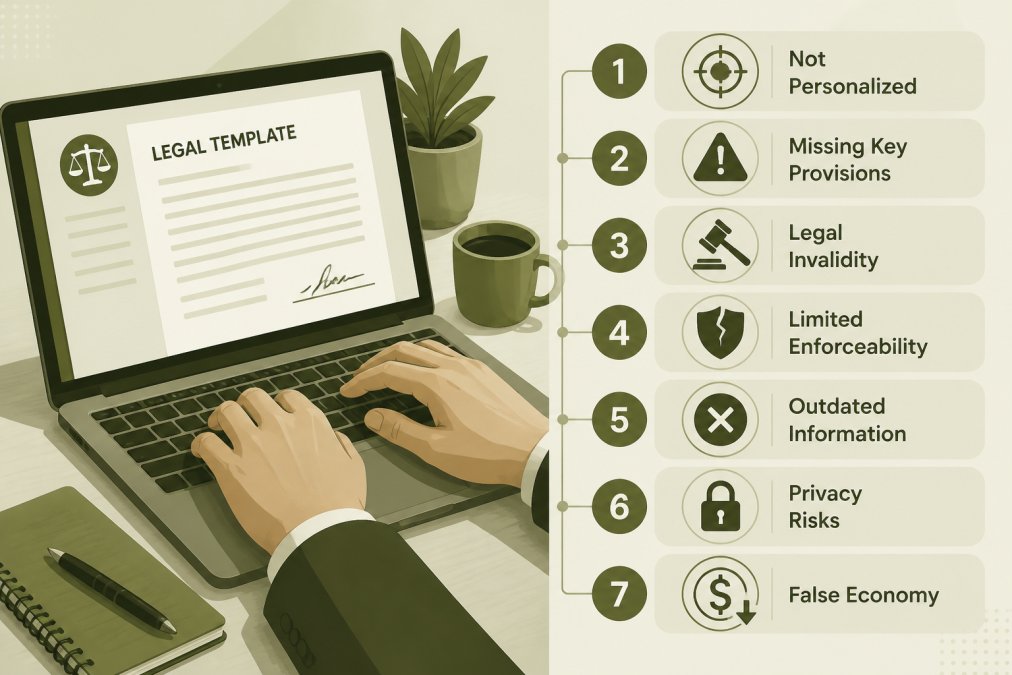
- Seven Critical Risks of Using Online Legal Templates
- Lack of Customization and Business Context
- Outdated Legal Language and Statutory Changes
- Hidden Costs of Fixing DIY Mistakes
- Inability to Handle Complex Legal Scenarios
- Risk of Unenforceable Terms and Contract Disputes
- Liability Exposure and Insurance Implications
- Digital Signature and E-Contract Validity
- When to Hire a Business Attorney Instead of Using Templates
- Checklist for Vetting a Template Before You Use It
- Conclusion
Last Updated: August 7, 2026
Why Online Legal Templates Create a False Sense of Security
Business owners often treat online legal templates like recipes, download, fill in blanks, assume protection. The reality is far more complicated. A template that works for one business in one state may create serious liability exposure for another. Many business owners in Coral Springs and throughout South Florida discover this the hard way, after a dispute arises and their "inexpensive" DIY contract becomes the source of tens of thousands in legal costs.
Templates are generic documents designed for the broadest possible audience, not tailored to your specific business structure, state requirements, or actual risks. When a partnership dissolves, a client refuses to pay, or a vendor breaches an agreement, you discover the gaps. According to the American Bar Association’s guidance on legal document validity, contracts that fail to comply with state-specific statutory requirements often become unenforceable in litigation. The cost of fixing this after a dispute starts is exponentially higher than addressing it upfront.
Templates create a false sense of legal protection. They may look complete, but they often lack the customization and state-specific compliance that makes a contract actually enforceable when disputes arise. Many business owners discover this gap only after a conflict starts.
Pros and Cons of DIY Legal Contracts
Pros of Using DIY Legal Templates:
The primary advantage is cost. Templates cost a fraction of what an attorney charges for custom drafting. For straightforward agreements where both parties are aligned and stakes are low, a template provides basic structure quickly. Many are professionally drafted and updated periodically. For entrepreneurs in early stages with tight cash flow, a template is genuinely better than no contract at all.
Cons of Using DIY Legal Contracts:
Templates cannot account for your business specifics, profit margins, customer acquisition costs, vendor relationships, or risk tolerance. State-specific legal requirements are a critical gap. Florida contract law differs from California law in meaningful ways. A template valid in one state may violate statutory requirements in another.
Templates also fail with complex scenarios: multiple business partners with different ownership percentages, recurring revenue with cancellation clauses, or regulated industries. When you force your specific situation into generic language, you create ambiguity or gaps that become problems later. Most importantly, templates don’t provide liability protection for the business owner. An attorney carries professional liability insurance; template providers have liability waivers protecting them from responsibility.
DIY templates work best for simple, low-stakes agreements between aligned parties. They fail when your business situation is complex, stakes are significant, or state-specific compliance matters. The money you save upfront often gets spent many times over fixing problems later.
State-Specific Legal Requirements for Contracts: Why One Size Doesn’t Fit All
Florida contract law has specific requirements that differ from other states. Templates written for a national audience often miss these details.
Florida law requires certain elements for contracts to be enforceable. Consideration (something of value exchanged between parties) must be clear and explicit. Non-compete agreements are subject to strict statutory standards under Florida Statute § 542.335, which limits their enforceability. A template written for a different state may include a non-compete clause that won’t hold up in Florida court.
Specific contract types require specific language. Employment agreements, independent contractor agreements, service agreements, and vendor contracts each have different legal requirements depending on your state. Digital signatures and e-contracts have specific validity requirements under the Uniform Electronic Transactions Act (UETA), which Florida has adopted. Not all templates account for proper e-signature execution, creating enforceability issues if challenged.
The statutory landscape also changes. Laws are updated, court decisions create new precedent, and regulatory requirements shift. A template from two years ago may reflect legal requirements that have since changed. Many template services update documents, but not all do frequently. You might be using outdated legal language without realizing it.
Before using any template, verify that it’s specifically written for Florida law and was updated within the last 12 months. Check whether it addresses your specific contract type and industry. If you can’t confirm these details, the template is likely not appropriate for your situation.
Seven Critical Risks of Using Online Legal Templates
The following are the most significant risks that arise when business owners rely on templates without professional legal review.
Lack of Customization and Business Context
Templates are optimized for no specific situation. Your business has unique characteristics: revenue model, customer base, vendor relationships, operational structure, and risk profile. When forced to accept generic language, your contract doesn’t reflect your actual agreement. When you modify it yourself without legal training, you introduce ambiguity or gaps.
An e-commerce business using a standard service agreement for vendor relationships illustrates this. The template includes standard payment terms and delivery schedules. But if your business operates on consignment with different payment triggers, the template language doesn’t address this. When you edit it, the contract becomes unclear about when payment occurs. During a dispute, the other party argues the contract is ambiguous and therefore unenforceable.
This is particularly problematic for businesses with complex structures. Multi-member LLCs, partnerships with unequal ownership, or businesses with multiple revenue streams need contract language reflecting their specific structure. Templates cannot do this.
Outdated Legal Language and Statutory Changes
Laws change. Court decisions create new precedent. Regulatory requirements evolve. A template that was legally compliant when created may no longer reflect current law. You might not recognize this because you assume "legal document" means "current legal document."
Florida law has been updated in various areas affecting business contracts. Changes to employment law, consumer protection requirements, and e-commerce regulations all affect how contracts should be drafted. A template from a national service may not reflect these updates consistently.
You might not realize the issue until you’re in a dispute and an attorney reviews your contract. At that point, you’re paying for litigation rather than prevention.
Hidden Costs of Fixing DIY Mistakes
The upfront savings are often dwarfed by the costs of fixing problems later. Consider a partnership agreement with minimal customization. The partnership works fine for two years. Then one partner wants to exit. You discover the agreement doesn’t clearly address what happens to the departing partner’s ownership stake, business valuation, or customer relationships. Now you need an attorney to interpret the agreement, negotiate a buyout, and potentially litigate.
The cost of fixing this problem is easily 10-20 times what it would have cost to draft the partnership agreement correctly upfront. You’re paying for dispute resolution, negotiation, and potentially litigation. The "savings" from using a template evaporate quickly once problems arise.
Inability to Handle Complex Legal Scenarios
Templates work for straightforward situations. They fail when your business involves complexity. Examples include multi-member LLCs with different ownership percentages, partnerships with different roles and decision-making authority, vendor relationships with performance guarantees, customer contracts with tiered pricing, employment agreements with equity components, and licensing or franchise arrangements with specific performance metrics.
When you force a complex situation into a generic template, you either leave out important details or create unclear language. An attorney can draft language addressing your specific complexity. A template cannot.
Risk of Unenforceable Terms and Contract Disputes
A contract that looks complete might be partially or completely unenforceable in court. The contract might be missing required elements under Florida law, include language that violates public policy or statutory requirements, or be ambiguous in ways that make it unenforceable. When a contract is unenforceable, you’ve lost your legal protection entirely.
Liability Exposure and Insurance Implications
Using an unenforceable or inadequate contract creates liability exposure for your business. More importantly, inadequate contracts create gaps in your business liability insurance. Insurance policies often require proper contractual protections. If your contract is inadequate or unenforceable, your insurance company might deny a claim because you failed to meet policy requirements.
For example, if you have a customer liability claim and your customer contract doesn’t include proper liability waivers or indemnification language, your insurance company might argue you failed to take reasonable steps to protect yourself. The claim gets denied, and you’re paying out of pocket.
Digital Signature and E-Contract Validity
Many templates include language about digital signatures and e-contracts, but not all comply with current legal requirements for electronic signature validity. Florida has adopted the Uniform Electronic Transactions Act (UETA), which has specific requirements for valid e-signatures.
A contract signed electronically must meet certain criteria to be enforceable. The parties must have agreed to conduct business electronically. There must be a clear record of the signature. The signature must be attributable to the person who signed it. Not all templates account for these requirements properly. Certain types of contracts cannot be signed electronically. A template that allows electronic signing for a contract type requiring a wet signature creates an unenforceable agreement.
When to Hire a Business Attorney Instead of Using Templates

The question isn’t whether to hire an attorney, it’s when the cost is justified by the risk you’re avoiding.
You should hire a business attorney if your business structure is complex, the contract involves significant money, you’re in a regulated industry, you’re in a dispute or anticipating one, the other party has their own attorney, you need a complex or unfamiliar contract type, or you operate in multiple states.
Partnership agreements, operating agreements, employment contracts with equity components, and licensing agreements need professional drafting. If a single contract represents a meaningful portion of your revenue or creates significant financial exposure, it’s worth having an attorney review or draft it. The cost of an attorney is cheap insurance against a contract dispute that could cost you tens of thousands of dollars.
Matthew Fornaro, P.A. works with business owners to assess this question directly. Rather than forcing you into a standard retainer or unnecessary services, the firm focuses on understanding your specific situation and determining where legal counsel actually adds value. This might be a full contract review, custom drafting for specific agreements, or strategic advice on protecting your business interests.
Hire an attorney when the stakes are significant, the situation is complex, or the cost of a contract dispute would exceed the cost of professional legal help. For most business owners, this threshold is lower than they think.
Checklist for Vetting a Template Before You Use It
If you do decide to use a template, use this checklist to assess whether it’s appropriate for your situation.
-
Jurisdiction verified. The template explicitly states it’s written for Florida law.
-
Recent update. The template was updated within the last 12 months.
-
Specific contract type. The template is designed for your specific type of agreement, not a generic "business contract."
-
Your business structure addressed. The template accounts for your business structure and multi-owner scenarios if applicable.
-
Industry-specific requirements. If you operate in a regulated industry, the template addresses those regulations.
-
Digital signature compliance. If you’ll be signing electronically, the template includes UETA-compliant language.
-
Customization possible. You can clearly identify which sections need customization and which should remain as-is.
-
Liability terms clear. The template includes liability limitations and indemnification language matching your risk profile.
-
Termination and exit provisions. The template clearly addresses how the agreement ends and what obligations continue after termination.
-
Dispute resolution process. The template includes a process for resolving disputes that you’re comfortable with.
-
No red flags. You’ve read through the template and don’t see outdated, unclear, or inappropriate language.
If you can’t check all of these boxes, the template is probably not appropriate.
Conclusion
Online legal templates create real risks that extend far beyond the document itself. A contract that looks professional might be unenforceable, inadequate, or non-compliant with Florida law. The cost of discovering this during a dispute is exponentially higher than addressing it upfront.
For business owners in Coral Springs, Parkland, Broward County, and throughout South Florida, the decision to use a template should be based on a clear assessment of risk. Simple, low-stakes agreements with aligned parties might be appropriate for templates. Complex situations, significant financial exposure, or regulated industries require professional legal review at minimum.
Matthew Fornaro, P.A. helps business owners navigate this decision by providing practical legal counsel focused on your actual needs. Whether you need a contract reviewed, custom language drafted, or strategic advice on protecting your business interests, the firm’s approach is straightforward: understand your situation, identify where legal protection matters most, and deliver the guidance you need without unnecessary costs or services. With over 20 years of experience serving South Florida entrepreneurs and small business owners, the firm specializes in turning legal complexity into practical protection for your business.
Frequently Asked Questions
Are online legal forms legally binding in the United States?
Online legal forms can be legally binding if they meet your state's requirements for contract formation, but many templates fail to include state-specific language or account for your unique business situation. A form that works in one state may not be enforceable in another. The enforceability of an online legal template depends on whether it complies with your jurisdiction's statutory requirements and whether all parties signed with proper intent. Generic templates often miss critical details that could render your contract unenforceable when you need it most.
What are the common pitfalls of using free legal document templates?
Free templates often contain boilerplate language that doesn't address your specific business structure, industry, or state requirements. They may include outdated statutory language, lack customization for complex scenarios, and fail to anticipate liability exposure. Many free templates also don't account for regulatory changes or include digital signature compliance issues. The biggest pitfall is assuming a generic template protects you equally to a document drafted for your actual situation, it typically doesn't.
When should you hire an attorney instead of using a template?
Hire a business attorney when your contract involves significant financial obligations, multiple parties, complex business structures, or state-specific compliance requirements. You should also seek legal counsel if you're forming a business entity, entering into partnership agreements, handling intellectual property, or facing potential litigation. Any situation where a contract dispute could threaten your business viability warrants professional legal review. Templates work for simple, low-risk documents; everything else benefits from due diligence by qualified legal counsel.
Can online legal templates be customized for specific state laws?
Some platforms offer state-specific templates, but customization is limited and often requires legal knowledge to implement correctly. Most online templates provide only basic state selections without addressing nuanced regulatory requirements or industry-specific statutes. True customization requires understanding your state's contract law, liability statutes, and business-specific regulations, expertise that template platforms rarely provide. Professional legal counsel ensures your contract reflects both state law and your actual business needs.
This article was written using GrandRanker


