

Key Takeaways
- Florida business law protects companies from unfair competition, contract breaches, and partner disputes.
- Acting early saves time, money, and business relationships.
- An experienced business attorney helps you assess risk and choose the right legal strategy.
A commercial litigator is a business attorney who manages legal disputes from the moment a conflict surfaces through resolution, whether that resolution comes at the negotiating table or in a courtroom. For small business owners in South Florida, understanding the role of commercial litigator means understanding who stands between your company and a potentially devastating financial or legal outcome. These attorneys combine legal analysis, risk assessment, negotiation, and trial advocacy into a single, strategic function. They are not just courtroom fighters. They are the first call you should make when a business relationship starts to break down.
What are the primary responsibilities of a commercial litigator?

The commercial litigation responsibilities of a skilled attorney span far more than filing lawsuits. Early case decisions like pleadings and evidence preservation materially affect litigation outcomes, which means the work starts well before any judge sees a document.
Here is what a commercial litigator does across a typical dispute:
- Case evaluation and risk assessment. The attorney reviews contracts, communications, and financial records to determine the strength of your position and the realistic range of outcomes. This is where you learn whether you have a strong claim, a weak one, or a settlement you should take.
- Drafting pleadings and legal documents. Complaints, answers, counterclaims, and motions all require precise legal drafting. A single procedural error can cost you a deadline or a defense.
- Managing discovery. Discovery includes exchanging evidence, written interrogatories, depositions, and managing electronic discovery. Commercial litigators handle high volumes of documents and use e-discovery tools to identify what matters and what does not.
- Negotiation and settlement. Only 2 to 5% of civil disputes reach trial. Attorneys spend 60 to 70% of their time on pre-trial negotiations and counseling. This means your litigator’s negotiation skill is often more valuable than their courtroom presence.
- Trial preparation and representation. When settlement fails, the litigator prepares witnesses, builds trial exhibits, argues motions in limine, and presents your case before a judge or jury.
- Strategic counseling throughout. A good commercial litigator also analyzes contracts for leverage and builds alternative case scenarios proactively, not reactively.
Pro Tip: Ask any attorney you consider hiring how many cases they have taken to verdict in the past three years. A litigator with real trial experience negotiates from a position of credibility because opposing counsel knows they will actually go to court.
How does the commercial litigation process unfold for South Florida businesses?
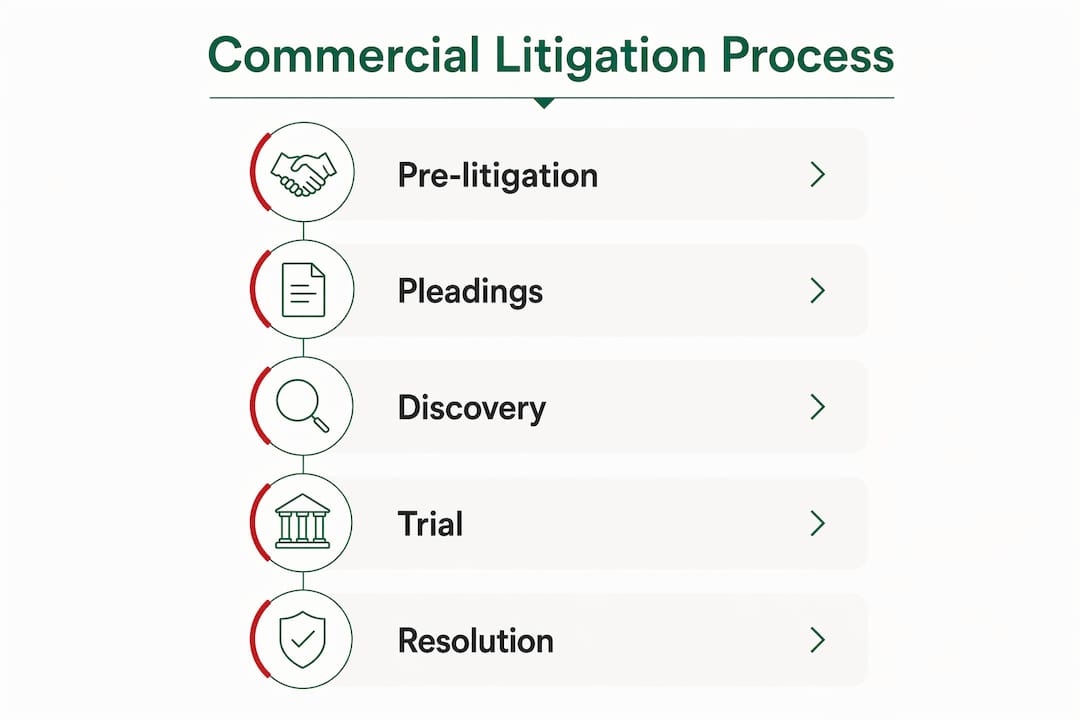
The litigation process follows a defined sequence, and knowing each stage helps you make smarter decisions at every turn.
- Initial case analysis. Your attorney reviews the facts, identifies the legal claims, checks for conflicts of interest, and advises on the realistic cost and timeline of pursuing or defending a dispute.
- Pre-litigation negotiation. Many disputes resolve here. A demand letter, a mediation session, or a direct negotiation can end a conflict before a single court filing. Early legal intervention at this stage saves significant time and money.
- Filing the complaint or responding to claims. If negotiation fails, the plaintiff files a complaint in the appropriate Florida court. The defendant has a set window to respond, and missing that deadline can result in a default judgment.
- Discovery phase. Both sides exchange documents, answer written questions, and take depositions. In commercial cases, this phase often involves thousands of emails, contracts, and financial records. Litigators use e-discovery platforms to manage this volume efficiently.
- Motions and hearings. Summary judgment motions, motions to dismiss, and evidentiary hearings can resolve cases or narrow the issues before trial.
- Trial. A small fraction of cases reach this stage, but preparation for trial begins on day one.
- Alternative dispute resolution. Florida courts actively encourage mediation. Many commercial contracts also include mandatory arbitration clauses, which route disputes to a private arbitrator rather than a public courtroom.
One Florida-specific detail every South Florida business owner should know: written contracts carry a 5-year statute of limitations under Fla. Stat. § 95.11(2)(b), while oral contracts carry only 4 years. Missing these deadlines permanently bars your claim, regardless of its merit.
| Litigation stage | Typical timeline in Florida |
|---|---|
| Pre-litigation negotiation | 1 to 3 months |
| Pleadings and initial motions | 1 to 2 months |
| Discovery | 6 to 12 months |
| Motions for summary judgment | 2 to 4 months |
| Trial (if reached) | 1 to 2 weeks |
Why is the commercial litigator’s role critical to managing business disputes?
The importance of commercial litigation counsel comes down to one word: risk. Business disputes carry financial, reputational, and operational risk simultaneously, and most business owners are not equipped to measure all three at once.
“Measurement of risk, protecting client position, and guiding toward settlement or trial is central to the role.” — What Do Litigation Attorneys Do?
A commercial litigator quantifies what you stand to lose, what you stand to gain, and what it will cost to get there. That analysis shapes every decision that follows. Without it, you are making expensive choices based on incomplete information.
One area where this expertise proves especially valuable is electronic evidence. Failure to preserve electronically stored information after the duty to preserve attaches can result in severe court sanctions in Florida. A litigator sends preservation notices immediately, before evidence is deleted or overwritten. That single action can determine whether you win or lose a case that has not even been filed yet.
Strong negotiation skills often have more impact on dispute outcomes than courtroom presence. A litigator who understands your business goals, not just the legal issues, can structure a settlement that protects your ongoing operations, your key relationships, and your cash flow. A pure trial attorney focused only on winning in court may push you toward a verdict that costs more than it delivers.
Pro Tip: Before any dispute escalates, ask your attorney to prepare a written risk memo. It should cover your best case, worst case, and most likely outcome, along with a cost estimate for each stage. This document becomes your decision-making framework for the entire dispute.
The procedural complexity of commercial litigation also demands specialized knowledge. Florida’s rules on discovery, evidence, and civil procedure are detailed and unforgiving. Missing a deadline, failing to respond to a motion, or improperly serving a party can forfeit rights that took years to build. A litigation readiness strategy built before disputes arise is the most cost-effective protection a South Florida business can have.
How does a commercial litigator compare to other legal professionals?
Many business owners confuse commercial litigators with transactional attorneys or assume paralegals perform the same functions. The distinctions matter when you are choosing who to call.
| Legal professional | Primary function | When to engage |
|---|---|---|
| Commercial litigator | Manages disputes, negotiation, and trial | When a dispute has arisen or is imminent |
| Transactional attorney | Drafts and negotiates contracts, deals | Before a transaction or agreement is signed |
| Paralegal | Supports litigation with research, documents | Works alongside litigators, not independently |
| General business attorney | Broad legal counsel across business matters | Ongoing compliance, formation, general advice |
A transactional attorney writes the contract that governs your vendor relationship. A commercial litigator enforces it when the vendor stops performing. These are different skill sets, and the best firms have both. Paralegals play a significant supporting role in commercial litigation, managing document review, drafting correspondence, and coordinating discovery logistics, but they operate under attorney supervision and cannot provide legal advice or represent clients in court.
The practical takeaway for South Florida business owners: if you already have a dispute on your hands, you need a litigator, not a general business attorney. If you are still in the contract phase, a transactional attorney is the right call. Many disputes that end up in litigation could have been avoided with better contract drafting at the start. Preventing business litigation through strong agreements and early legal counsel is almost always cheaper than resolving it after the fact.
Litigators guide clients through complex commercial disputes with a blend of legal analysis, communication, and commercial judgment. That combination is what separates a commercial litigator from a generalist who occasionally handles disputes.
Key takeaways
A commercial litigator’s value lies primarily in pre-trial risk management, negotiation, and evidence strategy, not in courtroom appearances, which represent only 2 to 5% of resolved disputes.
| Point | Details |
|---|---|
| Core role definition | A commercial litigator manages business disputes from early risk assessment through trial or settlement. |
| Pre-trial work dominates | Attorneys spend 60 to 70% of their time on negotiation and counseling, not courtroom advocacy. |
| Florida deadlines are strict | Written contracts have a 5-year limitations period; oral contracts have 4 years under Florida law. |
| Evidence preservation is urgent | Failing to preserve electronic evidence early can result in court sanctions before trial begins. |
| Litigator vs. transactional attorney | Engage a litigator when a dispute exists; engage a transactional attorney before signing agreements. |
What I have learned after 20 years of commercial litigation in South Florida
Most business owners come to me after a dispute has already escalated. By that point, evidence has been deleted, deadlines have been missed, and the other side has had months to build their case. The single most expensive mistake I see South Florida entrepreneurs make is treating legal counsel as a last resort rather than an early resource.
The conventional view of a commercial litigator is someone who fights in court. That image is mostly wrong. The real work happens in the weeks and months before any hearing. It happens in the risk memo, the preservation letter, the demand letter that gets a response, and the mediation session that resolves a dispute for a fraction of what trial would cost. Early case assessment and settlement efforts dominate a litigator’s actual work, and the attorneys who do that work well rarely need to go to trial.
I also want to push back on the idea that litigation is always adversarial. In South Florida’s business community, where industries are tight-knit and relationships matter, the best outcome in most disputes is one that resolves the conflict without destroying the relationship. A skilled litigator knows when to press hard and when to find a path that lets both sides move forward. That judgment comes from experience, not from a law school textbook.
If you are a small business owner in Miami-Dade, Broward, or Palm Beach County, the question is not whether you will face a commercial dispute. The question is whether you will be ready when you do.
— Matthew
How Fornarolegal helps South Florida businesses resolve disputes

Fornarolegal represents small businesses, startups, and entrepreneurs across South Florida in commercial disputes, from contract enforcement to complex multi-party litigation. With over 20 years of court-tested experience and an AV® Preeminent rating, Matthew Fornaro provides direct, practical guidance from the first sign of a dispute through resolution. Whether you are facing a breach of contract, a partnership breakdown, or a vendor dispute, the firm focuses on protecting your business position while minimizing cost and disruption. Learn how early legal guidance can prevent disputes from becoming lawsuits, or explore the firm’s approach to resolving commercial disputes efficiently and strategically.
FAQ
What does a commercial litigator do for a small business?
A commercial litigator evaluates disputes, manages evidence, negotiates settlements, and represents businesses in court when necessary. Their primary value is in risk assessment and pre-trial strategy, not just courtroom advocacy.
How is a commercial litigator different from a business attorney?
A commercial litigator specializes in resolving active disputes through negotiation, discovery, and trial. A general business attorney handles broader matters like contracts, compliance, and formation, and typically does not manage contested litigation.
What types of cases does a commercial litigator handle?
Commercial litigators handle breach of contract claims, partnership disputes, business fraud, non-compete enforcement, trade secret theft, and creditor or debtor disputes, among other business conflicts.
How long does commercial litigation take in Florida?
Most commercial disputes in Florida resolve within 12 to 24 months, depending on complexity and whether the case reaches trial. Cases that settle during or after discovery typically resolve faster than those that proceed to a full trial.
When should a South Florida business owner hire a commercial litigator?
Hire a commercial litigator as soon as a dispute becomes apparent, not after it escalates. Early involvement allows the attorney to preserve evidence, assess risk accurately, and pursue resolution before costs multiply.
Recommended
- Resolving Commercial Litigation in Florida: Proven Strategies to Protect Your Business » Matthew Fornaro, P.A.
- Commercial Litigation Attorneys: A Guide to Protecting Your Business » Matthew Fornaro, P.A.
- Effective Strategies to Resolve Business Litigation in Florida—Fast, Fair, and Focused on Your Bottom Line » Matthew Fornaro, P.A.
- Navigating Commercial Litigation: A Strategic Guide for Florida Businesses » Matthew Fornaro, P.A.


