Key Takeaways
- Florida business law protects companies from unfair competition, contract breaches, and partner disputes.
- Acting early saves time, money, and business relationships.
- An experienced business attorney helps you assess risk and choose the right legal strategy.
Most small business owners learn the hard way that a handshake is not a contract. Understanding what is a business contract goes beyond knowing it involves two parties and a signature. A legally binding agreement, which lawyers call an enforceable contract, is a formal commitment with specific elements that courts will uphold when things go wrong. Written contracts provide enforceable commitments and clarify expectations before problems arise. This guide walks you through what makes a contract valid, which types you will encounter, and how to protect your business with every deal you make.
Table of Contents
- Key Takeaways
- What is a business contract: definition and required elements
- Types of business contracts small businesses commonly use
- Why business contracts matter beyond just legal formality
- How to create and manage business contracts effectively
- What happens when contracts fail
- My take on what small business owners get wrong about contracts
- Protect your business with the right legal support
- FAQ
Key Takeaways
| Point | Details |
|---|---|
| Five elements are required | Every enforceable contract needs offer, acceptance, consideration, legal capacity, and lawful purpose. |
| Written beats verbal | Verbal agreements can be enforceable but are hard to prove, making written contracts the safer choice. |
| Contract type determines risk | Sales agreements, NDAs, and service contracts each carry different obligations and liability exposure. |
| Clear language protects you | Courts read contracts as written, so vague terms work against you when disputes arise. |
| Documentation fills the gaps | Keeping records of performance and communication is your best defense if a dispute reaches court. |
What is a business contract: definition and required elements
A business contract is a legally binding agreement between two or more parties that creates mutual obligations enforceable by law. The definition of a business contract is broader than most people assume. It covers everything from a one-page freelance agreement to a multi-year commercial lease. The core point is this: if one party fails to hold up their end, the other has legal recourse.
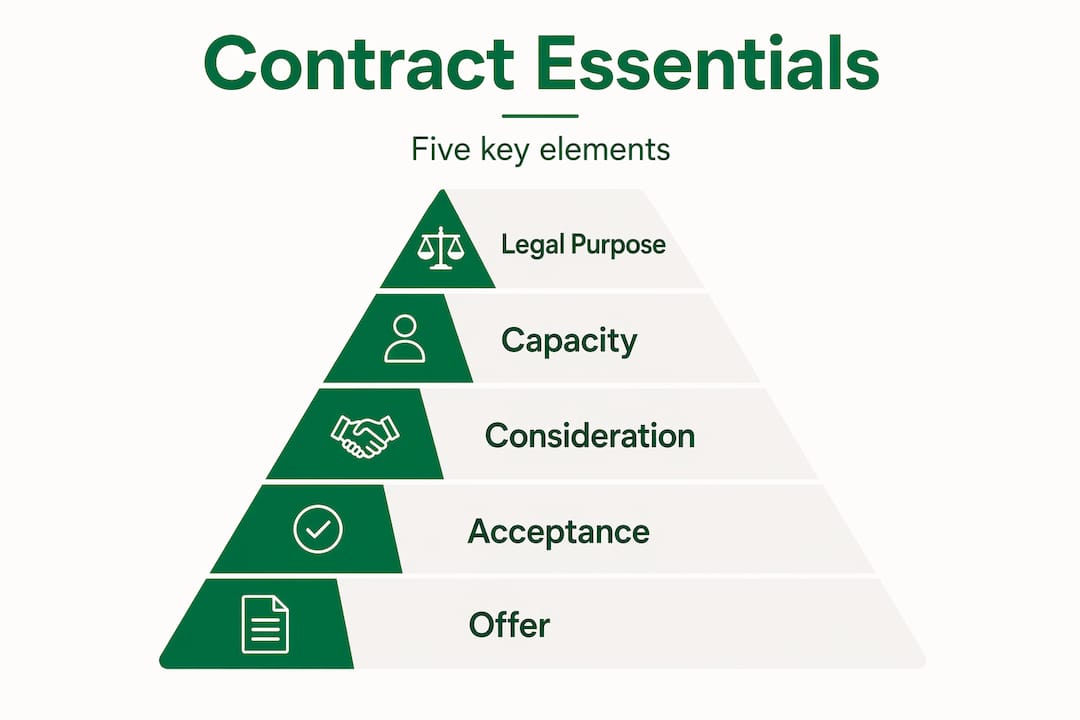
For a contract to hold up in court, five foundational elements must all be present:
- Offer. One party proposes specific terms. A quote, a proposal, or a scope of work document can all qualify.
- Acceptance. The other party agrees to those exact terms without material changes. Counter-offers restart the process.
- Consideration. Each side exchanges something of value. Money is the most common form, but services, goods, or a promise to act can all count.
- Legal capacity. Both parties must be of legal age and sound mind to enter a contract. A contract signed by a minor is generally voidable.
- Lawful purpose. The contract cannot require illegal activity. Courts will not enforce an agreement to do something prohibited by law.
Missing any single element puts the entire agreement at risk. You might have a signed piece of paper and still find yourself without legal protection if the terms were too vague or one party lacked capacity.
Consider a small business example: a contractor signs a service agreement with a client for $5,000 worth of graphic design work. The proposal sets the offer. The client’s signed approval is acceptance. The payment amount is the consideration. Both adults have capacity. And designing graphics is entirely lawful. Every element is present, so the contract is enforceable.
Pro Tip: Never treat a “standard form” contract as automatically complete. Even pre-printed agreements can be missing key terms that are specific to your industry or transaction.
Types of business contracts small businesses commonly use
Not every agreement looks the same, and the differences matter legally. Understanding the types of business contracts helps you spot which rules apply and where your risk lies.
Common written contract types
Here are the agreements most small businesses encounter regularly:
- Sales contracts. Define the transfer of goods or services for payment. These set out quantity, price, delivery terms, and warranties.
- Service agreements. Cover ongoing or project-based services. They should specify scope, timeline, payment schedule, and grounds for termination.
- Non-disclosure agreements (NDAs). Protect confidential information shared between parties, including trade secrets or client data.
- Commercial leases. Govern the use of business property, including rent, duration, renewal options, and permitted uses.
- Employment contracts. Establish the relationship between employer and employee, covering compensation, duties, non-compete clauses, and termination terms.
Written vs. verbal and other distinctions
Beyond format, contracts also differ in how they are formed:
| Contract Type | How It Forms | Key Limitation |
|---|---|---|
| Written | Documented and signed | Must still contain all required elements |
| Verbal | Spoken agreement | Verbal agreements are difficult to prove in disputes |
| Express | Terms stated explicitly | Clearest for enforcement |
| Implied | Created by conduct or circumstances | Harder to define and enforce |
| Bilateral | Both parties exchange promises | Most common in business |
| Unilateral | One party makes a promise in exchange for action | Common in reward-type offers |
Certain contracts must be in writing to be enforceable under law. In most states, agreements involving real estate, contracts lasting longer than one year, and sales of goods over $500 fall under the Statute of Frauds, which requires written documentation.
Why business contracts matter beyond just legal formality
A lot of small business owners think of contracts as paperwork you do to avoid trouble. That framing misses the real value. Contracts are financial guardrails. They lock in payment terms, define what happens when deliverables fall short, and determine who bears the cost of unexpected problems.
Including indemnification clauses and liability limits in your agreements prevents a single dispute from threatening your solvency. Without those clauses, you could find yourself personally absorbing losses that the other party should have covered. This is especially true for service businesses where one large project going sideways can wipe out months of profit.
“Contracts are no longer just compliance documents. Treating them as strategic business assets unlocks improved risk management and operational advantage.” (Generative AI for Contract Management)
Beyond the financial layer, contracts align expectations and build trust in professional relationships. When both parties understand their obligations from day one, projects run more smoothly and disputes are less likely to escalate. The contract is not just protection against bad actors. It is a communication tool that keeps everyone on the same page throughout the relationship.
Modern contract tools now go further. Generative AI can transform contract documents into searchable intelligence, flagging obligations and renewal dates you might otherwise miss. You do not need enterprise software to benefit from this shift. Even basic contract tracking practices can protect you from letting key terms slip through the cracks.

Pro Tip: Review every contract for an indemnity clause before signing. If one is missing and the deal involves significant financial exposure, add one or negotiate for it. This single clause can determine who pays when something goes wrong.
How to create and manage business contracts effectively
Drafting a contract is not just about what you include. It is about how precisely you say it. The most common mistake small business owners make is using boilerplate templates without customizing the language to their specific situation. Misusing boilerplate clauses and underestimating liability provisions can turn a generic contract into a liability rather than protection.
Here is a practical process for creating and managing contracts that actually work:
- Start with your specific terms. Define the exact scope of work, deliverables, deadlines, and payment amounts. Avoid phrases like “reasonable time” or “industry standard” without defining what those mean in your context.
- Address what happens when things go wrong. Include termination clauses, dispute resolution procedures, and remedies for non-payment or non-performance. If you skip this, you default to whatever the law provides, which may not favor you.
- Get everything in writing before work begins. Do not start a project based on a verbal go-ahead. Even a short written confirmation of the key terms provides more protection than a detailed conversation.
- Document performance in real time. Real-time performance documentation is often overlooked but is one of the most powerful tools you have if a dispute arises. Keep project logs, save email confirmations, and record any approved changes to scope.
- Review contracts periodically. Long-term agreements like leases or vendor contracts need regular review. Prices change, circumstances shift, and a clause that made sense two years ago may now create unnecessary risk.
- Use legal review for high-stakes agreements. For any contract involving significant money, ongoing obligations, or potential liability, get a qualified attorney to review it before you sign.
Pro Tip: When a client or vendor asks to use their contract instead of yours, do not just sign it because it looks standard. Their standard contract was written to protect them, not you. Always review it critically or have your attorney do so.
Good contract risk management is not a one-time task. It is an ongoing practice that saves significant money compared to resolving disputes after the fact.
What happens when contracts fail
Understanding what can go wrong is just as important as knowing how to create a solid agreement in the first place.
A breach of contract occurs when one party fails to fulfill their obligations without a legally valid excuse. To successfully pursue a breach claim, you generally need to prove four things:
- A valid contract existed with all required elements present
- You performed your obligations under the contract or had a valid reason for not doing so
- The other party failed to perform their obligations
- You suffered actual damages as a result of that failure
The outcome of a dispute frequently comes down to the contract language itself. Courts prioritize the literal text of contracts over what the parties claim they intended. If a term is not written clearly, courts apply the plain meaning rule and may interpret it against the party who drafted the contract. Oral side agreements or informal understandings that were never documented generally cannot be enforced.
Here is what courts look at when evaluating a disputed contract:
| Factor | Why It Matters |
|---|---|
| Written contract language | The primary basis for interpreting obligations |
| Performance documentation | Proves what was actually done and when |
| Communication records | Supports or contradicts claims about intent |
| Capacity of the parties | Affects whether the agreement is valid at all |
| Damages calculation | Determines what the injured party can recover |
The practical lesson here is that failing to document obligations and keep records of correspondence weakens your legal position significantly. You can be entirely in the right and still lose a dispute because you cannot prove what was agreed or what you delivered. Read more about managing contract disputes before they escalate for a deeper look at early intervention strategies.
My take on what small business owners get wrong about contracts
I have worked with hundreds of small businesses across South Florida over more than two decades, and I keep seeing the same patterns. Most owners who come to me with a contract problem could have avoided it entirely. Not because they were careless, but because they underestimated how much the details matter before a deal turns sour.
The most damaging misconception I encounter is the belief that a signed contract is automatically protective. It is not. A poorly written or poorly tailored contract can actually lock you into worse outcomes than no contract at all. I have seen clients bound by indemnity clauses they never read, paying legal fees for problems that were entirely the other party’s fault.
The second biggest mistake is treating contract review as optional for smaller deals. In my experience, the disputes that drain the most time and money from small businesses are not the million-dollar deals. They are the $20,000 service agreements with no termination clause and no payment schedule.
What I have learned is that the best contract is one that neither party ever needs to rely on in court. But you only get there by drafting it as if you will. Think through every scenario before you sign. Define every term that could be interpreted differently by two reasonable people. And when the stakes are high, get a professional review. It costs far less than the alternative.
— Matthew
Protect your business with the right legal support
Understanding contracts is the first step. Implementing them correctly is what actually protects your revenue and operations. At Fornarolegal, we work with small businesses, startups, and entrepreneurs across South Florida to review, draft, and enforce business contracts before disputes arise and after they do. Matthew Fornaro brings over 20 years of court-tested experience to every client engagement, offering practical guidance that fits the realities of running a business. Whether you need a contract reviewed before signing or representation when a deal has already broken down, early legal guidance is almost always the most cost-effective move you can make. You can also learn how avoiding costly litigation starts with proactive contract management well before any dispute surfaces.
FAQ
What is the basic definition of a business contract?
A business contract is a legally binding agreement between two or more parties that creates mutual obligations enforceable by law. It requires offer, acceptance, consideration, legal capacity, and a lawful purpose to be valid.
Are verbal business contracts enforceable?
Verbal agreements can be legally enforceable in some situations, but they are difficult to prove in court. Written contracts are strongly preferred for any transaction involving significant money or ongoing obligations.
What makes a business contract unenforceable?
A contract becomes unenforceable when it is missing one of the five required elements, involves illegal activity, or was entered into by a party without legal capacity. Vague or ambiguous terms can also lead courts to refuse enforcement.
What are the most common types of business contracts?
The most common types include sales contracts, service agreements, non-disclosure agreements, commercial leases, and employment contracts. Each allocates rights and responsibilities differently depending on the nature of the business relationship.
How do I protect myself if a contract is breached?
Document your performance and all related communications in real time from the start of the agreement. If a breach occurs, you will need to show a valid contract existed, you fulfilled your obligations, the other party did not, and you suffered damages as a result.
Recommended
- Florida Contract Essentials: 15 Clauses Every Business Owner Must Get Right » Matthew Fornaro, P.A.
- Florida Business Owners: A Practical Guide to Reviewing Contracts Before You Sign » Matthew Fornaro, P.A.
- Business Contract Attorney: A Guide for Florida Entrepreneurs » Matthew Fornaro, P.A.
- Florida Business Contract Review: 12 Clauses Owners Must Check Before Signing » Matthew Fornaro, P.A.