Key Takeaways
- Florida business law protects companies from unfair competition, contract breaches, and partner disputes.
- Acting early saves time, money, and business relationships.
- An experienced business attorney helps you assess risk and choose the right legal strategy.
Table of Contents
- How to Dissolve a Florida Corporation: An Overview of the Process
- Step-by-Step Guide to Dissolving a Florida Corporation
- Florida Corporation Dissolution Tax Requirements You Must Meet
- How Long Does It Take to Dissolve a Corporation in Florida?
- Consequences of Not Dissolving a Corporation in Florida
- Common Mistakes to Avoid When Dissolving a Florida Corporation
- When to Work With a Business Attorney in Coral Springs
- Conclusion
Last Updated: May 30, 2026
Closing a business is never simple, and knowing how to dissolve a florida corporation correctly can mean the difference between a clean exit and years of lingering liability. At Matthew Fornaro, P.A., we guide Coral Springs entrepreneurs through every stage of this process, from the initial board vote to the final tax filing. Most business owners assume dissolution is just a matter of "closing up shop," but Florida law imposes specific statutory requirements that, if ignored, leave the corporation legally alive, accumulating annual report fees and exposing shareholders to ongoing risk. Below, we’ll walk you through exactly what the process requires, where most guides fall short, and how to avoid the mistakes that turn a straightforward wind-down into a legal headache.
How to Dissolve a Florida Corporation: An Overview of the Process
Dissolving a Florida corporation is the formal legal process of terminating a business entity’s existence under Florida law, which requires filing Articles of Dissolution with the Florida Division of Corporations and completing all winding-up obligations. The process is governed by Florida Statutes Chapter 607 for profit corporations and Chapter 617 for non-profit corporations. Getting it wrong doesn’t just cost money; it can expose directors and shareholders to personal liability for debts incurred after the dissolution date.
The thing nobody tells you about Florida corporate dissolution is that the filing with the Florida Department of State is almost the easiest part. The hard work happens before and after that filing: settling creditor claims, liquidating assets, filing final tax returns, and ensuring payroll is properly finalized. Skipping any of these steps creates gaps that creditors or tax authorities can exploit later.
According to the Florida Division of Corporations official guidance, all dissolved corporations must complete winding-up activities before the entity can be fully terminated. Understanding the full scope of those obligations is what separates a clean dissolution from a costly one.
Voluntary vs. Administrative Dissolution: What Is the Difference?
Voluntary dissolution is initiated by the corporation itself, typically through a vote of the board of directors and shareholders, followed by a formal filing with the Florida Division of Corporations. The corporation controls the timeline and process.
Administrative dissolution is imposed by the state when a corporation fails to meet its statutory requirements, most commonly by failing to file an annual report or pay the associated fee. The Florida Department of State can administratively dissolve a corporation without the owners’ consent or participation. This is the dissolution you do not want, because it strips the entity of its legal protections while leaving owners potentially unaware of their ongoing obligations.
The practical difference matters enormously. A voluntarily dissolved corporation that has properly wound up its affairs provides clean legal protection. An administratively dissolved corporation may still have outstanding debts, unresolved contracts, and tax obligations that nobody is actively managing.
Profit Corporation vs. Non-Profit Corporation: Does It Change the Process?
The core filing process is similar for both entity types, but the details diverge in important ways. A profit corporation files under Florida Statutes Section 607.1401, while a non-profit corporation files under Section 617.1401. Non-profit dissolution also requires addressing the distribution of remaining assets, which typically must go to another tax-exempt organization rather than to individual members or directors. This is a hard rule under both Florida law and IRS regulations, and violating it can trigger significant tax consequences for the organization and its officers.
Step-by-Step Guide to Dissolving a Florida Corporation
Dissolving a Florida corporation follows a defined sequence of steps. Skipping or reordering them creates legal exposure. Here is the process as Florida law requires it.

Step 1: Authorize the Dissolution Through a Board Resolution
The dissolution process begins with a formal vote. The board of directors must adopt a dissolution resolution, and in most cases, shareholders must also approve the decision. Your corporate bylaws will specify the exact voting threshold required, typically a majority or supermajority of outstanding shares.
Document everything. The dissolution resolution should be recorded in the corporate minutes, signed by the appropriate officers, and retained in the corporate records. This documentation proves the dissolution was properly authorized if a creditor or taxing authority challenges it later.
A common mistake is treating this step as a formality. If the authorization is procedurally defective, the entire dissolution can be challenged.
Step 2: File Articles of Dissolution with the Florida Division of Corporations
Once authorized, the corporation files Articles of Dissolution with the Florida Division of Corporations through the Sunbiz portal. Florida accepts e-file submissions, which is the fastest method. You will need the corporation’s document number, the exact legal name of the entity, and confirmation that the dissolution was properly authorized.
The filing fee for Articles of Dissolution is set by the Florida Department of State. Check the Florida Division of Corporations fee schedule for current amounts before filing, as fees are subject to change. Processing times for e-file submissions are generally faster than paper filings.
After filing, verify the entity status on Sunbiz to confirm the dissolution has been recorded. Keep a copy of the filed Articles of Dissolution with your corporate records.
File electronically through Sunbiz. Paper filings take significantly longer to process and create a gap during which the corporation technically remains active, potentially triggering another annual report obligation.
Step 3: Notify Creditors and Settle Outstanding Liabilities
This is where the real work begins. Florida law requires that dissolving corporations notify known creditors of the dissolution and provide a deadline for submitting claims. This process protects shareholders from future claims by establishing a formal claims bar.
The notification should include the corporation’s name, a description of the information required in a claim, the deadline for submitting claims (Florida law allows you to set a deadline of at least 120 days from the date of notice), and the address to which claims should be sent. Corporations may also publish a notice of dissolution to address unknown creditors, which provides additional protection against future claims.
Do not distribute assets to shareholders until all creditor claims have been resolved. Doing so before settling liabilities can make shareholders personally liable for the unpaid amounts.
Step 4: Wind Up Corporate Affairs and Distribute Remaining Assets
Winding up corporate affairs means completing all pending business: collecting receivables, terminating contracts, closing bank accounts, canceling business licenses, and withdrawing from any states where the corporation was registered to do business (a process called withdrawal). If the corporation held intellectual property, real estate, or other assets, those must be formally transferred or liquidated.
After all liabilities are settled, remaining assets are distributed to shareholders in proportion to their ownership interests, unless the corporate bylaws specify a different arrangement. For non-profit corporations, as noted above, assets must go to qualified tax-exempt organizations.
Failing to formally withdraw from other states where the corporation was registered can leave the entity subject to ongoing fees and franchise taxes in those states, even after Florida dissolution is complete. Check every state where the corporation was authorized to do business.
Florida Corporation Dissolution Tax Requirements You Must Meet
Tax obligations do not disappear when a corporation dissolves. Many business owners are surprised to learn that the IRS and Florida Department of Revenue both require specific filings tied to dissolution. Missing these creates liability that survives the corporate entity and can attach to responsible individuals.
Filing IRS Form 966 and Your Final Corporate Tax Return
A dissolving corporation must file IRS Form 966, Corporate Dissolution or Liquidation within 30 days of the date the dissolution was formally authorized by the board and shareholders. This is a standalone filing, it is not part of the final tax return, and its sole purpose is to notify the IRS that the corporation is winding down. Missing the 30-day deadline does not automatically trigger a penalty, but it leaves the IRS corporate tax account open and creates a paper trail gap that can complicate later correspondence.
The final corporate tax return must cover the period from the first day of the tax year through the dissolution date. Mark the return as "Final Return" by checking the designated box on Form 1120 (for C-corporations) or Form 1120-S (for S-corporations). Filing a final return without checking that box is a common error that leaves the IRS expecting future returns and eventually generating automated notices.
For S-corporations, the final return closes the corporate-level tax account, but shareholders must also report their pro-rata share of the corporation’s final-year income, losses, and any gain or loss recognized on the liquidating distributions they receive. This is reported on each shareholder’s individual Form 1040 via Schedule K-1. The interaction between the final S-corp return and the shareholders’ individual returns requires coordination, filing them out of sequence creates mismatches that trigger IRS notices.
Florida does not impose a corporate income tax on S-corporations or most pass-through entities, but C-corporations must file a final Florida Corporate Income Tax Return (Form F-1120) with the Florida Department of Revenue. The final Florida return is due on the same schedule as the federal return. Confirm your corporation’s tax classification before assuming which state filings apply.
The Legal Priority Order for Paying Creditors and Distributing Assets
This is the step most dissolution guides skip entirely, and it is the one that creates the most personal liability risk for directors and shareholders who get it wrong.
Florida law, specifically Florida Statutes Section 607.1406, establishes a mandatory priority order for distributing corporate assets during wind-up. Directors who distribute assets out of this order can be held personally liable for the resulting harm to creditors. The order is:
-
Secured creditors, Creditors holding a security interest in specific corporate assets (equipment loans, mortgages, pledged receivables) are paid first from the collateral securing their claim. If the collateral is insufficient, they become unsecured creditors for the remainder.
-
Unsecured creditors, All other creditors with valid claims against the corporation, including vendors, landlords, former employees with wage claims, and tax authorities. The IRS and Florida Department of Revenue are unsecured creditors for unpaid income taxes, but employment taxes (payroll withholding) carry special priority treatment because of the Trust Fund Recovery Penalty, they should be treated as effectively senior to ordinary unsecured claims from a practical risk standpoint.
-
Shareholders, Only after all creditor claims have been paid in full (or formally resolved) may remaining assets be distributed to shareholders. Shareholders receive distributions in proportion to their ownership interests unless the articles of incorporation or a shareholder agreement specify a different arrangement, such as a liquidation preference for preferred shareholders.
Distributing assets to shareholders before all creditor claims are resolved is one of the most common and most costly dissolution mistakes. Under Florida Statutes Section 607.1408, a shareholder who receives a distribution when the corporation was insolvent or when the distribution left the corporation unable to pay its debts can be required to return those assets to satisfy creditor claims. Directors who authorized the improper distribution face personal liability alongside the shareholders who received it.
For corporations with disputed creditor claims, situations where a creditor has submitted a claim the corporation contests, Florida law allows the corporation to set aside a reserve fund to cover the disputed amount while distributing the remainder to shareholders. This requires careful documentation and, in most cases, legal counsel to structure correctly.
Tax Treatment of Liquidating Distributions
The tax consequences of the final asset distribution depend on the corporation’s tax classification and the nature of the assets being distributed.
For C-corporations, a liquidating distribution is treated as if the corporation sold its assets at fair market value on the date of distribution. This means the corporation recognizes gain (or loss) on appreciated assets at the corporate level, and shareholders then recognize additional gain or loss on the difference between the fair market value of what they received and their adjusted basis in the corporate stock. This potential double-taxation at the C-corp level is a significant reason why many small business owners elect S-corp status, but if the election was made within the past ten years and the corporation holds appreciated assets, the built-in gains tax under IRC Section 1374 may still apply.
For S-corporations, liquidating distributions generally do not trigger corporate-level tax (subject to the built-in gains exception noted above), but shareholders recognize gain to the extent the distribution exceeds their adjusted basis in the stock.
Most practitioners recommend completing a pre-dissolution review of the corporation’s asset values and tax basis before finalizing the distribution plan. Discovering a large built-in gain after assets have already been distributed creates a tax liability with no remaining corporate assets to pay it.
Employee and Payroll Finalization Before You Close
Payroll finalization is one of the most operationally complex parts of dissolving a Florida corporation, and the sequencing matters as much as the individual steps. Completing these items out of order creates coverage gaps, tax penalties, and potential wage claims.
The correct sequence is:
-
Determine the final payroll date before notifying employees of the closure. Florida law requires that final wages be paid on the next regular payday following the employee’s last day of work. Failing to pay final wages on time exposes the corporation (and potentially its officers) to wage claims under Florida Statutes Section 448.08, which allows prevailing employees to recover attorney’s fees in addition to unpaid wages.
-
Process the final payroll and make all required federal and state tax deposits before closing any accounts. Federal payroll tax deposits must be made through the Electronic Federal Tax Payment System (EFTPS). Do not close the EFTPS account or the corporate bank account until all deposits are confirmed.
-
File final federal payroll tax returns:
- Form 941 (Employer’s Quarterly Federal Tax Return) for the final quarter, marked as the final return
- Form 940 (Employer’s Annual Federal Unemployment Tax Return) for the final year, marked as the final return
- Form W-2 for each employee, issued by January 31 of the year following the final payroll (or earlier if the corporation dissolves mid-year and the IRS accelerated deadline applies)
- Form W-3 (transmittal) accompanying the W-2s to the Social Security Administration
-
File the final Florida state payroll tax return using Form RT-6 (Employer’s Quarterly Report) with the Florida Department of Revenue. Mark it as the final return and notify the Department of Revenue that the employer account should be closed.
-
Notify the Florida Department of Economic Opportunity to close the reemployment tax (unemployment) account. This is a separate step from filing the RT-6 and requires a specific written notification or online account closure request through the Florida DEO employer portal.
-
Cancel workers’ compensation and other insurance policies only after the final payroll has been processed and all payroll tax deposits are confirmed. Canceling coverage before the final payroll creates a gap during which a workplace injury would be uninsured, a risk that can result in personal liability for the officers who authorized the early cancellation.
Request a tax clearance or closing confirmation from the Florida Department of Revenue after filing the final RT-6 and closing the reemployment account. While Florida does not issue formal tax clearance letters for all tax types, having written confirmation that the state account is closed provides documentation if a question arises later about whether the corporation had outstanding state tax obligations at the time of dissolution.
The payroll finalization sequence, final paycheck, tax deposits, quarterly returns, W-2s, account closures, insurance cancellation, must be completed in that order. Reversing any two steps in this sequence creates either a tax deposit gap, a coverage gap, or a wage claim. Build the sequence into a written checklist and check off each item only after it is confirmed complete, not merely initiated.
How Long Does It Take to Dissolve a Corporation in Florida?
Dissolving a Florida corporation typically takes between 30 and 90 days from the date of the initial board resolution, assuming no complications. The Articles of Dissolution filing itself, when submitted electronically through Sunbiz, is often processed within a few business days. The longer timeline reflects the winding-up obligations: creditor notification periods, final tax filings, and asset distribution all take time.
Complications extend the timeline significantly. Outstanding litigation, disputed creditor claims, multi-state registrations requiring withdrawal, or unresolved tax issues can push the process to six months or longer. Starting the process with a clear checklist and professional guidance is the most reliable way to stay on schedule.
Consequences of Not Dissolving a Corporation in Florida
Ignoring dissolution does not make a corporation disappear. Florida treats an active corporation as a continuing legal entity until it is formally dissolved, which means annual report fees continue to accrue, and the corporation remains subject to state regulatory requirements.
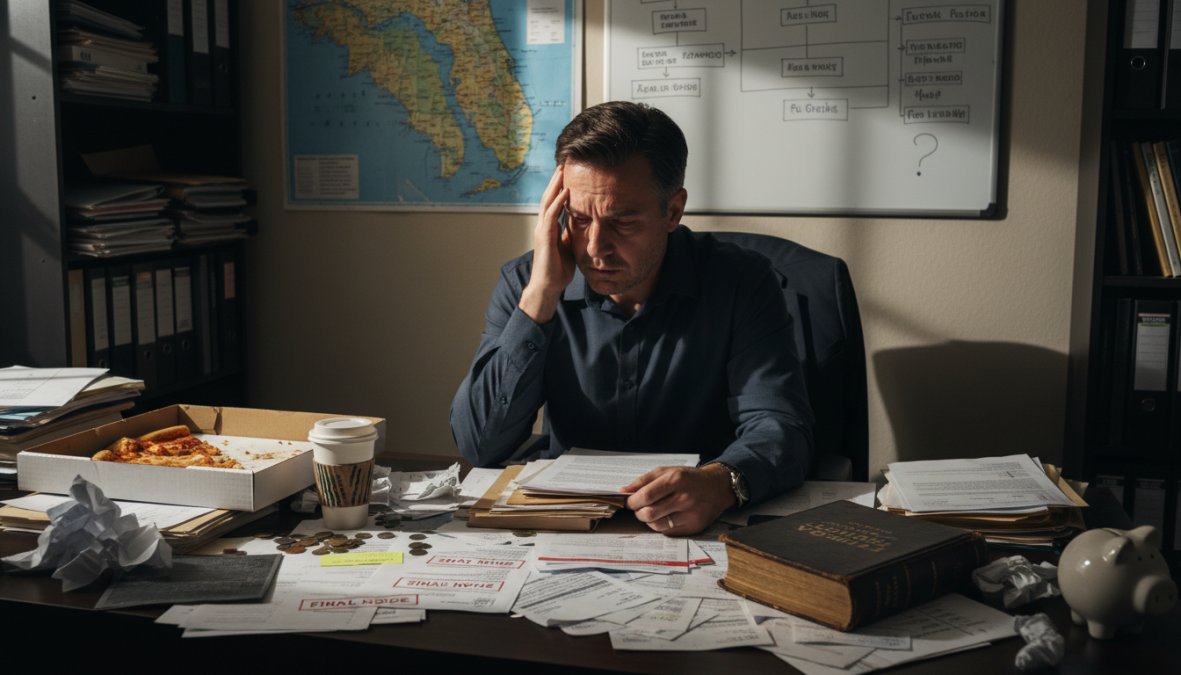
The consequences compound over time and fall into three distinct categories:
1. Ongoing State Fees and Administrative Dissolution
Florida requires every active corporation to file an annual report and pay the associated fee each year by May 1. If the report is not filed, the Florida Department of State assesses a late fee, and if the delinquency continues, the state administratively dissolves the corporation, typically in late September of the same year. Administrative dissolution sounds like a resolution, but it is not. It strips the entity of its legal authority to conduct business and removes the liability shield protecting shareholders, while doing nothing to extinguish the corporation’s debts, contracts, or tax obligations. The corporation is legally dead but its liabilities are very much alive.
2. Personal Liability Exposure for Directors and Officers
Once a corporation is administratively dissolved, directors and officers who continue to conduct business in the corporation’s name can be held personally liable for obligations incurred during that period. Florida courts have found that transacting business through a dissolved entity, signing contracts, accepting payments, incurring new debts, can pierce the corporate veil even when the original dissolution was involuntary. The practical risk is that a creditor who discovers the entity was dissolved at the time a contract was signed has a strong argument that the individuals who signed on behalf of the corporation are personally on the hook.
3. Tax Penalties That Accrue Without a Filing Trigger
The IRS does not automatically close a corporate tax account when a corporation stops operating. If no final return is filed and IRS Form 966 is not submitted, the IRS continues to expect annual returns. Failure-to-file penalties under IRC Section 6651 accrue at 5% of the unpaid tax per month, up to 25%. For corporations with payroll, undeposited employment taxes carry a Trust Fund Recovery Penalty under IRC Section 6672, which the IRS can assess personally against any officer, director, or employee who was responsible for collecting and remitting those taxes. This penalty does not go away when the corporation dissolves, it follows the individual.
Reinstatement vs. Dissolution: Which Path Is Right for You?
This is the question most guides skip entirely, and it is the one that matters most when a business owner discovers their corporation has been administratively dissolved. The answer is not obvious, and choosing the wrong path creates either unnecessary cost or unnecessary risk.
When Reinstatement Makes Sense
Florida law allows an administratively dissolved corporation to apply for reinstatement at any time by filing all delinquent annual reports, paying all outstanding fees and penalties, and submitting a reinstatement application to the Florida Division of Corporations through the Sunbiz portal. Reinstatement, when granted, restores the corporation to good standing retroactively, meaning the entity is treated as if it was never dissolved for purposes of contracts and legal standing.
Reinstatement is the right path when:
- The business has a viable future and intends to resume or continue operations
- The corporation was a party to contracts during the period of administrative dissolution and retroactive good standing is needed to validate those agreements
- The corporation holds assets (real estate, intellectual property, licenses) that are easier to transfer or monetize through an active entity
- The dissolution was an administrative oversight rather than a business decision
The cost of reinstatement is the sum of all missed annual report fees plus any late penalties assessed by the state. For a corporation that has been administratively dissolved for multiple years, this can represent a meaningful expense, but it is almost always less than the cost of litigation over a disputed contract or a personal liability claim.
When Voluntary Dissolution Is the Right Path
If the business has genuinely ceased operations and has no intention of resuming them, completing a voluntary dissolution is the cleaner and more protective option. Leaving an administratively dissolved entity sitting on the books creates ongoing risk without any corresponding benefit. The corporation’s debts do not disappear, its tax obligations do not close, and the owners remain exposed to the consequences described above.
Voluntary dissolution is the right path when:
- The business has permanently closed and there is no plan to reopen or sell it
- All assets have already been distributed or liquidated
- The owners want a definitive legal end date that stops the accrual of fees and penalties
- The corporation has no pending contracts or litigation that would benefit from retroactive good standing
The Decision Framework
The single most useful question to ask is: Does this corporation have economic value that justifies the cost of reinstatement? If the answer is yes, because the business is operating, the entity holds valuable assets, or contracts depend on its legal standing, reinstatement is worth the investment. If the answer is no, the path forward is a clean voluntary dissolution that formally closes the entity, files the final tax returns, and ends the owners’ exposure.
Do not assume that an administratively dissolved corporation is “already gone” and therefore requires no further action. The Florida Department of State’s dissolution removes the entity’s authority to act, but it does not close the IRS account, extinguish creditor claims, or stop the accrual of tax penalties. Owners who walk away from an administratively dissolved corporation without completing a formal wind-down frequently discover years later that the IRS or a creditor has been tracking the entity the entire time.
An attorney can assess the specific facts, outstanding debts, pending contracts, tax account status, and the presence of any assets, to determine which path creates the least risk and the lowest total cost. In many cases, the right answer is not obvious until someone has reviewed the full picture.
Common Mistakes to Avoid When Dissolving a Florida Corporation
Most dissolution problems are preventable. Here are the errors that create the most significant downstream liability.
| Mistake | Consequence | Fix |
|---|---|---|
| Distributing assets before settling creditor claims | Shareholders become personally liable for unpaid debts | Complete creditor notification and claims process first |
| Failing to file IRS Form 966 | IRS keeps the corporate tax account open; penalties accrue | File within 30 days of authorization |
| Not withdrawing from other states | Ongoing fees and franchise taxes in those states | File withdrawal in every state where registered |
| Canceling insurance before final payroll | Coverage gap; workers’ comp exposure | Keep all policies active through final payroll date |
| Skipping the formal board resolution | Dissolution can be challenged as unauthorized | Document the vote in corporate minutes |
| Forgetting to cancel business licenses | Local fees continue to accrue | Cancel all city, county, and state licenses |
The most expensive dissolution mistakes are not the filing errors. They are the sequencing errors: distributing assets too early, canceling insurance too soon, or filing final returns out of order. Get the sequence right and most other problems resolve themselves.
When to Work With a Business Attorney in Coral Springs
Some dissolutions are genuinely straightforward. A single-owner S-corp with no employees, no outstanding debt, and no multi-state registrations can often complete the process with minimal professional help. Most dissolutions are not that simple.
Work with a business attorney in Coral Springs when any of the following apply: the corporation has multiple shareholders with potentially competing interests, there are outstanding or threatened lawsuits, creditor claims are disputed, the corporation holds significant assets including real estate or intellectual property, or there are unresolved payroll tax issues. These are situations where the cost of professional guidance is far less than the cost of getting it wrong.
Matthew Fornaro, P.A. has spent over two decades helping South Florida entrepreneurs and small business owners work through exactly these scenarios. The firm’s focus on practical, results-oriented counsel means clients in Coral Springs, Parkland, and throughout Broward County get clear guidance on the steps that actually matter, not a generic checklist. If you are searching for a business attorney near me to help with corporate wind-down, the right time to call is before you start distributing assets, not after a problem surfaces.
The Florida Statutes Chapter 607 governing profit corporation dissolution is publicly available and worth reviewing, but statutory language alone does not tell you how to apply the rules to your specific situation.
Closing a corporation without proper legal guidance is one of the most common ways Coral Springs business owners create liability they thought they were escaping. Matthew Fornaro, P.A. brings over 20 years of experience in business formation, commercial litigation, and corporate transactions to every dissolution engagement, giving clients the practical guidance they need to close cleanly and move forward without lingering risk. Call today to discuss your situation and get a clear plan for completing your Florida corporation dissolution the right way.
Frequently Asked Questions
How do I voluntarily dissolve a corporation in Florida?
To voluntarily dissolve a Florida corporation, the board of directors must first pass a dissolution resolution, which shareholders then approve per your corporate bylaws. You then file Articles of Dissolution with the Florida Division of Corporations through Sunbiz.org, pay the required filing fee, notify creditors, settle all liabilities, and distribute remaining assets to shareholders. You must also file a final tax return and submit IRS Form 966. An attorney can help ensure every statutory requirement is met correctly.
How much does it cost to dissolve a corporation in Florida?
The Florida Division of Corporations charges a filing fee to submit Articles of Dissolution. For profit corporations, the fee is generally $35. Non-profit corporations may have a different fee schedule. You can file online through Sunbiz.org using the e-file system. Keep in mind that additional costs may apply, such as attorney fees, final tax filing costs, registered agent withdrawal fees, and any outstanding obligations to creditors that must be settled before dissolution is complete.
What happens if I don't formally dissolve my Florida corporation?
Failing to formally dissolve a Florida corporation can lead to serious consequences. The state may administratively dissolve the entity, but that does not eliminate your legal obligations. You may continue to owe annual report fees, face personal liability for ongoing corporate debts, and remain exposed to lawsuits filed against the entity. The corporation's entity status on Sunbiz may show as inactive or dissolved, but unresolved tax filings and creditor claims can follow the owners. Formal dissolution is the only way to cleanly end these obligations.
Do I need to file tax returns after dissolving a Florida corporation?
Yes. Florida corporation dissolution tax requirements include filing a final federal corporate tax return with the IRS and checking the 'final return' box on the form. You must also file IRS Form 966 within 30 days of the dissolution resolution. If your corporation had employees, final payroll tax returns are required. At the state level, you should close your Florida Department of Revenue accounts. Failing to meet these Florida corporation dissolution tax requirements can result in penalties even after the business has stopped operating.
What is the difference between administrative and voluntary dissolution in Florida?
Voluntary dissolution is initiated by the corporation's board of directors and shareholders following the proper legal process, including filing Articles of Dissolution with the Florida Division of Corporations. Administrative dissolution is imposed by the Secretary of State when a corporation fails to meet statutory requirements, such as not filing an annual report or not maintaining a registered agent. While both end the corporation's good standing, voluntary dissolution allows for an orderly wind-up of affairs, whereas administrative dissolution can leave liabilities and legal exposure unresolved.
Can I reinstate a Florida corporation instead of dissolving it?
Yes. If your corporation was administratively dissolved and you wish to continue operating, reinstatement may be an option. You would need to file for reinstatement through Sunbiz, pay all outstanding fees, and restore your entity status to good standing. However, if the business is no longer viable or you have no intention of continuing operations, formal dissolution is the cleaner path. Weighing reinstatement vs. dissolution depends on your business goals, outstanding liabilities, and the corporation's financial condition.
This article was written using GrandRanker