

Key Takeaways
- Florida business law protects companies from unfair competition, contract breaches, and partner disputes.
- Acting early saves time, money, and business relationships.
- An experienced business attorney helps you assess risk and choose the right legal strategy.
A civil fraud claim is a private lawsuit filed by an individual or business to recover money lost because of another party’s deliberate deception. Unlike criminal fraud, which the government prosecutes, a civil fraud action is brought by the victim directly. The goal is financial recovery, not imprisonment. Florida courts require plaintiffs to prove five specific legal elements by a preponderance of the evidence, meaning more likely true than not. That lower burden makes civil fraud a realistic path for South Florida individuals and businesses who cannot get police or prosecutors to act.
What is a civil fraud claim and how does it differ from criminal fraud?
A civil fraud claim is defined as a private cause of action where an injured party seeks compensation for financial losses caused by another’s deception. The formal legal term is “fraudulent misrepresentation,” though civil fraud claim is the phrase most people use when searching for help. Criminal fraud is prosecuted by the state or federal government. Civil fraud is prosecuted by you, the victim.
The practical difference matters enormously. A criminal case can result in jail time, but you see none of the money. A civil case can result in a judgment you can enforce against the defendant’s bank accounts, property, and wages. South Florida courts handle both, but only the civil route puts money back in your pocket.

The burden of proof also differs. Criminal fraud requires proof beyond a reasonable doubt. Civil fraud requires only a preponderance of the evidence. That means your evidence needs to tip the scales past 50 percent, not eliminate all doubt.
What are the legal elements required to prove a civil fraud claim?
Five elements must all be present for a civil fraud claim to succeed. Missing even one causes the entire claim to fail. Courts apply these elements strictly, so understanding each one before you file is not optional.
- False statement of material fact. The defendant must have made a specific false statement about a fact, not an opinion or a prediction. “This property is worth $500,000” is a factual claim. “I think prices will rise” is an opinion and does not qualify.
- Knowledge or reckless disregard. The defendant must have known the statement was false, or acted with reckless disregard for its truth. Honest mistakes do not meet this standard.
- Intent to induce action. The false statement must have been made to get you to do something, such as sign a contract, pay money, or give up a legal right.
- Justifiable reliance. You must have actually relied on the false statement, and that reliance must have been reasonable given the circumstances. Justifiable reliance is the element that fails most often. Simply proving a lie is not enough. You must show the lie was central to your decision, not incidental.
- Actual financial harm. You must have suffered a real, measurable financial loss as a direct result of your reliance on the false statement.
Every element must be proven with specific facts, not general allegations. Florida courts apply heightened pleading standards to fraud claims, meaning your complaint must identify who made the false statement, what was said, when it was said, and how it caused your loss.
Pro Tip: Build a written timeline of every communication before you file. Courts and opposing counsel will scrutinize inconsistencies, and a clear, organized record binder often sways early negotiations and mediations.
Clients frequently overestimate how easy fraud is to prove. Detailed factual allegations and evidence showing the defendant’s actual knowledge, such as internal emails or prior complaints, are what separate winning claims from dismissed ones.
How does the civil fraud claim process work in South Florida?
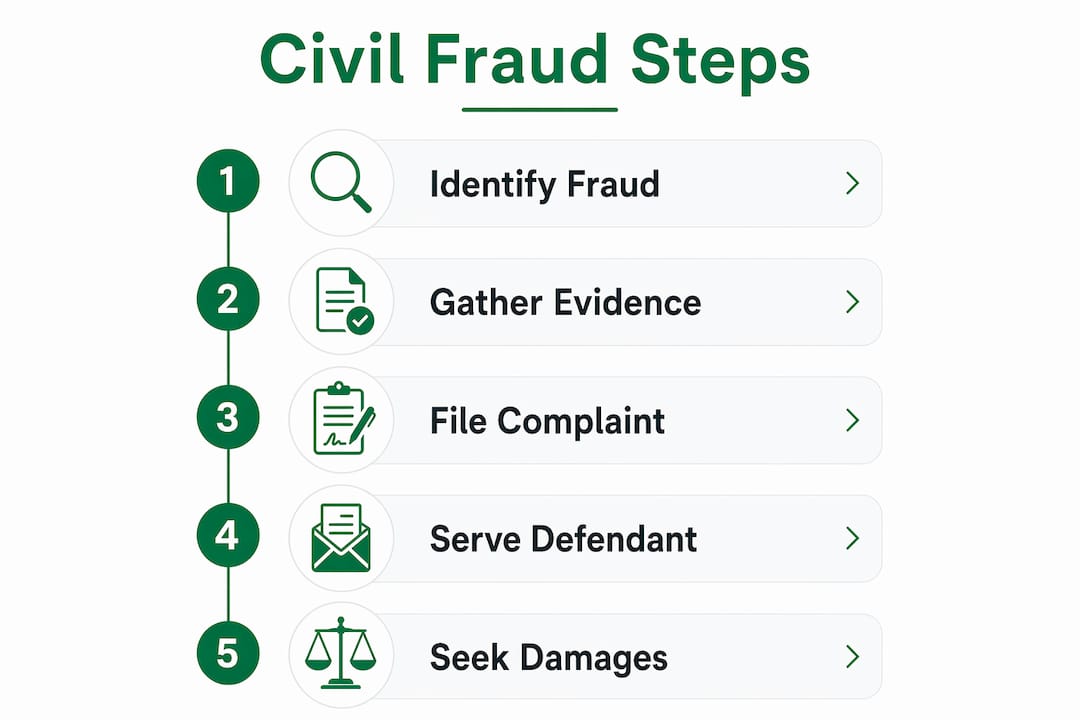
Filing a civil fraud lawsuit in South Florida follows a defined sequence. Skipping steps or missing deadlines can end your case before it begins.
- Gather and preserve evidence. Collect every contract, email, text message, invoice, and financial record related to the fraud. Issue a litigation hold notice immediately to prevent accidental deletion of relevant documents. Courts treat evidence destruction as a serious offense that can result in adverse jury inferences against you.
- Send a pre-litigation demand letter. A formal demand letter puts the defendant on notice and may open settlement discussions before you spend money on litigation. Pre-litigation demand letters are standard practice and sometimes resolve disputes without a single court filing. That said, demand letters are not always the right first move. Learn when demand letters fail before you send one.
- Draft and file the complaint. Your complaint must meet heightened pleading standards under Rule 9(b), specifying the who, what, when, and how of the fraud. Lack of specificity leads to early dismissal. Court filing fees in South Florida typically range from $75 to $500 depending on the amount in controversy.
- Serve the defendant. You must serve the defendant within 90 days of filing. Process servers typically charge $45 to $110. Failure to file proof of service prevents the court from issuing any orders against the defendant.
- Proceed through discovery and trial. After service, both sides exchange evidence through depositions, interrogatories, and document requests. Most civil fraud cases settle during or after discovery once the evidence is on the table.
Pro Tip: Hire a licensed process server rather than relying on a friend or family member. Improper service is one of the most common and avoidable reasons civil fraud cases get delayed or dismissed.
What are common examples of civil fraud claims?
Civil fraud appears in many forms across South Florida’s business and real estate markets. Recognizing the pattern helps you identify whether your situation qualifies.
Common scenarios include:
- A contractor collects a large deposit for home renovations and disappears without doing the work, having made false representations about licensing and materials.
- A financial advisor misrepresents the risk profile of an investment, causing a client to lose retirement savings.
- A business seller provides false financial statements to induce a buyer to pay an inflated purchase price.
- A landlord misrepresents the condition of a commercial property to secure a long-term lease.
Oral statements, emails, and conduct can all serve as evidence of fraud. You do not need a written contract to file a civil fraud claim. What you need is proof that a false statement was made and relied upon.
Civil fraud differs from breach of contract in one critical way. Breach of contract covers a failure to perform a promise. Civil fraud covers a deliberate lie made to induce that promise. The distinction matters because intentional fraud opens the door to punitive damages, while a breach of contract claim generally does not.
| Factor | Intentional fraud | Negligent misrepresentation |
|---|---|---|
| State of mind required | Knowledge or reckless disregard | Failure to exercise reasonable care |
| Punitive damages available | Yes, where willful conduct is proven | Generally not available |
| Burden of proof | Preponderance of the evidence | Preponderance of the evidence |
| Typical remedy | Compensatory and punitive damages | Compensatory damages only |
Understanding which category your claim falls into shapes your litigation strategy and your realistic recovery.
What is the statute of limitations for civil fraud claims in South Florida?
The statute of limitations for civil fraud claims generally ranges from 2 to 6 years, depending on the specific claim and applicable state law. Missing the deadline results in permanent dismissal, regardless of how strong your evidence is. The clock does not care about the merits of your case.
Florida’s discovery rule is important here. The clock typically starts when the fraud was discovered or when it reasonably should have been discovered. Delayed discovery rules allow victims of hidden fraud schemes to file even years after the fraudulent act, as long as they could not reasonably have detected it sooner.
Key steps to protect your rights before the deadline:
- Document the exact date you first learned of the potential fraud.
- Preserve all communications, contracts, and financial records immediately.
- Consult an attorney as soon as you suspect fraud, not after you are certain.
- Do not wait for a criminal investigation to conclude before filing your civil claim.
- Review evidence best practices specific to South Florida business disputes.
Waiting to act is the single most common mistake fraud victims make. Evidence disappears, witnesses forget details, and deadlines expire. Acting quickly preserves all your options.
What remedies and damages can you recover in a civil fraud claim?
A successful civil fraud claim in South Florida can produce several categories of financial and equitable relief. The type of remedy depends on the facts of your case and how the court characterizes the defendant’s conduct.
Civil fraud remedies fall into these categories:
- Compensatory damages cover your actual financial losses, including money paid, lost profits, and out-of-pocket costs directly caused by the fraud.
- Punitive damages are available when the defendant’s conduct was intentional and willful. Florida courts award punitive damages to punish wrongdoing and deter future misconduct, not merely to compensate the victim.
- Rescission cancels the fraudulent contract and restores both parties to their original positions. Courts favor rescission when fraud induced the contract itself.
- Attorney’s fees and costs may be recoverable in certain fraud cases, particularly where a statute or contract provision allows it.
- Equitable relief such as injunctions can prevent the defendant from continuing harmful conduct or transferring assets to avoid a judgment.
Fraud claims generally produce larger recoveries than breach of contract claims because punitive damages are on the table. For a full breakdown of how courts calculate these awards, the types of damages in business litigation vary significantly based on the facts presented.
What I’ve learned about civil fraud claims after 20 years in South Florida courts
After two decades handling business disputes in South Florida, the pattern I see most often is this: clients come in with a strong gut feeling that they were defrauded, but they have not preserved the evidence to prove it. They deleted the email thread. They never wrote down what was said in the meeting. They waited a year before calling an attorney.
The element that kills more civil fraud claims than any other is justifiable reliance. Judges and juries ask a hard question: why did you believe this person? If the answer involves ignoring obvious red flags or skipping basic due diligence, the claim weakens fast. I always tell clients to document not just what the defendant said, but why they believed it and what steps they took to verify it.
Pre-litigation strategy matters more than most people realize. A well-timed, well-documented demand letter combined with a clear evidence file often produces a settlement before trial. Litigation is expensive and emotionally draining. The goal is to win, and sometimes winning means settling on favorable terms rather than spending two years in court.
Choosing counsel who knows South Florida’s local rules and judges is not a minor detail. Procedural missteps, like improper service or vague pleadings, end cases that should have won. Experience in the specific courthouse where your case will be filed is worth more than a big firm’s name on the letterhead.
— Matthew
How Fornarolegal helps South Florida businesses navigate civil fraud claims
Civil fraud claims are winnable, but only with the right preparation from the start. Fornarolegal has spent over 20 years representing South Florida entrepreneurs, startups, and established businesses in complex fraud and commercial disputes.

Matthew Fornaro provides direct, court-tested guidance on evidence preservation, complaint drafting, and litigation strategy. Early legal intervention is the most cost-effective way to protect your position. Whether you are considering filing a claim or defending against one, early legal guidance can prevent a manageable dispute from becoming a costly trial. Contact Fornarolegal to schedule a consultation and get a clear picture of your options before the clock runs out.
FAQ
What is the civil fraud definition under Florida law?
Civil fraud, formally called fraudulent misrepresentation, is a private cause of action requiring proof of five elements: a false material fact, the defendant’s knowledge of falsity, intent to induce reliance, justifiable reliance by the plaintiff, and actual financial harm.
How do I file a civil fraud claim in South Florida?
File a detailed complaint in the appropriate Florida court, pay filing fees ranging from $75 to $500, and serve the defendant within 90 days using a licensed process server. The complaint must meet heightened pleading standards specifying who, what, when, and how the fraud occurred.
What constitutes civil fraud versus a breach of contract?
Civil fraud requires proof of a deliberate lie made to induce a transaction. Breach of contract covers a failure to perform a valid agreement. Fraud opens the door to punitive damages; breach of contract generally does not.
How long do I have to file a civil fraud claim in Florida?
The statute of limitations for civil fraud claims generally ranges from 2 to 6 years, starting from the date the fraud was discovered or reasonably should have been discovered. Missing this deadline results in permanent dismissal.
What damages can I recover in a civil fraud lawsuit?
Successful plaintiffs can recover compensatory damages for actual losses, punitive damages for willful misconduct, and rescission of fraudulent contracts. Attorney’s fees may also be recoverable depending on the applicable statute or contract terms.
Key takeaways
A civil fraud claim requires proving all five legal elements by a preponderance of the evidence, and missing any single element results in dismissal regardless of the strength of the remaining proof.
| Point | Details |
|---|---|
| Five elements are mandatory | False statement, knowledge, intent, justifiable reliance, and actual harm must all be proven. |
| Justifiable reliance is the hardest element | Victims must show the lie was central to their decision, not just present in the transaction. |
| Filing deadlines are permanent | Statutes of limitations range from 2 to 6 years; missing the deadline ends the case forever. |
| Punitive damages require intentional fraud | Negligent misrepresentation claims do not support punitive damages under Florida law. |
| Early evidence preservation is critical | Litigation holds, organized records, and documented timelines directly affect claim viability. |
Recommended
- Fraud Lawyer for Businesses: A Guide to Protecting Your Company » Matthew Fornaro, P.A.
- Business Fraud Attorney Miami: Protecting Your South Florida Operations in 2026 » Matthew Fornaro, P.A.
- Financial Fraud Lawyers: A Guide for Businesses to Recover Losses » Matthew Fornaro, P.A.
- Civil Litigation Attorney: Protecting Your Florida Business Interests


