

Key Takeaways
- Florida business law protects companies from unfair competition, contract breaches, and partner disputes.
- Acting early saves time, money, and business relationships.
- An experienced business attorney helps you assess risk and choose the right legal strategy.
A derivative lawsuit is defined as a legal action filed by a shareholder on behalf of a corporation to enforce a claim the company itself has failed to pursue, typically against directors or officers who have harmed the business by breaching their duties. The formal legal term is a shareholder derivative action, and it sits at the center of corporate governance law in the United States. Under this structure, any recovery goes to the corporation, not to the individual shareholder who brought the suit. That single fact separates derivative actions from every other type of shareholder claim. Key legal frameworks governing these suits include Federal Rules of Civil Procedure Rule 23.1, New York Business Corporation Law § 626, and the Companies Act 2006 in the UK.
What is a derivative lawsuit and how does it differ from a direct claim?
A derivative lawsuit gives shareholders a legal mechanism to act when corporate leadership refuses to. The corporation is the real party in interest. The shareholder acts as a proxy, stepping into the company’s shoes to enforce a right the board should have pursued but didn’t.

A direct lawsuit, by contrast, is filed by a shareholder to recover a personal loss. If a company dilutes your shares without authorization, that harm is personal and you sue directly. If a CEO steals from the company treasury, the harm is to the corporation. You cannot sue personally for that loss. You file a derivative action on the company’s behalf.
This distinction matters enormously in practice. Courts dismiss many shareholder claims because plaintiffs mischaracterize a corporate injury as a personal one. Getting the classification right from the start determines whether your case survives past the first motion to dismiss.
What procedural requirements govern a derivative suit?
Filing a derivative action is not as simple as writing a complaint. Courts impose strict procedural gates that filter out weak or opportunistic claims before they reach the merits stage.
-
Ownership at the time of wrongdoing. Under FRCP Rule 23.1, you must have been a shareholder when the alleged misconduct occurred and must remain a shareholder throughout the litigation. Buying shares after the harm was done disqualifies you.
-
Pre-suit demand on the board. Before filing, you must formally ask the board of directors to take action. New York Business Corporation Law § 626© and similar statutes require this step. The board gets a chance to fix the problem internally before litigation begins.
-
Demand futility pleading. If making a demand would be pointless because the board is conflicted or controlled by the wrongdoers, you can skip it. But you must plead demand futility with specific facts, not vague allegations. Courts reject conclusory claims that the board “would never act.”
-
Verified complaint with particularity. Your complaint must be verified under oath and must detail the demand you made or the specific reasons it was futile. Generic pleadings fail. Courts expect concrete facts.
-
Fair and adequate representation. You must demonstrate that you can fairly represent the interests of all similarly situated shareholders. A plaintiff with a personal agenda that conflicts with the corporation’s interests will not qualify.
Pro Tip: Before you decide whether to plead demand or demand futility, review board meeting minutes and any prior communications about the alleged misconduct. That documentary record is the foundation of your pleading strategy, and getting early access to those documents can make or break your case.
What are the most common grounds for filing a derivative action?
Derivative suits commonly allege three categories of corporate misconduct. Each targets harm done to the company, not to individual shareholders.
-
Breach of fiduciary duty. Directors and officers owe the corporation duties of care and loyalty. A CEO who approves a self-serving transaction that costs the company millions has breached both. This is the most frequently litigated ground in derivative actions. Fornarolegal handles these claims regularly, and you can learn more about fiduciary duty litigation in Florida specifically.
-
Corporate waste. This claim arises when executives authorize transactions so one-sided that no reasonable business person would approve them. Paying a departing executive $50 million for a company worth $10 million, with no legitimate business rationale, is a classic example.
-
Insider trading and self-dealing. Officers who trade on material non-public information or who steer corporate opportunities to themselves or related parties harm the corporation directly. These claims often overlap with federal securities law violations.
-
Mismanagement. Gross negligence in running the business, such as ignoring obvious financial red flags or failing to maintain required compliance programs, can also support a derivative claim when the board refuses to act.
These claims all share one purpose: they seek to restore value to the corporation, not to compensate individual shareholders for personal losses. That framing shapes every aspect of how the case is litigated and settled.
Pro Tip: If you suspect insider trading or self-dealing, document the timeline carefully before filing anything. Courts look for a clear connection between the alleged misconduct and the corporate harm. A well-organized chronology of events strengthens your particularity pleading and signals to the court that this is a serious claim.
How do derivative lawsuits affect business owners and shareholders?
The practical implications of a derivative action cut in multiple directions. Whether you are the shareholder filing the suit or the business owner defending against one, the stakes are significant.
| Stakeholder | Key Consideration | Practical Impact |
|---|---|---|
| Shareholder plaintiff | No direct financial recovery | Any damages go to the corporation; plaintiff may recover litigation costs |
| Director or officer defendant | Personal liability exposure | D&O insurance coverage becomes critical; indemnification rights matter |
| The corporation | Reputational and financial risk | Litigation signals governance problems to investors, lenders, and partners |
| Other shareholders | Indirect benefit from recovery | Corporate recovery increases company value, benefiting all shareholders |
| Board of directors | Authority to investigate and respond | Board may dismiss the suit after a good-faith investigation |
The remedy and settlement economics in derivative suits differ sharply from personal injury or contract cases. Because the corporation receives any recovery, shareholders who bring these suits are essentially volunteering their time and legal fees to benefit everyone. Courts recognize this and typically allow successful plaintiffs to recover their attorney fees from the corporation.
For business owners running closely held companies, a derivative suit from a minority shareholder can be a serious governance crisis. It signals that internal dispute resolution has broken down completely. The reputational damage from public litigation often exceeds the financial exposure from the underlying claim.
Strategic considerations matter here. Defending a derivative suit requires assessing whether the underlying claim has merit, whether D&O insurance applies, and whether a special litigation committee can investigate and potentially move to dismiss. Each of those decisions carries its own legal and business consequences. Consulting a shareholder dispute attorney early in the process is not optional. It is the difference between controlling the narrative and reacting to it.
How do courts oversee and protect the derivative lawsuit process?
Courts do not simply rubber-stamp derivative actions. Judicial oversight is built into every stage of the process, from filing through resolution.
| Stage | Court’s Role | Purpose |
|---|---|---|
| Filing | Reviews standing, demand, and pleading particularity | Filters frivolous or procedurally defective claims |
| Discovery | Manages scope of early document requests | Prevents fishing expeditions while allowing legitimate fact-finding |
| Board dismissal motion | Evaluates good-faith investigation by board | Balances board authority with shareholder protection |
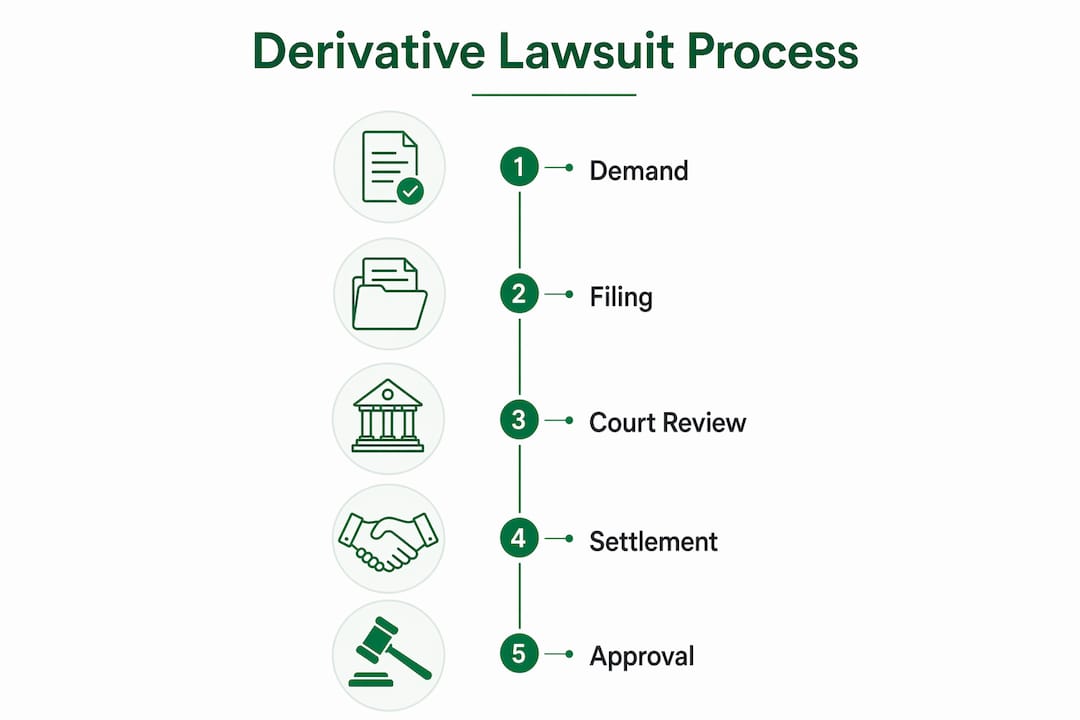
| Settlement | Requires court approval and shareholder notice | Prevents plaintiffs from settling for personal benefit at corporation’s expense |
| Dismissal | Requires court approval under FRCP Rule 23.1 | Protects all shareholders from collusive or premature dismissals |
Settlement or dismissal of derivative actions requires court approval and notice to shareholders. This oversight prevents a plaintiff from quietly settling a case in exchange for personal benefits while the corporation receives nothing. That kind of collusive settlement would undermine the entire purpose of the derivative mechanism.
The board also has a meaningful role in this process. The board of directors may dismiss derivative suits in good faith after a reasonable investigation if it concludes the litigation is not in the corporation’s best interest. This power is significant. It means a well-governed board can shut down even a technically valid derivative claim if it can demonstrate that pursuing the litigation would harm the company more than the underlying misconduct did.
In the UK, the Companies Act 2006 sections 260–264 take a similar approach. UK derivative claims require court permission to continue, and courts refuse that permission if the act complained of has already been ratified by shareholders or if the claim lacks a prima facie case. The permission stage functions as an early filter against claims that are vexatious or strategically motivated rather than genuinely aimed at protecting the corporation.
Key takeaways
A derivative lawsuit is the shareholder’s primary legal tool for holding corporate insiders accountable when the board refuses to act, and every recovery flows to the corporation rather than to the individual who filed the claim.
| Point | Details |
|---|---|
| Corporation is the real party | Any financial recovery from a derivative suit goes to the corporation, not the shareholder plaintiff. |
| Procedural gates are strict | Shareholders must satisfy ownership, demand, and pleading requirements before courts reach the merits. |
| Three core grounds dominate | Breach of fiduciary duty, corporate waste, and insider trading are the most common bases for derivative claims. |
| Courts supervise every exit | Settlement and dismissal both require court approval and shareholder notice to prevent self-dealing by plaintiffs. |
| Boards can fight back | A board that conducts a good-faith investigation can move to dismiss a derivative suit even after it is filed. |
What two decades of derivative litigation taught me
Most business owners I work with have never heard the term “derivative lawsuit” until they receive one. That gap in awareness is expensive. By the time a shareholder files a derivative action, the governance problem has usually been festering for months or years. The lawsuit is the symptom, not the disease.
The single biggest mistake I see on the defense side is treating a derivative suit like a standard commercial dispute. It is not. The procedural requirements under FRCP Rule 23.1 create early dismissal opportunities that most general litigators miss entirely. A well-crafted motion attacking standing, demand adequacy, or pleading particularity can end the case before discovery begins. That is a fundamentally different litigation posture than fighting on the merits.
On the plaintiff side, I see the opposite error. Shareholders who have a legitimate grievance rush to file without building the factual record first. Courts expect specific, verified allegations about demand or demand futility. Vague complaints about board misconduct get dismissed at the pleading stage, and that dismissal can preclude a better-pleaded second attempt.
The pre-suit demand requirement is also widely misunderstood. Many shareholders see it as a bureaucratic hurdle. It is actually a strategic opportunity. A formal demand letter puts the board on notice, creates a paper trail, and sometimes prompts the company to act without litigation. I have seen boards take corrective action after a well-drafted demand letter, saving everyone the cost and disruption of a full derivative suit. Understanding when demand letters work and when they don’t is part of building the right strategy from day one.
The bottom line is this: derivative litigation is a specialized area where procedural precision matters as much as the underlying facts. Get the procedure wrong and the most legitimate claim in the world gets dismissed.
— Matthew
How Fornarolegal helps you navigate derivative litigation
Derivative lawsuits are among the most procedurally demanding cases in corporate law. Whether you are a shareholder considering action against a board that has failed the company or a business owner defending against a derivative claim, the decisions you make in the first 60 days shape the entire outcome.

Fornarolegal has represented business owners, shareholders, and closely held companies across South Florida for over 20 years. Matthew Fornaro brings court-tested experience in corporate governance disputes, shareholder claims, and preventing business litigation before it escalates into costly, public proceedings. If you are facing a governance dispute or want to understand your rights before a conflict develops, contact Fornarolegal for a direct, practical assessment of your situation.
FAQ
What is a derivative lawsuit in simple terms?
A derivative lawsuit is a legal claim filed by a shareholder on behalf of a corporation against insiders, such as directors or officers, who have harmed the company. Any money recovered goes to the corporation, not to the shareholder who filed the suit.
Who can file a shareholder derivative action?
Any shareholder who owned stock at the time of the alleged misconduct and continues to hold shares throughout the litigation can file. Under FRCP Rule 23.1, the shareholder must also fairly represent the interests of similarly situated shareholders.
What is the pre-suit demand requirement?
Before filing a derivative suit, a shareholder must formally ask the board of directors to take action or explain why that demand would be futile. Failure to satisfy this requirement leads to dismissal of the case.
What types of claims are most common in derivative suits?
Breach of fiduciary duty, corporate waste, and insider trading are the three most common grounds. All three target harm done to the corporation rather than personal losses suffered by individual shareholders.
Can a board of directors dismiss a derivative lawsuit?
Yes. A board can move to dismiss a derivative suit after conducting a good-faith investigation if it concludes the litigation is not in the corporation’s best interest. Courts review that determination to confirm it was made in good faith and on a reasonable factual basis.
Recommended
- Shareholder Dispute Attorney Fort Lauderdale: A 2026 Guide » Matthew Fornaro, P.A.
- What Is a Shareholder Agreement? A 2026 Guide » Matthew Fornaro, P.A. Coral Springs Parkland Business Law
- Prepare for Litigation Tips for Business Owner Law Coral Springs Parkland
- Navigating the Business Litigation Process in Florida: A Strategic Guide for 2026


