

Key Takeaways
- Florida business law protects companies from unfair competition, contract breaches, and partner disputes.
- Acting early saves time, money, and business relationships.
- An experienced business attorney helps you assess risk and choose the right legal strategy.
Corporate governance is defined as the system of rules, practices, and processes by which a company is directed and controlled. It establishes how decisions are made, who holds authority, and how accountability flows between leadership and stakeholders. The G20/OECD Principles of Corporate Governance serve as the global benchmark for these frameworks, covering how companies set objectives and monitor performance. For business owners and professionals, understanding corporate governance is not a compliance exercise. It is the foundation for building a company that earns trust, attracts capital, and manages risk before problems arise.
What is corporate governance and why does it matter?
Corporate governance is the structured system through which companies are managed and overseen to ensure accountability, fairness, and transparency among leadership and stakeholders. The term covers everything from board composition and financial reporting to shareholder rights and ethical conduct. Governance frameworks emerged in the 1990s in direct response to high-profile corporate failures, with the explicit goal of reducing fraud, negligence, and mismanagement. That origin story matters because it tells you what governance is actually designed to prevent.
At its core, governance addresses a fundamental tension in business: the people who own a company are often not the same people who run it. This separation creates what economists call agency costs. Without clear oversight mechanisms, managers may act in their own interests rather than those of shareholders or other stakeholders. Governance mechanisms exist to align those interests and reduce financial inefficiencies caused by that misalignment.

One detail most business owners overlook: under the internal affairs doctrine, U.S. corporate governance is governed by the law of the state where a company is incorporated, not where it operates. A Florida business incorporated in Delaware follows Delaware corporate law on governance matters. That distinction has real consequences for board authority, shareholder rights, and fiduciary duties.
What are the core principles of corporate governance?
Good governance rests on five foundational principles. Each one addresses a specific way that companies can fail their stakeholders when leadership goes unchecked.
- Accountability. Leaders answer to shareholders, employees, customers, and the broader community. Accountability requires clear reporting lines and consequences for poor decisions.
- Transparency. Companies disclose accurate financial information and operational decisions in a timely way. Transparency builds stakeholder trust and reduces the risk of fraud or mismanagement across the organization.
- Fairness. All stakeholders receive equitable treatment. Minority shareholders, for example, should not be disadvantaged by decisions that benefit only majority owners.
- Responsibility. Leadership takes ownership of ethical and strategic decisions. This goes beyond legal compliance to include the broader impact of business conduct on employees and communities.
- Communication. Regular, meaningful engagement with shareholders and stakeholders keeps governance active rather than ceremonial. Annual reports and shareholder meetings are the minimum, not the standard.
These principles do not operate in isolation. A company that scores high on transparency but low on accountability has a governance gap. Effective governance requires all five to function together.
Pro Tip: Document each principle in a written governance policy and assign a specific person or committee to own it. Vague commitments to “transparency” mean nothing without named responsibilities and review schedules.
How do corporate governance frameworks and models guide businesses?
A governance framework is the formal structure that translates principles into practice. It defines board composition, decision-making authority, risk oversight, and reporting obligations. The G20/OECD Principles are the most widely adopted international framework, updated as of 2026 to reflect modern economic environments including digital markets and sustainability reporting.
Two dominant governance models shape how companies approach these frameworks. The shareholder model prioritizes returns to equity owners above all other considerations. The stakeholder model expands that obligation to include employees, customers, suppliers, and communities. Most modern governance frameworks blend both, recognizing that long-term shareholder value depends on treating other stakeholders well.
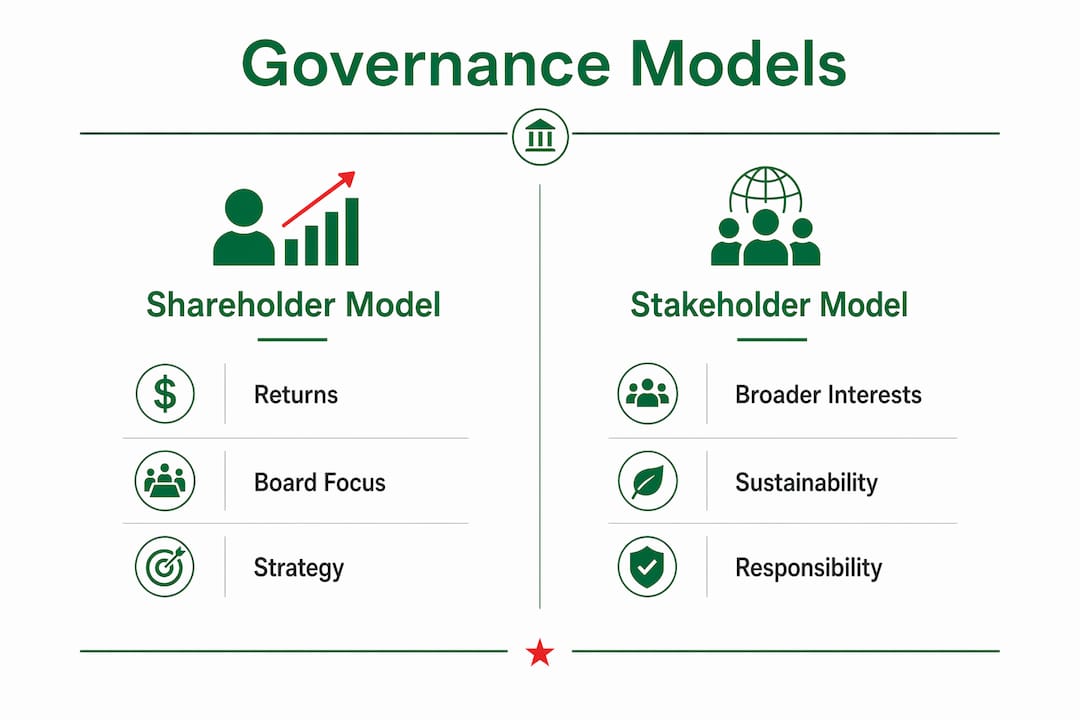
The table below compares key features across governance framework types to help you assess which approach fits your business structure.
| Framework feature | Shareholder model | Stakeholder model | OECD-aligned framework |
|---|---|---|---|
| Primary obligation | Equity owners | All stakeholders | Balanced accountability |
| Board composition | Majority independent directors | Mixed representation | Independent oversight required |
| Risk focus | Financial and legal risk | Operational, reputational, and social risk | Comprehensive risk management |
| Reporting standard | Financial statements | ESG and financial reporting | Transparency across both |
| Best suited for | Publicly traded companies | Private companies, B Corps | Companies seeking global credibility |
Risk management sits at the center of any working framework. Boards of directors provide independent oversight and strategic leadership without managing daily operations. That separation is deliberate. It creates a check on executive decision-making that protects the company from concentrated power. For small and mid-sized businesses, formalizing this separation, even without a full public-company board structure, produces the same protective effect.
Sound tax planning practices also intersect with governance. Tax strategy decisions made at the leadership level carry governance implications, particularly around disclosure, compliance, and fiduciary duty to shareholders.
Why is corporate governance important for businesses of all sizes?
Strong governance enhances access to capital and investor confidence, which leads to more sustainable economic development. That is not a statement about Fortune 500 companies. It applies directly to a 12-person startup seeking its first round of outside investment. Investors evaluate governance before they write checks. A company with clear board oversight, documented policies, and transparent financials presents a lower risk profile than one where the founder makes every decision without oversight.
The benefits of governance for smaller businesses include:
- Investor readiness. Early governance adoption signals maturity to lenders and investors, even before a company seeks outside capital.
- Risk reduction. Clear roles and documented processes reduce the chance of costly disputes between co-founders, partners, or shareholders.
- Compliance confidence. Governance frameworks create the internal controls that keep companies on the right side of regulatory requirements.
- Agile growth. Small businesses benefit from governance by establishing clear roles and processes that enable growth without chaos.
- Ethical culture. Written governance standards set behavioral expectations that protect the company’s reputation as it scales.
Many small business owners wrongly assume governance is only relevant to large public companies. That assumption is expensive. A company that waits until it faces a dispute or a regulatory inquiry to formalize its governance structure pays far more in legal fees and lost opportunity than one that built those structures early. The legal protections available to Florida SMBs are most effective when governance structures are already in place to support them.
Pro Tip: If you have two or more co-founders or equity partners, a governance framework is not optional. A shareholder agreement, defined decision-making authority, and a dispute resolution process should exist before you need them.
What practical steps can businesses take to implement effective governance?
Implementing governance does not require a full corporate bureaucracy. It requires deliberate structure applied consistently. Governance must integrate with company strategy rather than function as a regulatory checkbox reviewed once a year.
-
Establish board oversight. Define who governs versus who manages. Even a small advisory board with one or two independent members creates meaningful oversight. Document the board’s authority, meeting schedule, and decision-making scope.
-
Write your governance policies. A governance handbook does not need to be long. It needs to cover decision-making authority, conflict of interest rules, financial controls, and how disputes between owners are resolved. Written policies prevent the “we never agreed on that” conversations that destroy partnerships.
-
Define roles clearly. Every executive and senior leader should have a written role description that specifies their authority and accountability. Overlap and ambiguity in leadership roles are among the most common triggers for internal disputes.
-
Build a risk management process. Identify the top five risks to your business, assign ownership of each, and review them quarterly. This does not require a risk committee. It requires a calendar entry and honest conversation.
-
Communicate with stakeholders. Shareholders, investors, and key employees deserve regular updates on company performance and direction. Quarterly financial summaries and annual strategy reviews build the trust that governance is designed to create.
-
Review governance documents annually. A governance framework that was right for a five-person company may not fit a 50-person company. Schedule an annual review of your governance policies alongside your midyear legal document review to catch gaps before they become problems.
A corporate governance attorney can help you translate these steps into legally sound documents that hold up when tested.
Key Takeaways
Corporate governance is the system of rules and processes that directs company leadership, aligns management with stakeholder interests, and reduces the risk of fraud, disputes, and financial mismanagement.
| Point | Details |
|---|---|
| Governance is a system, not a document | Rules, practices, and oversight mechanisms must work together continuously, not just at formation. |
| Agency costs are the core problem | Separating ownership from management creates misalignment that governance structures are designed to fix. |
| Small businesses benefit early | Governance adopted before a dispute or funding round costs far less than governance built in response to a crisis. |
| OECD Principles set the global standard | The G20/OECD framework, updated in 2026, provides the most widely recognized governance benchmark for companies of all sizes. |
| Written policies prevent disputes | Documented decision-making authority and conflict of interest rules are the most practical governance tools for small and mid-sized businesses. |
Governance is a competitive advantage, not a compliance burden
Most business owners I work with come to governance conversations after something has gone wrong. A co-founder dispute. A shareholder who feels cut out of decisions. An investor who walked away because the company could not answer basic questions about its oversight structure. By that point, governance is expensive to fix.
The misconception I see most often is that governance is a large-company concern. It is not. The principles of accountability, transparency, and clear authority matter just as much in a 10-person company as in a 10,000-person one. The difference is that a small company has fewer resources to absorb the cost of getting it wrong.
What I have found after more than 20 years of working with South Florida businesses is that governance done well looks invisible. Nobody notices the shareholder agreement until there is a dispute. Nobody appreciates the board oversight until an executive makes a bad call. The value of governance shows up in what does not happen.
Governance is also not static. A framework that works at year one needs to evolve as the company grows, adds partners, or enters new markets. Treating governance as an ongoing discipline rather than a one-time task is what separates companies that scale cleanly from those that accumulate legal and operational debt along the way.
If you view governance as a strategic discipline rather than a legal obligation, you will make better decisions, attract better partners, and build a company that is genuinely harder to disrupt.
— Matthew
Fornarolegal helps South Florida businesses build sound governance
Building a governance framework that actually protects your business requires more than a template. It requires legal documents that reflect your specific ownership structure, risk profile, and growth plans.

Fornarolegal works with small businesses, startups, and established companies across South Florida to formalize governance structures, draft shareholder agreements, and put the oversight mechanisms in place before disputes arise. With over 20 years of AV®-rated, court-tested experience, the firm provides practical legal guidance that keeps governance from becoming litigation. Early legal guidance is the most cost-effective governance investment a business owner can make. Contact Fornarolegal to discuss your governance needs directly.
FAQ
What is the corporate governance definition?
Corporate governance is the system of rules, practices, and processes by which a company is directed and controlled. It establishes accountability between leadership and stakeholders, covering board oversight, financial reporting, and ethical conduct.
What are the main principles of corporate governance?
The five core principles are accountability, transparency, fairness, responsibility, and communication. Each principle addresses a specific way that companies can fail stakeholders when leadership operates without oversight.
Why is corporate governance important for small businesses?
Governance gives small businesses the clear roles and documented processes that enable growth while managing risk. Early adoption improves investor readiness and reduces the cost of disputes between owners or partners.
What is the role of the board in governance?
Boards of directors provide independent oversight and strategic leadership without managing daily operations. Their primary function is to ensure that executive decisions align with shareholder interests and the company’s stated objectives.
How does the OECD corporate governance framework apply to my business?
The G20/OECD Principles of Corporate Governance set the global standard for how companies are directed, objectives are set, and performance is monitored. While designed with public companies in mind, the framework’s principles on transparency, accountability, and board oversight apply directly to private companies seeking credibility with investors and lenders.
Recommended
- Florida Business Owners’ Midyear Legal Document Review Checklist » Matthew Fornaro, P.A. Coral Springs Parkland Business Law
- Protecting Your Ownership When Adding a Partner or Investor in Florida » Matthew Fornaro, P.A. Coral Springs Parkland Business Law
- Corporate Governance Attorney in South Florida: Protecting Your Business from Within » Matthew Fornaro, P.A.
- Corporate Fraud Attorney: A Guide for South Florida Businesses » Matthew Fornaro, P.A.


