

Key Takeaways
- Florida business law protects companies from unfair competition, contract breaches, and partner disputes.
- Acting early saves time, money, and business relationships.
- An experienced business attorney helps you assess risk and choose the right legal strategy.
An indemnification dispute is a formal contract disagreement where one party refuses to accept financial responsibility for losses that the other party claims are covered under an indemnity clause. These disputes typically center on three flashpoints: whether a triggering event actually occurred, whether the contract language covers that event, and how much compensation is owed. The stakes are real. Legal defense costs alone can be very high even before a case reaches trial.
The core parties in any indemnity agreement are the indemnitor (the party promising to cover losses) and the indemnitee (the party seeking protection). When those obligations are contested, the dispute usually traces back to one of these sources:
- Ambiguous or overly broad indemnity clause language
- Failure to provide timely notice of a claim
- Disagreement over whether the loss falls within the covered event scope
- Disputes over the amount of compensation owed
- Procedural missteps like failing to formally tender a defense
Understanding how these disputes arise, and what the contract actually requires, is the first step toward managing them without losing control of your business finances or your business relationship.
What indemnification actually means in a contract
Indemnification is a promise by one party to compensate another for specified losses, damages, or liabilities, usually triggered by third-party claims or defined events. It functions as a risk allocation tool: instead of leaving each party exposed to whatever liability the law assigns, the contract shifts that risk deliberately. Courts and practitioners treat it as one of the most heavily negotiated provisions in any commercial agreement.
Three distinct obligations often appear together in indemnity provisions, and conflating them is a common drafting mistake:
- Indemnify: Pay or compensate the other party for its losses or legal liabilities once a claim resolves.
- Defend: Engage attorneys and fund litigation as soon as a covered claim is asserted, before any final resolution. The duty to defend arises immediately upon assertion of a claim, while the duty to indemnify typically triggers only after the claim is resolved and losses are paid.
- Hold harmless: Absorb any costs or fallout from a covered claim, including downstream consequences of a settlement.
Most commercial indemnity clauses cover third-party claims only. Courts generally will not allow an indemnitee to recover attorneys’ fees spent fighting the indemnitor directly unless the contract explicitly covers first-party disputes. That distinction catches a lot of businesses off guard when they finally read the clause they signed.
Pro Tip: When reviewing any indemnity clause, check whether it covers direct claims between the parties or only third-party claims. Most standard clauses cover only the latter, which means your legal fees in a dispute with the other party may not be recoverable.

Common causes and examples of indemnification disputes
Most indemnification disputes do not start with bad faith. They start with ambiguous contract language that two reasonable parties read differently once a loss actually occurs. A phrase like “arising out of” covers a much wider range of events than “directly caused by,” and that gap becomes a lawsuit.
“Sometimes there will be a dispute over whether you can invoke your indemnity clause, or over what level of compensation is actually due. When this happens, it can be complex to resolve and there are several factors to consider.” — Ken Stangoe, Partner, Geoffrey Leaver Solicitors
Typical triggers for indemnification disputes include:
- Notice failures: Many contracts require written notice of a claim within a specific window. Miss that deadline, and the indemnitor may argue it was prejudiced in its ability to defend, potentially voiding the obligation entirely.
- Scope disagreements: The indemnitor argues the event does not fall within the covered events defined in the clause. The indemnitee argues it does. Both point to the same sentence.
- Third-party patent infringement claims: A buyer contracts with a manufacturer, a third party sues the buyer for patent infringement based on the manufacturer’s product, and the manufacturer refuses to cover defense costs. These cases require technical expert analysis of the underlying infringement record before the indemnity question can even be framed properly.
- Breach of representations and warranties: Many indemnity provisions require the indemnitee to first prove the indemnitor breached a specific representation or warranty before the indemnity obligation becomes active. That threshold requirement turns an indemnity claim into a breach of contract analysis.
- Causation gaps: Courts will reduce or deny compensation when the indemnitee cannot prove the loss was actually caused by the covered event, or when the loss was too remote from the event to have been contemplated at the time of contracting. Proving causation and remoteness is often where indemnity claims collapse.
How indemnification disputes get resolved
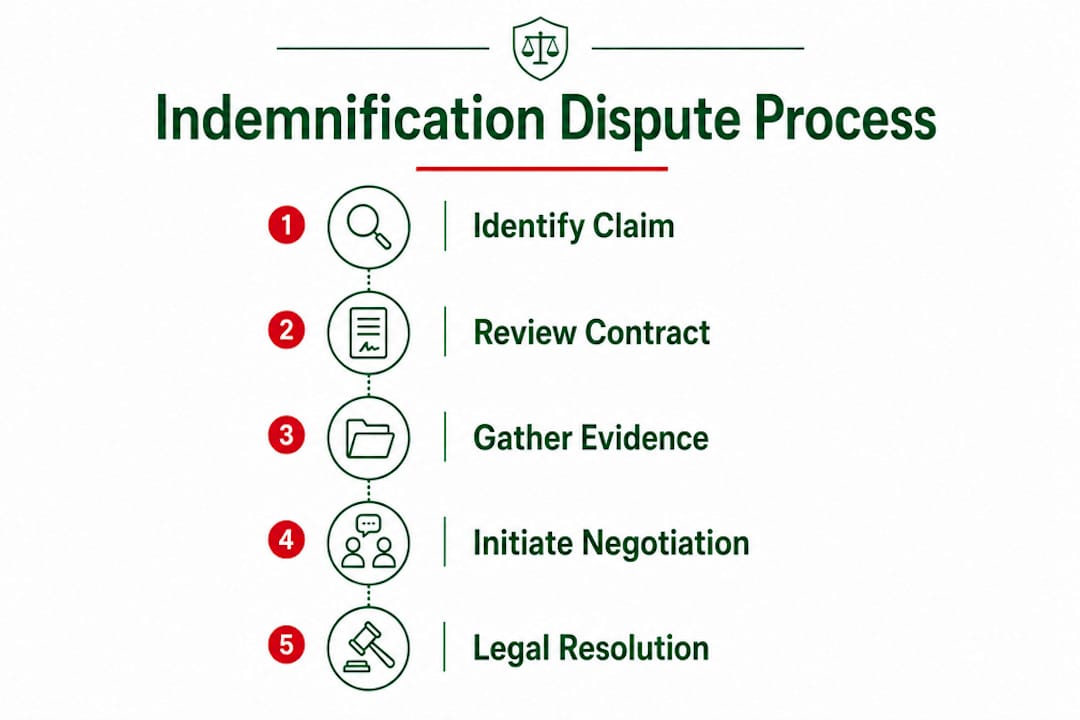
Most contracts spell out a resolution path, and that path usually runs in a fixed sequence before either party can file suit. Skipping a step can waive rights or create procedural defenses for the other side.
- Negotiation: Direct settlement discussions between the parties, often the fastest and cheapest resolution. Most disputes that settle do so here, before formal proceedings begin.
- Mediation: A neutral third party facilitates settlement without imposing a decision. Courts increasingly require mediation before trial, and many commercial contracts mandate it as a precondition to arbitration or litigation.
- Arbitration: A private adjudicator issues a binding decision. Many commercial contracts require arbitration for indemnity disputes, which keeps the matter out of public court records but limits appellate options.
- Litigation: Full court proceedings, with discovery, expert witnesses, and a judge or jury. Patent indemnification disputes almost always end up here because of the technical complexity involved.
The contract’s dispute resolution clause governs which path applies and in what order. A well-drafted clause reduces the risk of costly litigation by giving both parties a clear, agreed process to follow.
| Resolution method | Cost level | Speed | Binding outcome |
|---|---|---|---|
| Negotiation | Low | Fast | Only if settled |
| Mediation | Low to moderate | Moderate | Only if settled |
| Arbitration | Moderate | Moderate | Yes |
| Litigation | High | Slow | Yes |

Two procedural issues trip up parties before they even reach the resolution stage. First, the accrual date matters: a claim based on indemnification for liability accrues when the judgment is fixed, while a claim based on indemnification for loss accrues when the loss is actually paid. Get that wrong and the statute of limitations may bar the claim entirely. Second, privilege waiver is a real risk in some states. Filing an indemnification action can trigger an implied waiver of attorney-client privilege over the underlying litigation, giving the indemnitor access to communications you may have assumed were protected.
Why indemnification clauses generate so much conflict
Indemnification provisions appear in nearly all commercial agreements and are consistently among the most negotiated terms in any deal. The reason is straightforward: they can expose a party to open-ended financial liability for events it did not directly cause, and the language that determines that exposure is often drafted quickly and reviewed carefully only after a loss occurs.
Several structural features make these clauses especially prone to dispute:
- Scope language is inherently elastic. Phrases like “related to,” “in connection with,” and “arising out of” cover vastly different ranges of events depending on how a court interprets them. Parties often agree to broad language during negotiation without realizing how broadly it will read after a loss.
- Liability caps may or may not apply. Some agreements carve indemnification out of general liability caps; others subject indemnity to the same limits as ordinary breach of contract damages. The contract may not say clearly which applies, and that gap becomes the dispute.
- Insurance coverage creates a false sense of security. Parties assume their insurer will cover indemnity obligations, then discover the policy excludes contractual liability or has sublimits that fall short of the actual claim. The indemnitor ends up personally exposed for the gap.
- State statutes add another layer. Most states have indemnity statutes that limit or prohibit certain indemnity provisions, particularly in construction, engineering, and architectural contracts. A clause that looks enforceable on its face may be void under applicable state law.
- Business relationship pressure distorts negotiation. The party with more leverage often pushes for broad indemnity language. The weaker party accepts it to close the deal, without fully pricing the risk into the contract terms.
Practical legal guidance for managing indemnification disputes
The single most costly mistake businesses make in indemnification disputes is waiting. Delay gives the other side grounds to argue acquiescence, and it allows the underlying loss to compound. A pre-litigation case assessment conducted early gives counsel the opportunity to analyze the contract language, evaluate the facts, identify potential defenses, and map out exposure before positions harden on both sides.
Concrete steps that reduce risk and improve outcomes:
- Act on notice requirements immediately. Read the contract the day a potential claim surfaces. If written notice is required within 30 days, that clock starts running whether you know about it or not.
- Tender the defense before settling or admitting liability. Failing to formally tender a claim to the indemnitor before settling can waive your right to reimbursement entirely. This is one of the most common and most avoidable mistakes in indemnity practice.
- Get legal counsel before responding to the other party. An informal acknowledgment of responsibility, even in an email, can be used against you. Counsel can help you respond in a way that preserves your options.
- Assess whether mediation fits the dispute. For disputes where the business relationship has value worth preserving, mediation often produces faster and cheaper resolution than litigation, and it keeps the outcome confidential.
- Review your insurance coverage against the indemnity obligation. Check whether your commercial general liability policy, errors and omissions coverage, or umbrella policy actually covers the contractual indemnity you agreed to. Gaps between the policy and the contract are common and expensive.
Pro Tip: Conduct a pre-litigation due diligence review as soon as a potential indemnity claim surfaces. Early fact-gathering shapes every decision that follows, from whether to assert the claim to how to value it.
Good contract drafting prevents most of these problems before they start. Specify the covered events with precision, define the notice procedure in plain terms, state explicitly whether the indemnity applies to direct claims between the parties, and address whether it is subject to or carved out of any liability cap. A contract review before signing costs a fraction of what a dispute costs after.
Typical outcomes and remedies in indemnification disputes
What a party actually recovers in an indemnification dispute depends heavily on how the clause is written, how well the claim is documented, and whether the court finds the loss falls within the covered scope.
Debt claims are the clearest outcome. When the indemnity covers a specific, calculable sum, such as lease arrears a landlord claims against a former tenant under an assignment, the indemnitee can demand that exact amount without proving causation or mitigating losses. The math is straightforward and the recovery is predictable.
Damages claims are harder. When the loss is not a fixed sum but rather lost profits, diminished business value, or other consequential harm, the indemnitee must prove causation, demonstrate that the loss was not too remote from the triggering event, and show that reasonable steps were taken to mitigate. Courts will reduce awards when mitigation was inadequate or when market conditions, rather than the indemnitor’s breach, explain part of the loss.
Defense cost recovery follows its own rules. If the indemnitor refused to defend and the indemnitee funded its own defense, the indemnitee can typically recover those legal fees as part of the indemnity claim, provided the underlying claim was covered. Recovery of fees spent fighting the indemnitor directly requires express contractual language authorizing it.
Partial recovery is a common outcome in complex disputes. Courts may find the indemnitor liable for some categories of loss but not others, particularly where the contract excludes certain damages or where multiple parties contributed to the underlying claim. In patent indemnification cases, a damages expert may need to allocate liability across several suppliers whose products were all accused in the same infringement action.
No recovery happens when the indemnitee missed a notice deadline, failed to tender the defense, settled without the indemnitor’s consent, or cannot prove that the loss falls within the covered events. Procedural failures kill otherwise valid claims with surprising regularity.
Working with Fornarolegal on indemnification disputes

Indemnification disputes move fast once a claim surfaces, and the procedural steps in the first days often determine the outcome. Fornarolegal has spent over 20 years helping South Florida businesses navigate exactly these situations, from reviewing indemnity clauses before a deal closes to litigating complex disputes when negotiation fails. Whether you are facing a demand or considering asserting one, early legal guidance is the most cost-effective investment you can make at this stage.
Key Takeaways
Indemnification disputes are won or lost on contract language, procedural compliance, and how quickly you act after a claim surfaces.
| Point | Details |
|---|---|
| Disputes hinge on contract language | Ambiguous scope terms like “arising out of” are the most common source of indemnification conflicts. |
| Notice deadlines are non-negotiable | Missing a contractual notice window can void an otherwise valid indemnity claim entirely. |
| Defend vs. indemnify are distinct duties | The duty to defend triggers on claim assertion; the duty to indemnify triggers only after resolution and payment. |
| Early assessment shapes every decision | Pre-litigation case review lets counsel evaluate facts and exposure before positions harden on both sides. |
| Procedural failures kill valid claims | Settling or admitting liability before tendering the defense can waive your right to reimbursement. |


