

Key Takeaways
- Florida business law protects companies from unfair competition, contract breaches, and partner disputes.
- Acting early saves time, money, and business relationships.
- An experienced business attorney helps you assess risk and choose the right legal strategy.
Tortious interference with a contract is a civil tort claim against a third party who intentionally disrupts a valid contract between two other parties, causing measurable financial harm. It is not a criminal charge, and a contracting party who simply fails to perform cannot be sued under this theory. The claim targets the outsider who caused the problem.
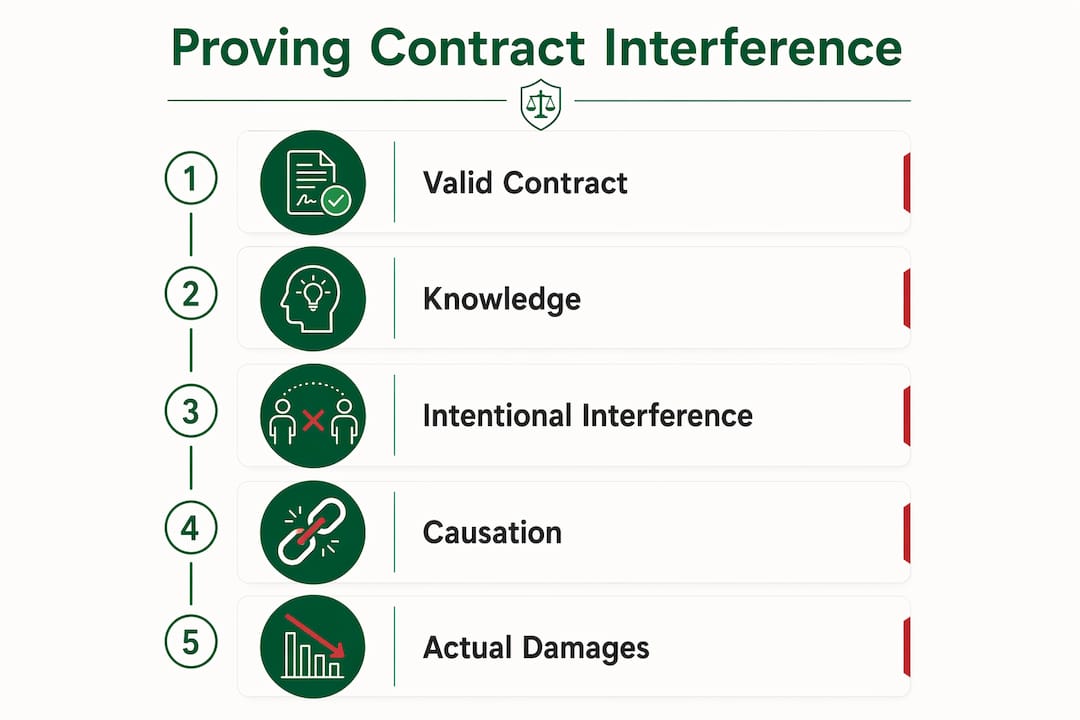
Most U.S. jurisdictions require proof of five core elements:
- Valid contract: An enforceable agreement existed between the plaintiff and a third party.
- Defendant’s knowledge: The defendant knew the contract existed.
- Intentional interference: The defendant deliberately acted to disrupt performance.
- Causation: That conduct caused a breach or made performance significantly harder or more costly.
- Actual damages: The plaintiff suffered real, measurable financial loss as a result.
Unsuccessful interference attempts do not support a claim. Both elements four and five must be satisfied for the lawsuit to survive.
What does interference with a contract require you to prove?
Each element carries its own evidentiary weight, and courts do not treat them as interchangeable. Here is what each one demands in practice.
Valid contract means an enforceable agreement with offer, acceptance, and consideration. It does not have to be written if an oral contract is enforceable under state law, but it must be real and identifiable.
Knowledge does not require the defendant to have read every clause. Courts ask whether the defendant genuinely knew a deal existed. A competitor who claims ignorance after receiving a copy of your signed agreement will not get far.

Intentional interference is where intent standards matter most. The defendant must have acted with the purpose of disrupting performance, or at minimum known disruption was substantially certain to follow. Accidentally causing a breach is not enough. Common examples include bribing a supplier to short-ship an order, threatening a contractor to walk off a job, or feeding false information to a business partner to induce them to cancel.
Causation requires a direct link. If the third party would have breached the contract regardless of the defendant’s conduct, the causation element fails.
Actual damages must be concrete. Courts require proof of lost profits, added costs, or other measurable financial losses. Hurt feelings and reputational speculation do not qualify.
State law introduces variations. California’s jury instructions, for instance, ask whether the defendant’s conduct was a “substantial factor” in causing harm, while some states frame the element as requiring an actual breach rather than just harder performance. At-will contracts add another wrinkle: some courts treat interference with an at-will arrangement more like interference with a prospective relationship, requiring proof of independently wrongful conduct beyond mere persuasion.
Pro Tip: Document every communication with the interfering party as soon as you suspect a problem. Emails, texts, and meeting notes are often the difference between a viable claim and one that gets dismissed for lack of evidence.
How do you tell wrongful interference from normal competition?
Not every act that disrupts a contract crosses the legal line. Courts protect competitive business conduct, and the law draws a clear boundary between aggressive competition and wrongful interference.
Lawful conduct generally includes:
- Offering a better price or terms to lure a customer away
- Hiring a competitor’s employee after their contract expires
- Publicly criticizing a competitor’s product based on accurate facts
- Advising a business partner to reconsider a deal, without deception
Wrongful conduct typically involves an independently unlawful act. The Restatement (Third) of Torts defines liability under three narrow categories: the defendant acted to appropriate the benefits of the plaintiff’s contract, committed an independent and intentional legal wrong, or acted for the sole purpose of injuring the plaintiff. Fraud, bribery, defamation, and threats all qualify. Simply outcompeting someone does not.
The practical test: if the defendant’s conduct would be legal standing alone, it usually does not create tortious interference liability, even if it causes a contract to fall apart. The wrongful conduct requirement is now a recognized element in virtually every U.S. jurisdiction.
What defenses work against a tortious interference claim?
Defendants have real options. The burden of proof rests on the plaintiff throughout, and several defenses can defeat a claim entirely.
- Justification: The defendant had a legitimate business reason for the conduct, such as protecting their own financial interest or advising a party they had a legal duty to advise.
- Privilege: Certain relationships, like a parent company directing a subsidiary, or an attorney advising a client, create a privilege to interfere that courts recognize.
- Lack of intent: If the defendant did not know about the contract or did not intend disruption, the intent element fails.
- No actual harm: A plaintiff who cannot show concrete financial loss cannot recover, regardless of how bad the defendant’s conduct looks.
- Statute of limitations: Tortious interference claims are subject to state-specific filing deadlines, which vary but commonly run two to three years from the date of the interference. Missing that window ends the case.
Knowing which defense fits your situation requires a close look at the facts. Florida businesses facing these claims can find practical guidance on protecting against contract disputes before they escalate.
What remedies can you recover for tortious interference?
A successful plaintiff can pursue several types of relief, and the available remedies differ from what you would recover in a straight breach of contract case.
- Compensatory damages cover lost profits, increased costs of performance, and other direct financial losses caused by the interference.
- Punitive damages are available in some states when the defendant’s conduct was malicious or egregious, though courts set a high bar.
- Injunctive relief can stop ongoing interference before a trial concludes, which matters when the defendant is actively continuing to disrupt the contract.
Courts award only financial damages. Emotional distress and speculative future losses do not qualify. That distinction separates tortious interference recovery from some other tort claims. For a closer look at enforcing your rights and securing remedies, the process of enforcing a business contract follows a similar evidentiary path.
Practical guidance from a South Florida business attorney
Matthew Fornaro has spent over 20 years representing entrepreneurs, startups, and established businesses across South Florida in contract disputes and commercial litigation. His AV®-rated practice focuses on identifying interference early, building the evidentiary record, and resolving disputes before they consume a business.
When you suspect interference, the first practical step is to preserve every communication, contract, and financial record tied to the disrupted relationship. The second is to get legal counsel before confronting the interfering party directly, since that conversation can inadvertently harm your claim.
How does tortious interference with a contract differ from interference with business relations?
These two claims are closely related but target different situations. Tortious interference with a contract applies when a valid, existing agreement is disrupted. Tortious interference with prospective business relations applies when someone sabotages a business opportunity that had not yet become a signed contract.
The key distinction is the proof standard. An existing contract gives you a concrete legal right; courts protect that right more readily. A prospective relationship is an economic expectation, and courts require independent wrongful conduct such as defamation or bribery to succeed, not just aggressive competition. The Third Restatement of Torts treats these as two separate and distinct torts, not variations of the same claim.
The practical consequence: if your signed contract was disrupted, your claim is stronger and easier to prove. If you lost a deal that was still in negotiation, you face a higher bar and need clearer evidence of wrongful conduct.
How do you gather evidence for a tortious interference claim?
Evidence is where most tortious interference cases are won or lost. Concrete proof of financial harm tied directly to the interference is what courts require, and plaintiffs frequently fail for lack of it.
Start with the contract itself and any amendments, side letters, or purchase orders that show the scope of the relationship. Then collect communications showing the defendant knew about the contract: emails referencing the deal, meeting notes, or messages where the defendant discussed your arrangement with the third party.
Next, document the interference act. If a competitor bribed your supplier, bank records or wire transfers may show it. If false statements were made, gather the communications or witness accounts. Finally, build your damages record: invoices showing lost revenue, cost comparisons showing increased expenses, and any written statements from the third party explaining why they breached or stopped performing.
Working with an attorney early in this process helps you manage the legal process around evidence collection, including preserving electronically stored information before it disappears.
Key Takeaways
Tortious interference with a contract requires proving five specific elements, and courts award only measurable financial damages, not speculative or emotional losses.
| Point | Details |
|---|---|
| Five required elements | Prove valid contract, defendant’s knowledge, intentional interference, causation, and actual financial damages. |
| Wrongful conduct threshold | Lawful competition does not qualify; fraud, bribery, or defamation typically must be present. |
| Available remedies | Compensatory damages, injunctive relief, and punitive damages in egregious cases. |
| Contract vs. prospective relations | Existing contracts carry a lower proof burden than disrupted business expectations. |
| Evidence is decisive | Concrete documentation of financial harm is the most common reason claims succeed or fail. |
Recommended
- How to Enforce a Business Contract » Matthew Fornaro, P.A. Coral Springs Parkland Business Law
- Vendor Breach of Contract in Florida: Immediate Steps to Protect Your Business » Matthew Fornaro, P.A.
- Florida Breach of Contract Lawyer: A Strategic Guide for Businesses (2026) » Matthew Fornaro, P.A.
- Contract Dispute Resolution: A Practical 2026 Guide » Matthew Fornaro, P.A. Coral Springs Parkland Business Law


