

Key Takeaways
- Florida business law protects companies from unfair competition, contract breaches, and partner disputes.
- Acting early saves time, money, and business relationships.
- An experienced business attorney helps you assess risk and choose the right legal strategy.
A business contract is a legally binding agreement that creates enforceable rights and obligations between parties, making it the single most important risk management tool a small business owner can use. Without one, you are operating on expectations alone, and expectations do not hold up in court. Whether you are a freelancer in Miami, a startup in Coral Springs, or a service provider in Broward County, understanding why contracts matter for your small business is the difference between protecting your revenue and losing it to a dispute you cannot prove.
Why contracts matter for small business protection
Contracts spell out scope, deliverables, timelines, and payment terms so you can enforce performance and seek compensation if the other party fails to deliver. That is not a formality. That is your legal foundation. Without those details in writing, you face a significantly higher risk of disputes and financial loss rooted in nothing more than unclear expectations.
Think about a graphic designer who completes a full brand identity package for a client who then refuses to pay, claiming the work did not match the “agreed” scope. If no written contract exists, the designer has no documented scope to point to. The client’s version of events carries equal legal weight. Contracts function as a risk management system that reallocates risk and enforces rights. Without one, you only have expectations that are difficult to enforce.

The benefits of contracts for small businesses go beyond just legal protection. They establish a professional framework that signals to clients and partners that you run a serious operation. They also force both parties to think through the details before work begins, which prevents misunderstandings that would otherwise surface mid-project.
Here is what a well-drafted contract protects you from:
- Scope creep that expands your workload without additional compensation
- Late or non-payment by giving you a documented basis for collections or litigation
- Liability exposure when a client claims your work caused them financial harm
- Relationship breakdowns by giving both parties a clear reference point when disagreements arise
Pro Tip: Before signing any agreement, confirm that the contract includes a governing law clause specifying which state’s laws apply. For Florida businesses, this matters significantly if a dispute ever reaches court.
How do contracts protect small businesses from disputes?
The most direct protection a contract provides is legal enforceability. When a party breaches the agreement, you have documented proof of what was promised, when it was due, and what the consequences of non-performance are. That proof is what converts a business disagreement into a winnable legal claim.
Written contracts reduce the risk of “he said, she said” disputes common in verbal agreements and allow upfront negotiation of responsibilities. Verbal agreements are difficult to prove and increase legal uncertainty for small businesses. A contractor who relies on a handshake deal to confirm a $40,000 renovation project has no written record of payment milestones, change order procedures, or completion deadlines. When the homeowner disputes the final invoice, the contractor’s only evidence is their own testimony.
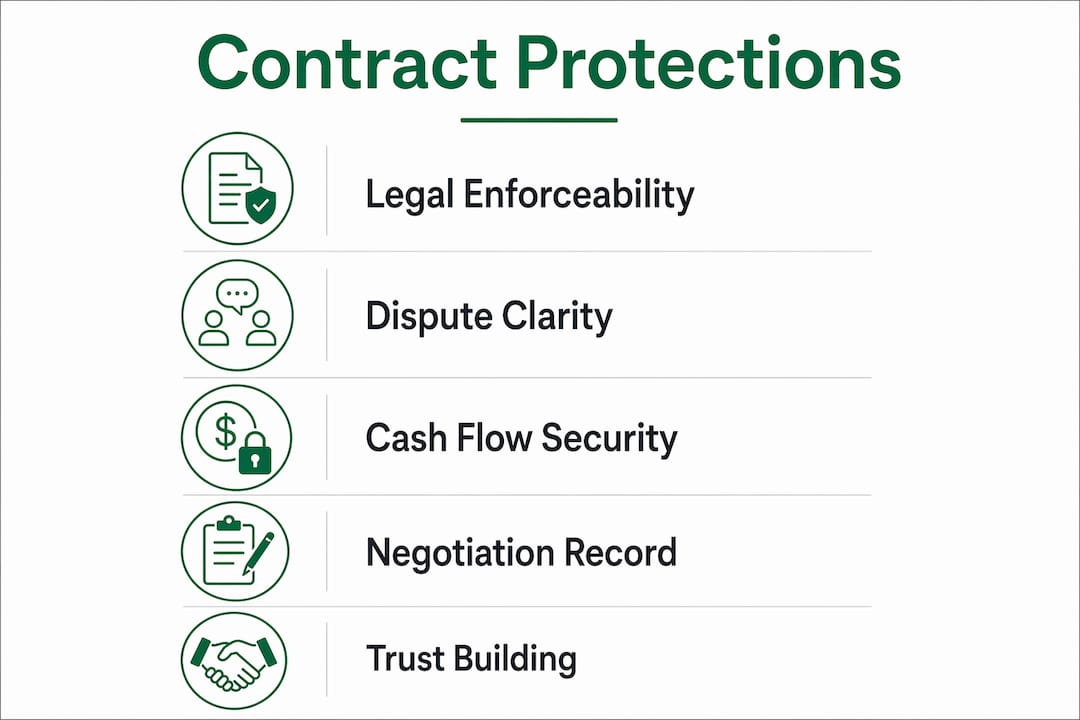
Written contracts also protect cash flow. Contract terms regarding payment timing, reimbursement, and termination often determine whether a small business can maintain cash flow or shifts financial risk unfairly. Improper contract language can wipe out profit margins or expose companies to uncapped liability. A net-90 payment term buried in a client’s standard agreement can cripple a small business that operates on a net-30 cash cycle.
What are the most critical contract clauses to understand?
Not all contract clauses carry equal weight. Some protect you. Some expose you. Knowing the difference is where small business owners most often fall short.
| Clause | What it does | Risk if ignored |
|---|---|---|
| Indemnity | Shifts liability for losses or damages to the responsible party | You absorb costs for problems you did not cause |
| Limitation of liability | Caps the maximum financial exposure for either party | Uncapped liability can exceed the contract’s total value |
| Payment terms | Defines when and how invoices are paid | Late payment or non-payment with no legal recourse |
| Termination rights | Specifies how and when either party can exit the agreement | Locked into a bad deal with no clean exit |
| Dispute resolution | Sets the process for resolving disagreements | Defaults to expensive litigation with no alternatives |
Clarity in contracts reduces litigation triggers by eliminating ambiguity about obligations, timelines, remedies, and jurisdiction. Clear terms lead to approximately 27% fewer litigation triggers according to studies. That number reflects a direct financial benefit: fewer disputes mean lower legal costs and fewer operational interruptions.
One-sided boilerplate clauses, especially about indemnity and termination rights, often expose small businesses to hidden risks and costs. Even standard contracts can shift financial risk disproportionately to the smaller party without careful review. A vendor agreement that looks routine may contain an indemnity clause requiring you to cover the vendor’s legal fees in any dispute, regardless of fault. Fornarolegal has a detailed breakdown of critical contract provisions that Florida businesses must get right to avoid litigation.
Pro Tip: Never treat a “standard” contract as non-negotiable. Every clause is a starting point for discussion, and the party who drafted it wrote it in their own favor.
Why written contracts outperform verbal agreements
Verbal agreements are legally recognized in Florida under certain conditions, but proving their terms in court is a different matter entirely. The moment a dispute arises, a verbal agreement becomes a memory contest. Courts cannot enforce what they cannot verify.
Written agreements are valuable not just as formalities but because they force clarification and reduce uncertainty, making obligations and dispute pathways provable. That process of writing things down catches ambiguities before they become arguments. When you negotiate a written contract, you are forced to answer questions like: What exactly is the deliverable? What happens if the deadline is missed? Who owns the intellectual property?
Beyond legal protection, written contracts build credibility. Contracts reassure clients and improve trust, counteracting fears that contracts “scare off” customers. In practice, the opposite is true. Clients who see a professional, well-drafted agreement are more likely to trust you with larger projects and longer engagements. The hidden legal risks of handshake deals in Florida are well-documented and avoidable with a single written agreement.
Written contracts also give you a negotiation record. If a client later claims they never agreed to a specific term, you have a signed document that says otherwise.
How can small businesses manage contract disputes proactively?
Disputes will happen. The question is whether your contract gives you a structured path to resolve them without spending $50,000 in litigation fees. Modern contracts can include dispute resolution mechanisms that keep disagreements out of court entirely.
Here is a practical dispute escalation structure you can build directly into your contracts:
- Direct negotiation. Require both parties to attempt a good-faith resolution within 15 to 30 days of a dispute arising. Most disagreements resolve at this stage when both parties are required to engage.
- Online dispute resolution (ODR). If direct negotiation fails, ODR provides a cost-effective structured first step to resolve business disagreements before escalating to mediation or litigation. ODR platforms allow parties to submit claims and responses digitally, reducing both cost and time.
- Mediation. A neutral third party facilitates a negotiated settlement. Mediation is non-binding but resolves a high percentage of commercial disputes before trial.
- Arbitration. Binding arbitration produces a final decision without a full court trial. It is faster and less expensive than litigation for most small business disputes.
- Litigation. The last resort. Reserve this for cases where the amount at stake justifies the cost and time.
Including ODR provisions in contracts before a dispute arises gives small businesses control and a proactive path to early resolution. Contractual ODR provisions are a strategic tool to avoid costly litigation and business interruptions. Disputes disproportionately burden small businesses, and building early, structured dispute steps into your contracts reduces legal expenses and operational disruption before a problem ever surfaces.
Key takeaways
Contracts are the legal infrastructure of a small business, and every agreement you sign without reviewing carefully is a risk you are accepting without knowing the terms.
| Point | Details |
|---|---|
| Contracts are legally enforceable | Written agreements give you documented proof to enforce performance and seek compensation for breach. |
| Key clauses determine cash flow | Payment terms, indemnity, and termination rights directly affect your financial exposure and profitability. |
| Written beats verbal every time | Verbal agreements are difficult to prove in court and increase legal uncertainty for small businesses. |
| ODR reduces dispute costs | Building online dispute resolution clauses into contracts gives you a low-cost path before litigation. |
| Boilerplate is not neutral | Standard contract language is often drafted in the other party’s favor and requires careful review before signing. |
What I have learned after 20 years of contract disputes in South Florida
Most small business owners do not lose disputes because they had bad contracts. They lose because they had no contract at all, or they signed one without reading it. I have seen this pattern repeat across industries, from construction subcontractors in Broward County to software developers in Miami. The business owner trusted the relationship, skipped the paperwork, and paid for it later.
The most dangerous assumption in small business is that a good working relationship makes a contract unnecessary. Relationships change. People leave companies. Memories fade. A contract does not signal distrust. It signals that you are a professional who takes the agreement seriously enough to document it.
What I tell every client is this: the time to negotiate a contract is before you start work, not after a dispute arises. Once a problem surfaces, your leverage disappears. The other party has already received your services or your money, and now you are arguing about terms that were never written down.
I also see owners sign contracts without reading the indemnity clause or the limitation of liability section, because those paragraphs look like standard legal language. They are not standard. They are the paragraphs that determine who pays when something goes wrong. Review them every time, or have someone review them for you. The cost of a one-hour contract review is a fraction of what a single dispute will cost you in legal fees, lost time, and damaged relationships.
The contract risk management strategies that protect your business are not complicated. They require attention, not expertise. But when the language gets technical, get help before you sign.
— Matthew
Protect your business before a dispute starts

A contract dispute can cost a small business tens of thousands of dollars in legal fees, lost revenue, and management time. The most effective way to avoid that outcome is to get your contracts right before work begins, not after a problem surfaces. Fornarolegal works with small businesses, startups, and entrepreneurs across South Florida to review, draft, and negotiate contracts that protect your interests and reduce your exposure. With over 20 years of AV-rated, court-tested experience, Matthew Fornaro provides practical legal guidance that keeps your business moving. Start with early legal guidance to prevent disputes before they escalate, or explore contract dispute strategies tailored for Florida businesses.
FAQ
Do small businesses legally need written contracts?
Florida law recognizes verbal contracts in many situations, but written contracts are far easier to enforce because they provide documented proof of terms, scope, and obligations. For any agreement involving significant money or services, a written contract is not optional.
What happens if you operate without a contract?
Without a written contract, you rely on verbal testimony to prove what was agreed, which courts treat as unreliable. Without clear contract terms, businesses face higher risks of disputes and financial loss due to unclear expectations.
Which contract clause causes the most problems for small businesses?
Indemnity clauses and one-sided termination rights are the most common sources of unexpected liability. Boilerplate indemnity language can shift financial risk disproportionately to the smaller party without careful review.
What is online dispute resolution and should I include it in my contracts?
Online dispute resolution (ODR) is a digital process for resolving business disagreements before they escalate to mediation or litigation. Including an ODR clause in your contracts gives you a structured, low-cost path to resolve disputes early and preserve business relationships.
How much does a contract dispute cost a small business?
Costs vary widely, but commercial litigation in Florida routinely runs from $25,000 to well over $100,000 in attorney fees alone, before accounting for lost time and business disruption. Proactive contract review and dispute resolution clauses are the most cost-effective way to avoid those expenses entirely.


