

Key Takeaways
- Florida business law protects companies from unfair competition, contract breaches, and partner disputes.
- Acting early saves time, money, and business relationships.
- An experienced business attorney helps you assess risk and choose the right legal strategy.
Incorporation is defined as the legal process of creating a business entity that is separate from its owners, one that can own assets, sign contracts, and absorb liability in its own name. For startup founders, this distinction is not a formality. It is the foundation for protecting your personal savings, attracting investors, and building a business that can outlast any single founder. The federal corporate income tax rate sits at a flat 21%, which is lower than the top individual rates paid by sole proprietors. That gap alone makes the question of why incorporate your startup worth answering before you sign your first contract.
Why incorporate your startup before anything else
Incorporation provides limited liability protection that legally separates your personal assets from your business’s debts and lawsuits. Without it, a creditor or plaintiff can pursue your savings account, your car, and your home to satisfy a business obligation. That exposure is not theoretical. Sole proprietors and general partners face it every time they sign a contract or hire someone.
The benefits of incorporating go beyond a legal shield. A corporation can issue stock, hold intellectual property, and enter agreements in its own name. These capabilities are prerequisites for hiring employees, raising venture capital, and building a brand that has value independent of you personally. Founders who skip incorporation early often discover the hard way that retroactive fixes are expensive and messy.

The standard industry term for this process is “business incorporation,” and it applies whether you form a C-Corporation, an S-Corporation, or a limited liability company. Each structure carries different rules, but the core principle is the same: a separate legal entity protects you and gives your business room to grow.
What legal protections does incorporation give startup founders?
Limited liability protection means your personal assets stay off the table when your business faces a lawsuit or cannot pay a debt. A creditor can sue the corporation, win a judgment, and collect from corporate assets. Your personal bank account remains untouched, provided you follow the rules.
Those rules matter. Courts can “pierce the corporate veil” and hold founders personally liable when they treat the business like a personal piggy bank. The conditions that trigger this are specific:
- Commingling personal and business funds in the same account
- Failing to hold required board meetings or record minutes
- Signing contracts in your own name instead of the company’s name
- Undercapitalizing the business from the start
Maintaining corporate formalities like separate bank accounts and documented board resolutions is not optional. It is the ongoing price of limited liability. Founders who treat these as bureaucratic nuisances often lose their protection at the worst possible moment.
Pro Tip: Open a dedicated business checking account the same day you file your formation documents. Commingling funds is the single most common reason courts pierce the corporate veil.
How does incorporation benefit startup taxation and financial growth?
The flat 21% corporate tax rate applies to C-Corporations as of 2026. That rate is significantly lower than the top marginal individual income tax rates that sole proprietors pay on business profits. The gap creates a real compounding advantage when you reinvest earnings inside the corporation rather than distributing them.
The double taxation concern that founders often raise is largely a myth for early-stage startups. C-Corps often avoid double taxation entirely because they reinvest profits instead of paying dividends. A startup burning cash to build a product never distributes dividends, so the second layer of tax never triggers. The retained earnings compound at the lower corporate rate, which accelerates growth.
Corporations also access deductions that sole proprietors cannot fully use, including health insurance premiums, retirement plan contributions, and certain business expenses that reduce taxable income at the entity level. The table below compares the core tax positions:
| Tax Factor | Sole Proprietor | C-Corporation |
|---|---|---|
| Federal income tax rate | Individual marginal rate (up to 37%) | Flat 21% |
| Self-employment tax | Yes (15.3% on net earnings) | No (owners pay payroll tax as employees) |
| Retained earnings | Taxed as personal income | Taxed at 21% corporate rate |
| Double taxation risk | None | Low for reinvesting startups |
| Business expense deductions | Limited | Broader access |
Pro Tip: If your startup is not yet profitable, the tax rate difference matters less than the structural benefits. Incorporate for the liability protection and investor readiness, and the tax advantages will compound as you grow.
What corporate structures matter most for startups raising capital?
Most venture-backed startups choose the C-Corporation structure, and most of those incorporate in Delaware. Delaware’s Court of Chancery has over a century of corporate case law, which gives investors and lawyers a predictable legal framework. That predictability reduces friction during due diligence and term sheet negotiations.
The C-Corp structure offers specific advantages that other entities cannot match for fundraising:
- Stock issuance: C-Corps can issue multiple classes of stock, including common shares for founders and preferred shares for investors, with different voting rights and dividend priorities.
- Stock options: Employee stock option plans (ESOPs) require a corporate structure to function properly.
- Venture capital compatibility: Most institutional investors are legally prohibited from investing in pass-through entities like LLCs or S-Corps.
- Perpetual existence: A corporation continues operating through changes in ownership, unlike a sole proprietorship that ends when the owner exits.
The cap table is the document that records who owns what percentage of the company. Think of it as the scoreboard for your startup’s ownership. Investors demand clean cap tables with clear ownership and IP rights before they write a check. A messy ownership history, one with undocumented equity promises or missing IP assignments, signals risk and can kill a deal.
| Structure | Investor Compatibility | Stock Classes | Pass-Through Taxation | Best For |
|---|---|---|---|---|
| C-Corporation | High | Multiple | No | VC-backed startups |
| S-Corporation | Low | One | Yes | Small, profitable businesses |
| LLC | Low to medium | Units only | Yes | Lifestyle businesses |
Choosing the right business structure early prevents a painful conversion later, when investors are waiting and your legal costs are multiplying.
When and how should startup founders incorporate?
Founders should incorporate before signing contracts, hiring employees, or building valuable IP to avoid complex and costly retroactive assignments. The trigger for incorporation is not a revenue milestone or a product launch. It is the first moment your startup takes on real-world obligations.
The practical sequence looks like this:
- Before signing any contract. Every agreement you sign as an individual binds you personally. Once you incorporate, the company signs and bears the obligation.
- Before hiring anyone. Employment relationships create liability. The corporation absorbs that liability, not you.
- Before building IP. Code, designs, and inventions created before incorporation must be formally transferred to the company later. That transfer is costly and prone to errors, and investors will scrutinize it during due diligence.
- Before raising money. Investors write checks to entities, not individuals. You cannot issue equity without a corporate structure.
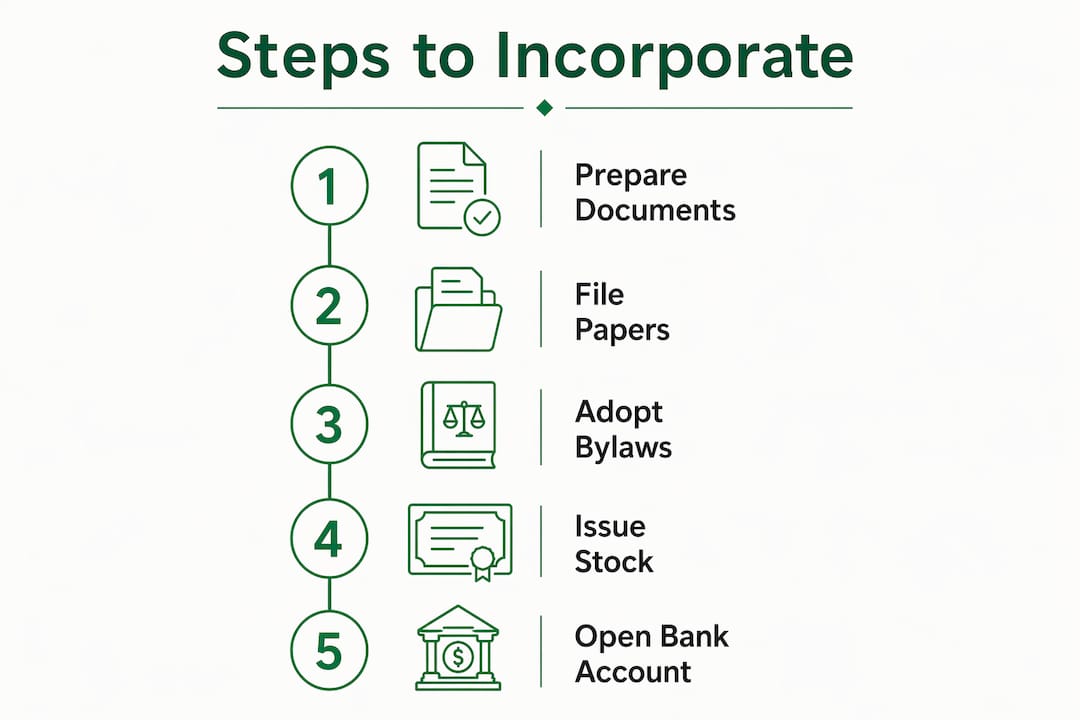
The paperwork that matters at formation includes articles of incorporation, bylaws, an initial board resolution, stock purchase agreements for founders, and IP assignment agreements. Founder vesting is equally critical. A standard four-year vesting schedule with a one-year cliff protects the company if a co-founder leaves early. Without it, a departing founder walks away with a permanent equity stake and no ongoing obligation to the business.
Incorporation creates a clean story of ownership, authority, and IP that makes every subsequent step, from hiring to fundraising, faster and cheaper. Review a startup legal checklist before you file to confirm you have covered every formation step.
Pro Tip: Assign all IP to the corporation on day one using a written IP assignment agreement. Verbal agreements and informal understandings do not hold up in court or investor due diligence.
What ongoing responsibilities come with an incorporated startup?
Incorporation is not a one-time filing. It creates ongoing compliance obligations that founders must meet to keep their liability protections intact. Neglecting annual filings and board resolutions can result in the loss of those protections entirely.
The core ongoing requirements include:
- Annual state filings: Most states require an annual report and a filing fee to keep the corporation in good standing.
- Registered agent: The corporation must maintain a registered agent in its state of formation to receive legal notices.
- Board meetings and minutes: Even a two-person startup must hold annual board meetings and record the decisions made.
- Separate finances: Business income, expenses, and accounts must remain entirely separate from personal finances.
- Tax filings: C-Corps file their own federal and state tax returns, separate from the founders’ personal returns.
The administrative cost of maintaining a corporation is real but modest compared to the protection it provides. Annual state fees typically run from a few hundred dollars to a few thousand, depending on the state. Legal fees for maintaining compliance are far lower than the cost of defending a lawsuit without liability protection. Founders who treat compliance as a background task, handled by a lawyer or a registered agent service, rarely face problems. Those who ignore it entirely often discover the gap at the worst possible time.
Key Takeaways
Incorporation is the single most protective legal step a startup founder can take before the business faces its first real obligation.
| Point | Details |
|---|---|
| Incorporate before obligations arise | Sign contracts, hire, and build IP only after the corporation exists to absorb the liability. |
| Limited liability requires maintenance | Separate accounts, board minutes, and corporate formalities must be kept to preserve the protection. |
| C-Corp is the investor standard | Venture capital requires C-Corp structure for stock classes, options, and legal compatibility. |
| 21% corporate rate beats personal rates | Reinvesting profits inside a C-Corp compounds growth faster than distributing and paying individual rates. |
| Clean cap table signals readiness | Clear ownership and IP records reduce investor risk perception and accelerate due diligence. |
What I’ve learned from watching founders delay incorporation
After more than 20 years working with entrepreneurs in South Florida, the pattern I see most often is this: founders treat incorporation as a reward for validation rather than a tool for execution. They wait until they have customers, or revenue, or a term sheet. By then, the damage is already done.
I have seen co-founders build an entire product on personal laptops, sign vendor agreements in their own names, and bring on early employees with handshake equity deals. When the first investor showed up, the due diligence process turned into a months-long cleanup project. IP had to be formally transferred. Equity promises had to be documented retroactively. Some of those deals fell apart entirely because the investor’s counsel could not get comfortable with the ownership history.
The founders who incorporate early do not spend more money overall. They spend less. The formation cost is a few hundred to a few thousand dollars. The retroactive cleanup, when it happens, costs multiples of that and creates delays that kill momentum. Early incorporation is not about being cautious. It is about being ready.
One thing I tell every founder: the protection of your personal assets is worth more than the time it takes to file. Do it before you need it, because by the time you need it, it is too late to get it retroactively.
— Matthew
Fornarolegal helps South Florida founders get incorporated right
Founders who incorporate without legal guidance often miss the details that matter most: IP assignment agreements, founder vesting schedules, and the corporate formalities that keep liability protection intact. Getting the structure right from day one is far cheaper than fixing it later.

Fornarolegal works with entrepreneurs and startups across South Florida to handle business formation, contract review, and IP protection from the earliest stages. With over 20 years of court-tested experience, Matthew Fornaro provides the kind of early legal guidance that prevents the disputes and ownership problems that derail growing companies. If you are preparing to incorporate or want to confirm your existing structure is sound, Fornarolegal is ready to help you build on a solid legal foundation.
FAQ
What does it mean to incorporate a startup?
Incorporation is the legal process of forming a separate business entity, such as a C-Corporation, that can own assets, sign contracts, and limit the personal liability of its founders.
Should I incorporate my startup before getting customers?
Yes. Founders should incorporate before signing contracts or building IP, not after reaching revenue milestones, because obligations and liability begin the moment you take real-world business actions.
What is the tax rate for an incorporated startup?
The federal corporate income tax rate for C-Corporations is a flat 21% as of 2026, which is lower than the top individual marginal rates that sole proprietors pay on business profits.
Why do investors require a C-Corporation structure?
Most institutional investors cannot legally invest in pass-through entities like LLCs. C-Corps allow multiple stock classes and employee stock option plans, which are standard tools in venture capital financing.
What happens if I skip corporate formalities after incorporating?
Courts can pierce the corporate veil and hold founders personally liable if they commingle funds, skip board meetings, or fail to maintain required records. The liability protection disappears when the formalities are ignored.
Recommended
- Startup Legal Checklist Before Launch » Matthew Fornaro, P.A. Coral Springs Parkland Business Law
- Drafting Founder Agreements for Startups » Matthew Fornaro, P.A. Coral Springs Parkland Business Law
- Should I Incorporate My Small Business in 2026? A Comprehensive Florida Guide
- Startup Legal Mistakes to Avoid: A Guide for Florida Founders in 2026

