

Key Takeaways
- Florida business law protects companies from unfair competition, contract breaches, and partner disputes.
- Acting early saves time, money, and business relationships.
- An experienced business attorney helps you assess risk and choose the right legal strategy.
Table of Contents
- LLC vs Sole Proprietorship in Florida: Which Business Structure Fits You?
- What Is a Sole Proprietorship in Florida?
- What Is a Florida LLC? Key Characteristics Explained
- Key Differences: Benefits of LLC vs Sole Proprietorship in Florida
- Sole Proprietorship Taxes in Florida: What Owners Must Know
- Cost of Starting an LLC in Florida: Full Breakdown
- Florida LLC Formation Requirements: Step-by-Step
- Transitioning from a Sole Proprietorship to an LLC in Florida
- Conclusion: Choosing the Right Business Structure in Coral Springs and South Florida
Last Updated: May 22, 2026
LLC vs Sole Proprietorship in Florida: Which Business Structure Fits You?
Understanding the benefits of llc vs sole proprietorship florida is one of the most consequential decisions a new business owner will make. The choice shapes your personal liability, tax obligations, and long-term growth potential from day one. At Matthew Fornaro, P.A., we have helped hundreds of South Florida entrepreneurs work through exactly this decision, and the wrong choice consistently costs business owners more than they expect. Below, we’ll show you exactly how these two structures differ, what they cost to set up in Florida, and how to transition between them if your situation changes.
Here’s what most guides get wrong: they frame this as a simple "liability vs. simplicity" tradeoff. The reality is more nuanced, especially in Florida, where specific tax filing rules, professional licensing requirements, and annual compliance costs affect the math significantly.
| Feature | Sole Proprietorship | Florida LLC |
|---|---|---|
| Personal liability protection | None | Yes, limited liability protection |
| Formation cost | Low (DBA filing only) | State filing fee required |
| Tax flexibility | Self-employment taxes only | Pass-through or S corp election |
| Compliance requirements | Minimal | Annual report required |
| Separate legal entity | No | Yes |
| Best for | Solo freelancers, low-risk work | Growth-focused, asset-heavy businesses |
What Is a Sole Proprietorship in Florida?
A sole proprietorship is an unincorporated business owned and operated by a single individual where no legal distinction exists between the owner and the business. This is the simplest business structure available in Florida. You start operating under your own name, and the state does not require any formal registration to exist as a sole proprietor.
The tradeoff for that simplicity is total exposure. Business debts, lawsuits, and legal liabilities attach directly to the owner’s personal assets. A client who sues your business is suing you personally.
Many freelancers, consultants, and tradespeople in Coral Springs start this way because the barrier to entry is essentially zero. No formation fees, no operating agreement, no registered agent. You earn income, you report it on Schedule C, and you pay self-employment taxes on net earnings.
How a DBA (Fictitious Name) Works for Sole Proprietors
Sole proprietors who want to operate under a name other than their legal name must register a fictitious name, commonly called a DBA (Doing Business As), with the Florida Department of State Division of Corporations. This does not create a separate legal entity. It simply allows you to use a trade name for marketing and banking purposes.
In Florida, fictitious name registrations are filed through Sunbiz, the state’s online business portal. The registration costs a small filing fee and must be renewed periodically. Failing to register a DBA before using it publicly violates Florida statute and can create complications when opening business bank accounts or entering contracts.
A critical point many sole traders miss: registering a fictitious name provides zero liability protection. You are still personally exposed to every business debt and claim, regardless of what name appears on your invoices.
What Is a Florida LLC? Key Characteristics Explained
A Florida LLC (Limited Liability Company) is a separate legal entity formed under Florida Statutes Chapter 605, the Florida Revised Limited Liability Company Act. The LLC exists independently of its owners, called members. That separation is the foundation of limited liability protection: the company’s debts and legal obligations generally cannot reach the personal assets of its members.
Formation requires filing Articles of Organization with the Florida Department of State through Sunbiz, paying the required state fee, and maintaining ongoing compliance obligations including an annual report.
Florida LLCs offer significant tax flexibility. By default, a single-member LLC is taxed as a disregarded entity (similar to a sole proprietorship), while a multi-member LLC is taxed as a partnership. Members can also elect S corporation or C corporation tax treatment, which can reduce self-employment taxes for profitable businesses.
Single-Member vs Multi-Member LLC in Florida
A single-member LLC has one owner and is the most common structure for solo entrepreneurs making the transition from a sole proprietorship. For federal tax purposes, the IRS treats it as a disregarded entity unless a different election is made.
A multi-member LLC has two or more members and is taxed as a partnership by default. Each member reports their share of profits and losses on their personal tax return. Multi-member LLCs are common for business partners in Coral Springs and throughout Broward County who want shared ownership with liability protection.
Both structures require an operating agreement, which is the internal document governing how the LLC is managed, how profits are distributed, and what happens when a member exits. Florida does not legally require a written operating agreement, but operating without one is a significant risk.
Operating a Florida LLC without a written operating agreement leaves critical decisions, including ownership splits and dissolution procedures, subject to default state rules that may not reflect your actual intentions. Courts have also used missing formalities as grounds for piercing the corporate veil.
Key Differences: Benefits of LLC vs Sole Proprietorship in Florida
The core benefits of llc vs sole proprietorship florida come down to three factors: liability exposure, tax treatment, and compliance costs. Each one affects a different dimension of your business risk.
Liability Protection and Personal Asset Protection
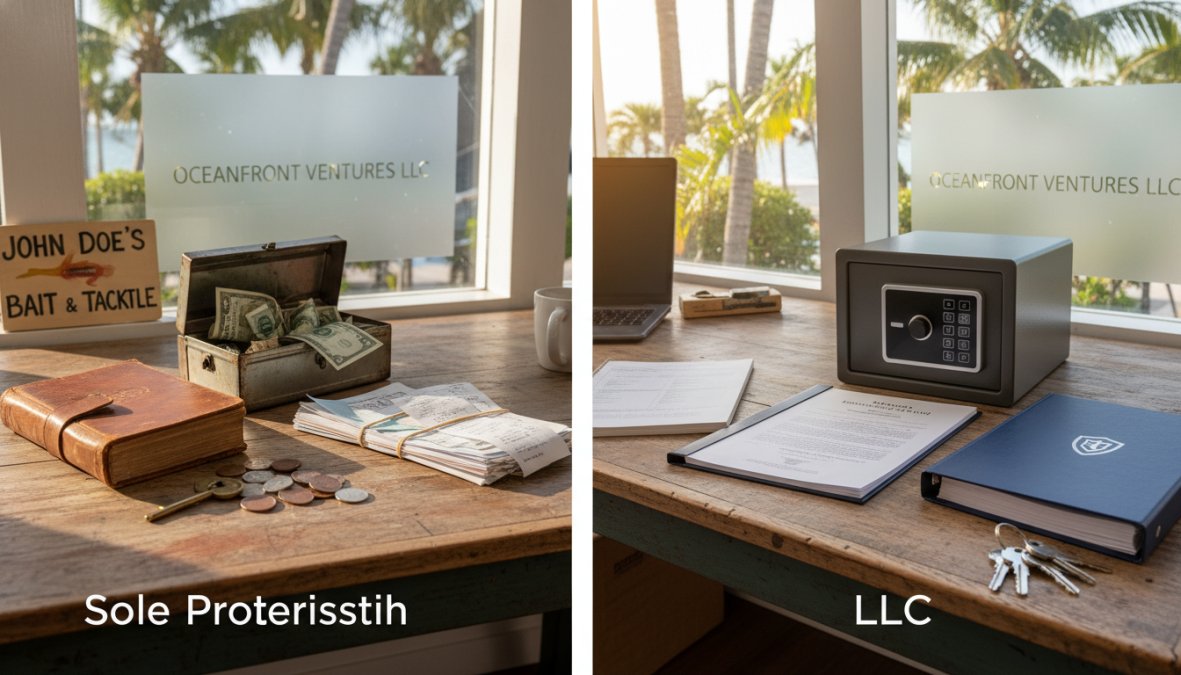
Limited liability protection is the defining advantage of an LLC over a sole proprietorship. As a sole proprietor, your personal bank accounts, home equity, and personal property are all reachable by creditors and plaintiffs. An LLC creates a legal barrier between those assets and business claims.
That protection is not absolute. Courts can pierce the corporate veil when members blur the line between personal and business finances, fail to maintain corporate formalities, or use the LLC to commit fraud. Practical steps to preserve protection include maintaining a separate business bank account, documenting capital contributions, and keeping accurate records.
For business owners in South Florida operating in higher-liability industries, such as construction, healthcare services, or real estate, the asset protection an LLC provides is not optional. It is essential.
Compliance Responsibilities and Corporate Formalities
Sole proprietors face almost no ongoing compliance burden. There is no annual report, no state filing, and no registered agent requirement. This is genuinely attractive for low-revenue, low-risk operations.
Florida LLCs must file an annual report with the Florida Department of State each year between January 1 and May 1. Missing the deadline triggers a late fee, and continued non-compliance can result in administrative dissolution. LLCs must also maintain a registered agent with a physical Florida address, which adds a recurring cost.
The compliance gap between the two structures is real, but for most serious businesses, it is manageable and worth the protection.
Sole Proprietorship Taxes in Florida: What Owners Must Know
Sole proprietorship taxes in Florida follow federal pass-through rules. All business income flows directly to the owner’s personal tax return via Schedule C. The owner pays federal income tax on net profit plus self-employment tax, currently 15.3% on the first tier of net earnings, covering both the employer and employee portions of Social Security and Medicare. For a sole proprietor netting $80,000, that self-employment tax obligation alone exceeds $11,000 before any federal income tax is calculated.
Florida has no state personal income tax, which benefits both sole proprietors and LLC members equally. However, that advantage does not eliminate Florida’s other tax obligations, and this is where most general guides stop short.
Florida-Specific Tax Filing Nuances for Both Structures
This is the area most competing articles treat as a footnote. Florida imposes several tax obligations that interact directly with your business structure choice, and failing to register correctly with the Florida Department of Revenue (FDOR) creates penalties that compound quickly.
Florida Sales and Use Tax Registration
Any sole proprietor or LLC selling taxable tangible personal property, certain digital products, or specific services, including commercial pest control, interior nonresidential cleaning, and certain repair services, must register with the FDOR and collect sales tax at the applicable rate. Registration is completed through the Florida Department of Revenue online registration portal. The business structure does not change this obligation, but the entity name on your registration must match your legal operating name. A sole proprietor using an unregistered DBA who files sales tax returns under that trade name without a proper fictitious name registration on file creates a mismatch the FDOR flags during audits.
Florida Corporate Income Tax, Who Actually Owes It
Florida imposes a corporate income tax on C corporations and on LLCs that have elected C corporation status with the IRS. Single-member LLCs taxed as disregarded entities, multi-member LLCs taxed as partnerships, and LLCs with an S corporation election are all exempt from Florida’s corporate income tax. Sole proprietors are also exempt. This means the most common LLC structures used by small business owners in Florida carry no Florida corporate income tax exposure, a point worth confirming with your CPA because the answer changes the moment you elect C corporation treatment.
Florida Reemployment Tax
If your business has employees, both sole proprietors and LLCs must register with the FDOR for Florida reemployment tax (Florida’s equivalent of state unemployment insurance). Registration is required before the first payroll is run. The structure itself does not change the registration requirement, but how owner-compensation is classified does matter: LLC members who elect S corporation status and pay themselves a W-2 salary are subject to reemployment tax on that salary, while distributions above the salary are not.
Documentary Stamp Tax on Business Transactions
Florida imposes documentary stamp taxes on promissory notes, mortgages, and deeds. LLCs that take on commercial loans, execute promissory notes, or acquire real property will encounter this tax at closing or loan execution. Sole proprietors taking on business debt in their personal name face the same tax. The structure does not eliminate the obligation, but LLCs acquiring real estate or financing equipment should budget for this cost as part of the transaction.
The S Corporation Election: Florida’s Most Underused Tax Strategy
An LLC that elects S corporation status with the IRS can split owner income into two buckets: a reasonable W-2 salary (subject to payroll taxes including self-employment equivalents) and profit distributions (not subject to self-employment tax). For a Florida LLC netting $100,000 annually, paying the owner a reasonable salary of $50,000 and taking the remaining $50,000 as a distribution can eliminate self-employment tax on that distribution portion, a meaningful annual saving that compounds over time.
The IRS requires the salary to be "reasonable" for the services performed. Unreasonably low salaries are a known audit trigger. Most practitioners recommend working with a CPA to document the salary benchmark before making the election. The election is made by filing IRS Form 2553 and must be submitted within the IRS deadline window to take effect for the current tax year.
Florida does not impose a separate state-level S corporation tax, which makes this election more valuable for Florida business owners than for owners in states that tax S corporation income at the entity level.
The S corporation election is irrevocable for five years without IRS consent. It also introduces payroll compliance obligations, quarterly 941 filings, W-2 issuance, and Florida reemployment tax registration, that a simple LLC without employees does not face. The tax savings must be weighed against the added compliance cost and the cost of payroll processing.
According to IRS guidance on S corporation elections, the election must be filed no later than two months and fifteen days after the beginning of the tax year it is to take effect. Missing this window means waiting until the following tax year.
For Florida sole proprietors and LLC owners, the absence of state income tax is a genuine advantage, but it does not eliminate sales tax registration, reemployment tax, or documentary stamp tax obligations. The S corporation election is the highest-leverage tax planning tool available to profitable single-member LLCs in Florida, but it introduces compliance obligations that require professional support to manage correctly.
Cost of Starting an LLC in Florida: Full Breakdown
The cost of starting an LLC in Florida is predictable once you know every component, including the ones most formation guides omit. Below is a complete picture of both the one-time formation costs and the recurring annual costs that determine the true multi-year price of maintaining an LLC versus operating as a sole proprietor.
One-Time Formation Costs
Articles of Organization filing fee: The Florida Department of State currently charges $100 to file Articles of Organization through Sunbiz. This is the mandatory state fee and is non-refundable regardless of whether the filing is accepted or rejected. Confirm the current amount at Florida Division of Corporations fee schedule before filing, as fees are subject to legislative adjustment.
Registered agent designation: If you serve as your own registered agent, the cost is zero at formation. If you use a professional service, most charge an annual fee (discussed in detail below). No separate formation-time fee applies beyond the annual service cost.
Operating agreement: Not filed with the state and not legally required, but essential. A basic attorney-drafted single-member operating agreement from a Florida business attorney typically costs less than a multi-member agreement, which requires more negotiation and drafting around profit splits, buyout provisions, and dispute resolution. Attempting to use a generic online template for a multi-member LLC is a known risk, courts have used poorly drafted or missing operating agreements as a basis for piercing the corporate veil.
EIN (Employer Identification Number): Free to obtain directly from the IRS at IRS EIN application. Required for opening a business bank account, hiring employees, and making the S corporation election. Takes minutes to obtain online.
Fictitious name registration (if applicable): If your LLC will operate under a trade name different from its legal name, a separate fictitious name registration through Sunbiz is required. This carries a small additional filing fee.
By contrast, starting a sole proprietorship in Florida costs nothing unless you register a DBA, which carries a modest fictitious name registration fee. There is no state filing, no registered agent, and no operating agreement.
Recurring Annual Costs: Where the Real Comparison Lives
This is the calculation most formation guides skip entirely, and it is the number that actually determines whether an LLC makes financial sense for your specific situation.
Annual report: Florida LLCs must file an annual report with the Florida Department of State each year between January 1 and May 1. The current filing fee for the annual report is $138.75. Filing after May 1 triggers a late fee that significantly increases the total cost. Sole proprietors have no equivalent state filing requirement.
Registered agent service: If you use a professional registered agent rather than serving as your own, expect an annual fee. Most national registered agent services charge in the range of $49 to $299 per year depending on the provider and service tier. Northwest Registered Agent and Bizee (formerly Incfile) are among the commonly used options; both offer Florida registered agent service and use their own address on public Sunbiz filings, which protects your personal address from appearing in the public record.
Payroll and accounting complexity (if S corp election is made): An LLC that elects S corporation status must run payroll for the owner-member, file quarterly IRS Form 941, issue a W-2 at year-end, and register for Florida reemployment tax. Most business owners in this situation engage a payroll service or CPA for ongoing support. This is a real recurring cost that sole proprietors and simple LLCs without the S corp election do not face.
True Three-Year Cost Comparison
To make this concrete, here is a realistic cost comparison for a solo service business in Florida over three years:
| Cost Item | Sole Proprietorship | Florida Single-Member LLC |
|---|---|---|
| Formation (Year 1) | $0-$50 (DBA only) | ~$100 state fee + registered agent + operating agreement |
| Annual report (Years 2-3) | $0 | ~$138.75 per year |
| Registered agent (Years 1-3) | $0 | $49-$299 per year if using a service |
| Accounting complexity | Schedule C only | Schedule C (or payroll if S corp elected) |
| Estimated 3-year overhead | Under $150 | $500-$1,200+ depending on service choices |
The gap is real but manageable. For a business generating meaningful revenue with any client-facing liability exposure, the cost of a single lawsuit that reaches personal assets dwarfs the three-year compliance cost of an LLC by orders of magnitude.
Cost-Benefit Analysis of Registered Agent Services
Every Florida LLC must designate a registered agent, a person or company with a physical Florida street address who accepts legal documents, state notices, and service of process on behalf of the LLC during normal business hours. This is a statutory requirement under Florida Statutes Chapter 605, not optional.
You have three realistic options, each with a different cost-benefit profile:
Option 1: Serve as your own registered agent. The annual cost is zero. The tradeoffs are significant: your personal address becomes part of the permanent public record on Sunbiz, you must be physically present at that address during business hours to accept service of process, and if you miss a legal notice while traveling or working remotely, the consequences can include a default judgment entered against your LLC before you are aware a lawsuit was filed.
Option 2: Use a national formation or registered agent service. Services like Northwest Registered Agent and Bizee offer Florida registered agent service at flat annual rates. The primary advantages are privacy (their address appears on Sunbiz instead of yours), reliability (they are staffed during business hours), and immediate forwarding of legal documents. For home-based business owners in Coral Springs and throughout Broward County, the privacy benefit alone is worth the annual fee, your home address appearing in a searchable public database is permanent and cannot be retroactively removed.
Option 3: Use a local Florida business attorney as registered agent. This option provides registered agent service alongside immediate legal triage when documents are received. When a lawsuit is served on your registered agent, the difference between a law firm that can begin responding immediately and a national service that scans and emails you a PDF can be measured in days, and in litigation, days matter. The annual cost is typically higher than a national service but includes the value of that legal relationship.
Home-based business owners in Coral Springs should treat the registered agent decision as a privacy decision first and a cost decision second. Once your home address is published on Sunbiz, it is part of the permanent public record and will appear in third-party business databases that aggregate state filing data. Using a professional registered agent from day one prevents this exposure entirely.
The hidden cost most owners discover too late: missing a legal notice because you were traveling, changed addresses, or were simply not at your registered address during business hours. A default judgment entered against your LLC while you were unaware a suit had been filed is a recoverable situation, but only with significant legal expense and delay. The annual cost of a reliable registered agent service is insurance against exactly this scenario.
Florida LLC Formation Requirements: Step-by-Step
Forming a Florida LLC is a defined process with no shortcuts. Here is the sequence:
- Choose a unique business name. Search the Sunbiz name database to confirm availability. The name must include "LLC," "L.L.C.," or "Limited Liability Company."
- Designate a registered agent. The agent must have a physical Florida street address and consent to the appointment in writing.
- File Articles of Organization. Submit online through Sunbiz or by mail to the Florida Division of Corporations. Include the LLC name, principal office address, registered agent information, and management structure (member-managed or manager-managed).
- Draft an operating agreement. Not filed with the state, but essential for internal governance and bank account opening.
- Obtain an EIN. Apply directly through the IRS website at no cost.
- Open a business bank account. Requires your EIN, Articles of Organization, and operating agreement.
- Register for applicable taxes. If selling taxable goods or services, register with the Florida Department of Revenue.
- File annual reports. Beginning the year after formation, file annually between January 1 and May 1 to maintain active status.
Processing times through Sunbiz vary. Online filings are generally processed faster than mail submissions.
Transitioning from a Sole Proprietorship to an LLC in Florida
Transitioning from a sole proprietorship to an LLC is one of the most common moves business owners in Coral Springs and South Florida make as their revenue grows. The process is straightforward, but several details require careful attention.
The core steps are:
- Form the LLC through Sunbiz following the formation steps above.
- Obtain a new EIN for the LLC (your sole proprietorship EIN cannot transfer).
- Open a new business bank account in the LLC’s name.
- Transfer business assets, contracts, and client agreements into the LLC’s name.
- Notify clients, vendors, and service providers of the new legal entity.
- Update business licenses and permits to reflect the LLC.

The most overlooked step is contract novation. Existing contracts signed in your personal name do not automatically transfer to the LLC. Each contract technically requires the other party’s consent to assign it to a new legal entity. In practice, many small business owners simply update their invoicing and notify clients going forward, but for significant contracts, formal novation or re-execution is the right approach.
Impact on Florida Professional Licensing When You Switch Structures
This is the angle most guides completely skip, and it matters significantly for professionals in Florida.
Florida licenses many professions at the individual level, not the business entity level. Doctors, attorneys, engineers, contractors, and real estate agents hold licenses personally. Forming an LLC does not transfer your license to the entity.
However, certain professions require a separate entity license or permit to operate through a business structure. General contractors in Florida, for example, must qualify their LLC separately with the Florida Department of Business and Professional Regulation (DBPR). According to Florida DBPR licensing information, failing to properly qualify a business entity can result in license suspension or disciplinary action.
The practical implication: before transitioning from a sole proprietorship to an LLC, verify with the relevant licensing board whether your specific license requires re-registration or entity qualification. This step can take weeks and should happen before, not after, you complete the LLC formation.
Professional licensing and LLC formation are separate processes in Florida. Forming an LLC does not automatically transfer or satisfy professional license requirements. Check with the DBPR or your licensing board before completing your transition.
Conclusion: Choosing the Right Business Structure in Coral Springs and South Florida
For most serious business owners in Coral Springs and throughout South Florida, the benefits of llc vs sole proprietorship florida favor the LLC once the business carries any meaningful revenue, employees, or client-facing risk. The limited liability protection alone justifies the formation and compliance costs for the vast majority of operations. Sole proprietorships make sense for truly low-risk, low-revenue activities where simplicity is the priority and personal exposure is minimal.
The decision becomes more complex when professional licensing, existing contracts, and tax planning enter the picture. That is where qualified legal guidance pays for itself.
Choosing the wrong business structure in Florida can expose personal assets, trigger unexpected tax liabilities, and complicate professional licensing in ways that take years to untangle. Matthew Fornaro, P.A. has over two decades of experience helping South Florida entrepreneurs navigate business formation, structure transitions, and commercial contracts with practical, results-oriented counsel. The firm provides comprehensive support across business formation, litigation, and transactions, with deep local knowledge of Coral Springs, Parkland, and Broward County. Call Matthew Fornaro, P.A. today to get your business structure right from the start.
Frequently Asked Questions
Is an LLC better than a sole proprietorship in Florida?
For most Florida business owners, an LLC offers significant advantages over a sole proprietorship, primarily because it creates a separate legal entity that provides limited liability protection for your personal assets. A sole proprietorship offers no such separation, you are personally responsible for all business debts and legal claims. The right choice depends on your risk tolerance, revenue level, and long-term growth plans. Consulting a Florida business attorney can help you evaluate which structure fits your situation.
What are the tax differences between an LLC and a sole proprietorship in Florida?
Both structures are treated as pass-through entities by default, meaning business income flows to your personal tax return and you pay self-employment taxes on net earnings. However, a Florida LLC has additional flexibility: it can elect S corporation or C corporation tax treatment, which may reduce self-employment tax liability at higher income levels. Florida also has no state personal income tax, which benefits both structures, but LLCs must file an annual report with the Florida Department of State through Sunbiz and pay the associated fee.
How much does it cost to start an LLC in Florida?
The core cost of starting an LLC in Florida includes a $125 Articles of Organization filing fee paid to the Florida Department of State through Sunbiz. After formation, LLCs must file an annual report, which costs $138.75 per year. You will also need a registered agent, which can cost anywhere from $0 if you serve as your own agent to $39-$150 per year for a professional service. Optional but recommended costs include drafting an operating agreement and obtaining an EIN, which is free through the IRS.
Can a sole proprietorship be converted to an LLC in Florida?
Yes, Florida allows sole proprietors to transition to an LLC. The process involves filing Articles of Organization with the Florida Department of State, obtaining a new EIN from the IRS, opening a dedicated business bank account, and updating any existing contracts, licenses, and permits under the new legal entity. If you operate under a DBA or fictitious name, you will need to re-register that name under the LLC. Florida professional license holders should also verify with their licensing board whether the license must be reissued under the new entity.
Do I need a business license for a sole proprietorship in Florida?
Florida does not issue a single statewide general business license, but most sole proprietors will need local business tax receipts from their county or city, including Broward County municipalities like Coral Springs. Depending on your industry, you may also need state-level professional or occupational licenses. If you operate under a name other than your legal name, you must register a fictitious name (DBA) with the Florida Department of State. Failure to comply can result in fines or inability to enforce contracts.
What Florida LLC formation requirements do I need to meet?
To form an LLC in Florida, you must file Articles of Organization with the Florida Department of State via Sunbiz, designate a registered agent with a Florida street address, and pay the $125 filing fee. While not legally required, drafting an operating agreement is strongly recommended to define member roles, capital contributions, and profit-sharing. After formation, you must file an annual report each year between January 1 and May 1 to maintain good standing and avoid a $400 late fee.
This article was written using GrandRanker


