

Key Takeaways
- Florida business law protects companies from unfair competition, contract breaches, and partner disputes.
- Acting early saves time, money, and business relationships.
- An experienced business attorney helps you assess risk and choose the right legal strategy.
A breach of contract is defined as one party’s failure to fulfill a contractual obligation without a lawful excuse. For South Florida business owners, this failure can trigger financial losses, damaged relationships, and costly litigation. Proving a breach requires four cumulative elements: a valid contract, your own performance, the other party’s failure, and measurable financial harm. Miss any one of those four, and the claim fails regardless of how clear the violation appears. Understanding the breach of contract definition before a dispute arises is the difference between recovering your losses and absorbing them.
What are the essential legal elements to prove a breach of contract?
Four elements must all be proven for a contract breach claim to succeed in court. Courts treat these as cumulative, meaning a strong showing on three elements does not save a weak fourth. South Florida business owners who understand this structure can build stronger contracts and better document their performance from day one.
The four elements are:
- Valid, enforceable contract. The agreement must meet basic contract law requirements: offer, acceptance, consideration, and mutual assent. An unsigned email chain may not qualify.
- Your own performance. The plaintiff must show they fulfilled their own duties under the agreement. A contractor who never delivered the first phase cannot sue for the client’s failure to pay the second.
- The other party’s failure to perform. The defendant must have failed to meet a specific contractual obligation. Vague dissatisfaction is not a breach.
- Actual financial harm. Courts require proof of measurable damages. A technical violation with zero financial impact rarely survives a motion to dismiss.
Plaintiffs bear the entire burden of proof, making detailed, contemporaneous business records vital for success. That means saving emails, invoices, delivery confirmations, and meeting notes from the moment a contract is signed.
Pro Tip: Date-stamp every communication related to contract performance. Courts weigh contemporaneous records far more heavily than reconstructed timelines.

What are the types of breach of contract and how do they differ?
Contract breaches classify into four primary types: material, minor, anticipatory, and actual. Each carries different legal consequences and remedies. Knowing which type you are facing shapes every decision you make after the breach occurs.
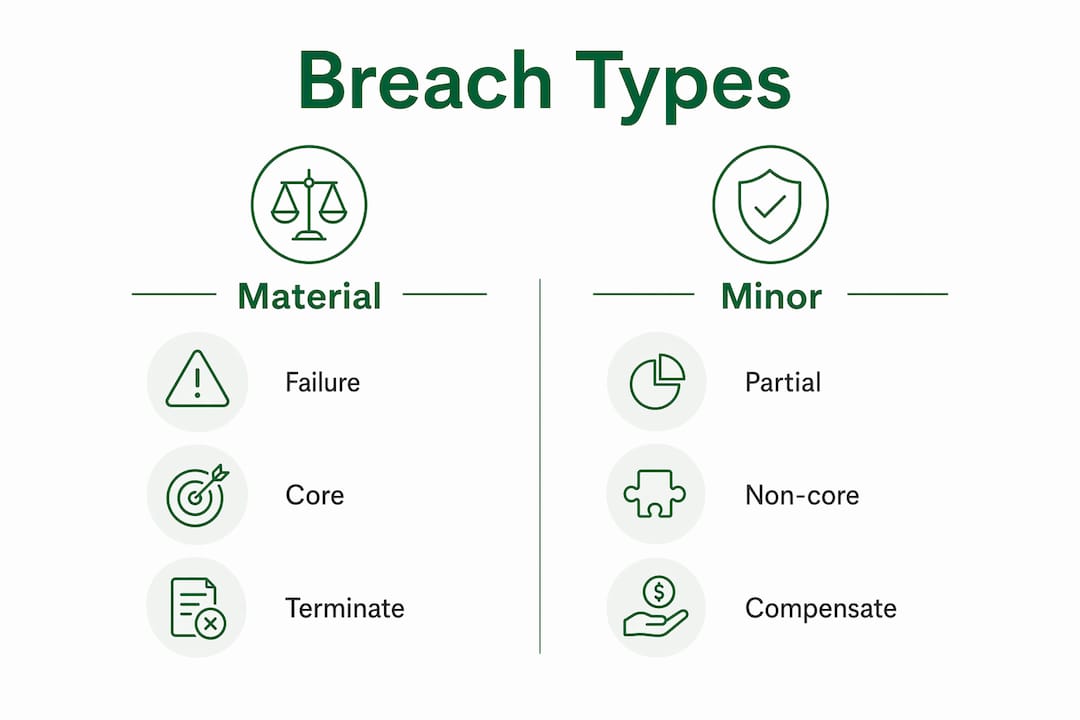
| Type | Definition | Example | Primary Remedy |
|---|---|---|---|
| Material breach | Failure that defeats the contract’s core purpose | Vendor delivers no product at all | Termination and full damages |
| Minor breach | Slight deviation that does not destroy the contract’s value | Delivery arrives two days late with no “time is of the essence” clause | Damages only; contract continues |
| Anticipatory breach | Party announces in advance they will not perform | Contractor emails that they are walking off the job next week | Early termination and immediate damages claim |
| Actual breach | Non-performance at the time performance was due | Payment not made on the due date | Damages, specific performance, or rescission |
Distinguishing material from minor breaches depends on contract wording and facts. A “time is of the essence” clause converts a late delivery from a minor inconvenience into a material breach. That single phrase can change whether you can terminate the contract outright or only sue for limited damages.
Anticipatory breach is a strategic risk management opportunity. When a vendor tells you they cannot perform, you do not have to wait for the deadline to pass. You can terminate the agreement immediately and begin pursuing damages, which limits your exposure and lets you find a replacement faster.
Pro Tip: Include “time is of the essence” language in any contract where deadlines are critical to your business operations. Without it, a court may treat a missed deadline as only a minor breach.
What are common examples and causes of contract breaches in business?
Common breach scenarios include failure to pay, late delivery, substandard goods or services, incomplete work, and misrepresentation. South Florida businesses face these patterns across industries from construction and real estate to professional services and retail supply chains. Recognizing the pattern early gives you time to respond before losses compound.
Typical breach examples business owners encounter:
- A client receives your completed work but refuses to issue final payment.
- A supplier delivers materials that fail to meet the quality specifications written into the purchase order.
- A service provider completes only part of the contracted scope and stops responding.
- A business partner misrepresents their licensing credentials when signing a joint venture agreement.
- A tenant vacates a commercial space months before the lease term ends.
The causes behind these breaches are often predictable. Vague contract language creates room for parties to interpret obligations differently. Poor internal communication means one team member commits to a deadline another cannot meet. Cash flow problems push vendors to prioritize other clients. Operational failures like staffing shortages or supply chain disruptions lead to non-performance that was never intended.
The most preventable breaches trace back to contracts that were never reviewed by legal counsel. A commercial contract review before signing catches ambiguous terms, missing deadlines, and unenforceable clauses before they become disputes. Spending a few hundred dollars on a review routinely saves tens of thousands in litigation costs.
What are the legal and financial consequences of a breach of contract for businesses?
The financial consequences of a contract breach fall into several distinct damage categories. Understanding each one helps you calculate your actual exposure and present a credible claim.
- Compensatory damages. These cover the direct financial loss caused by the breach, including lost profits and the cost to obtain substitute performance.
- Reliance damages. These reimburse expenses you incurred in preparation for performance, such as materials purchased or staff hired in anticipation of the contract.
- Restitution damages. These prevent the breaching party from being unjustly enriched by returning any benefit they received from you.
- Incidental damages. Incidental damages cover out-of-pocket expenses like return shipping and inspection fees, which are easier to prove than consequential damages.
“Courts don’t punish breaching parties. They focus on expectation damages to restore the non-breaching party to the financial position they would have occupied had the contract been performed.” — LegalClarity
Punitive damages in contract cases are rare. This surprises many business owners who expect courts to penalize bad actors. The legal system’s goal is to make you whole, not to punish the other side.
The duty to mitigate damages requires the non-breaching party to take reasonable steps to limit losses. If you sit on a breach for months without finding a replacement vendor, a court may reduce your recovery. Document every step you take to minimize the financial impact.
Timing also matters. Statutes of limitations for breach claims vary by state, with some states imposing six-year limits. Florida has its own deadlines depending on whether the contract is written or oral. Waiting too long to act can bar your claim entirely, regardless of how strong the underlying facts are. Consult a Florida breach of contract lawyer promptly after a breach occurs to protect your filing rights.
How can South Florida business owners manage and respond effectively to breaches?
The first 48 hours after you identify a breach are the most consequential. Acting quickly preserves your legal rights, limits your financial exposure, and creates a clear record of your response.
Practical steps to take immediately:
- Document the breach in writing. Send a formal notice to the other party identifying the specific obligation they failed to meet and the date of the failure.
- Preserve all communications. Do not delete emails, texts, or voicemails related to the contract or the breach.
- Calculate your losses. Identify direct costs, lost revenue, and expenses you have incurred as a result of the non-performance.
- Take steps to mitigate. Find a replacement vendor or service provider and document those efforts. Courts expect you to act reasonably to limit your losses.
- Explore resolution options. Mediation and arbitration often resolve disputes faster and at lower cost than litigation. Many Florida commercial contracts include mandatory dispute resolution clauses.
Vendor breach situations require immediate protective steps to prevent operational disruption. If a key supplier stops performing, your ability to serve your own clients may be at risk. Treat vendor breaches as operational emergencies, not just legal problems.
Consulting experienced legal counsel early changes outcomes. An attorney can assess whether the breach is material or minor, advise on your mitigation obligations, and determine whether litigation, mediation, or a negotiated settlement best serves your business goals.
Pro Tip: Before sending a demand letter, have an attorney review it. Poorly worded demand letters can inadvertently waive rights or create new legal exposure.
Key Takeaways
A breach of contract requires proof of all four legal elements, and missing even one causes the claim to fail regardless of how clear the violation appears.
| Point | Details |
|---|---|
| Four elements are required | Prove a valid contract, your performance, the other party’s failure, and actual financial harm. |
| Breach type determines your remedy | Material breaches allow termination; minor breaches allow damages only; anticipatory breaches allow early action. |
| Courts make you whole, not rich | Damages restore your financial position; punitive damages in contract cases are rare. |
| Mitigation is mandatory | Document every step you take to limit losses or risk reduced recovery in court. |
| Timing controls your rights | Florida’s statute of limitations can bar your claim if you wait too long to act. |
What I’ve learned after 20 years of contract disputes in South Florida
Most business owners I work with come to me after a breach has already cost them money. That pattern is not inevitable. The businesses that fare best in contract disputes are the ones that treated their contracts as living documents, not filing cabinet items.
The most common misunderstanding I encounter is the belief that a clear breach automatically produces a clear recovery. It does not. I have seen clients with undeniable violations lose significant portions of their damages because they failed to mitigate, or because their own performance was imperfect in ways they had not considered. The four-element requirement is unforgiving.
Anticipatory breach is the most underused tool in a business owner’s legal arsenal. When a vendor or partner signals they will not perform, many owners wait and hope the situation resolves. That waiting period costs them money and weakens their legal position. Acting on an anticipatory breach the moment it is clear is almost always the right call.
The other pattern I see repeatedly is poor documentation. Business owners who kept detailed records of their performance, their communications, and their mitigation efforts consistently recover more than those who did not. Courts respond to evidence. A well-organized file of emails, invoices, and correspondence is worth more in litigation than almost any legal argument.
My advice: treat every contract as if it will eventually be disputed. Draft it carefully, perform your obligations precisely, document everything, and get legal counsel involved before a problem becomes a lawsuit. Reducing contract risk before disputes arise is always cheaper than resolving them after the fact.
— Matthew
Fornarolegal helps South Florida businesses protect their contracts
Contract disputes can disrupt your operations, drain your cash flow, and consume time you need to run your business. Fornarolegal works with entrepreneurs and business owners across South Florida to resolve those disputes efficiently and protect the agreements that keep your business running.

Whether you are facing a vendor who stopped performing, a client who refuses to pay, or a partner who walked away from a deal, Fornarolegal provides court-tested representation backed by over 20 years of experience. Start with a clear picture of your litigation readiness before a dispute escalates into a lawsuit. When you are ready to talk through your situation, Fornarolegal is here to help you protect what you have built.
FAQ
What is breach of contract in simple terms?
A breach of contract occurs when one party fails to fulfill a contractual obligation without a valid legal excuse. The non-breaching party is then entitled to seek legal remedies, including financial damages.
What are the four elements needed to prove a contract breach?
You must prove a valid contract existed, that you performed your own obligations, that the other party failed to perform, and that you suffered measurable financial harm as a result.
What is the difference between a material and a minor breach?
A material breach defeats the core purpose of the contract and allows the non-breaching party to terminate the agreement. A minor breach involves a small deviation that does not destroy the contract’s value, limiting the remedy to damages only.
What happens after a breach of contract is identified?
The non-breaching party should document the breach, notify the other party in writing, take steps to mitigate losses, and consult legal counsel promptly to preserve their rights and evaluate remedies.
How long do you have to file a breach of contract claim in Florida?
Florida imposes different statutes of limitations depending on whether the contract is written or oral. Waiting too long can permanently bar your claim, so consulting an attorney as soon as a breach occurs is the safest course of action.
Recommended
- Defending Against a Breach of Contract Claim: A Strategic Guide for Florida Businesses
- Florida Breach of Contract Lawyer: A Strategic Guide for Businesses (2026) » Matthew Fornaro, P.A.
- South Florida Lawyer for Contract Disputes: Protecting Your Business in 2026 » Matthew Fornaro, P.A.
- Vendor Breach of Contract in Florida: Immediate Steps to Protect Your Business » Matthew Fornaro, P.A.


