

Key Takeaways
- Florida business law protects companies from unfair competition, contract breaches, and partner disputes.
- Acting early saves time, money, and business relationships.
- An experienced business attorney helps you assess risk and choose the right legal strategy.
Attorney fee shifting is a legal rule that requires the losing party in a lawsuit to pay the winning party’s attorney fees. This overrides the standard American Rule, where each party pays their own legal costs regardless of outcome. For South Florida business owners, understanding what is attorney fee shifting is not optional. Fee-shifting clauses appear in commercial leases, service agreements, and loan documents across Miami-Dade, Broward, and Palm Beach counties. Knowing when this rule applies can change how you negotiate contracts, budget for disputes, and decide whether to settle or fight.
What is attorney fee shifting and how does it work?
Attorney fee shifting is the exception to the American Rule, not the norm. The American Rule is the default in U.S. litigation. Under it, you pay your own attorney regardless of whether you win or lose. Fee shifting flips that default when a specific legal trigger exists.
Three main triggers activate fee shifting:
- Statutory fee shifting: A federal or state law explicitly authorizes the court to award fees. Civil rights statutes, consumer protection laws, and employment statutes are common examples.
- Contractual fee shifting: A clause in your contract requires the losing party to pay the winner’s attorney fees. These appear frequently in commercial leases, vendor agreements, and loan documents.
- Court-imposed sanctions: A judge can order a party to pay fees as a penalty for bad-faith conduct, frivolous claims, or discovery abuse under rules like Federal Rule of Civil Procedure 11.
One distinction matters here. Court costs and attorney fees are not the same thing. Court costs include filing fees and expert witness fees. They are often automatically recoverable by the prevailing party. Attorney fees require a specific statutory or contractual basis. Confusing the two leads to budget surprises.
Pro Tip: Judges do not write blank checks for attorney fees. Courts scrutinize fee requests and cut hours that appear duplicative, excessive, or unrelated to the core dispute. Build that reality into your litigation budget from day one.
What are statutory fee-shifting provisions and how do they affect business disputes?
Statutory fee shifting is the most powerful form of fee recovery in litigation. Over 200 federal and state statutes override the American Rule to mandate fee awards in areas including civil rights, consumer protection, and employment law. That number reflects how broadly Congress and state legislatures have used fee shifting as a policy tool.
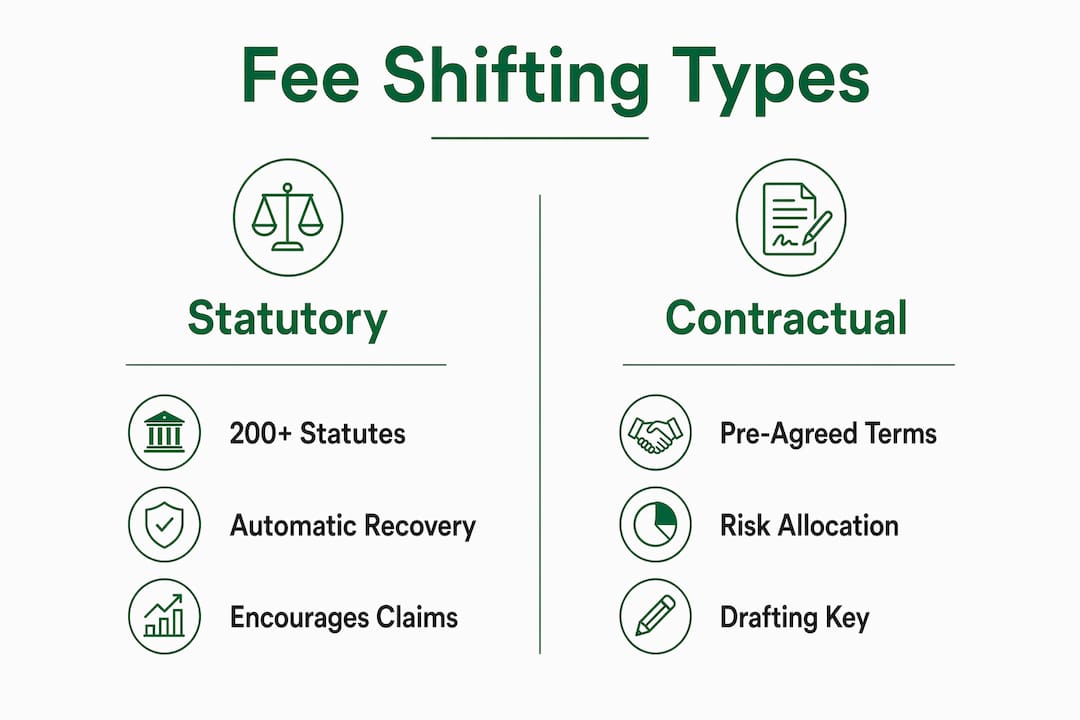
The logic is straightforward. Without fee shifting, a plaintiff with a valid $15,000 discrimination claim cannot afford to hire an attorney when legal fees could reach $50,000. Statutory fee shifting removes that barrier. It lets smaller claimants enforce their legal rights without absorbing the full cost of litigation.
The rules are not symmetric between plaintiffs and defendants. Statutory fee-shifting awards generally favor plaintiffs. A plaintiff who wins can typically recover fees. A defendant who wins faces a much higher bar. Under the Christiansburg standard, a defendant must prove the plaintiff’s claim was frivolous, unreasonable, or without foundation to recover fees. Courts apply that standard strictly.
For South Florida business owners, this asymmetry has real consequences:
- A former employee who files a weak wage claim still puts you at risk of paying their fees if you lose on any part of the case.
- A consumer protection claim under Florida’s Deceptive and Unfair Trade Practices Act can trigger fee shifting even in disputes over relatively small amounts.
- Employment and civil rights statutes at the federal level, including Title VII and the Americans with Disabilities Act, carry fee-shifting provisions that apply in every Florida federal court.
Understanding which statutes govern your industry is not a legal formality. It directly determines your financial exposure in any dispute.
How do contractual fee-shifting clauses work in South Florida?
Contractual fee shifting gives parties the ability to allocate attorney fee risk before a dispute ever arises. These clauses are common in South Florida commercial contracts, including commercial leases, franchise agreements, construction contracts, and loan documents. The clause typically reads that the prevailing party is entitled to recover reasonable attorney fees and costs.

The practical effect depends heavily on how the clause is drafted. A one-sided clause that only benefits the landlord or lender sounds unfair, and Florida law addresses that directly. Florida reciprocity statutes convert one-sided fee-shifting clauses into mutual obligations. If the contract gives one party the right to recover fees, Florida law extends that right to both parties. That is a significant protection for business owners who sign contracts drafted by larger counterparties.
Enforceability is not guaranteed. Federal courts and Florida courts enforce contractual fee-shifting clauses when they are clear, but refuse enforcement when clauses conflict with federal law or public policy. The Eleventh Circuit, which covers Florida federal courts, scrutinizes these clauses carefully.
Here are the key considerations when reviewing or negotiating a fee-shifting clause:
- Define “prevailing party” explicitly. Courts define the prevailing party as the side that wins on the central issues, not every minor claim. Ambiguous language leads to post-trial disputes over who actually prevailed.
- Include a fee cap. An uncapped fee-shifting clause in a $50,000 contract dispute can result in a $200,000 fee award. Caps protect both sides from disproportionate outcomes.
- Check for reciprocity. If the clause only benefits the other party, Florida’s reciprocity statute likely makes it mutual. Confirm this with counsel before signing.
- Review scope carefully. Some clauses cover only breach of contract claims. Others extend to all disputes arising from the agreement. Scope determines your exposure.
| Clause Type | Effect in Florida |
|---|---|
| One-sided (favors one party only) | Florida reciprocity statute makes it mutual |
| Reciprocal (both parties covered) | Enforceable as written if clear and specific |
| Ambiguous prevailing party definition | Risk of post-dispute “mini-trial” over who won |
| Uncapped fee recovery | Potential for disproportionate fee awards |
Pro Tip: Ambiguous fee-shifting clauses create a second lawsuit inside your lawsuit. Explicit language and fee caps prevent costly post-dispute arguments over who prevailed and what fees are reasonable.
What practical impacts does fee shifting have on South Florida business owners?
Fee shifting changes the math on every business dispute. When your contract or the governing statute includes a fee-shifting provision, losing is not just about the judgment amount. You also absorb the other side’s legal bill. For a contested commercial lease dispute in Broward County, that exposure can reach six figures.
The lodestar method is the standard courts use to calculate fee awards. It multiplies the hours reasonably spent by a reasonable hourly rate. The problem is that parties frequently dispute both numbers. Litigating the fee award itself generates additional fees. This “fees-for-fees” dynamic can double your total legal exposure in a contested case.
Fee shifting also drives settlement behavior. A defendant facing a strong statutory claim knows that losing means paying both the judgment and the plaintiff’s attorney fees. That pressure accelerates settlement discussions. The flip side is that a plaintiff with a weak claim may pursue it aggressively if a fee award is on the table.
“Fee-shifting provisions mainly serve to encourage settlement and enforcement of legal rights, but they require judicial oversight to prevent excessive fees.” — Nolo
Practical steps South Florida business owners should take now:
- Audit your contracts. Identify every fee-shifting clause in your active commercial leases, vendor agreements, and loan documents.
- Know your statutory exposure. If you have employees, customers, or regulated operations, identify which statutes carry fee-shifting provisions in your industry.
- Budget for fee risk. When a dispute arises, your legal budget should include a scenario where you pay the other side’s fees if you lose.
- Evaluate settlement early. Fee shifting incentivizes early settlement and can reduce total legal costs when both sides recognize the risk.
The difference between Florida state court and federal court practice matters here. Florida state courts apply their own fee-shifting statutes and contract enforcement rules. Federal courts in the Southern District of Florida apply Eleventh Circuit precedent, which adds another layer of analysis. Working with counsel who knows both systems is not a luxury for South Florida businesses. It is a necessity.
Key takeaways
Attorney fee shifting is a concrete financial risk that every South Florida business owner must account for before signing contracts or entering litigation.
| Point | Details |
|---|---|
| American Rule is the default | Each party pays their own fees unless a statute or contract says otherwise. |
| Statutory fee shifting favors plaintiffs | Defendants face the strict Christiansburg standard to recover fees under most statutes. |
| Florida reciprocity protects businesses | One-sided fee clauses become mutual under Florida law, benefiting both parties equally. |
| Ambiguous clauses create extra litigation | Define “prevailing party” and include fee caps to avoid post-dispute fee fights. |
| Fee shifting drives settlement decisions | Knowing your fee exposure early helps you decide whether to settle or litigate. |
What I’ve learned about fee shifting after 20 years of South Florida business litigation
Most business owners I work with encounter fee shifting for the first time when they are already in a dispute. That is the wrong moment to learn about it. By then, the contract is signed, the clause is fixed, and the only question is how much exposure you are carrying.
The mistake I see most often is treating fee-shifting clauses as boilerplate. A landlord hands you a 40-page commercial lease, and the fee-shifting clause is buried on page 32. You sign it without negotiating the cap or clarifying the prevailing party definition. Two years later, you are in a lease dispute and facing a potential $150,000 fee award on top of a $60,000 judgment. That outcome was preventable.
The second mistake is underestimating the “fees-for-fees” problem. I have watched clients win the underlying dispute and then spend another six months litigating whether the fee request was reasonable. The lodestar calculation sounds mechanical, but it is not. Opposing counsel challenges every hour. Judges cut entries they find vague. The process is expensive and unpredictable.
My practical advice is this: review every contract’s fee-shifting provisions before you sign, not after a dispute starts. If you are already in litigation, get a clear-eyed assessment of your fee exposure in the first meeting with your attorney. And if a statute governs your dispute, find out immediately whether it carries fee-shifting provisions. That single fact can change your entire litigation strategy.
Fee shifting is not just a legal technicality. It is a financial lever that affects every decision from contract negotiation to settlement timing. Treat it that way.
— Matthew
How Fornarolegal helps South Florida businesses manage fee-shifting risk
Fee-shifting clauses in your contracts and the statutes governing your industry create real financial exposure. The time to address that exposure is before a dispute starts, not after you receive a demand letter.

Fornarolegal works with South Florida entrepreneurs and business owners to review contracts, identify fee-shifting risk, and build litigation strategies that account for the full cost of a dispute. With over 20 years of court-tested experience in Florida state and federal courts, Matthew Fornaro provides the kind of early legal guidance that keeps a manageable contract dispute from becoming a six-figure legal bill. If your business has active commercial contracts or faces a dispute with fee-shifting implications, a focused contract review is the right first step. Connect with Fornarolegal to protect your bottom line before the dispute defines it.
FAQ
What is the American Rule in attorney fees?
The American Rule requires each party in a lawsuit to pay their own attorney fees, regardless of who wins. Fee shifting is the exception to this rule, triggered by a statute or contract clause.
When is fee shifting allowed in Florida?
Fee shifting is allowed in Florida when a statute authorizes it, a contract clause requires it, or a court imposes it as a sanction for bad-faith conduct. Florida also has reciprocity statutes that make one-sided contractual fee clauses mutual.
What does “prevailing party” mean in a fee-shifting clause?
The prevailing party is the side that wins on the central issues in a dispute, not necessarily every claim. Courts scrutinize fee requests and reduce awards for hours unrelated to the winning claims.
How does the lodestar method calculate attorney fee awards?
The lodestar method multiplies the hours reasonably spent on a case by a reasonable hourly rate. Courts then adjust the result based on the complexity of the dispute and the results achieved.
Can a business owner negotiate fee-shifting clauses in contracts?
Yes. Business owners can negotiate fee caps, reciprocal language, and clear definitions of “prevailing party” before signing. Reviewing fee-shifting provisions before execution is far less costly than litigating their meaning after a dispute arises.
Recommended
- Florida Business Litigation Attorney Cost: 2026 Guide » Matthew Fornaro, P.A.
- Cost of a Business Lawyer in Miami: 2026 Price Guide & Value Analysis » Matthew Fornaro, P.A.
- Florida Prevailing Party Fees Explained for Business Owners
- Matthew Fornaro, P.A. Featured on ABNewswire | South Florida Business Law


