

Key Takeaways
- Florida business law protects companies from unfair competition, contract breaches, and partner disputes.
- Acting early saves time, money, and business relationships.
- An experienced business attorney helps you assess risk and choose the right legal strategy.
Table of Contents
- Common Causes of Business Partner Disputes in Florida
- Your Business Partnership Agreement in Florida: The First Line of Defense
- How to Resolve Business Partner Disputes in Florida: A Step-by-Step Framework
- Alternative Dispute Resolution in Florida: Mediation vs. Arbitration
- The Business Dissolution Process in Florida When Partners Cannot Agree
- Managing the Emotional and Psychological Side of a Partnership Dispute
- When to Hire a Florida Partnership Dispute Attorney
- Protecting Your Business Interests: Final Steps to Resolve Business Partner Disputes in Florida
Last Updated: May 25, 2026
Partnership disputes are among the most disruptive events a small business can face, and Florida business owners are not immune. The attorneys at Matthew Fornaro, P.A. work with South Florida entrepreneurs who need to resolve business partner disputes florida every year, and the pattern is consistent: the businesses that come out intact are the ones who understood their options before the relationship fully broke down. Below, you will find a practical, step-by-step framework covering everything from the root causes of commercial conflict to Florida-specific dissolution procedures, alternative dispute resolution, and the tax consequences most business owners never see coming.
A partnership dispute is not just a legal problem. It is an operational crisis that can freeze bank accounts, stall contracts, and drive away key employees while the principals are locked in conflict. The good news is that most disputes have a resolution pathway, and Florida law provides several tools to reach one.
Common Causes of Business Partner Disputes in Florida
Most partnership disputes do not erupt overnight. They build from unresolved friction around money, authority, or trust until one event tips the relationship into open conflict.
Breach of Fiduciary Duty and Self-Dealing
Fiduciary duty is the legal obligation each partner owes to the business and to fellow partners, requiring them to act in the business’s best interest rather than their own. In Florida, this duty is codified under the Florida Revised Uniform Partnership Act (RUPA), Florida Revised Uniform Partnership Act Chapter 620 which imposes duties of loyalty and care on all general partners.
Self-dealing is the most common breach: a partner steers a contract to a company they own, takes a business opportunity without disclosing it, or competes directly with the partnership. These actions are not just ethical violations. They are grounds for litigation, disgorgement of profits, and in some cases, personal liability.
If you suspect a partner is engaging in self-dealing, document every transaction before confronting them. Confronting a partner without documentation often gives them time to obscure the paper trail, which makes subsequent litigation significantly harder.
Financial Mismanagement and Misappropriation of Funds
Misappropriation of funds is the issue that most often triggers an emergency call to a Florida partnership dispute attorney. One partner controls the books, the other partner eventually notices discrepancies, and the relationship collapses. Common red flags include unauthorized salary increases, personal expenses run through the business account, and undisclosed loans from company assets.
Florida courts take financial mismanagement seriously. A partner who can demonstrate misappropriation has grounds for both an accounting action and, where the conduct is egregious, a claim for punitive damages.
Disagreements Over Strategic Direction and Decision-Making Authority
Strategic direction disputes are subtler but just as damaging. One partner wants to expand, the other wants to consolidate. One wants to bring in outside investors, the other refuses. When the partnership agreement does not clearly define decision-making authority, these disagreements paralyze the business entity.
The practical damage is real: vendors wait for approvals that never come, employees lose confidence in leadership, and competitors gain ground while the partners argue. Clarifying management responsibilities in a written agreement is the single most effective way to prevent this category of dispute.
Your Business Partnership Agreement in Florida: The First Line of Defense
A business partnership agreement Florida courts will actually enforce is not a formality. It is the document that determines whether your dispute gets resolved in a conference room or a courtroom.
The hard truth is that many small business partnerships in Coral Springs and across Broward County operate on oral agreements or bare-bones templates that leave critical questions unanswered. When the relationship sours, those gaps become battlegrounds.
Pre-Dispute Prevention Checklist: What Your Agreement Must Cover
Use this checklist to evaluate whether your current agreement provides adequate protection:
- Profit sharing formula: Specifies exact percentages, distribution timing, and conditions for withholding distributions
- Decision-making authority: Defines which decisions require unanimous consent versus majority vote versus single-partner authority
- Management responsibilities: Assigns specific operational roles to each partner by name
- Capital contribution requirements: States what each partner must contribute and the consequences of failure to contribute
- Dispute resolution clause: Requires mediation or arbitration before litigation, and names the governing rules (e.g., AAA Commercial Rules)
- Buyout mechanism: Includes a valuation formula and payment schedule for voluntary or involuntary exits
- Non-compete and non-solicitation provisions: Defines geographic scope, duration, and covered activities
- Dissolution triggers: Lists specific events (death, disability, criminal conviction, bankruptcy) that automatically trigger dissolution procedures
- Admission of new partners: Requires unanimous consent and specifies dilution mechanics
If your agreement is missing three or more of these provisions, you are operating with significant exposure. According to Florida Bar guidance on business entity planning, courts default to statutory rules when partnership agreements are silent, and those defaults rarely match what either partner actually intended.
Have your partnership agreement reviewed every two years, or whenever the business adds a new revenue stream, takes on debt, or changes its management structure. Agreements that made sense at formation often create serious gaps as the business evolves.
How to Resolve Business Partner Disputes in Florida: A Step-by-Step Framework
The most effective way to resolve business partner disputes in Florida is to follow a structured escalation process that starts with the least adversarial option and moves toward litigation only when earlier steps fail. Skipping steps is expensive. A dispute that could have been resolved in mediation for a few thousand dollars can cost six figures in commercial litigation fees.
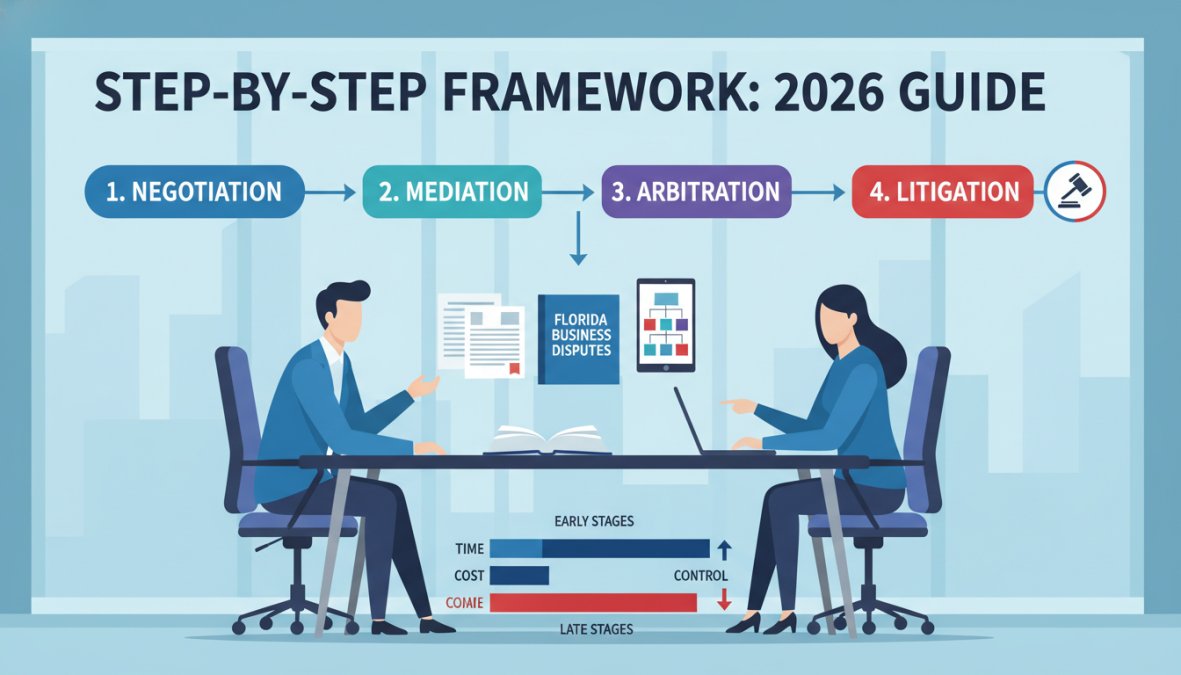
Step 1: Document the Dispute and Gather Evidence
Before any conversation, build your file. Pull financial statements, email threads, meeting minutes, bank records, and any communications that relate to the disputed conduct. Courts and mediators respond to documentation. Verbal accounts without supporting records rarely move the needle.
Organize your evidence chronologically. Note specific dates, dollar amounts, and the names of anyone else who witnessed relevant events. This documentation serves two purposes: it clarifies your own thinking about what actually happened, and it gives your attorney the raw material to assess the strength of your position.
Step 2: Attempt Direct Negotiation
Many Florida business partner disputes resolve through a direct, structured conversation between the partners, ideally with each party’s attorney present. The goal is not to relitigate grievances but to identify whether a mutually agreeable solution exists: a buyout, a restructured profit-sharing arrangement, or a clear division of management responsibilities.
Direct negotiation works best when the underlying relationship is still functional and both parties have economic incentives to avoid prolonged conflict. A common mistake is entering these conversations without a written proposal. Come with a specific offer, not just a complaint.
Step 3: Engage a Neutral Third Party
When direct negotiation fails, alternative dispute resolution Florida options become the next logical step. Mediation and arbitration are both faster and less expensive than litigation, and Florida courts increasingly expect parties to attempt ADR before filing suit. The Florida Dispute Resolution Center Florida Dispute Resolution Center resources provides resources for finding qualified neutrals.
Step 4: Consider Litigation as a Last Resort
Commercial litigation in Florida is a last resort, not a first response. A shareholder dispute or breach of fiduciary duty claim can take two to three years to resolve through the court system, and the legal fees often exceed the economic value of the original dispute. That said, litigation is sometimes necessary, particularly when a partner has misappropriated funds, violated a non-compete, or is actively destroying business value during the dispute.
Alternative Dispute Resolution in Florida: Mediation vs. Arbitration
Alternative dispute resolution (ADR) in Florida encompasses two primary mechanisms for resolving business disputes outside of court: mediation and arbitration. Understanding the difference is essential because choosing the wrong process can cost you time, money, and leverage, and in Florida, the choice is governed by specific statutes that most generic guides never mention.

Florida’s Legal Framework for ADR: What the Statutes Actually Say
Florida is one of the more ADR-friendly states in the country, and that posture is written into law. Florida courts operate under Florida Rule of Civil Procedure 1.700-1.730, which governs court-ordered mediation and gives judges broad authority to compel mediation before a case proceeds to trial. For business disputes specifically, this means that even if your partnership agreement is silent on ADR, a Florida court may order mediation anyway, making it a near-universal step in the litigation pathway regardless of what your agreement says.
Arbitration in Florida is governed by the Florida Arbitration Code (Chapter 682, Florida Statutes) for agreements entered into under state law, and by the Federal Arbitration Act (FAA) for agreements that touch interstate commerce, which includes most business partnerships with vendors, clients, or operations outside Florida. The distinction matters: the FAA imposes stricter limits on a court’s ability to vacate an arbitration award than the Florida statute does, which affects your ability to appeal an unfavorable result.
Florida Arbitration Code Chapter 682
If your partnership agreement contains an arbitration clause but does not specify whether it is governed by the FAA or the Florida Arbitration Code, a court will determine which applies based on the facts of your business. In most commercial partnerships, the FAA will govern, which significantly limits post-award appeals. Have your agreement reviewed by a Florida business attorney to understand which regime controls your dispute.
Mediation: How It Actually Works in a Florida Partnership Dispute
Mediation is a facilitated negotiation. A neutral mediator helps the parties communicate and explore options, but the mediator has no authority to impose a decision. Both parties must agree to any resolution. Mediation is non-binding unless the parties sign a written settlement agreement at the conclusion of the session.
In practice, a Florida partnership dispute mediation typically follows this sequence:
- Selection of mediator: Parties either agree on a mediator or use a provider such as the American Arbitration Association (AAA) or a Florida-certified mediator listed through the Florida Dispute Resolution Center. Florida Dispute Resolution Center resources Florida Supreme Court certification for circuit civil mediators requires specific training and experience hours, a credential worth verifying before agreeing to a mediator.
- Pre-mediation submissions: Each side typically submits a confidential mediation statement outlining their position, key facts, and settlement parameters. These are not shared with the opposing party, only with the mediator.
- Joint session and caucuses: The mediation usually opens with a joint session where both parties and their attorneys are present. The mediator then moves between private caucuses with each side, carrying proposals and testing settlement ranges.
- Settlement agreement: If the parties reach agreement, a written settlement agreement is signed at the mediation. That agreement is immediately enforceable as a contract under Florida law.
Mediation sessions for business partnership disputes in Florida typically run one full day, though complex disputes involving financial mismanagement or valuation disagreements may require multiple sessions.
Arbitration: How It Actually Works in a Florida Partnership Dispute
Arbitration is a private adjudication. An arbitrator (or a panel of three arbitrators in larger disputes) hears evidence and issues a binding decision called an award. Florida arbitration awards are enforceable in court, and the grounds for vacating an award are narrow, limited primarily to fraud, arbitrator misconduct, or an arbitrator exceeding their authority.
For Florida partnership disputes, the AAA’s Commercial Arbitration Rules are the most commonly referenced procedural framework when partnership agreements specify arbitration without naming a specific set of rules. Key features of AAA commercial arbitration relevant to partnership disputes:
- Expedited procedures are available for claims under a threshold amount (check current AAA fee schedules, as thresholds are updated periodically), which can compress the timeline significantly.
- Discovery is limited but available: Unlike court litigation, arbitration does not include full civil discovery as a matter of right. Parties may request document exchanges and depositions, but the arbitrator controls scope, which can be an advantage or a disadvantage depending on whether you need extensive financial records from the other side.
- The arbitrator’s decision is final: Absent the narrow grounds for vacatur under Chapter 682 or the FAA, you cannot appeal an arbitration award to a Florida court simply because you believe the arbitrator reached the wrong conclusion on the facts or the law.
If your dispute involves suspected financial misappropriation and you need broad access to your partner’s financial records, arbitration’s limited discovery may work against you. Discuss this trade-off with your attorney before agreeing to arbitrate rather than litigate.
Mediation vs. Arbitration: Side-by-Side Comparison
| Feature | Mediation | Arbitration |
|---|---|---|
| Decision-maker | Parties themselves | Arbitrator or panel |
| Binding? | Only if settlement signed | Yes, generally final |
| Governing Florida statute | Fla. R. Civ. P. 1.700-1.730 | Ch. 682, Fla. Stat. / FAA |
| Average duration | 1-2 days | Weeks to several months |
| Cost | Lower | Moderate to significant |
| Discovery | Minimal | Limited but available |
| Confidential? | Yes, by statute (§44.405) | Usually yes, by agreement |
| Appellate rights | N/A | Very narrow |
| Best for | Preserving relationships; creative solutions | Clear legal violations; need binding resolution |
Florida Statute §44.405 provides that mediation communications are confidential and generally inadmissible in subsequent legal proceedings, a meaningful protection that encourages candid settlement discussions without fear that an admission made in mediation will be used against you at trial.
Which Process Should You Choose?
The practical rule: choose mediation when you want to preserve some version of the business relationship, need a creative solution the law cannot provide (such as a restructured profit-sharing arrangement or a phased buyout), or want to test settlement ranges before committing to a more expensive process.
Choose arbitration when you have a clear legal claim, need a binding decision that the other party cannot simply ignore, and want to avoid the full cost and timeline of circuit court litigation. Arbitration is particularly well-suited to disputes where the facts are relatively contained, for example, a partner who took unauthorized distributions in a documented amount, rather than disputes requiring extensive financial forensics.
Most well-drafted Florida partnership agreements include a mandatory mediation clause followed by binding arbitration under AAA Commercial Rules, with Florida law as the governing law and Broward or Miami-Dade County as the seat of arbitration. If your agreement lacks both provisions, you are one dispute away from expensive litigation with no structured off-ramp, and a Florida court may impose its own ADR process on a timeline you do not control.
The Business Dissolution Process in Florida When Partners Cannot Agree
Sometimes the only viable resolution is ending the partnership. The business dissolution process Florida law governs is more structured than most business owners realize, and handling it incorrectly creates personal liability exposure that survives the dissolution itself.
Under the Florida Revised Uniform Partnership Act (Chapter 620, Florida Statutes), a partnership may be dissolved by agreement of the partners, by a judicial decree, or by operation of law upon certain triggering events. Florida Revised Uniform Partnership Act Chapter 620 When partners cannot agree, either party can petition a Florida circuit court for judicial dissolution. The statutory grounds include a finding that it is not reasonably practicable to carry on the business in conformity with the partnership agreement, a standard that gives courts meaningful discretion and that experienced Florida business attorneys use strategically when a partner is obstructing operations.
For limited liability companies structured as partnerships, the parallel provision is Florida Statute §605.0702, which governs judicial dissolution of Florida LLCs and uses similar "not reasonably practicable" language. If your business is organized as an LLC rather than a general or limited partnership, your dissolution pathway runs through Chapter 605, not Chapter 620, a distinction that affects both the procedural steps and the remedies available.
The Winding-Up Process: What Happens After Dissolution Is Triggered
Dissolution does not immediately end the partnership. Under Florida RUPA, dissolution triggers a winding-up period during which the partnership continues to exist solely for the purpose of completing unfinished business, collecting receivables, paying creditors, and distributing remaining assets to partners. The sequence matters:
- Creditors are paid first, including amounts owed to partners who are also creditors of the partnership (for example, a partner who made a documented loan to the business).
- Capital contributions are returned to partners in proportion to their documented contributions.
- Remaining assets are distributed according to the profit-sharing percentages in the partnership agreement, or equally if the agreement is silent.
A common and costly mistake is distributing assets to partners before all creditor obligations are satisfied. Partners who receive distributions ahead of creditors can face personal liability for the shortfall, even in an LLC context if the distribution rendered the entity insolvent.
Partner Buyout vs. Full Dissolution: Choosing the Right Exit
A partner buyout is almost always preferable to full dissolution when the underlying business has value. Dissolution liquidates assets, terminates contracts, and often destroys goodwill that took years to build. A buyout allows the business to continue under one partner’s control while the departing partner receives fair compensation.
The central challenge in a buyout is valuation. Partners frequently disagree on what the business is worth, which is why a well-drafted operating agreement should include a pre-agreed valuation formula, for example, a multiple of trailing twelve-month EBITDA, or a process requiring each side to obtain an independent appraisal with a third appraiser resolving any gap above a defined threshold. Without a pre-agreed mechanism, valuation disputes become a second litigation embedded within the first, often adding months and significant legal fees to a process both parties want to conclude.
If your partnership agreement does not include a buyout valuation formula, consider negotiating one now, before a dispute arises, as a standalone amendment. Courts in Florida will generally enforce a pre-agreed valuation mechanism even if one party later believes the result is unfavorable, as long as the process was followed correctly.
Tax Implications of Partnership Dissolution in Florida: The Gap Most Guides Skip
This is the dimension that nearly every competing guide ignores entirely, and it is a serious and expensive omission. The legal structure of a dissolution or buyout and its tax consequences must be planned together. Handling them sequentially, finalizing the legal agreement first and calling the CPA afterward, is one of the most common and costly mistakes Florida business owners make in this process.
Partnerships are pass-through entities for federal tax purposes. Gains on the sale or liquidation of partnership interests flow directly to the individual partners’ personal tax returns in the year the transaction closes, regardless of whether cash actually changed hands. IRS guidance on partnership taxation and dissolution The following issues require specific attention before any dissolution or buyout agreement is signed:
1. Ordinary income versus capital gains treatment
Not all gain from a partnership buyout is taxed at favorable long-term capital gains rates. Under IRC §751, amounts attributable to "hot assets", specifically unrealized receivables (including depreciation recapture) and substantially appreciated inventory, are recharacterized as ordinary income regardless of how long the partnership interest was held. For service-based businesses with significant accounts receivable, this distinction can meaningfully increase the departing partner’s tax bill relative to what a simple capital gains calculation would suggest.
2. The Section 754 Election
When a partner exits via buyout, the remaining partnership has the option to make an election under IRC §754, which allows the partnership to step up (or step down) the inside basis of partnership assets to reflect the price paid in the buyout. This election benefits the remaining partners by reducing future taxable gain when those assets are eventually sold or depreciated. However, the election is not automatic, it must be affirmatively made on a timely filed partnership return, and it applies to all future transfers and distributions, not just the current buyout. Partnerships that have not previously made a §754 election should evaluate whether doing so in connection with a partner exit serves the remaining partners’ long-term interests.
3. Installment sales and the timing of gain recognition
If a buyout is structured as an installment payment over multiple years rather than a lump sum, the departing partner may be able to spread gain recognition across the payment period under the installment sale rules of IRC §453. However, this treatment is not available for the ordinary income portion attributable to hot assets under §751, which is recognized in full in the year of sale regardless of when payments are received. Structuring a multi-year buyout without accounting for this creates a mismatch between cash received and taxes owed.
4. Guaranteed payments versus distributive share
Payments to a departing partner structured as guaranteed payments under IRC §707(c), that is, payments not contingent on partnership income, are deductible by the partnership but are treated as ordinary income subject to self-employment tax for the recipient. Payments structured as liquidating distributions, by contrast, are generally not subject to self-employment tax. The economic amount may be identical; the tax treatment is not. This distinction is frequently overlooked in buyout negotiations and can result in a materially worse after-tax outcome for the departing partner.
5. Florida state-level obligations upon dissolution
Florida has no personal income tax, which eliminates one layer of complexity relative to states like California or New York. However, dissolving a Florida business entity still triggers specific state-level obligations:
- Articles of Dissolution must be filed with the Florida Division of Corporations. For LLCs, this is governed by §605.0707, Florida Statutes. Failure to formally dissolve leaves the entity on the state’s active rolls and continues annual report and fee obligations.
- Sales tax obligations must be settled with the Florida Department of Revenue before dissolution is complete, including any tax on the sale of tangible personal property as part of asset distribution.
- Payroll tax accounts with the Florida Department of Revenue must be formally closed.
- Fictitious name registrations and any professional licenses held by the entity must be separately cancelled.
Do not sign a buyout or dissolution agreement before your attorney and your CPA have reviewed the document together. The legal structure that minimizes litigation risk and the tax structure that minimizes the combined tax burden of both partners are often different, and the optimal outcome requires coordinating both simultaneously, not sequentially.
The businesses that navigate dissolution most effectively treat the tax analysis not as an afterthought but as a negotiating variable. A buyout structured as a lump sum may be legally cleaner but tax-inefficient for the departing partner; an installment structure may reduce the immediate tax burden but create cash flow risk for the buyer. Understanding these trade-offs before the term sheet is signed gives both parties more room to reach an agreement that actually works.
Managing the Emotional and Psychological Side of a Partnership Dispute
Business partnerships often resemble marriages in their intensity, and the dissolution of one carries similar emotional weight. This is the part of the process that legal guides almost universally ignore, and the omission is costly.
Partners who allow emotional reactivity to drive their legal strategy routinely make decisions that harm their own interests. Refusing a reasonable buyout offer out of anger, escalating to litigation as a form of punishment, or destroying business value to "win" are patterns that experienced Florida business attorneys see regularly.
A few practical principles:
Separate the business decision from the personal grievance. Your goal is to protect your financial interest and your professional future, not to be proven right. These objectives sometimes conflict, and the business objective should win.
Get support outside the legal process. A therapist, a trusted mentor, or a peer who has been through a similar experience can provide perspective that your attorney cannot. Legal counsel is not equipped to manage the psychological dimensions of a dispute, and expecting them to is both unfair and expensive.
Maintain professional conduct in writing. Every email you send during a dispute is potential evidence. Emotional or threatening communications create legal exposure and weaken your negotiating position. Write every message as if a judge will read it.
The business owners who resolve disputes most effectively are the ones who stay clear-eyed about their actual objectives throughout a process that is designed, at every turn, to provoke them.
When to Hire a Florida Partnership Dispute Attorney
The right time to hire a Florida partnership dispute attorney is before the dispute becomes a crisis, not after. Many business owners wait until they have been served with a lawsuit, a partner has frozen a bank account, or a key contract is at risk. By that point, options that were available earlier have closed.
Specific triggers that warrant immediate legal consultation:
- A partner has taken unilateral action affecting business assets or accounts
- You have discovered financial irregularities or suspected misappropriation of funds
- A partner has threatened litigation or sent a formal demand letter
- The partnership agreement is silent on the issue in dispute
- You are considering a buyout and need to understand your valuation rights
- The business is approaching insolvency and partners disagree on next steps
Matthew Fornaro, P.A. has served Coral Springs, Parkland, and Broward County business owners for over two decades, providing legal guidance on commercial litigation, business formation, and contract disputes. If you are searching for a partnership dispute attorney near me in South Florida, the firm’s combination of local knowledge and litigation experience is directly relevant to the disputes described throughout this guide.
Protecting Your Business Interests: Final Steps to Resolve Business Partner Disputes in Florida
The throughline of everything covered here is preparation. The businesses that successfully resolve business partner disputes in Florida share a common characteristic: they treated their partnership agreement as a living document, not a one-time formality.
The final practical steps to protect your position:
- Audit your partnership agreement now, before a dispute arises, using the checklist above
- Establish clear financial controls including dual-signature requirements for transactions above a defined threshold
- Document all major business decisions in writing, even informal ones made via email
- Include ADR clauses that require mediation before arbitration, and arbitration before litigation
- Plan for exit from day one by including a buyout mechanism with a pre-agreed valuation formula
- Consult a Florida business attorney annually to review your agreement against the current state of the business
According to American Arbitration Association commercial dispute resources, the majority of commercial disputes that go through structured ADR processes reach resolution without proceeding to arbitration or litigation. The implication is clear: the process matters as much as the legal arguments.
The businesses that come through partnership disputes intact are not the ones with the strongest legal claims. They are the ones who took the process seriously, stayed disciplined under pressure, and got competent legal counsel early.
Partnership disputes threaten not just the business relationship but the entire enterprise you have built. Matthew Fornaro, P.A. brings over two decades of experience in commercial litigation and business law to help Coral Springs and Broward County business owners protect their interests, whether through negotiation, mediation, or litigation when it becomes necessary. The firm’s focused practice on South Florida entrepreneurs means you get practical, results-oriented guidance rather than generic legal advice. Call Today to discuss your situation with a Florida partnership dispute attorney who understands what is actually at stake.
Frequently Asked Questions
What are the most common causes of business partner disputes in Florida?
The most common causes include breach of fiduciary duty, financial mismanagement or misappropriation of funds, disagreements over profit sharing, conflicts about strategic direction, and unequal contributions to management responsibilities. In many cases, disputes arise because the original partnership agreement was vague or incomplete. Florida business law requires partners to act in good faith, and violations of that standard can quickly escalate a minor disagreement into formal litigation.
What is the difference between mediation and arbitration for resolving business partner disputes in Florida?
Mediation is a voluntary, non-binding process where a neutral third party helps partners reach a mutually agreeable solution. Arbitration is a more formal alternative dispute resolution process where an arbitrator hears both sides and issues a binding decision. In Florida, many partnership agreements include mandatory arbitration clauses. Mediation is generally faster and less costly, while arbitration offers a definitive outcome without going through full litigation. Consulting a Florida partnership dispute attorney can help you choose the right path.
Can I dissolve a business partnership in Florida if my partner and I disagree?
Yes. Under Florida Statutes and the Revised Uniform Partnership Act adopted in Florida, a partner may seek judicial dissolution when the business entity can no longer function effectively due to an internal crisis or irreconcilable conflict. The business dissolution process in Florida involves settling liabilities, distributing business assets, and filing the appropriate paperwork. A partner buyout is often explored first as a less disruptive alternative to full dissolution. Legal counsel is strongly recommended before taking either step.
How can a partnership agreement prevent future disputes in Florida?
A well-drafted business partnership agreement in Florida should clearly define profit sharing, management responsibilities, decision-making authority, buyout procedures, and dispute resolution mechanisms such as mediation or arbitration. It should also address what happens if a partner breaches the agreement or fails their fiduciary duty. Treating the agreement as a living document and reviewing it regularly, especially after major business changes, is one of the most effective pre-dispute prevention strategies available to Florida business owners.
When should I hire a Florida partnership dispute attorney?
You should seek legal guidance as soon as a dispute begins affecting business performance, involves allegations of breach of contract, self-dealing, or misappropriation of funds, or when a partner threatens litigation. An experienced Florida partnership dispute attorney can assess your partnership agreement, advise on alternative dispute resolution options, and represent your interests in mediation, arbitration, or commercial litigation. Early involvement of legal counsel often leads to faster, less costly resolutions and better protection of your business interests.
Are there tax consequences when dissolving a business partnership in Florida?
Yes. Dissolving a business partnership in Florida can trigger capital gains taxes, recognition of previously deferred income, and tax consequences related to the distribution of business assets. The specific tax implications depend on how the partnership is structured, how assets are divided, and whether a partner buyout is involved. Because Florida has no state income tax, federal tax rules under the IRS partnership provisions are the primary concern. Consulting both a Florida partnership dispute attorney and a tax professional before dissolution is strongly advised.
This article was written using GrandRanker


