

Key Takeaways
- Florida business law protects companies from unfair competition, contract breaches, and partner disputes.
- Acting early saves time, money, and business relationships.
- An experienced business attorney helps you assess risk and choose the right legal strategy.
A commercial landlord dispute is a formal or informal conflict between a property owner and a business tenant over the terms, obligations, or management of a commercial lease agreement. These disputes range from unpaid rent and maintenance disagreements to lease renewal battles and dilapidation claims at the end of a tenancy. For small business owners in South Florida, understanding what triggers these conflicts, and how to resolve them, can mean the difference between protecting your business and losing your location entirely.
What is a commercial landlord dispute and why does it happen?
A commercial landlord dispute arises when one party believes the other has failed to meet their obligations under a commercial lease. The industry term for this category of conflict is “commercial landlord and tenant dispute,” and it covers a wide range of disagreements tied to lease performance, property condition, and contractual rights.
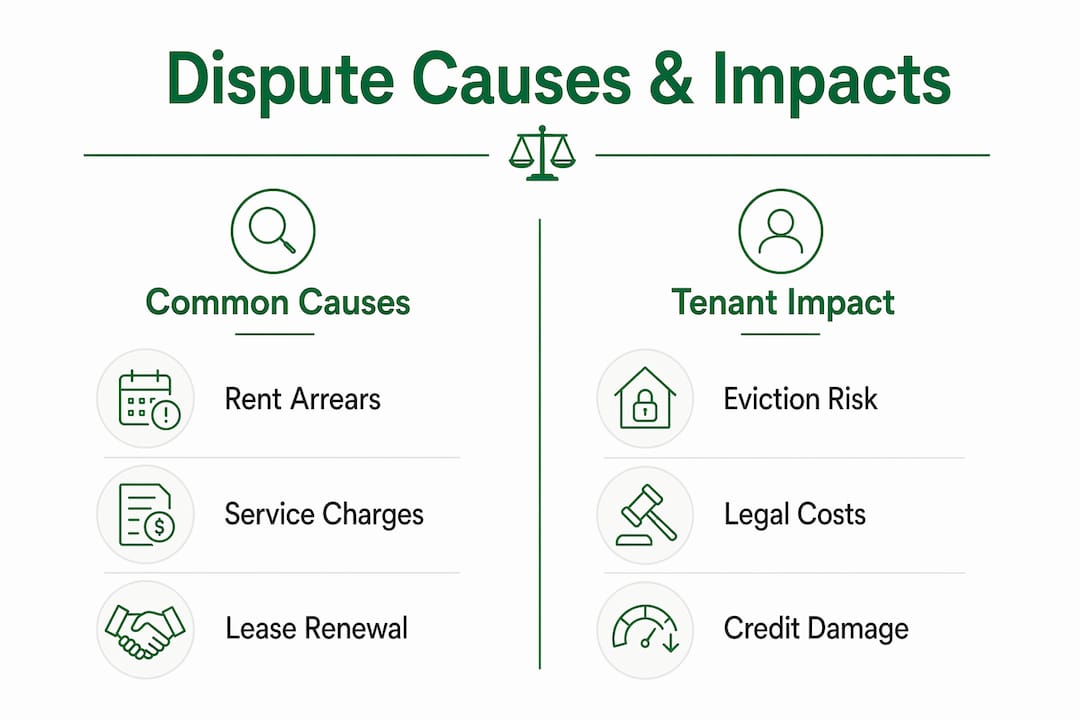
The most common dispute causes include rent arrears, service charge disagreements, dilapidation claims, and lease renewal conflicts. Each of these can escalate quickly if the lease language is vague or if neither party documents their communications carefully.
South Florida adds its own layer of complexity. The region’s competitive retail and office markets mean lease terms are often heavily negotiated, and landlords frequently include provisions that shift significant financial risk onto tenants. A restaurant owner in Broward County signing a five-year lease may not realize until year three that the lease holds them responsible for HVAC replacement costs. That misunderstanding is the seed of a commercial lease conflict.

What are the most common causes of commercial landlord disputes?
Understanding the triggers of landlord tenant disputes helps you spot problems before they become legal battles.
- Rent arrears and payment disputes. A tenant falls behind on rent, or disputes whether a rent increase was properly noticed. This is the most frequent trigger and the fastest path to eviction proceedings.
- Service charge disagreements. Landlords pass on building maintenance costs through service charges. Tenants often dispute the calculation, the scope, or the reasonableness of those charges.
- Lease renewal conflicts. When a lease approaches its end, disagreements over renewal terms, rent reviews, or break clause activation create significant friction. Break clauses in particular are frequently misunderstood and misapplied.
- Dilapidation claims. At lease end, landlords may claim the property was returned in worse condition than required. These claims can run into tens of thousands of dollars and often come as a shock to tenants who believed they maintained the space properly.
- Repair and maintenance responsibilities. Who fixes the roof? Who replaces the plumbing? Ambiguous lease language on these points generates constant disputes.
The table below summarizes these causes and their typical business impact:
| Dispute cause | Typical impact on tenant |
|---|---|
| Rent arrears | Eviction risk, credit damage, legal costs |
| Service charge disputes | Unexpected financial liability |
| Lease renewal conflict | Loss of business location, forced relocation |
| Dilapidation claims | Large end-of-lease financial exposure |
| Repair responsibility disputes | Operational disruption, cost overruns |
Ambiguous lease language causes many of these disputes. Precise contract definitions reduce litigation risk significantly, which is why reviewing your lease before signing is not optional.
How do commercial landlord disputes differ from residential disputes?
Commercial tenants carry far less statutory protection than residential tenants. This is the single most important distinction for South Florida business owners to understand.
Residential tenants in Florida benefit from the Florida Residential Landlord and Tenant Act, which sets minimum standards for habitability, notice periods, and security deposits. Commercial tenants get no equivalent safety net. The terms of your commercial lease are almost entirely what govern your rights. If the lease is silent on an issue, you may have very little recourse.
Most commercial leases are structured as “full repairing and insuring” agreements, meaning tenants bear responsibility for maintenance and insurance across the entire premises. This is a stark contrast to residential leases, where landlords typically handle structural repairs. A commercial tenant in a full repairing lease could be on the hook for a new roof even if the building is 40 years old.
The financial stakes are also categorically higher. A residential dispute might involve a $2,000 security deposit. A commercial lease conflict over dilapidations or a wrongful eviction can involve hundreds of thousands of dollars and threaten the survival of the business itself.
Pro Tip: Before signing any commercial lease in South Florida, review it against a checklist of common lease red flags specific to Florida. Provisions that seem standard may carry outsized risk in a commercial context.
What are the most effective ways to prevent and resolve commercial landlord disputes?
Prevention is cheaper than litigation. These steps reflect what actually works in practice for South Florida businesses.
- Negotiate precise lease language from the start. Vague terms like “reasonable maintenance” or “good condition” are dispute generators. Define every obligation with specificity, including dollar thresholds, timelines, and responsible parties.
- Document everything in writing. Written requests and notices are foundational to dispute resolution. Courts evaluate whether parties attempted informal resolution before escalating, and a paper trail is your primary evidence.
- Schedule regular lease reviews. Set a calendar reminder every 12 months to review your lease obligations, upcoming rent review dates, and any notice deadlines for break clauses or renewals.
- Attempt negotiation first. Over 95% of commercial disputes resolve outside court through negotiation, mediation, or arbitration. Structured communication alone resolves 80% of issues before formal escalation. Reaching out directly and professionally to your landlord at the first sign of a problem is almost always the right first move.
- Use mediation before litigation. Mediation carries roughly a 95% success rate in resolving landlord tenant disputes. It is faster, cheaper, and preserves the business relationship far better than court proceedings.
- Engage qualified legal counsel early. An attorney who understands commercial lease dispute resolution can often resolve a conflict in weeks that would otherwise drag into months of litigation.
Pro Tip: Keep a dedicated email thread or folder for every landlord communication. If a dispute arises, your organized records will carry more weight than your landlord’s verbal account of events.
When disputes escalate: what legal options do South Florida tenants and landlords have?
Litigation is the last resort, but knowing your options before you need them is smart business practice.
Florida’s court system offers several pathways depending on the size and complexity of the dispute. Small claims court handles matters up to $8,000. Most commercial lease conflicts exceed that threshold, which means they land in the civil division of the county circuit court. Broward County and Miami-Dade County both have active commercial litigation dockets, and cases can take 12 to 24 months to resolve if they go to trial.
Courts weigh documentation heavily. Judges in commercial disputes look for written notices, email correspondence, lease amendments, and inspection records. A tenant who can show they reported a maintenance issue in writing three times before the landlord acted is in a fundamentally stronger position than one who made only verbal requests.
Two legal nuances deserve particular attention:
- Nuisance claims as lease termination tactics. Landlords using nuisance claims such as noise or odors to terminate leases face judicial reluctance unless the lease explicitly forbids that conduct. Courts resist these tactics when the lease language does not clearly support them.
- Exclusivity and restrictive covenant enforcement. Private contractual obligations like exclusivity provisions can override local zoning approvals. A tenant who negotiated an exclusive right to sell a product category can enforce that right even if a competing tenant received municipal permits.
The table below outlines the primary legal escalation options:
| Resolution method | Best suited for | Typical timeline |
|---|---|---|
| Direct negotiation | Early-stage, lower-value disputes | Days to weeks |
| Mediation | Mid-level disputes, relationship preservation | 1 to 4 weeks |
| Arbitration | Complex disputes with arbitration clause | 1 to 6 months |
| Circuit court litigation | High-value, unresolvable disputes | 12 to 24 months |
For a deeper look at how Florida courts handle commercial property conflicts, Fornarolegal’s guide on commercial litigation in Florida covers the procedural specifics that matter most to business owners.
Key takeaways
Commercial landlord disputes are almost always preventable with precise lease drafting, consistent documentation, and early legal intervention before positions harden.
| Point | Details |
|---|---|
| Definition matters | A commercial landlord dispute is a conflict over lease terms, obligations, or property management between landlord and tenant. |
| Prevention starts at signing | Ambiguous lease language is the primary driver of disputes; negotiate precise terms before you sign. |
| Document every interaction | Written records are your strongest asset in any dispute resolution process, formal or informal. |
| Mediation works | Mediation resolves roughly 95% of landlord tenant disputes faster and cheaper than litigation. |
| Legal counsel pays early | Engaging an attorney at the first sign of conflict typically costs far less than resolving a fully escalated dispute. |
What I’ve learned after 20 years of commercial lease disputes in South Florida
The pattern I see most often is not malice. It is ambiguity. A landlord and tenant each read the same lease clause and reach completely different conclusions about who is responsible for a repair or what “reasonable notice” means. By the time they call me, both parties are entrenched, the relationship is damaged, and what could have been resolved with a two-paragraph lease amendment two years ago is now a six-figure litigation.
The most expensive mistake South Florida business owners make is treating the lease signing as the finish line. It is actually the starting line. Your lease is a living document that governs your business operations for years. Rent review dates, break clause windows, and renewal notice deadlines all require active calendar management. Miss a 90-day renewal notice window and you may lose your right to renew entirely.
I also see tenants underestimate the power of their own documentation. Courts in Florida take written evidence seriously. A tenant who sends a formal written notice about a leaking roof, follows up in writing, and keeps copies of both is in a categorically stronger legal position than one who called the landlord three times and has no record of it.
My honest advice: get your lease reviewed by a commercial attorney before you sign, not after the dispute starts. The cost of a lease review is a fraction of the cost of a commercial lease conflict. And if a dispute does arise, contact counsel at the first sign of trouble. Early intervention almost always produces better outcomes at lower cost.
— Matthew
Resolve your commercial lease dispute with Fornarolegal
If you are a South Florida business owner facing a commercial lease conflict, or you want to prevent one before it starts, Fornarolegal is ready to help. With over 20 years of AV-rated, court-tested experience representing businesses across Broward County and Miami-Dade, Matthew Fornaro provides direct, practical guidance on lease disputes, eviction defense, and commercial lease negotiation problems.

Whether you need a lease reviewed before signing or legal representation in an active dispute, Fornarolegal’s dispute resolution strategies resource is the right starting point. You can also explore the Broward County landlord tenant practice page for representation options specific to your region. Contact Fornarolegal today to protect your business and your lease.
FAQ
What is a commercial landlord dispute?
A commercial landlord dispute is a conflict between a property owner and a business tenant over the terms, performance, or management of a commercial lease agreement. Common triggers include unpaid rent, maintenance disagreements, service charge disputes, and lease renewal conflicts.
How is a commercial lease dispute different from a residential one?
Commercial tenants have far less statutory protection than residential tenants, meaning the lease contract itself governs nearly all rights and obligations. Financial stakes are also higher, and tenants often bear full repair and insurance responsibilities under commercial lease terms.
What is the most effective way to resolve a commercial landlord dispute?
Mediation is the most effective first step, carrying roughly a 95% success rate in resolving landlord tenant disputes outside of court. Direct negotiation backed by written documentation resolves the majority of issues before formal escalation becomes necessary.
Can a landlord use a nuisance claim to terminate my commercial lease?
Courts resist nuisance-based lease terminations unless the lease explicitly prohibits the conduct in question. Tenants facing this tactic should document the alleged nuisance claims and seek legal counsel immediately.
When should I hire a commercial real estate attorney?
Engage an attorney at the first sign of a dispute, not after positions have hardened. Early legal intervention in commercial lease conflicts consistently produces faster resolutions at significantly lower cost than waiting until litigation becomes unavoidable.


