

Key Takeaways
- Florida business law protects companies from unfair competition, contract breaches, and partner disputes.
- Acting early saves time, money, and business relationships.
- An experienced business attorney helps you assess risk and choose the right legal strategy.
Table of Contents
- What Is a Commercial Property Boundary Dispute?
- Common Causes of Commercial Boundary Disputes
- The Role of Land Surveys in Commercial Real Estate Boundary Disputes
- Commercial Property Encroachment Laws and Your Rights
- Steps to Resolving Commercial Boundary Disputes
- Financial and Operational Impact on Commercial Landowners
- Pre-Acquisition Due Diligence Checklist
- Why Professional Legal Counsel Matters
Last Updated: August 1, 2026
What Is a Commercial Property Boundary Dispute?
A commercial property boundary dispute occurs when adjacent landowners disagree about the exact location of the property line separating their parcels. These conflicts arise when property lines are unclear, physical improvements encroach across alleged boundaries, or historical records contradict current conditions on the ground.
Unlike residential disputes, commercial boundary conflicts carry additional weight because they affect financing, insurance coverage, zoning compliance, and the ability to refinance or sell the property. A fence built two feet over the line becomes material when a lender’s title company flags the encroachment as a defect during loan approval.
Key Elements That Define a Boundary Dispute
A boundary dispute centers on the legal description of the property, the official written boundary defined in the deed and recorded documents. When that description contradicts what’s physically marked on the ground, or when two deeds reference different boundary markers, conflict emerges.
The parties involved are usually adjoining landowners, though sometimes municipalities or government entities with easement rights become parties. What distinguishes a boundary dispute from other property conflicts is that it specifically challenges WHERE the property line runs, not WHO owns the land or WHETHER the ownership is valid.
Common Causes of Commercial Boundary Disputes
Surveying Errors and Inaccuracies
Historical surveys conducted decades ago sometimes contain mathematical errors, outdated reference points, or ambiguous descriptions. A surveyor might have relied on landmarks that no longer exist, a large oak tree, a creek bend, or a fence that has since been removed. Modern surveying technology (GPS, digital mapping, laser measurement) has improved accuracy significantly, but older properties often have surveys conducted with less precise methods.
When two surveys disagree, determining which one is correct becomes a legal question. The older survey might be legally binding if it was accepted and acted upon for decades, even if a newer survey suggests it was inaccurate. Errors also occur when surveyors misinterpret the legal description in the deed. Metes and bounds descriptions define property by compass directions, distances, and reference points, but can be ambiguous, for example, "north along the fence line" creates problems if the fence has moved.
Missing or Unclear Property Deeds
Some commercial properties, particularly older ones in South Florida, have incomplete or unclear deed language. A deed might reference a "natural boundary" without specifying which natural feature serves as the actual boundary. Older deeds sometimes lack precise legal descriptions entirely, referencing instead "the land adjacent to the Johnson property" or "the parcel south of the commercial plaza", descriptions that become meaningless if the referenced property changes hands or is redeveloped.
Encroachment Issues: Fences, Buildings, and Parking
Physical encroachment is perhaps the most visible cause of boundary disputes. A fence, building, parking lot, or landscaping feature constructed across the actual property line creates a concrete problem. In commercial settings, the stakes are high: a loading dock, storage structure, or parking area built on the neighbor’s land represents significant capital investment that the encroaching owner is unwilling to remove. Parking lot encroachments are particularly common in commercial real estate, where a shopping center owner might extend the lot into an adjacent property’s setback area, or a manufacturing facility might have a dumpster enclosure that sits partially on adjacent land.
The Role of Land Surveys in Commercial Real Estate Boundary Disputes
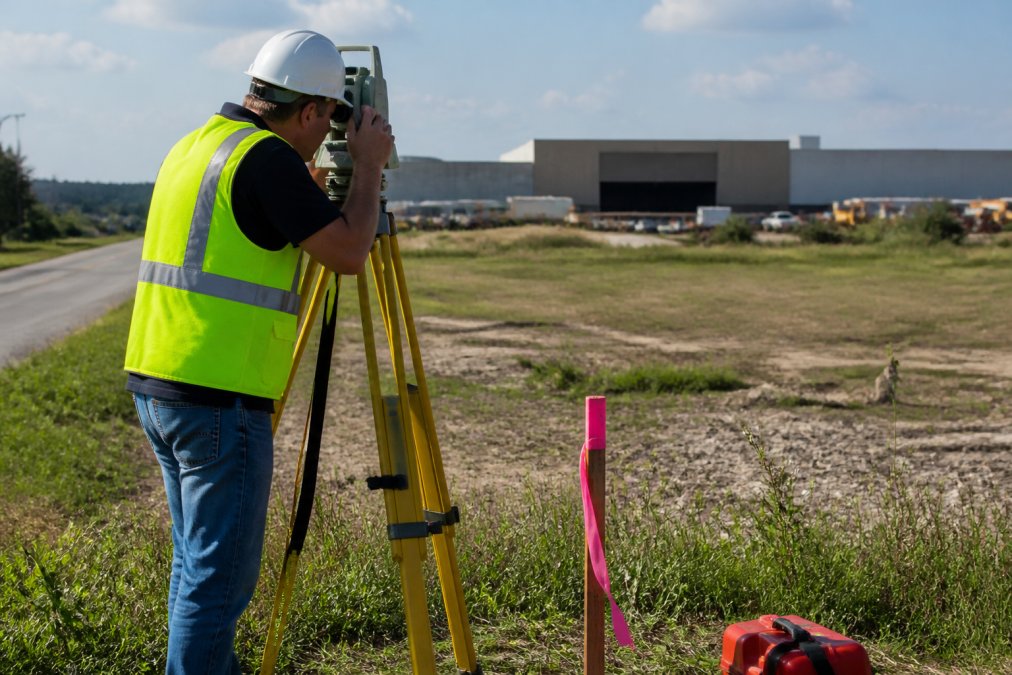
A professional land survey is the foundation of any boundary dispute resolution. The surveyor begins by researching the property’s deed, previous surveys, and any recorded easements or encumbrances. They identify reference points, monuments, or landmarks mentioned in the legal description, then conduct field measurements using GPS, total stations, or other precision instruments to establish where the property line should be located.
When a surveyor’s findings conflict with what’s physically on the ground, the discrepancy becomes evidence in the dispute. If a fence has stood in the same location for 50 years but the survey shows it’s two feet over the line, the surveyor’s report documents this. That documentation is essential for mediation, negotiation, or litigation because it provides an objective, professional assessment of the boundary location. Surveys also reveal encroachments that the property owner may not have been aware of, which is critical for title insurance purposes, financing, and legal strategy.
Commercial Property Encroachment Laws and Your Rights
Commercial property owners in Florida have legal rights when a neighbor’s improvements encroach on their land. The law recognizes both the right to exclude trespassers and the right to seek remedies when encroachment occurs. However, available remedies depend on the circumstances and how long the encroachment has persisted.
Adverse Possession and Commercial Property Claims
Adverse possession is a legal doctrine that can transfer property ownership if certain conditions are met. In Florida, a person can gain ownership of land through adverse possession if they occupy it openly, continuously, and exclusively for seven years without permission from the true owner. For commercial property, the implications are serious: a neighbor’s encroachment that goes unchallenged for seven years might result in losing part of your land.
The occupation must be actual (physical use of the land), open (visible to the true owner and the public), notorious (not hidden), exclusive (the adverse possessor is the sole occupant), and continuous (without significant interruption). A neighbor’s fence or parking area that has been in place for seven years and is visible to anyone passing by meets these criteria. The practical consequence is that boundary disputes involving long-standing encroachments carry urgency. If you discover a neighbor’s fence, building, or structure on your land, addressing it quickly is important.
Title Insurance and Encumbrance Protection
Title insurance policies protect commercial property owners against losses caused by title defects, including boundary disputes and encroachments. However, most standard policies exclude known encroachments or defects that appear on the survey or were visible at the time the policy was issued.
An encumbrance is any claim, lien, or restriction on the property that affects ownership or use. A title search reveals recorded encumbrances, but physical encroachments that haven’t been formally recorded might not appear in the title search. This is why a professional survey is essential: it identifies physical encroachments that the title search might miss. For commercial lenders, title insurance is mandatory, and a lender will not finance a property with a known encroachment or boundary dispute unless the issue is resolved.
Steps to Resolving Commercial Boundary Disputes
Resolving a boundary dispute requires a systematic approach. The goal is to clarify the true property line, document the dispute, and reach a resolution through negotiation, mediation, or litigation.
1. Conduct a Thorough Title Search and Due Diligence
Begin by obtaining a comprehensive title search from a title company. This search reveals all recorded documents affecting the property: deeds, easements, covenants, liens, and any recorded boundary disputes or agreements. Review the property deed carefully and identify the legal description and any language defining the boundary. Gather all previous surveys of the property and compare them to identify discrepancies.
2. Obtain a Professional Land Survey
Commission a current, professional boundary survey from a licensed surveyor. Provide the surveyor with the deed, previous surveys, and any other relevant documents. The survey should include a detailed report documenting the surveyor’s findings, the methods used, and any discrepancies between the legal description and physical conditions. Request that the surveyor mark the property line with temporary flags or monuments so both parties can see exactly where the surveyor determined the line to be.
3. Document the Dispute and Gather Evidence
Create a written record of the dispute. Document when you first became aware of the boundary issue, what triggered your concern, and what communications you’ve had with the neighbor. Take photographs and video of the disputed area, the encroaching improvement (if any), and any boundary markers or monuments. Preserve all communications with the neighbor: emails, letters, text messages, or notes from conversations.
4. Attempt Mediation and Negotiated Settlement
Before pursuing litigation, attempt to resolve the dispute through negotiation or mediation. Many boundary disputes can be resolved through a boundary line agreement, a formal, recorded document in which both parties agree on the location of the property line. Mediation involves a neutral third party who helps both sides communicate and reach a mutually acceptable resolution. It is less formal and less expensive than litigation, and it preserves the business relationship between neighbors.
During mediation or negotiation, consider compromises that might satisfy both parties. If the dispute is over a small area, one party might agree to grant an easement allowing the other party’s improvement to remain. Matthew Fornaro, P.A. can represent your interests during negotiation and mediation, ensuring that any agreement protects your legal rights and doesn’t create unforeseen problems for future transactions or refinancing.
5. Pursue Quiet Title Action or Litigation if Necessary
If negotiation and mediation fail, a quiet title action is often the next step. A quiet title action is a lawsuit in which you ask the court to determine the true property line and remove any clouds on title created by the dispute. The court reviews the legal description, surveys, historical documents, and testimony from both parties and then issues a judgment declaring where the property line is located.
If the dispute involves significant encroachment or if one party refuses to accept the quiet title judgment, litigation may proceed to trial. At trial, both parties present evidence, expert testimony from surveyors, and legal arguments about the boundary. The judge or jury determines the boundary location and may award damages if one party has suffered losses due to the other’s encroachment.
Financial and Operational Impact on Commercial Landowners
Boundary disputes create ripple effects throughout a business’s operations and financial health. Beyond the direct costs of surveying and legal fees, disputes affect refinancing, property sales, insurance coverage, and operational planning.
Impact on Commercial Financing and Lending
Lenders are extremely sensitive to boundary disputes and title defects. When you apply for a commercial loan or refinancing, the lender’s title company conducts a title search and often orders a survey. If the survey reveals an encroachment or if the title search shows a recorded boundary dispute, the lender will likely refuse to proceed until the issue is resolved. This creates a catch-22: you need to refinance to access capital for business expansion, but you cannot refinance until the boundary issue is resolved. For property sales, a boundary dispute is a major obstacle. Buyers and their lenders will not proceed with a purchase if there is a known boundary issue.
Environmental Liability and Boundary Disputes
Boundary disputes can intersect with environmental liability in complex ways. If the disputed area contains contaminated soil or if a neighbor’s improvement creates drainage or runoff issues that affect your land, the boundary dispute becomes entangled with environmental concerns. Environmental liability is often tied to land ownership, and a boundary dispute can delay environmental assessment and cleanup, creating regulatory risk.
Pre-Acquisition Due Diligence Checklist
Before purchasing commercial property, conducting thorough due diligence on boundary issues can prevent disputes after closing. Use this checklist to evaluate boundary risk:
| Step | Action | Why It Matters |
|---|---|---|
| 1 | Order a current boundary survey | Identifies encroachments and boundary discrepancies before purchase |
| 2 | Review the property deed carefully | Reveals vague or ambiguous boundary language that could cause disputes |
| 3 | Obtain a comprehensive title search | Shows recorded easements, covenants, and prior boundary disputes |
| 4 | Compare all previous surveys | Identifies patterns of disagreement about the boundary location |
| 5 | Walk the entire perimeter | Physically observe fences, structures, and improvements near the boundary |
| 6 | Interview the current owner | Learn about any known boundary issues or neighbor disputes |
| 7 | Review permits and construction records | Verify that improvements were built within the property line |
| 8 | Check for adverse possession risk | Determine if any neighbor’s improvements have been in place for seven years or longer |
| 9 | Obtain title insurance commitment | Review exceptions and exclusions related to boundary issues |
| 10 | Engage legal counsel for review | Have an attorney assess boundary risk before closing |
Why Professional Legal Counsel Matters
Boundary disputes involve overlapping legal, surveying, and financial issues that require professional expertise. Attempting to resolve a boundary dispute without legal counsel often results in costly mistakes: agreements that don’t adequately protect your interests, failure to meet legal deadlines, or settlement terms that create problems for future transactions.
An attorney experienced in commercial real estate boundary disputes understands Florida property law, the mechanics of adverse possession, title insurance limitations, and the procedural requirements for quiet title actions. Matthew Fornaro, P.A. has over two decades of experience representing commercial property owners in South Florida boundary disputes and commercial real estate conflicts. The firm provides practical, results-oriented guidance tailored to the unique circumstances of your dispute. Whether your goal is to negotiate a boundary line agreement, pursue mediation, or litigate a quiet title action, Matthew Fornaro, P.A. works to protect your property rights and minimize the time and cost of resolution.
Boundary disputes are complex problems that affect financing, operations, and property value. Early action, obtaining a professional survey, documenting the dispute, and engaging legal counsel significantly improve your options and reduce ultimate costs. If you own commercial property in Coral Springs, Parkland, or elsewhere in South Florida and are facing a boundary dispute or concerned about boundary risk, Matthew Fornaro, P.A. can help you assess the situation and develop a resolution strategy that protects your interests.
Florida Statutes Chapter 95 on adverse possession and property claims
American Land Title Association guidance on boundary disputes and title insurance
National Society of Professional Surveyors resources on boundary surveys and dispute resolution
Frequently Asked Questions
What is a commercial property boundary dispute?
A commercial property boundary dispute occurs when there is disagreement or conflict over the exact location of property lines between adjoining landowners. This can involve encroachment (where one property owner's improvements cross onto a neighbor's land), unclear legal descriptions in deeds, or discrepancies between what a property deed states and what a land survey reveals. Disputes may involve physical structures like fences or buildings, parking areas, or landscaping that crosses the established boundary.
What are the most common causes of commercial boundary disputes?
Common causes include surveying errors or inaccuracies from historical surveys, missing or unclear property deeds that lack precise legal descriptions, encroachment by structures or improvements, disagreements over boundary markers, and adverse possession claims where someone has occupied land for an extended period. Changes in zoning regulations or property improvements can also trigger disputes when adjoining landowners interpret property lines differently.
How does a commercial real estate boundary survey help resolve disputes?
A professional land survey establishes the precise legal description and physical location of property boundaries using modern surveying equipment and metes and bounds documentation. A licensed surveyor reviews the property deed, examines existing boundary markers, and creates a detailed plat map showing the exact property lines. This objective evidence is critical in mediation, settlement negotiations, and litigation, as it provides a factual basis for resolving disagreements between adjoining landowners.
What should I include in a pre-acquisition due diligence checklist for commercial property?
Review the property deed and legal description carefully, obtain a current title search and title insurance commitment, commission a professional boundary survey, verify zoning regulations and land use restrictions, inspect the property for any visible encroachments or boundary markers, check for easements or encumbrances that affect property rights, and review environmental records. For commercial financing, lenders typically require these documents before approving a loan, so thorough due diligence protects both your investment and your ability to refinance or sell the property.
This article was written using GrandRanker


