

Key Takeaways
- Florida business law protects companies from unfair competition, contract breaches, and partner disputes.
- Acting early saves time, money, and business relationships.
- An experienced business attorney helps you assess risk and choose the right legal strategy.
Florida prevailing party fees are the attorney’s fees and costs the winning side may recover when a contract clause or statute authorizes that award in civil litigation. Most business owners assume winning a lawsuit means the other side pays their legal bills. Florida law does not work that way by default. Understanding the actual rules, the contract language that triggers fee recovery, and the procedural deadlines that can wipe out your rights is the difference between recovering tens of thousands of dollars and walking away empty-handed.
Florida prevailing party fees explained: the American Rule baseline
Florida follows the American Rule, meaning each party pays its own attorney’s fees regardless of who wins. That default applies to virtually every civil dispute unless a specific exception applies. For small business owners, this is the most important starting point in understanding party fees in Florida.
Three exceptions override the American Rule:
- Contractual fee clauses. A written agreement that awards fees to the prevailing party creates a binding right to recover those costs if the clause is clear and unambiguous.
- Statutory fee-shifting provisions. Florida law authorizes fee awards in specific categories of cases, such as unpaid wage claims, insurance disputes, and certain consumer protection actions.
- Bad faith conduct. Courts may award fees against a party that litigates in bad faith, though this standard is difficult to meet.
The practical impact on your business is significant. If your contract lacks a fee clause and no statute applies, you absorb your own legal costs even if you win completely. A $50,000 dispute can generate $30,000 or more in attorney’s fees on each side. Without a fee-shifting clause, you net far less than the judgment amount.
Pro Tip: Review every vendor, service, and client contract you currently use. If none of them contain a prevailing party fee clause, you are exposed to full litigation costs with no recovery path.
What makes a prevailing party clause enforceable in Florida?
Florida courts enforce prevailing party clauses only when the contract language is clear and unambiguous. Vague or broadly worded clauses often fail in court, leaving the winning party with no fee recovery. The drafting details matter far more than most business owners realize.
A well-drafted prevailing party clause should address:
- Scope of fees. Does it cover only attorney’s fees, or also paralegal time, expert witness fees, and electronic discovery costs?
- Definition of prevailing party. Does the clause define what “prevailing” means, or does it leave that to the court’s discretion?
- One-way vs. mutual. Some clauses favor only one party. Florida courts may apply a mutual fee right even to one-sided clauses in certain contexts, but you should not rely on that.
- Appellate fees. A clause that does not mention appeals may not cover fees incurred at the appellate level.
Failure to include detailed cost categories in the contract often limits recovery to attorney’s fees alone. Expert witness fees, travel costs, and electronic discovery expenses get excluded when the clause is silent on those items. That gap can represent a substantial portion of your total litigation expenses.
| Clause element | Narrow drafting risk | Better approach |
|---|---|---|
| Fee scope | “Attorney’s fees only” excludes expert costs | List all recoverable expense categories explicitly |
| Prevailing party definition | Court decides, outcomes may be mixed | Define threshold for prevailing (e.g., net monetary recovery) |
| Appellate coverage | Trial fees only, appeal costs unrecovered | Expressly include all appellate proceedings |
| Paralegal and staff time | Often excluded by default | Name paralegal and legal assistant time as recoverable |

Pro Tip: When negotiating a contract, treat the fee clause as a risk allocation tool. A well-drafted fee clause often deters the other side from filing weak claims because they know they will pay your fees if they lose.
What Florida statutes authorize attorney fee awards?
Statutory fee-shifting in Florida covers a defined set of dispute types. Fla. Stat. § 448.08 authorizes attorney’s fee awards for the prevailing party in unpaid wage disputes. That statute matters directly to small business owners who face wage claims from employees or contractors.
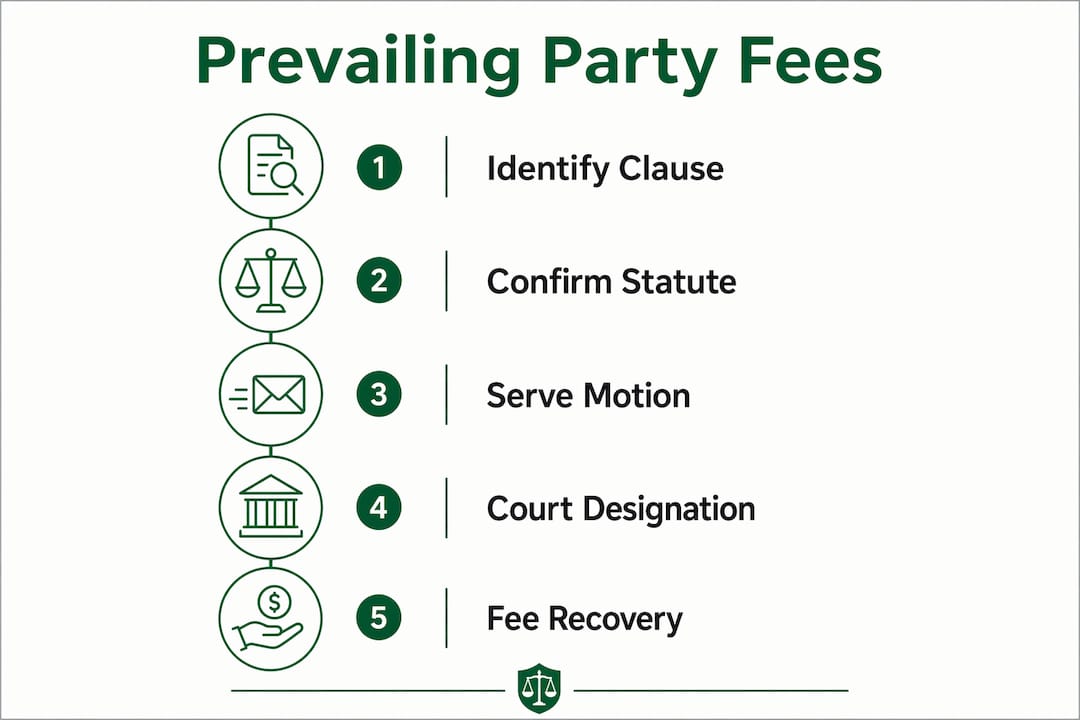
Beyond § 448.08, Florida has fee-shifting provisions in insurance bad faith actions, certain landlord-tenant disputes, and consumer protection cases. Each statute sets its own conditions. You cannot assume a fee award is available just because you won. You must identify the specific statute that applies before the case is filed.
The procedural rules governing fee motions are just as critical as the substantive right to fees. The steps below apply once you have a judgment or dismissal:
- Serve the fee motion within 30 days. Florida Rule of Civil Procedure 1.525 requires that motions for attorney’s fees and costs be served within 30 days after the judgment or order of dismissal is entered.
- Document every hour billed. Courts require detailed, itemized billing records. Vague entries like “legal research” without context are routinely challenged and reduced.
- Prepare for an evidentiary hearing. If the opposing party contests the fee amount, the court holds a hearing. You must present testimony and records supporting both the necessity and reasonableness of the fees.
- File a separate motion for costs. Attorney’s fees and taxable costs are often handled in separate motions. Missing the costs motion deadline forfeits that recovery independently.
Missing the Rule 1.525 deadline permanently bars your attorney fee claim, regardless of whether you were legally entitled to fees. Florida courts treat this deadline as a hard cutoff with no exceptions for oversight or delay.
Strict procedural deadlines like Rule 1.525’s 30-day window, if missed, permanently bar attorney fee claims regardless of entitlement. That outcome is entirely avoidable with proper calendar management from day one of the litigation.
What costs and fees can the prevailing party actually recover?
Attorney’s fees and recoverable costs are two separate categories under Florida law. Confusing them is a common and expensive mistake. Attorney’s fees cover the time your lawyer billed. Recoverable costs cover specific litigation expenses the court allows you to shift to the losing party.
Typical recoverable costs in Florida civil litigation include:
- Court filing fees and service of process costs
- Deposition transcript fees
- Expert witness fees (if the contract or statute covers them)
- Costs of copies and exhibits admitted at trial
- Electronic discovery processing costs (if expressly included in the contract)
Expert witness fees, paralegal time, travel, and electronic discovery may be excluded if not specified in the fee clause. A business owner who spends $15,000 on expert witnesses in a contract dispute may recover none of that if the contract clause only mentions “attorney’s fees.” The financial gap between a narrow clause and a comprehensive one can be dramatic.
Courts may not declare a prevailing party if outcomes on claims are mixed. A lawsuit with five claims where you win three and lose two may leave neither side qualifying as the prevailing party. That result means no fee award for anyone, regardless of what the contract says.
Being the prevailing party requires formal court designation. Settlements without a court order often do not qualify. If you settle a dispute and the settlement agreement does not expressly address fees, you likely forfeit your right to recover them. Settlement agreements should expressly address prevailing party fees to preserve rights on resolution.
Key Takeaways
Florida prevailing party fee awards require a clear contractual or statutory basis, strict procedural compliance, and detailed documentation to succeed.
| Point | Details |
|---|---|
| American Rule is the default | Florida courts do not award fees automatically; a contract clause or statute must authorize the award. |
| Contract language controls scope | Narrow fee clauses exclude expert costs and paralegal time; draft broadly to capture all litigation expenses. |
| Rule 1.525 deadline is absolute | Serve your fee motion within 30 days of judgment or dismissal, or the right is permanently lost. |
| Mixed outcomes block fee awards | Winning some claims and losing others may prevent either party from qualifying as the prevailing party. |
| Settlements need fee language | A settlement that does not address attorney’s fees typically forfeits any right to recover them. |
What 20 years of Florida business disputes taught me about fee clauses
Most business owners treat the prevailing party clause as boilerplate. They copy it from a template, paste it into every contract, and never think about it again. That approach costs real money when a dispute actually lands in court.
The single biggest mistake I see is the narrow clause. A business owner wins a contract case, presents a fee motion, and then watches the court exclude $20,000 in expert fees because the clause only said “attorney’s fees.” The client won the case and still absorbed a significant chunk of the litigation cost. That outcome was entirely preventable with two additional sentences in the original contract.
The second mistake is treating settlement as a clean exit. When a dispute settles, both sides often want to close the file quickly. Fee rights get waived in the rush. I have seen clients settle a strong case, accept a payment, and then realize they gave up a legitimate fee claim worth more than the settlement itself. The fix is simple: address fees explicitly in every settlement agreement, even if the answer is that each side bears its own costs.
Winning a fee award is distinct from collecting it. Detailed preparation and evidence backing are required at every stage. The business owners who recover the most are the ones who kept clean billing records from the first day of the dispute, not the ones who scrambled to reconstruct time entries after the judgment came in.
My advice is to treat fee recovery as a parallel workstream during litigation. Track every billable hour, categorize every cost, and calendar the Rule 1.525 deadline the moment a judgment or dismissal is entered. The hidden contract pitfalls that kill fee recovery are almost always fixable before the dispute starts.
— Matthew
How Fornarolegal helps Florida businesses protect their fee rights
Florida prevailing party fee issues rarely surface at a convenient time. They show up mid-dispute, when the contract language is already fixed and the clock on procedural deadlines is already running.
Fornarolegal works with South Florida small business owners before disputes start and during active litigation. Matthew Fornaro drafts fee-shifting clauses that hold up in court, prepares timely fee motions with the documentation courts require, and guides clients through the full cost recovery process. With over 20 years of court-tested experience, the firm helps you avoid the procedural and drafting mistakes that forfeit fee awards. Early legal guidance is the most cost-effective way to protect your right to recover Florida litigation expenses before a dispute forces the issue.
FAQ
What are Florida prevailing party fees?
Florida prevailing party fees are attorney’s fees and litigation costs that a winning party may recover when a contract clause or Florida statute authorizes the award. They are not automatic under Florida’s American Rule baseline.
Does winning a lawsuit in Florida mean the other side pays your attorney’s fees?
Not automatically. Florida follows the American Rule, so each party pays its own fees unless a contract, statute, or bad faith exception applies to the case.
How do you claim attorney fees after winning in Florida?
You must serve a motion for attorney’s fees within 30 days of the judgment or dismissal under Florida Rule of Civil Procedure 1.525, supported by detailed billing records. Missing that deadline permanently forfeits the claim.
Can you recover expert witness fees as part of prevailing party costs?
Only if the contract clause or applicable statute expressly includes expert witness fees. A clause limited to “attorney’s fees” typically excludes expert costs, deposition transcripts, and electronic discovery expenses.
Does a settlement agreement affect prevailing party fee rights?
Yes. A settlement that does not expressly address attorney’s fees typically waives the right to recover them. Every settlement agreement should include a clear provision on how fees are handled.
Recommended
- Florida Business Litigation Attorney Cost: 2026 Guide » Matthew Fornaro, P.A.
- How to Protect a Florida Business from Partnership Disputes » Matthew Fornaro, P.A.
- Arbitration vs. Litigation in Florida: A Practical Guide for Business Owners » Matthew Fornaro, P.A.
- How Does My Business Get Paid? » Matthew Fornaro, P.A.


