

Key Takeaways
- Florida business law protects companies from unfair competition, contract breaches, and partner disputes.
- Acting early saves time, money, and business relationships.
- An experienced business attorney helps you assess risk and choose the right legal strategy.
Table of Contents
- What an HOA Compliance Attorney in South Florida Actually Does
- Florida Statute 720 Explained: What Every South Florida Homeowner Must Know
- Types of HOA Disputes Handled by South Florida Attorneys
- How to Fight HOA Fines in Florida: A Step-by-Step Approach
- Writing an HOA Violation Notice Response Letter That Works
- Filing a Formal Complaint with the DBPR: Step-by-Step Guide
- Litigation vs. Mediation: Choosing the Right Path With an HOA Compliance Attorney in South Florida
- Conclusion
Last Updated: June 12, 2026
South Florida homeowners and community associations face some of the most complex HOA regulatory environments in the country, and finding the right hoa compliance attorney south florida can mean the difference between a resolved dispute and a costly legal battle. At Matthew Fornaro, P.A., we have spent over two decades helping property owners and association boards in Coral Springs, Parkland, and throughout Broward County protect their rights under Florida community association law. Below, you’ll find how HOA legal representation works, what your rights are under Florida Statutes Chapter 720, and how to take action when disputes arise, whether you’re a homeowner facing an unjust fine or a board member enforcing governing documents.
This guide includes a step-by-step DBPR complaint guide, a checklist for reviewing your HOA governing documents, and a frank breakdown of when litigation makes sense versus when mediation saves everyone time and money.
What an HOA Compliance Attorney in South Florida Actually Does
HOA compliance legal representation covers two distinct client types: homeowners who need protection from overreaching boards, and association boards that need defensible enforcement strategies. The legal tools, statutes, and risk calculus differ significantly depending on which side of the dispute you’re on.
A qualified hoa compliance attorney south florida handles far more than courtroom appearances. Day-to-day work includes reviewing governing documents, advising boards on proper notice and meeting procedures, drafting violation letters that withstand legal challenge, and negotiating settlements before disputes escalate.
Legal Representation for Homeowners Facing HOA Disputes
The biggest mistake homeowners make is assuming HOA boards hold all the power. They don’t.
Florida law grants unit owners specific rights: the right to inspect records, attend and speak at board meetings, challenge fines through an internal hearing process, and pursue arbitration or litigation when those processes fail. Common matters include disputing fines, challenging selective enforcement, contesting assessment liens, and defending against HOA-initiated foreclosure, an area where early legal intervention produces dramatically better outcomes.
Ignoring an HOA fine or assessment lien does not make it go away. Florida law allows associations to place liens on property and, in some cases, pursue foreclosure. Waiting to consult an attorney until a lien has been recorded significantly narrows your options.
Representation for HOA Boards and Associations
Board members carry fiduciary duty obligations that many volunteers don’t fully appreciate. A board that enforces rules inconsistently, fails to follow proper notice procedures, or levies fines without a compliant hearing process creates legal exposure for the entire association.
An HOA compliance attorney working with boards provides ongoing governance counsel, drafts or updates collection policies, reviews proposed rule amendments for statutory compliance, and defends the association against DBPR complaints or arbitration. Proactive legal counsel is consistently less expensive than reactive litigation.
Florida Statute 720 Explained: What Every South Florida Homeowner Must Know
Florida Statutes Chapter 720 is the primary statute governing homeowners associations in Florida. It establishes the rights of unit owners, the obligations of association boards, and the procedures for everything from rule enforcement to assessment collection.
According to Florida Legislature’s official text of Chapter 720, the statute covers meeting notice requirements, record inspection rights, the fine and suspension process, and mandatory pre-lien notice procedures. Chapter 720 compliance is not optional, a fine levied without a proper hearing, or a lien recorded without the required notice letter, may be legally unenforceable.
Governing Documents: Declaration of Covenants, Bylaws, and Articles of Incorporation
Every HOA operates under a hierarchy of governing documents. Understanding this hierarchy is essential before you can challenge or enforce anything.
Declaration of Covenants, Conditions, and Restrictions (CC&Rs): The foundational document recorded in the county records, establishing basic rules, property restrictions, and the association’s authority to collect assessments.
Bylaws: Govern internal operations, including board election procedures, meeting requirements, and officer roles.
Articles of Incorporation: Establish the HOA as a legal entity under Florida corporate law.
Rules and Regulations: The most flexible layer, typically adopted by the board without homeowner vote. These must be consistent with the documents above them and with Florida Statutes Chapter 720.
When conflict exists, the hierarchy controls: statutes override everything, then the Declaration, then the Bylaws, then the Rules. Many disputes stem from boards enforcing rules that contradict a higher-level document.
Types of HOA Disputes Handled by South Florida Attorneys
HOA disputes in South Florida fall into predictable categories, and knowing which applies to your situation points you toward the right legal remedy.
Selective Enforcement of Rules and Fine Disputes
Selective enforcement is one of the most defensible claims a homeowner can raise. Florida courts have consistently held that an HOA cannot enforce a rule against one homeowner while ignoring the same violation by others. If your neighbor has the same fence you do and hasn’t received a violation notice, that disparity is legally significant.
Fine disputes often arise from vague rule language, inadequate notice, or failure to follow the mandatory hearing process under Chapter 720. The statute requires that before a fine exceeds $1,000, the homeowner must appear before a fining committee, boards that skip this step face having their fines invalidated.
Collection of Unpaid Assessments and Assessment Liens
Assessment collection is the financial lifeblood of any community association, and Florida law gives associations substantial tools, including assessment liens and, after following specific statutory procedures, foreclosure. A pre-lien notice must be sent by certified mail before a lien can be recorded; errors in this process create legitimate defenses. A compliant collection policy reduces procedural challenges and speeds recovery of delinquent assessments.
Condominium and HOA Litigation Including Construction Defects
Construction defect claims represent a high-stakes category of HOA litigation. Condominium associations in South Florida frequently discover defects in common areas or structural components years after construction. According to Florida Bar’s resources on construction law, Florida’s Chapter 558 imposes specific pre-suit notice requirements, missing these procedural steps can bar an otherwise valid claim entirely.
If your condominium association suspects construction defects, document everything with dated photographs and written communications immediately. The statute of repose in Florida construction claims begins running from substantial completion, not from discovery of the defect.
How to Fight HOA Fines in Florida: A Step-by-Step Approach
Fighting HOA fines in Florida requires a specific sequence of actions. Taking steps out of sequence or missing deadlines can waive rights that would otherwise be available to you.
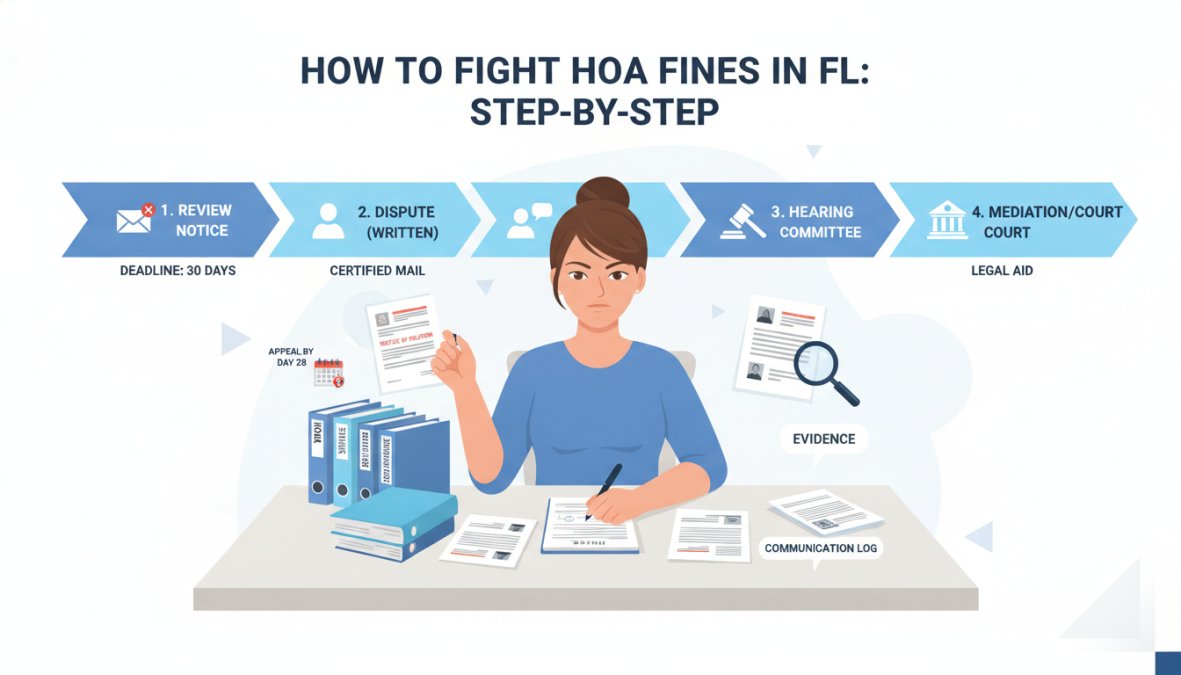
Step 1: Request the full violation file. Florida law gives homeowners the right to inspect HOA records. Request the written violation notice, any photographs, and the relevant rule the board claims you violated.
Step 2: Compare the alleged violation to the governing documents. Pull the actual rule text. Vague language, conflicts with the Declaration, or rules adopted without proper procedure are all potential defenses.
Step 3: Check the notice and hearing process. Did the association send written notice? Did they offer a hearing before the fining committee? Procedural defects can invalidate the fine entirely.
Step 4: Appear at the fining committee hearing. Do not skip this step. Failing to appear can be construed as waiving your objection. Bring supporting documentation.
Step 5: Submit a written response. Whether or not you attend the hearing, submit a written objection that preserves your arguments for any future arbitration or litigation.
Step 6: Consult an HOA compliance attorney. If the fine stands after the hearing process, an attorney can evaluate whether arbitration, mediation, or litigation is the appropriate next step.
Checklist for Reviewing Your HOA Governing Documents
Use this checklist before any dispute escalates. Reviewing these items early identifies procedural defenses and strengthens your position.
- Obtain certified copies of the Declaration of Covenants, Bylaws, and Articles of Incorporation from the county recorder or association
- Confirm the HOA is registered with the DBPR and in good standing
- Verify the rule allegedly violated appears in the current, adopted Rules and Regulations
- Check whether the rule was adopted by proper board vote with adequate notice to homeowners
- Confirm the violation notice includes the specific rule citation and a description of the alleged violation
- Verify the association sent a written violation notice before levying any fine
- Confirm the fining committee is composed of non-board members as required by Chapter 720
- Check whether the same rule has been enforced against other homeowners in similar situations
- Review whether the association’s collection policy has been formally adopted and distributed
Writing an HOA Violation Notice Response Letter That Works
An HOA violation notice response letter is your first formal opportunity to create a legal record and signal that you intend to defend your rights. A poorly written response can inadvertently waive defenses; a well-written one establishes your position and puts the association on notice that procedural errors will be challenged.
The letter should accomplish four things: acknowledge receipt without admitting the underlying violation; identify procedural defects in the notice; state your factual position concisely; and request a hearing before the fining committee if one hasn’t been scheduled. Keep the tone professional, aggressive language undermines credibility and rarely produces better outcomes.
A standard response structure looks like this:
[Date]
[Association Name]
[Association Address]Re: Response to Violation Notice Dated [Date], Property at [Address]
Dear [Board President or Property Manager]:
I am writing in response to the violation notice dated [date], which I received on [date]. I dispute the alleged violation for the following reasons: [state specific factual and procedural grounds]. I request a hearing before the fining committee at the earliest available date. Please confirm the hearing date and time in writing.
I reserve all rights under Florida Statutes Chapter 720 and the Association’s governing documents.
Sincerely,
[Your Name]
[Property Address]
Filing a Formal Complaint with the DBPR: Step-by-Step Guide
The Florida Department of Business and Professional Regulation oversees HOA and condominium association compliance. Filing a complaint is an option when an association violates Chapter 720 in ways within the agency’s jurisdiction, such as failing to maintain records, refusing homeowner inspection rights, or failing to hold required meetings.
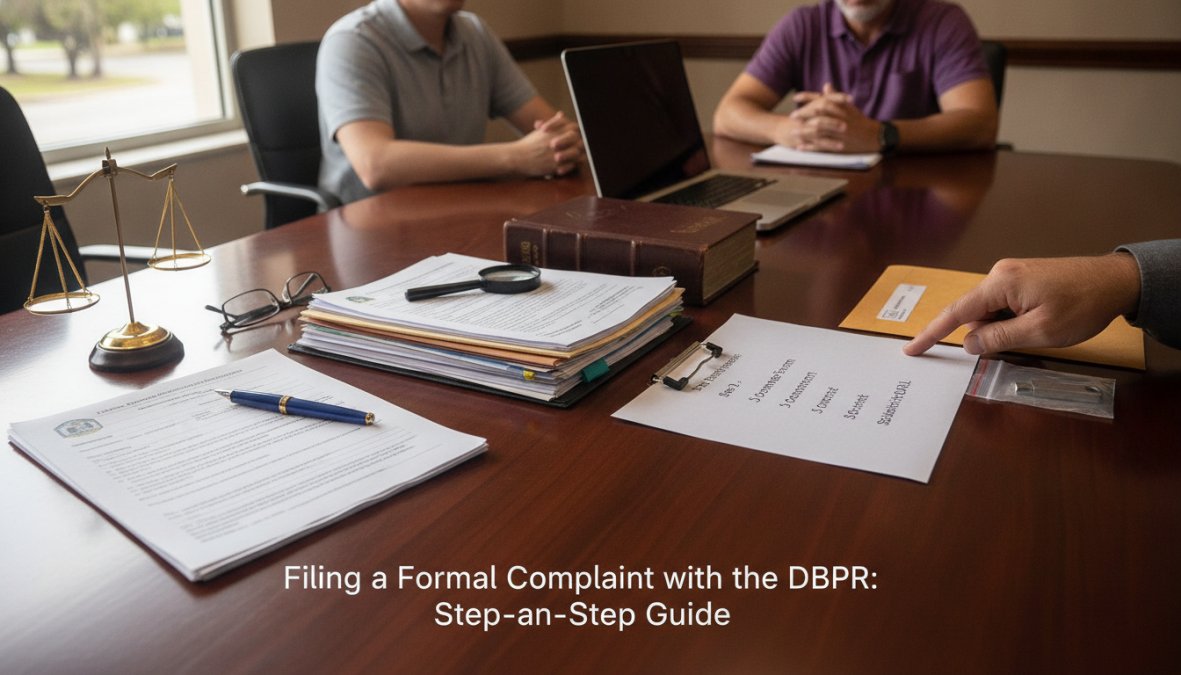
Step 1: Verify the DBPR has jurisdiction. The DBPR handles complaints about record access, meeting procedures, and certain election disputes. It does not resolve fine disputes or assessment collection matters, which go to arbitration.
Step 2: Gather documentation. Collect all written communications with the association, the governing documents, any denial letters, and a timeline of events. The process is document-driven.
Step 3: Complete the online complaint form. According to DBPR’s official HOA complaint portal, complaints must be submitted through the agency’s online system with supporting documentation attached.
Step 4: Submit and retain your confirmation number. The DBPR will acknowledge receipt and assign a case number.
Step 5: Respond to DBPR inquiries promptly. Delays in responding can result in case closure.
Step 6: Understand the limits of the DBPR process. The DBPR can issue citations and require corrective action, but cannot award damages or order the association to pay your legal fees. For monetary relief, arbitration or litigation remains the appropriate forum.
Litigation vs. Mediation: Choosing the Right Path With an HOA Compliance Attorney in South Florida
The choice between litigation and mediation is one of the most consequential decisions in any HOA dispute.
Mediation is a facilitated negotiation where a neutral third party helps both sides reach a voluntary agreement. It is faster and less expensive than litigation and preserves the ongoing relationship between the homeowner and the community. Florida law requires mandatory non-binding arbitration through the DBPR before certain HOA disputes can proceed to circuit court. Litigation makes sense when stakes are high, the other side is not negotiating in good faith, or the legal question sets a precedent affecting multiple homeowners. Construction defect claims, foreclosure defense, and fundamental governance challenges typically require litigation.
Here’s a practical framework for the decision:
| Factor | Favors Mediation | Favors Litigation |
|---|---|---|
| Dollar amount in dispute | Under $10,000 | Over $25,000 |
| Ongoing relationship with HOA | Important to preserve | Less critical |
| Strength of legal position | Moderate | Strong and clear |
| Time sensitivity | Flexible | Urgent (foreclosure) |
| Precedent value | Low | High (affects others) |
| Association’s negotiating posture | Cooperative | Adversarial |
The hoa compliance attorney south florida you choose should be direct about which path fits your situation, not reflexively push toward litigation because it generates more billable hours.
2024 and 2025 Florida Legislative Updates Affecting HOA Community Association Law
Florida’s legislature has been actively amending HOA law, and the 2024 and 2025 sessions produced significant changes every South Florida homeowner and board member should know.
The 2024 session expanded board member accountability requirements, including mandatory training obligations and enhanced criminal penalties for financial misconduct by association officers. The 2025 session addressed reserve funding requirements for condominium associations in response to structural safety concerns following high-profile building failures. According to Florida’s Division of Condominiums official guidance, associations that fail to meet the new reserve requirements face potential state intervention and board member liability. Boards operating under pre-2024 practices without a legal review are now at greater statutory risk.
The 2024 and 2025 Florida legislative sessions significantly increased both board member obligations and homeowner protections. Any HOA operating under pre-2024 governance practices without a legal review is likely out of compliance with current statutory requirements.
HOA disputes in South Florida are rarely simple, and the stakes, property rights, financial exposure, and community relationships, make getting the legal strategy right from the start essential. Matthew Fornaro, P.A. brings over two decades of experience in South Florida community association law to homeowners and boards in Coral Springs, Parkland, and throughout Broward County. Call today to schedule a consultation and get the representation your situation requires.
Frequently Asked Questions
What does an HOA compliance attorney do in South Florida?
An HOA compliance attorney in South Florida advises homeowners and associations on their rights and obligations under Florida Statutes Chapter 720, condominium law, and governing documents. They handle fine disputes, selective enforcement claims, assessment lien defense, foreclosure defense, and HOA litigation. For boards, they ensure statutory compliance, draft enforceable rules, and represent the association in mediation or court proceedings. Having qualified legal counsel can prevent costly mistakes on both sides of a dispute.
How do I challenge an HOA fine in Florida?
To fight HOA fines in Florida, start by requesting a formal hearing before the association's fines committee, which is required under Florida Statute 720 before a fine can be imposed. Review your Declaration of Covenants, Bylaws, and the specific rule allegedly violated. Document any evidence of selective enforcement. If the fine stands, you may file a complaint with the DBPR or pursue arbitration. An HOA compliance attorney can help you draft a strong HOA violation notice response letter and represent you throughout the process.
When should I hire an attorney for an HOA dispute in Florida?
You should consult an HOA compliance attorney in South Florida as soon as you receive a formal violation notice, a lien filing, or a foreclosure threat. Early legal counsel helps you respond within statutory deadlines and preserves your rights. Situations involving selective enforcement, unpaid assessment disputes, construction defects, or board governance failures especially benefit from professional legal representation. Waiting too long can limit your options under Florida community association law.
Can an HOA foreclose on my home in Florida?
Yes. Under Florida law, a homeowners association can place an assessment lien on your property for unpaid dues and, in some circumstances, pursue foreclosure to satisfy that lien. However, strict procedural requirements must be followed under Florida Statutes Chapter 720, and homeowners have the right to contest the lien and foreclosure. Foreclosure defense by a qualified HOA compliance attorney can challenge improper collection practices, procedural errors, or inflated fee calculations before the situation escalates.
What are the most common HOA violations in South Florida?
Common HOA violations in South Florida include unapproved exterior modifications, parking infractions, landscaping non-compliance, pet policy breaches, and short-term rental violations. Disputes often arise from inconsistent rule enforcement, where some homeowners are cited while others are not, a legal issue known as selective enforcement. Under Florida community association law, boards have a fiduciary duty to enforce rules uniformly. An attorney can help you document selective enforcement patterns and build a defense based on your governing documents.
Is mediation or litigation better for HOA disputes in Florida?
Mediation is generally faster, less expensive, and preserves relationships between homeowners and their association, making it preferable for fine disputes, rule interpretation conflicts, and minor governance disagreements. Litigation becomes necessary when an HOA refuses to negotiate in good faith, when property rights or significant financial stakes are involved, or when statutory violations require court enforcement. A South Florida HOA compliance attorney can help you weigh the cost-benefit of each path based on your specific circumstances and the strength of your case.
This article was written using GrandRanker


