

Key Takeaways
- Florida business law protects companies from unfair competition, contract breaches, and partner disputes.
- Acting early saves time, money, and business relationships.
- An experienced business attorney helps you assess risk and choose the right legal strategy.
Mediation is the process by which business partners resolve disputes with the help of a neutral third party, giving both sides control over the outcome instead of handing that power to a judge. To mediate a partnership dispute effectively, you need more than a willingness to talk. You need the right legal framework, a qualified mediator, and a structured process. Florida partnership disputes, whether over profit splits, buyouts, or governance deadlocks, are resolved through mediation far more often than litigation because mediation costs a fraction of the price and preserves the business relationship. This guide walks South Florida business owners through every step.
How to mediate a partnership dispute: what you need first
Before you sit down at a mediation table, three things must be in place: an enforceable mediation clause, an understanding of Florida’s procedural rules, and organized documentation. Skipping any one of these turns mediation into an expensive delay rather than a resolution.
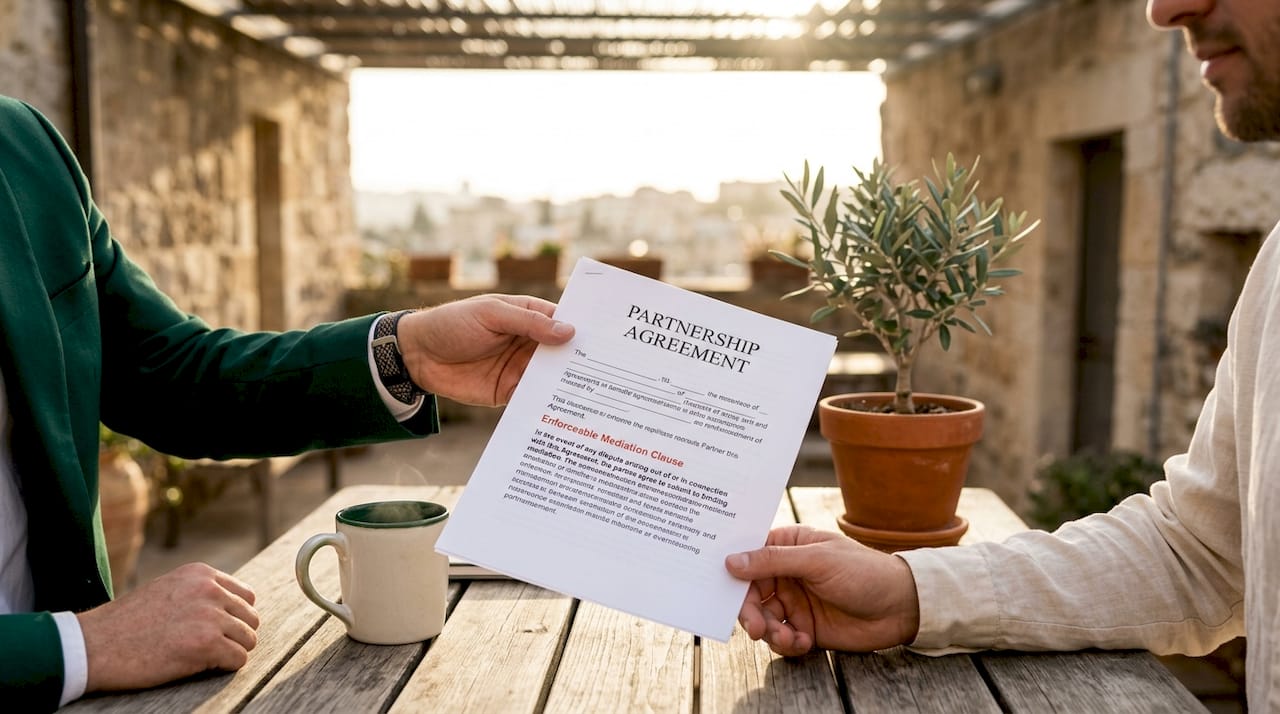
Enforceable mediation clauses. A mediation clause buried in your partnership or operating agreement is only useful if it is specific. Mandatory mediation clauses must detail the selection process for the mediator, the timeline, and who pays. Vague clauses that say “the parties shall attempt to resolve disputes amicably” have been challenged in court and found unenforceable. If your current agreement lacks specificity, get it updated before a dispute matures.
Florida procedural rules. Under Florida Rule 1.710, civil mediation must be completed within 45 days of the first mediation conference unless the court extends that deadline or the parties agree otherwise. This timeline matters because it forces both sides to prepare quickly. Discovery continues during mediation unless the parties stipulate to pause it, so you cannot use mediation as a stalling tactic.
Confidentiality protections. Florida’s Mediation Confidentiality and Privilege Act makes mediation communications confidential and generally inadmissible in later proceedings. Settlement offers, mediator notes, and party admissions made during sessions are protected. Exceptions exist for threats, criminal activity, and abuse, but the default protection is strong. This confidentiality is one of the most underappreciated advantages of mediation over open-court litigation.
Documentation preparation. Prepare a written position summary before the first session. Include your version of the facts, the financial records that support your position, and the specific relief you are seeking. Unorganized facts and unclear timelines are a leading cause of settlement breakdowns, so treat your position summary like a legal brief, not a casual memo.
Pro Tip: Have legal counsel review your mediation clause and position summary before the first session. A poorly drafted clause or a disorganized fact summary can derail the entire process before it begins.
How do you select the right mediator for a Florida partnership dispute?
The mediator you choose shapes the entire process. In Florida, you want a Florida Supreme Court-certified mediator with experience in commercial or business disputes, not a general civil mediator who primarily handles personal injury cases. The Florida Dispute Resolution Center maintains a roster of certified mediators, and many specialize in business and partnership conflicts specifically.
Here is how to work through the selection and preparation process:
-
Identify certified candidates. Search the Florida Dispute Resolution Center’s directory for mediators certified in circuit civil or county civil mediation. Filter for those with business dispute experience, particularly in partnership or LLC conflicts.
-
Evaluate neutrality and background. A mediator with a background in business law or accounting brings practical knowledge to disputes over profit splits and buyout valuations. Confirm the mediator has no prior relationship with either party or their attorneys.
-
Agree on the mediator jointly. Both partners must agree on the selection. If you cannot agree, your mediation clause should specify a fallback, such as appointment by the American Arbitration Association or a local bar association.
-
Set the agenda before the session. Work with the mediator to establish an agenda that covers the core issues in order of priority. Opening statements from each side should be limited to 10 to 15 minutes to keep the session focused.
-
Prepare your opening statement. Your opening is not a legal argument. It is a clear, factual statement of your position and what you need to move forward. Emotional language slows the process. Stick to business interests.
-
Keep communication constructive during the session. The mediator’s role is to facilitate, not to decide. When the other side speaks, listen for interests rather than positions. What does your partner actually need, as opposed to what they are demanding?
Pro Tip: Confirm before the session that every person in the room has full authority to settle. Without decision-maker authority, mediation stalls at the finish line when the person who can actually approve a deal is not present.
What does the step-by-step mediation process look like?
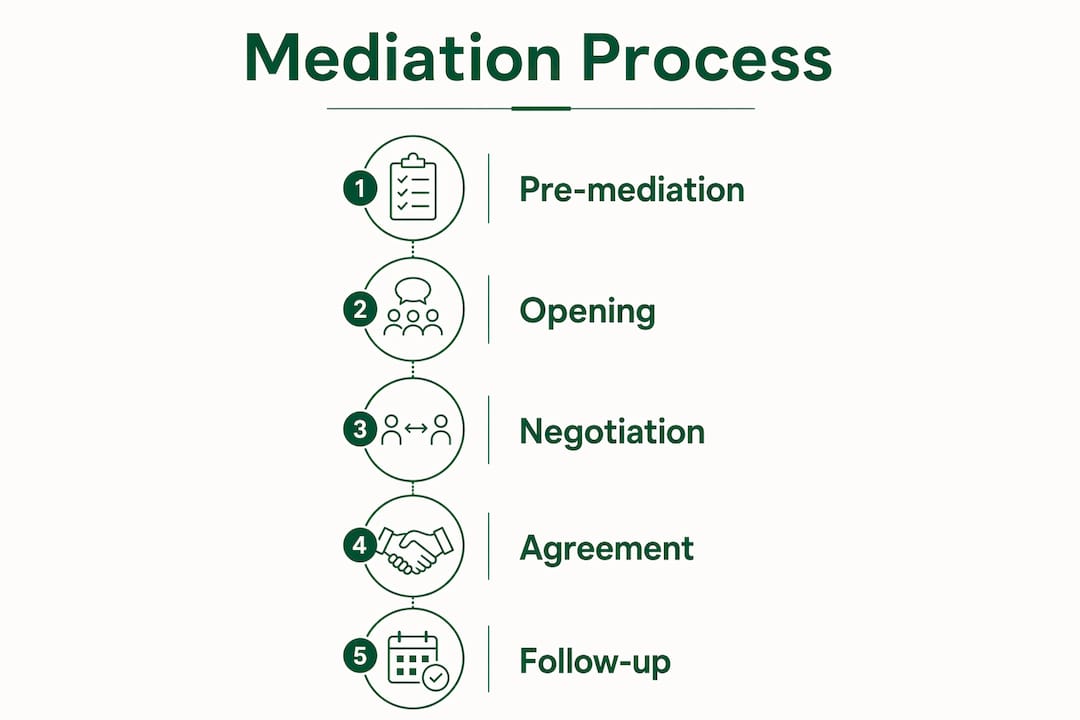
Understanding the flow of a mediation session removes the anxiety that causes partners to show up unprepared. Here is what a typical partnership dispute mediation looks like from start to finish.
-
Pre-mediation exchange. Both parties submit position summaries to the mediator at least five business days before the first session. These documents outline the facts, the legal basis for each claim, and the desired resolution. Structured exchange of position statements early in the process reduces surprise and builds enough trust to negotiate.
-
Opening joint session. The mediator opens with ground rules, then each party delivers their opening statement. This is often the first time both partners hear each other’s full perspective without interruption. Many mediators find this session alone shifts the tone of negotiations.
-
Private caucuses. The mediator meets with each party separately to explore interests, test settlement options, and reality-check positions. These private sessions are where most of the real negotiation happens. The mediator carries proposals between rooms without revealing confidential strategy.
-
Expert input when needed. For disputes involving business valuation, a jointly retained appraiser or forensic accountant can provide a neutral number that both sides can negotiate around. Using a shared expert inside mediation is far cheaper than dueling experts in litigation.
-
Drafting the settlement agreement. When the parties reach terms, the mediator or attorneys draft a mediated settlement agreement on the spot. Both parties sign before leaving. This agreement is binding and enforceable as a contract under Florida law.
-
If mediation stalls. Escalation paths after a failed mediation include binding arbitration, Florida circuit court buyout proceedings, or judicial dissolution as a last resort. Knowing this in advance motivates both sides to settle at mediation rather than face a judge.
| Stage | What happens |
|---|---|
| Pre-mediation | Position summaries exchanged; mediator reviews facts |
| Opening session | Ground rules set; each party states their position |
| Private caucuses | Mediator shuttles proposals; real negotiation occurs |
| Expert input | Jointly retained appraiser or accountant provides neutral valuation |
| Settlement drafting | Written agreement signed by both parties before leaving |
| Escalation (if needed) | Arbitration, circuit court buyout, or judicial dissolution |
Common mistakes that derail partnership conflict mediation
Most mediation failures are predictable. The same patterns appear repeatedly in partnership disputes, and recognizing them early gives you a real advantage.
-
Delaying document exchange. Florida rules expect evidence and positions prepared early. Treating mediation as last-minute forces the mediator to manage chaos instead of facilitating resolution. Bring organized financials, the partnership agreement, and any relevant correspondence to the first session.
-
Sending a representative without authority. Florida Rule 1.720 requires that a party representative attending mediation have full authority to settle. Sending a manager or junior partner who must “check with the owner” kills momentum and signals bad faith.
-
Vague or non-binding dispute resolution clauses. If your agreement does not specify how the mediator is selected, who pays, and what happens if mediation fails, you may spend the first session arguing about the process rather than the dispute. Fix the clause before you need it.
-
Ignoring confidentiality boundaries. Parties sometimes discuss mediation communications with employees, investors, or the press, not realizing this can create legal exposure. The Mediation Confidentiality and Privilege Act protects most communications, but only if you respect those boundaries yourself.
-
Letting emotions drive the session. Conflict between co-founders follows predictable escalation cycles. Naming those patterns early, before the session, helps both parties recognize when they are reacting personally rather than thinking about business outcomes. Mediation works best when both sides focus on what they need going forward, not on who was wrong in the past.
Pro Tip: Write down your three non-negotiable business interests before the session, separate from your legal positions. When the conversation gets heated, return to those interests. They are your anchor.
Key takeaways
Effective partnership dispute mediation requires preparation, legal grounding, and the right mediator. Skipping any of these three elements is the most common reason mediation fails.
| Point | Details |
|---|---|
| Draft an enforceable clause | Mediation clauses must specify mediator selection, timeline, and payment to hold up in court. |
| Prepare early and thoroughly | Submit organized position summaries before the first session to avoid surprise and build trust. |
| Confirm decision-maker authority | Every person at the table must have full authority to settle or mediation will stall. |
| Use confidentiality strategically | Florida’s Mediation Confidentiality and Privilege Act protects most communications, so speak freely in caucus. |
| Know your escalation path | If mediation fails, arbitration or a circuit court buyout proceeding is the next step, not dissolution. |
What I’ve learned from watching mediation succeed and fail in South Florida
After more than 20 years working with South Florida business owners on disputes, I have watched mediation save partnerships that looked completely unsalvageable, and I have watched it fail when it should have worked. The difference almost never comes down to the legal merits. It comes down to preparation and mindset.
The partners who succeed in mediation treat it as a smart first step, not a last resort. They arrive with organized financials, a clear sense of what they actually need from the business going forward, and the authority to make a deal. The partners who fail arrive angry, unprepared, and focused entirely on proving the other side wrong. A mediator cannot fix that.
I have also seen how much mediator selection matters. A Florida Supreme Court-certified mediator with real business dispute experience reads a room differently than a general civil mediator. They know when to push, when to let silence work, and when to call a break before emotions take over. That expertise is worth paying for.
My honest advice: do not wait for the relationship to hit rock bottom before you use mediation. The earlier you bring in a neutral third party, the more options both sides have. Once partners are in litigation, the relationship is almost always gone. Mediation at the first serious disagreement, not the fifth, is where it actually preserves the business.
— Matthew
How Fornarolegal helps South Florida partners resolve disputes through mediation
Fornarolegal works with South Florida business owners and partners who need practical, experienced legal guidance when a partnership dispute surfaces. Matthew Fornaro has over 20 years of experience helping entrepreneurs and established businesses manage conflict efficiently, from drafting enforceable mediation clauses to representing clients through the full mediation process.

Early legal involvement is the single biggest factor in keeping mediation costs low and outcomes favorable. Fornarolegal helps clients prepare position summaries, select qualified mediators, and structure agreements that hold up after the session ends. If you are facing a partnership conflict and want to resolve it without litigation, learn how early legal guidance can protect your business and your investment. Contact Fornarolegal to discuss your situation with Matthew directly.
FAQ
What does it mean to mediate a partnership dispute?
Mediation is a structured process where a neutral third party helps business partners negotiate a resolution to their conflict. Unlike litigation, mediation keeps both sides in control of the outcome and is confidential under Florida law.
How much does partnership mediation cost in Florida?
Mediation in Florida costs $3,000 to $12,000 on average, compared to $50,000 to $200,000 or more for litigation. Most partnership disputes resolve in one to three sessions.
Is a mediated settlement agreement legally binding in Florida?
Yes. Once both parties sign a mediated settlement agreement, it is enforceable as a binding contract under Florida law. Courts can enforce the terms if either party fails to comply.
What happens if mediation fails to resolve the dispute?
If mediation is unsuccessful, partners can escalate to binding arbitration, pursue a Florida circuit court buyout proceeding, or, as a last resort, seek judicial dissolution of the business entity.
Do both partners need an attorney at mediation?
Florida does not require attorneys at mediation, but having legal counsel present protects your interests when drafting the settlement agreement and evaluating proposed terms. For disputes involving significant assets or complex operating agreements, legal representation is strongly recommended.
Recommended
- How to Protect a Florida Business from Partnership Disputes » Matthew Fornaro, P.A.
- Partnership Dispute Lawyer South Florida: A Guide for Business Owners » Matthew Fornaro, P.A.
- Partnership Disputes in Florida: Legal Options for Business Owners » Matthew Fornaro, P.A.
- Resolve Business Partner Disputes in Florida: 2026 Guide » Matthew Fornaro, P.A.


