

Key Takeaways
- Florida business law protects companies from unfair competition, contract breaches, and partner disputes.
- Acting early saves time, money, and business relationships.
- An experienced business attorney helps you assess risk and choose the right legal strategy.
A vendor contract dispute can put your South Florida business in a difficult position fast. One missed delivery, a payment disagreement, or a sudden refusal to perform can ripple through your entire operation, threatening cash flow, client relationships, and your legal standing. Knowing how to respond to a vendor contract dispute correctly from the start is what separates business owners who resolve these situations efficiently from those who spend months in costly litigation. This guide walks you through exactly what to do, step by step.
Table of Contents
- Key takeaways
- How to respond to a vendor contract dispute in Florida
- Preparing your response: gathering evidence and reviewing contracts
- Step-by-step response actions when a vendor breaches
- Common mistakes that make vendor disputes worse
- What to expect from each resolution path
- My take on handling Florida vendor disputes
- How Fornarolegal helps South Florida businesses protect their interests
- FAQ
Key takeaways
| Point | Details |
|---|---|
| Respond in writing immediately | Document every dispute communication in writing to protect your legal position from day one. |
| Review your contract first | Check for mandatory mediation or arbitration clauses before taking any formal action. |
| Avoid stopping payments prematurely | Withholding payment without legal basis can make you the breaching party, not the vendor. |
| Escalation costs rise sharply | Mediation costs a fraction of arbitration or litigation, so attempt resolution early. |
| Get legal counsel before terminating | Premature contract termination without clear repudiation proof creates serious liability. |
How to respond to a vendor contract dispute in Florida
Before you send a single email or make a phone call, you need to understand what you are actually dealing with. A vendor dispute is a formal disagreement between your business and a supplier or service provider over the terms, performance, or obligations of a contract. Common triggers include late or incomplete deliveries, defective goods, overbilling, failure to meet service specifications, and outright refusal to perform.
In Florida, vendor disputes typically follow a four-step escalation path: direct negotiation, mediation, arbitration, and circuit court litigation. Each step carries different time commitments, costs, and levels of control over the outcome.
The table below gives you a realistic picture of what each path looks like:
| Resolution path | Timeline | Estimated cost | Privacy | Outcome control |
|---|---|---|---|---|
| Direct negotiation | Days to 2 weeks | Minimal | High | Full |
| Mediation | 2 to 6 weeks | $1,500 to $8,000 | High | Shared |
| Arbitration | 3 to 12 months | $15,000 to $60,000 | Moderate | Limited |
| Litigation | 18 months to 3+ years | $25,000 to $150,000+ | Low | Low |
The gap between negotiation and litigation in both time and money is enormous. That alone should motivate you to act early, act strategically, and resist the urge to escalate before you have exhausted lower-cost options.
Florida law recognizes two main categories of vendor contracts. Contracts for goods fall under the Uniform Commercial Code (UCC), while service contracts are governed by common law. This distinction matters because your available remedies and the rules around performance differ depending on which category applies to your situation.
Preparing your response: gathering evidence and reviewing contracts
The work you do before sending any formal communication determines how strong your position will be throughout the entire contract dispute resolution process. Rushing to fire off a demand letter without first reviewing your own obligations is one of the most common and costly mistakes small business owners make.
Start by pulling the original contract and reading it carefully. You are looking for several things:
- Breach and default provisions: What specific actions or failures constitute a breach?
- Notice requirements: Does the contract require you to send written notice to a specific address within a defined time period?
- Dispute resolution clauses: Does the contract mandate mediation or arbitration before you can file suit?
- Cure periods: Is the vendor entitled to a window to fix the problem before you can claim a breach?
Once you understand the contract terms, build your evidence file. Gather every relevant invoice, purchase order, delivery confirmation, email, text message, and internal record related to the dispute. The goal is to document the breach with specifics tied directly to the contract’s language, not just a general sense that things went wrong.
Pro Tip: Confirm all dispute-related communications in writing. If you have a phone call with the vendor, follow up with a brief email summarizing what was discussed and agreed. Written communication confirmation protects you if the dispute later escalates.

One step business owners frequently skip is auditing their own performance. Before you accuse a vendor of breach, confirm that you have met your own obligations under the contract. If you owe payment and have not paid, or if you failed to provide specifications the vendor needed to perform, those gaps could be used against you. Checking your own contract obligations first puts you on solid ground before you make any claims.
Step-by-step response actions when a vendor breaches
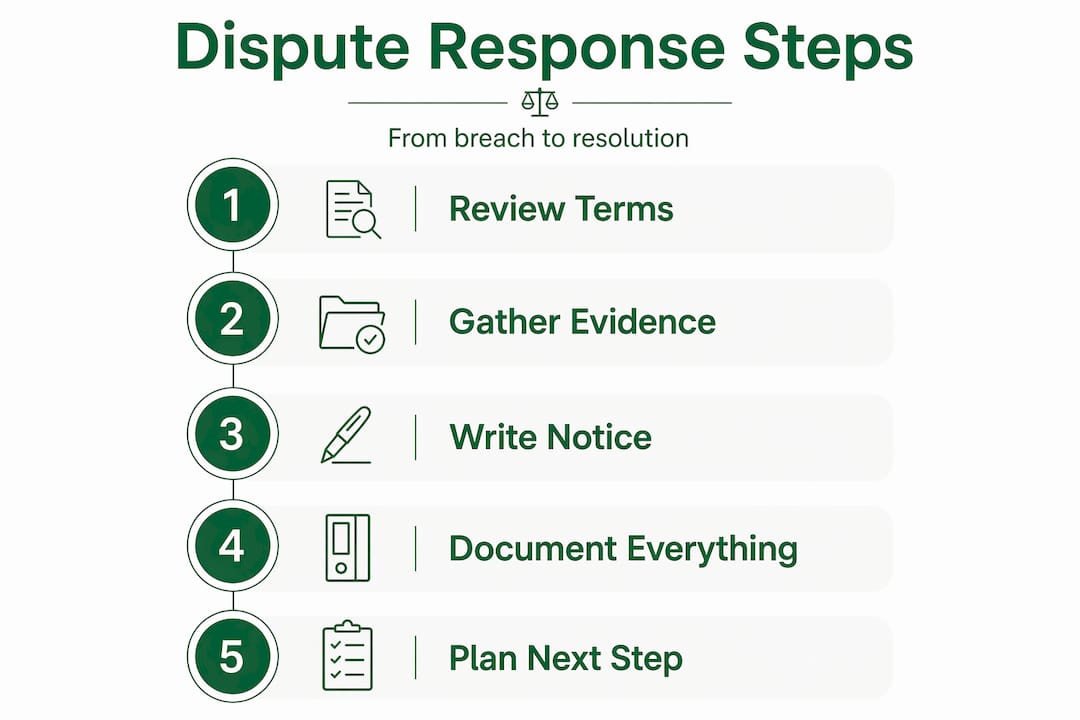
Once your evidence is organized and you have reviewed the contract terms, you are ready to act. Here is how to move through the response process in a way that protects your business and keeps your options open.
-
Send a formal written notice of breach. Reference the specific contract provisions the vendor has violated. State the facts plainly, describe the impact on your business, and request a specific remedy within a defined time period. Keep the tone professional. Avoid emotional language.
-
Issue a demand for adequate assurance if you have doubts about future performance. Under Florida’s UCC for goods contracts, demanding adequate assurance forces the vendor to confirm in writing that they will perform as required. The vendor has 30 days to respond. If they do not, you can treat the silence as a repudiation of the contract. This is a practical legal tool that many business owners do not know they have.
-
Satisfy any mandatory dispute clauses before escalating. Florida courts enforce mandatory mediation clauses as conditions that must be met before you can file a lawsuit. If your contract has one and you skip it, the court can dismiss your case. Check the clause, follow its procedure, and document every step.
-
Continue your own performance unless the contract explicitly permits suspension. This is critical. Even while the dispute is unresolved, stopping your own obligations without legal authority can transform you from the aggrieved party into the breaching party.
-
Handle anticipatory breach situations carefully. If your vendor signals they will not perform before the performance date, do not rush to terminate the contract. Anticipatory breach requires clear, unequivocal evidence that the vendor will not perform. Acting on ambiguous signals and terminating prematurely can expose you to liability.
When responding to a vendor agreement conflict, the goal of every early action is to preserve your legal rights while leaving space for the dispute to resolve short of litigation. Every letter, email, and phone call you send is a potential exhibit.
Pro Tip: If the vendor’s failure is causing you to lose business, document those losses in real time. Lost profits and consequential damages can significantly increase your recovery if the dispute escalates to arbitration or court.
Common mistakes that make vendor disputes worse
Responding incorrectly to a contractual obligation dispute often causes more harm than the original breach. Here are the mistakes most likely to backfire:
-
Stopping payments immediately. Withholding payment the moment you suspect a breach can be treated as your own breach of contract. Florida courts look carefully at whether stopping payment is justified under the specific contract terms. Unless the contract clearly permits payment withholding upon breach, keep paying while you pursue formal remedies.
-
Terminating the contract too quickly. This is where business owners get into the most trouble. Premature termination without meeting the high legal standard for repudiation can flip the liability entirely onto you.
-
Skipping mandatory dispute steps. If your contract requires mediation first and you file suit directly, you may find your case dismissed. Many Florida vendor contracts require mediation as a strict prerequisite to litigation, and courts enforce these clauses without exception.
-
Failing to mitigate damages. Even after a vendor breaches, Florida law expects you to take reasonable steps to limit your own losses. If you can purchase substitute goods or services from another supplier, you are generally expected to do so. Document those efforts carefully.
-
Ignoring vendor defenses. Vendors will often claim their nonperformance was caused by your own failure to provide necessary information, approvals, or payment. Anticipate these defenses and document your own cooperation and performance throughout.
Pro Tip: If the dispute involves more than a few thousand dollars or threatens a key business relationship, consult a Florida business dispute attorney before sending any formal demand. An hour of legal advice can prevent weeks of costly mistakes.
What to expect from each resolution path
Understanding realistic timelines and costs helps you allocate resources and plan your business operations during a dispute.
Direct negotiation is almost always worth attempting first. It costs virtually nothing, can be completed in days, and preserves the vendor relationship better than any other option. Come prepared with your documented evidence, a clear statement of what you need, and a willingness to discuss the vendor’s perspective.
Mediation is the next step and frequently the most cost-effective formal path. Mediation typically concludes in two to six weeks with either a settlement or a formal impasse. A neutral mediator helps both sides find a middle ground, and because the process is confidential, neither party’s admissions during mediation can be used against them later. For most South Florida small businesses, a successful mediation is the best outcome available.
Arbitration is faster than litigation but significantly more expensive than mediation. Arbitration awards are also difficult to appeal, which means you need to go in prepared. The outcome is final in most cases.
Litigation is the last resort. Beyond the potential cost of $25,000 to $150,000+, litigation disrupts your business operations for months or years. That said, there are cases where it is the right call, particularly when the breach is egregious and the damages are large. One often-overlooked benefit in Florida is that prejudgment interest accrues from the date performance was due. If you document your losses carefully, that interest can meaningfully increase your total recovery. Florida also applies a reciprocal attorney fee rule automatically if the contract contains any fee-shifting provision, which incentivizes both sides to settle in good faith.
My take on handling Florida vendor disputes
I have worked on vendor contract disputes across South Florida for over 20 years, and the pattern I see most often is this: business owners wait too long to get organized and then move too fast once they do.
The waiting happens because no one wants to believe a vendor relationship has broken down. By the time they accept that the dispute is real, they have lost two or three weeks of documentation that would have strengthened their case considerably. Start documenting the moment you sense something is wrong.
The moving too fast part looks like sending a termination letter the week after the first missed delivery, or stopping payment because it “feels fair.” I have seen otherwise strong cases turn into significant liabilities because the business owner made a unilateral decision without understanding the contract’s cure period or the legal standard for repudiation.
What I have found actually works is a measured, documented approach that makes your position undeniable on paper before you demand anything. You send the formal notice. You demand adequate assurance if warranted. You follow the contract’s dispute steps. And then you negotiate from a position of documented strength.
Mediation, in my experience, resolves far more Florida vendor disputes than business owners expect. The confidentiality alone makes parties willing to say things in mediation that they would never put in a court filing. That openness creates settlement opportunities that litigation destroys. If you go into mediation prepared, with an attorney who knows the local rules and the realistic value of your claim, you have a genuinely strong shot at resolving the dispute without spending six figures.
— Matthew
How Fornarolegal helps South Florida businesses protect their interests

When a vendor dispute threatens your business, the decisions you make in the first few weeks matter most. Fornarolegal works with small businesses, startups, and entrepreneurs across South Florida to respond to vendor contract disputes with the right strategy from day one. With over 20 years of experience in contract enforcement, mediation, arbitration, and business litigation, the firm helps clients protect their operations without getting buried in unnecessary legal costs.
If you are facing a vendor agreement conflict and are not sure whether to exit the contract, send a formal notice, or take the dispute to mediation, Fornarolegal’s dispute guidance can help you understand your options and build a position that protects your bottom line. Contact Matthew Fornaro directly for a consultation tailored to your situation.
FAQ
What is a vendor dispute?
A vendor dispute is a formal disagreement between a business and a supplier or service provider over contract terms, performance, or obligations. Common causes include missed deliveries, defective goods, billing errors, and refusals to perform.
How do I formally respond to a vendor contract dispute?
Send a written notice of breach referencing the specific contract provisions violated, request a remedy within a defined timeframe, and check whether your contract requires mediation or arbitration before escalating.
Can I stop paying my vendor during a contract dispute?
Generally, no. Stopping payments without clear contractual authority can make you the breaching party. Continue your obligations while pursuing formal remedies unless your contract explicitly permits payment suspension upon breach.
How long does a vendor contract dispute take to resolve?
Resolution time depends on the path chosen. Direct negotiation can wrap up in days, mediation typically takes two to six weeks, arbitration runs three to twelve months, and litigation can take eighteen months to three years or longer.
When should I hire an attorney for a vendor dispute?
Consult an attorney before sending any formal termination notice, before skipping mandatory mediation steps, or when the dispute involves significant financial exposure. Early legal guidance prevents the kind of procedural mistakes that can turn a strong claim into a liability.


